
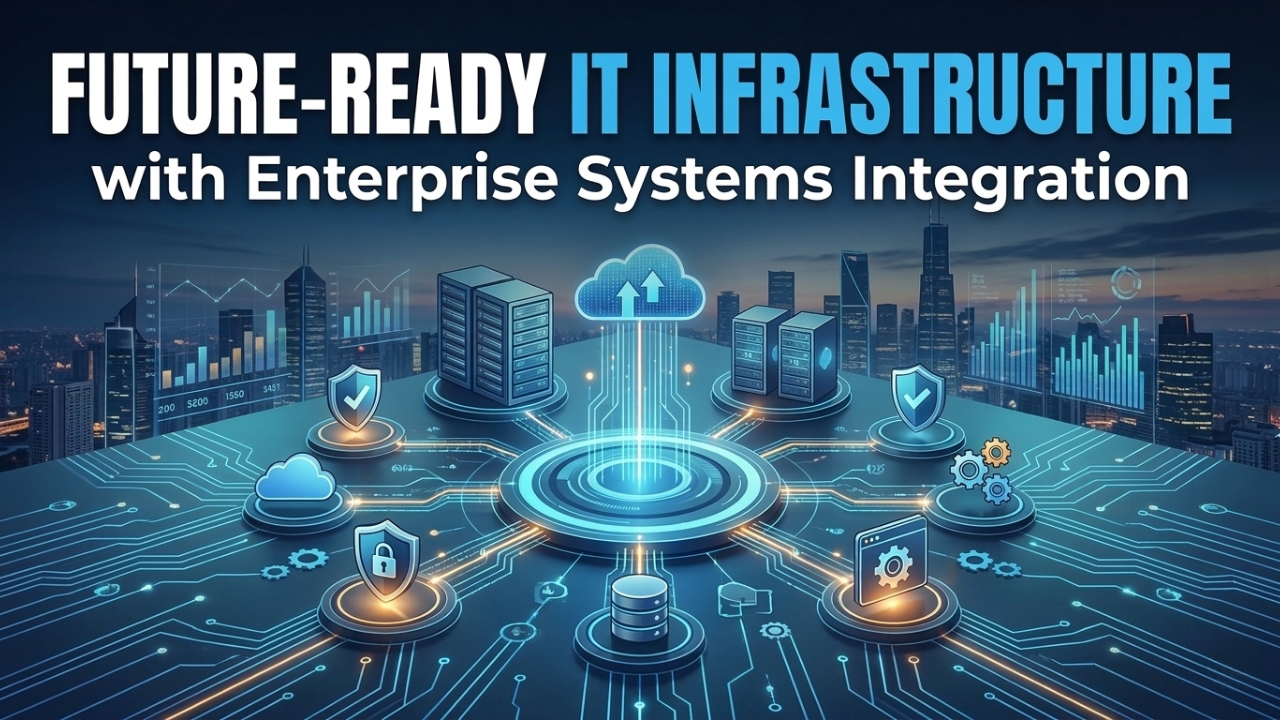
Enterprise technology environments are becoming more complex every year. Organizations now operate across hybrid cloud environments, distributed workforces, multi-vendor applications, and rapidly evolving cybersecurity requirements. Yet many enterprises still rely on disconnected systems that struggle to support modern digital demands.
A recent industry study found that many enterprises operate with fragmented IT systems, which creates operational inefficiencies, security gaps, and difficulty scaling infrastructure as the business grows.
This is where enterprise systems integration becomes critical. Rather than adding more tools to already complex environments, integration connects infrastructure, applications, cloud platforms, and security frameworks into a unified ecosystem. The result is a technology environment that works cohesively, scales efficiently, and supports long-term digital transformation initiatives.
For organizations looking to build future-ready IT infrastructure, integration is no longer optional, it is foundational.
In this article, we explore how enterprise systems integration enables scalable infrastructure, why fragmented environments hold organizations back, and how structured integration strategies help enterprises prepare their IT environments for future growth.
The Growing Complexity of Enterprise IT Environments
Enterprise IT ecosystems rarely remain simple for long. As organizations expand operations, adopt new technologies, and integrate digital platforms, infrastructure naturally becomes more complex. Many enterprises now operate across hybrid cloud and on-premise environments, multiple enterprise applications and SaaS platforms, distributed branch networks with remote users, and advanced cybersecurity tools aligned with compliance frameworks.
While each of these technologies plays an important role in supporting business operations, the absence of enterprise systems integration often leads to fragmentation between systems, making it harder for organizations to maintain visibility, efficiency, and consistent control across their IT environments.
The Hidden Impact of Fragmented Infrastructure
Disconnected systems can quietly undermine enterprise performance in several ways. Operational inefficiencies often arise when teams rely on manual data transfers between applications, slowing workflows and increasing the likelihood of errors. Security blind spots may emerge because monitoring tools operate in isolation, preventing security teams from gaining a complete view of potential threats across the environment.
Organizations also experience delayed decision-making when data visibility remains inconsistent across platforms, making it difficult for leadership to rely on unified insights. At the same time, IT teams face growing management complexity as they attempt to maintain multiple disconnected systems. Over time, these inefficiencies slow innovation and increase operational risk. Without proper integration, enterprises may continue investing in new technologies while the underlying infrastructure remains misaligned.
Also Read: The Role of Systems Integration in Digital Transformation
Why Enterprise Systems Integration Is Critical for Future-Ready IT
Future-ready infrastructure requires more than modern hardware or cloud platforms. It requires systems that communicate, share data, and operate within a unified architecture. This is the primary goal of enterprise systems integration—aligning infrastructure, applications, and security technologies into a cohesive operational framework.
When organizations implement structured integration, data begins to move seamlessly across enterprise applications, improving operational visibility and reducing the need for manual processes. IT teams gain centralized monitoring capabilities, enabling them to identify performance issues faster and maintain greater control over the technology environment. At the same time, leadership teams benefit from clearer insights because information from different platforms becomes accessible through unified dashboards and reporting systems.
Integrated environments also improve infrastructure scalability. As enterprises adopt new technologies – such as advanced analytics platforms, automation tools, or additional cloud services – these systems can connect easily to the existing ecosystem. Security also becomes more consistent because policies and controls can be applied across infrastructure, applications, and networks rather than being managed separately.
When infrastructure components operate together rather than independently, organizations gain the flexibility needed to introduce new capabilities without disrupting ongoing operations. For enterprises undergoing digital transformation, enterprise systems integration ultimately becomes the foundation that supports long-term innovation and sustainable growth.
Key Pillars of a Future-Ready Integrated IT Infrastructure
Building future-ready IT environments requires a structured integration approach that considers infrastructure, networking, security, and application architecture together.
Several core pillars guide successful enterprise systems integration strategies.
Infrastructure Modernization
Enterprises must ensure that physical and virtual infrastructure can support modern workloads.
Integration enables:
- Consolidated infrastructure management
- Efficient resource utilization across environments
- Seamless interaction between legacy and modern systems
Hybrid and Multi-Cloud Connectivity
Most enterprises now operate across multiple cloud platforms.
Integration ensures:
- Secure connectivity between cloud providers and on-premise systems
- Consistent governance policies
- Unified workload management
Security-First Architecture
Future-ready infrastructure must embed security directly into the architecture.
Integrated environments support:
- Centralized threat monitoring
- Identity-driven access controls
- Automated security policy enforcement
How Enterprise Systems Integration Supports Business Scalability
Technology infrastructure must evolve in step with business growth. As enterprises expand into new markets, support higher transaction volumes, and launch digital services, the pressure on IT systems increases significantly. Without a structured approach to enterprise systems integration, scaling infrastructure can quickly become complex, inefficient, and costly. Disconnected systems often require manual configuration, duplicate resources, and constant troubleshooting, all of which slow down operational growth.
A well-planned enterprise systems integration strategy enables organizations to scale their IT environments in a controlled and efficient way. By aligning infrastructure, applications, and cloud platforms within a unified architecture, enterprises can standardize their technology frameworks and simplify expansion. Integration also supports automation across IT operations, reducing the burden of repetitive manual tasks while improving consistency across systems. At the same time, unified monitoring platforms provide greater visibility into performance, allowing IT teams to identify issues early and maintain stable operations.
Another major advantage of enterprise systems integration is architectural flexibility. Integrated environments allow organizations to introduce new applications, platforms, or digital capabilities without disrupting existing infrastructure. This adaptability is critical for enterprises undergoing rapid digital transformation, where technology ecosystems must continuously evolve to support innovation, operational efficiency, and long-term scalability.
What Enterprises Should Look for in a Systems Integration Partner
Not all integration initiatives deliver the expected results. The success of enterprise systems integration often depends on the experience and strategic capabilities of the integration partner involved. Because enterprise IT environments include infrastructure, networking, cloud platforms, applications, and security frameworks, integration requires deep technical expertise combined with a strong architectural vision.
Organizations should evaluate integration partners carefully, particularly their ability to manage complex infrastructure environments, hybrid and multi-cloud ecosystems, and enterprise cybersecurity frameworks. A capable partner must also demonstrate proven methodologies for large-scale IT transformation, ensuring that integration initiatives align with long-term business goals rather than just short-term connectivity.
More importantly, enterprise systems integration is not simply a technical implementation. It involves architectural planning, operational alignment, and continuous lifecycle management of integrated systems. When integration strategies are designed with scalability and governance in mind, enterprises can ensure that their technology ecosystem remains resilient as new platforms, applications, and digital capabilities are introduced.
Enterprises benefit most from integration partners who understand how IT environments evolve over time and can design connected architectures that support innovation, security, and operational efficiency in the long run.
Team Computers’ Approach to Future-Ready Enterprise Infrastructure
At Team Computers, systems integration is approached as a strategic transformation initiative, not just a technical deployment.
With decades of enterprise IT expertise, the organization helps businesses align infrastructure, networking, security, and cloud platforms into cohesive environments designed for long-term performance.
The integration approach focuses on:
- Comprehensive infrastructure assessment to identify integration opportunities=
- Architecture design aligned with enterprise growth strategies
- Secure connectivity across hybrid IT environments
- Continuous optimization and lifecycle management
This structured methodology allows enterprises to transform fragmented IT landscapes into scalable, secure, and future-ready infrastructure ecosystems.
CONCLUSION
Enterprises today operate in technology environments that are constantly evolving. New platforms, expanding operations, and increasing cybersecurity threats all place additional demands on IT infrastructure.
Without structured alignment, these environments become fragmented and difficult to manage.
Enterprise systems integration provides the foundation needed to create cohesive, scalable, and secure infrastructure ecosystems.
Key takeaways include:
- Integrated IT environments improve operational efficiency and visibility
- Future-ready infrastructure depends on seamless connectivity between systems
- Structured integration strategies support long-term scalability
- Security frameworks become stronger when integrated across the ecosystem
- Experienced integration partners help enterprises navigate complex transformations
As organizations continue investing in digital transformation, enterprise systems integration will remain a critical enabler of innovation, resilience, and sustainable growth.
Building future-ready IT infrastructure starts with the right integration strategy.
Discover how Team Computers’ enterprise systems integration services can help you unify infrastructure, strengthen security, and prepare your IT environment for the future. Engage with our experts to explore how a structured integration approach can support your organization’s next phase of digital growth.