
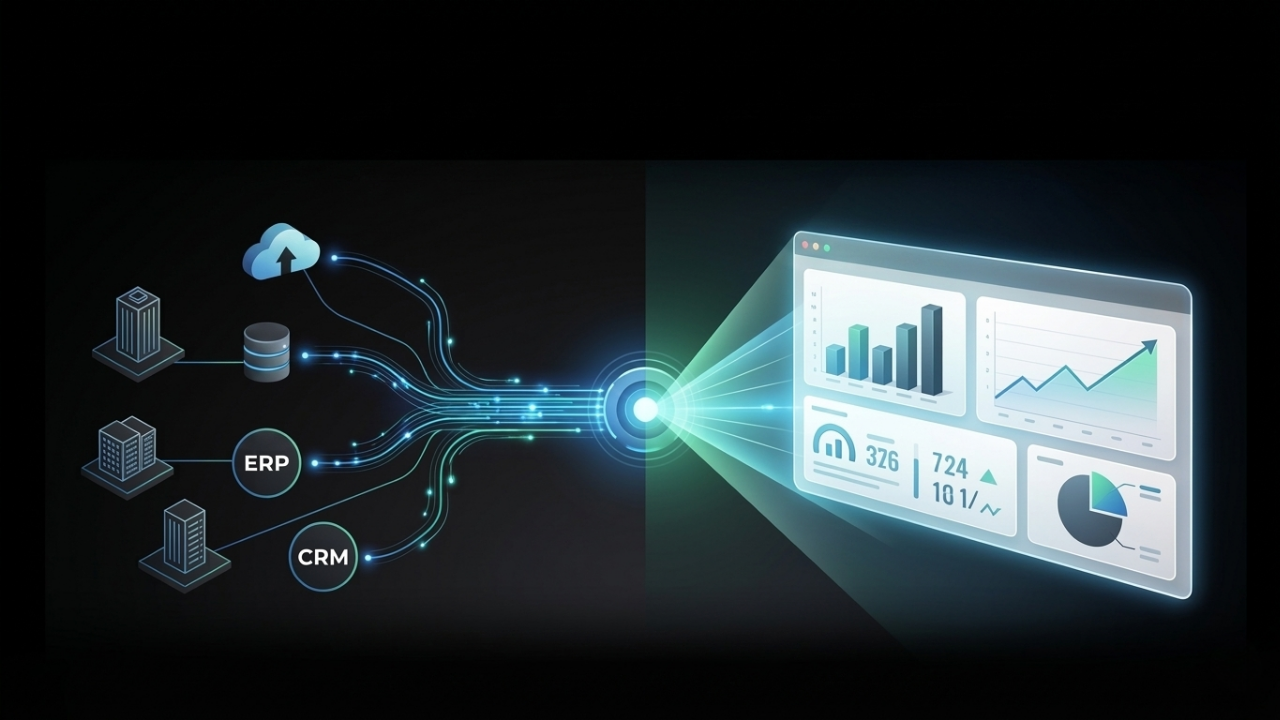
Enterprise leaders rely on data to guide strategic decisions, monitor operations, and identify growth opportunities. Yet in many organizations, critical data remains scattered across multiple applications, cloud platforms, and legacy systems. When information is stored in disconnected environments, obtaining a clear and accurate view of business performance becomes extremely difficult.
This is where systems integration for enterprise data visibility plays a crucial role. By connecting applications, infrastructure, and data platforms, integration enables organizations to consolidate information and create a unified operational view. Instead of relying on fragmented reports from isolated systems, enterprises gain access to consistent and real-time insights across departments.
For growing organizations, data visibility is more than a technical advantage. It becomes a strategic capability that improves decision-making, operational efficiency, and long-term scalability. In this article, we explore how systems integration improves enterprise data visibility and why it has become essential for modern digital enterprises.
The Data Visibility Challenge in Modern Enterprises
Most enterprises adopt new technologies over time to address evolving business needs. Finance teams deploy specialized accounting systems, marketing teams rely on CRM platforms, and operations teams manage supply chain tools. While each platform serves a specific function, they often operate independently from one another.
As a result, organizations frequently struggle with fragmented data ecosystems. Information may exist across on-premise servers, cloud platforms, SaaS applications, and departmental databases. Without proper connectivity between these systems, data becomes difficult to access, analyze, and trust.
Fragmented environments create several operational challenges. Leadership teams may rely on multiple reports from different departments that present inconsistent figures. IT teams spend significant time manually extracting and reconciling data across systems. Decision-making slows down because executives lack real-time insights into enterprise performance.
These challenges highlight why enterprises increasingly prioritize systems integration for enterprise data visibility. Integration connects data sources across the organization and ensures information flows seamlessly between platforms.
How Systems Integration Connects Enterprise Data
Systems integration creates a unified technology environment where applications, infrastructure, and data platforms communicate effectively. Instead of maintaining isolated systems, integration enables organizations to synchronize data across platforms and centralize visibility.
At its core, systems integration establishes structured connections between technologies through APIs, middleware platforms, and data orchestration frameworks. These connections allow systems to exchange information automatically and in real time.
For example, customer data captured in a CRM platform can automatically update financial systems, marketing automation tools, and analytics dashboards. Operational data from infrastructure monitoring systems can feed directly into centralized reporting platforms used by leadership teams.
This connectivity eliminates manual data transfers and reduces the risk of inconsistencies across systems. IT teams gain a single view of enterprise technology operations, while business leaders gain access to reliable insights that support faster decision-making.
Also Read: How Systems Integration Accelerates Enterprise Scalability
Key Benefits of Improved Enterprise Data Visibility
When organizations implement structured integration strategies, the impact extends beyond IT operations. Data visibility improves collaboration, operational transparency, and strategic planning across the enterprise.
One major advantage is improved decision-making. With integrated systems, executives can access real-time dashboards that combine financial, operational, and customer data from multiple platforms. This consolidated view enables leaders to identify trends and respond to opportunities more quickly.
Operational efficiency also improves significantly. Teams no longer need to manually collect and reconcile information from different systems. Automated data flows ensure that all departments work with consistent and up-to-date information.
Integration also enhances reporting accuracy. When data originates from a centralized ecosystem rather than multiple disconnected platforms, organizations reduce discrepancies and improve compliance with governance standards.
Over time, this visibility becomes a foundation for advanced capabilities such as predictive analytics, artificial intelligence, and automation.
Building a Unified Data Ecosystem Through Integration
Achieving enterprise-wide data visibility requires more than simply connecting a few applications. Organizations must adopt a structured integration architecture that aligns infrastructure, data platforms, and business applications within a cohesive ecosystem.
A well-designed integration framework typically includes centralized data pipelines, unified monitoring tools, and governance policies that maintain data consistency across systems. These frameworks ensure that information flows securely between platforms while maintaining compliance with enterprise security standards.
Organizations also benefit from integrating both legacy infrastructure and modern cloud platforms within the same architecture. Hybrid integration approaches allow enterprises to modernize technology environments while preserving operational continuity.
When implemented correctly, this integrated ecosystem becomes the foundation for enterprise intelligence. Data flows continuously across systems, enabling teams to access insights without delays or manual intervention.
How Team Computers Enables Enterprise Data Visibility
Enterprises often require specialized expertise to design and implement large-scale integration frameworks. Connecting infrastructure, cloud platforms, enterprise applications, and data systems requires deep understanding of both architecture and operational requirements.
Team Computers helps organizations implement systems integration strategies that improve enterprise data visibility across complex IT environments. By aligning infrastructure, applications, and analytics platforms, enterprises gain a unified view of operations and performance.
The approach focuses on creating integrated ecosystems where data flows seamlessly between systems. This includes connecting enterprise applications, aligning hybrid cloud environments, implementing centralized monitoring frameworks, and enabling real-time data exchange across platforms.
Through structured integration strategies, organizations can eliminate data silos, strengthen operational transparency, and empower leadership teams with reliable insights.
Conclusion
Modern enterprises generate enormous volumes of data across applications, cloud environments, and operational systems. Without structured integration, this data often remains fragmented, limiting its value to the organization.
By implementing systems integration for enterprise data visibility, organizations can transform disconnected information into actionable insights that support smarter business decisions.
Key takeaways include:
- Fragmented systems reduce enterprise data visibility and operational efficiency
- Systems integration connects applications, infrastructure, and data platforms
- Integrated environments enable real-time reporting and improved decision-making
- Unified data ecosystems support advanced analytics and innovation
As enterprises continue expanding their digital ecosystems, integration will remain a critical capability for unlocking the full value of enterprise data.
If your organization struggles with fragmented data across multiple systems, a structured integration strategy can help unlock real-time visibility and operational intelligence.
Discover how Team Computers can design and implement systems integration solutions that connect your enterprise technologies and transform data into actionable insights for business growth.