
For decades, the IT Service Desk has operated on a simple model, users report issues, tickets are created, and engineers resolve them.
Even with the introduction of automation and AIOps, this model remained largely reactive. Systems could detect anomalies, but resolution still depended on human intervention.
That model is now being redefined.
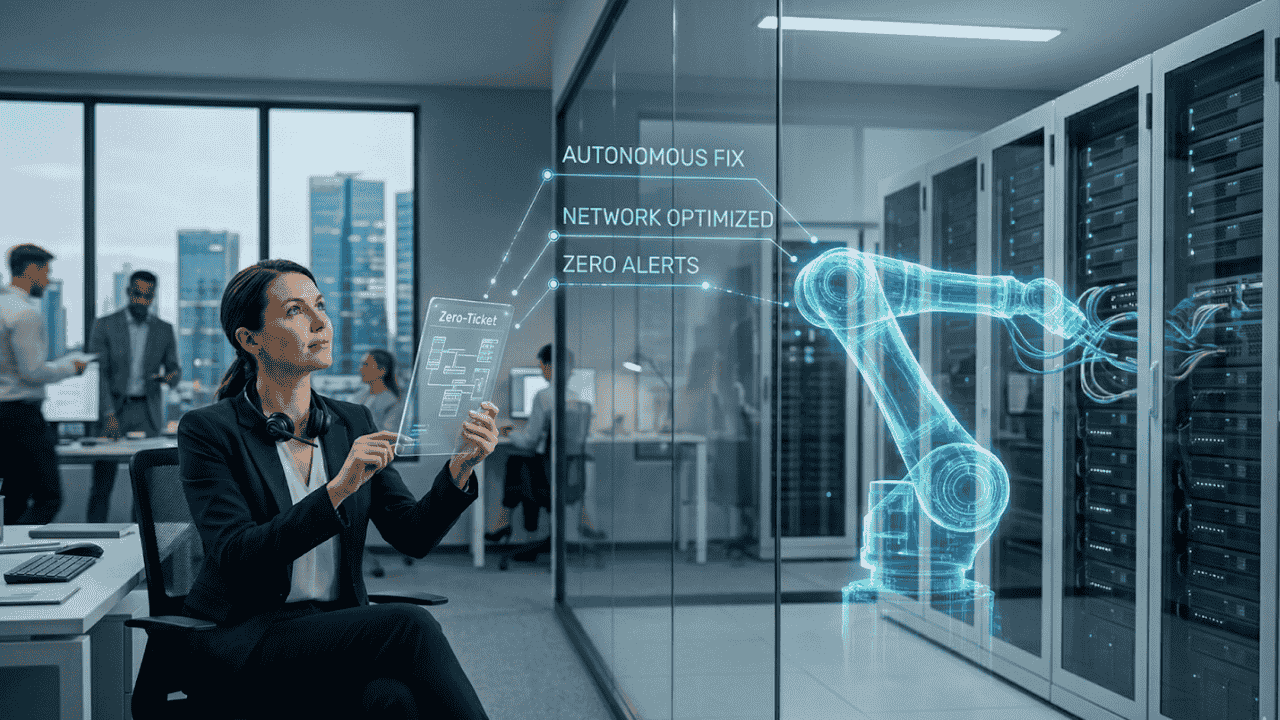
In 2026, enterprises are entering the era of Agentic AI, where service desks no longer revolve around ticket management, they focus on eliminating issues before they are even noticed.
This marks a fundamental shift from reactive IT support to autonomous IT operations.
Early implementations of AI in service desks were primarily conversational. Chatbots could assist users with basic queries or execute predefined workflows such as password resets.
Agentic AI introduces a significant advancement, it brings decision-making capability and execution autonomy.
An Agentic Service Desk does not simply respond to user inputs. It interacts directly with infrastructure and systems to identify, analyze, and resolve issues independently.
For example:
In this model, many incidents are resolved before they ever become visible to users.
To understand how Agentic AI transforms IT operations, it is important to look at how these systems function.
Traditional automation operates on predefined logic, fixed workflows triggered by specific conditions.
Agentic AI goes beyond this by applying contextual reasoning. It can evaluate complex scenarios and determine the most effective course of action, even when no predefined rule exists.
Modern IT environments span multiple systems, ITSM tools, cloud platforms, security frameworks, and endpoint management solutions.
Agentic AI operates across these environments seamlessly, enabling it to correlate data and execute actions across the entire technology stack.
Agentic systems are designed to adapt.
If an initial resolution attempt fails, the system evaluates alternative approaches. When required, it escalates the issue to human teams with complete context, reducing diagnostic time and improving resolution efficiency.
The introduction of Agentic AI is redefining how Managed Services are delivered.
Traditional service models focused on ticket volumes, response times, and resolution metrics. With Agentic AI, the focus shifts toward incident prevention and system resilience.
Key impacts include:
This evolution enables service providers like Team Computers to deliver more proactive and outcome-driven IT operations.
Agentic AI is not replacing IT professionals, it is redefining their role.
By automating repetitive tasks typically handled at L1 and L2 levels, organizations can redirect their talent toward higher-value initiatives.
IT teams are increasingly taking on roles such as:
This transition allows IT teams to move from operational support to strategic enablement.
The long-term vision of Agentic AI is the Zero-Ticket Enterprise.
In this model:
While this may not eliminate all incidents, it significantly reduces the dependency on traditional ticket-based workflows.
The Future of IT Service Management
Agentic AI represents a fundamental shift in how IT services are delivered.
Instead of measuring success through ticket volumes and response times, organizations are beginning to focus on system stability, user experience, and operational efficiency.
Key takeaways include:
As enterprises continue to adopt intelligent automation, the service desk will evolve from a support function into a core driver of digital resilience and efficiency.
Is your service desk still operating in a reactive, ticket-driven model?
Discover how Team Computers can help you transition toward intelligent, autonomous IT operations, reducing incidents, improving efficiency, and enabling your teams to focus on innovation.