
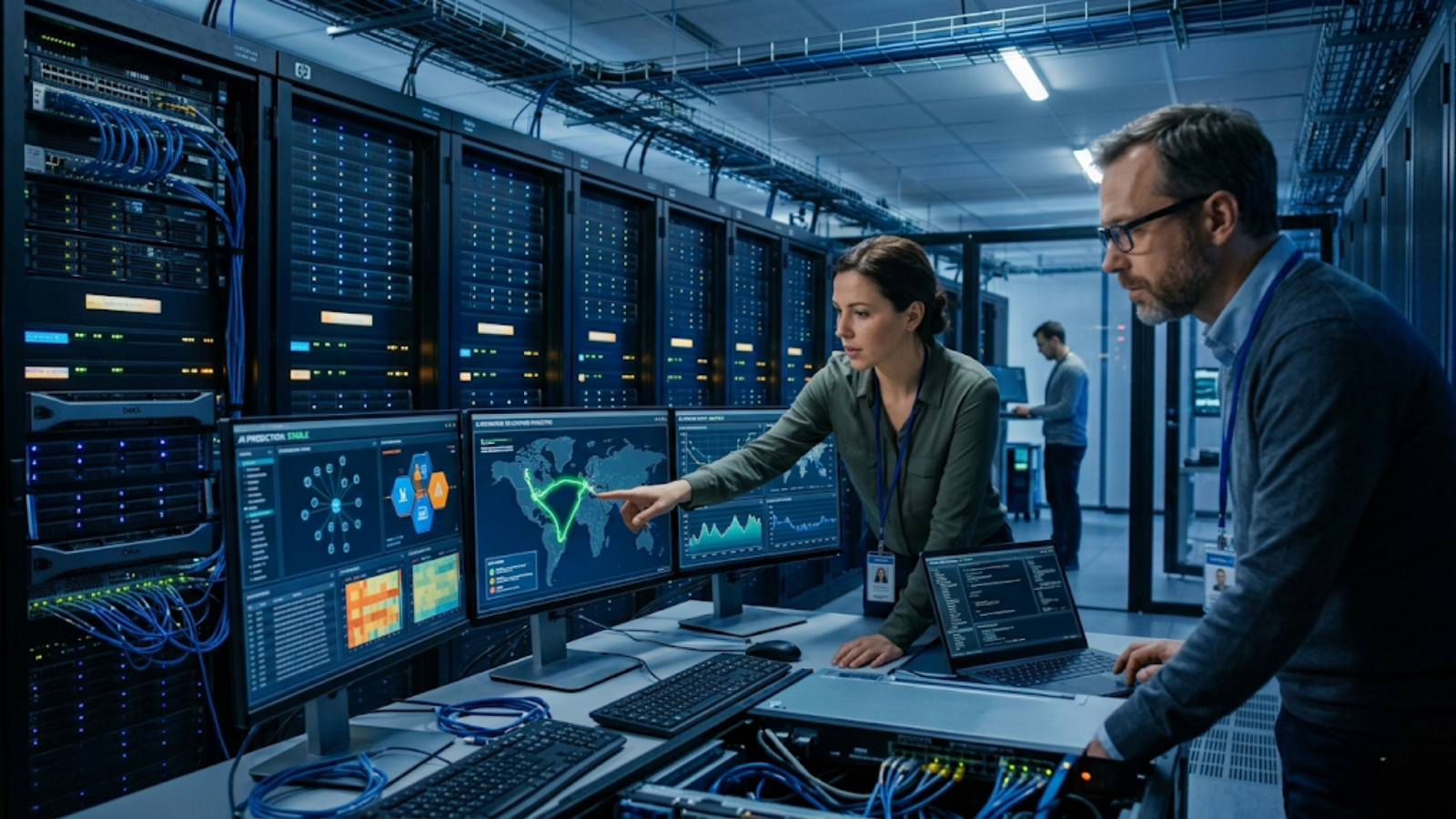
IT downtime is no longer just a technical issue, it is a direct business risk. From lost revenue to degraded customer experience, even short disruptions can have significant consequences. Many enterprises still rely on reactive monitoring, where issues are identified only after systems fail.
To truly reduce IT downtime, organizations are shifting toward AI-driven operations. By combining machine learning, automation, and real-time analytics, AI enables faster detection, smarter decision-making, and proactive issue resolution.
This article breaks down nine practical ways AI is transforming IT downtime prevention in enterprise environments.
1. Intelligent Alert Correlation to Reduce Noise
One of the biggest challenges in IT operations is alert fatigue. Monitoring tools generate thousands of alerts daily, many of which are duplicates or symptoms of the same issue.
AI reduces noise by correlating related alerts into a single incident. Instead of investigating multiple signals, teams can focus on one root cause.
This approach significantly improves alert fatigue in IT operations, allowing teams to respond faster and more effectively.
2. Predictive Analytics for IT Downtime Prevention
Traditional systems react after failures occur. AI changes this by identifying patterns that signal potential issues before they escalate.
By analyzing historical and real-time data, AI enables IT downtime prevention through early detection. Teams can take corrective action before users are impacted.
In enterprise environments, this shift from reactive to predictive operations is critical for maintaining uptime.
3. Automated Root Cause Analysis
When an incident occurs, identifying the root cause often takes longer than resolving it. Engineers must analyze logs, metrics, and dependencies across multiple systems.
AI automates this process by mapping relationships between components and identifying the most likely cause of failure.
This reduces investigation time and accelerates recovery, helping organizations reduce IT downtime more consistently.
4. Self-Healing IT Infrastructure
AI enables systems to resolve issues automatically without human intervention. This is known as self-healing IT infrastructure.
For example, if a service becomes unresponsive, the system can restart it automatically or scale resources to handle load spikes.
This capability minimizes downtime and ensures that issues are resolved before they affect end users.
5. Proactive IT Monitoring with AI
AI transforms monitoring from passive observation to active intervention. Instead of waiting for alerts, systems continuously analyze performance and behavior.
This enables proactive IT monitoring, where anomalies are detected in real time and addressed immediately.
The result is fewer incidents and more stable systems.
6. Capacity Planning and Resource Optimization
Many outages occur due to resource constraints—CPU overload, memory exhaustion, or network bottlenecks.
AI analyzes usage patterns and predicts future demand, enabling better capacity planning. This ensures that systems have the resources they need to operate smoothly.
By preventing resource-related failures, AI plays a key role in reducing downtime.
7. Faster Incident Response Through Automation
AI-driven automation reduces the time required to respond to incidents. Once an issue is detected, predefined workflows can be triggered automatically.
This includes actions such as:
- Restarting services
- Scaling infrastructure
- Redirecting traffic
These automated responses significantly improve recovery time and help reduce IT downtime across environments.
8. Continuous Learning from Past Incidents
AI systems improve over time by learning from historical data. Every incident becomes a source of insight.
Patterns from past failures are used to refine detection models and improve future responses. This creates a feedback loop that enhances system reliability.
9. Unified Visibility Across Hybrid Environments
Enterprise IT environments are often fragmented across cloud, on-premises, and third-party systems.
AI provides a unified view by aggregating data from all sources and analyzing it centrally. This enables better decision-making and faster issue resolution.
Solutions like ZerofAI from Team Computers integrate observability, automation, and AI to deliver end-to-end visibility across complex environments.
The Business Impact: AIOps ROI in Enterprise Operations
AI-driven operations are not just about efficiency—they directly impact business performance.
By reducing incident frequency and improving response time, organizations can:
- Improve system uptime
- Enhance customer experience
- Optimize operational costs
This is where AIOps ROI becomes evident. The value lies in fewer disruptions, faster recovery, and more predictable performance.
Conclusion
Enterprises that rely on reactive monitoring will continue to struggle with outages and inefficiencies. AI offers a different approach—one that focuses on prediction, automation, and continuous improvement.
If your goal is to reduce IT downtime, adopting AI-driven operations is no longer optional. It is a strategic requirement for managing modern IT environments.
With solutions like ZerofAI from Team Computers, organizations can move toward proactive IT monitoring, self-healing systems, and intelligent incident management—ensuring greater reliability and long-term resilience.