Many enterprises moved to the cloud with a simple expectation: lower costs and greater agility. Yet years later, CIOs and CTOs are asking a difficult question.
Why is our cloud bill rising faster than our business value?
Industry estimates suggest that [up to 30% of cloud spend is wasted due to poor architecture and unmanaged workloads]. Add to that rising concerns around data residency, regulatory compliance, and whether hyperscalers could potentially access sensitive enterprise data, and the cloud conversation suddenly becomes much more complex.
This is where a structured cloud migration strategy becomes critical.
Cloud migration is not simply lifting workloads from on-premise servers and dropping them into AWS or Azure. It requires rethinking data architecture, security boundaries, governance, and cost management so that your platform can support analytics, AI models, and real-time insights without runaway costs or risk exposure.
In this blog, we’ll explore:
A large percentage of enterprise cloud initiatives stall after the first phase. The reason is simple: migration without architecture transformation.
Organizations often approach cloud migration with a lift-and-shift mindset. Existing systems move into cloud infrastructure without redesigning how data pipelines, compute workloads, or storage layers operate.
The result?
Higher infrastructure costs and minimal innovation.
The reality is more nuanced.
Cloud providers operate under a shared responsibility model. While infrastructure security sits with providers, data security, governance, and access controls remain the enterprise’s responsibility.
Without a clear platform migration strategy, organizations end up with expensive infrastructure rather than a modern data platform.
For many technology leaders, the biggest challenge isn’t whether the cloud works. It’s whether it works economically and securely at scale.
Three concerns dominate boardroom discussions.
Cloud pricing models can be difficult to predict.
Small workloads cost little initially, but enterprise-scale analytics pipelines can quickly generate massive compute and storage consumption.
Major cost drivers include:
Without cost governance, cloud platforms can become more expensive than on-premise infrastructure.
Industries such as banking, insurance, and healthcare face strict regulatory mandates.
CIOs often ask:
While hyperscalers provide robust security frameworks, data residency policies and encryption controls must still be architected by the enterprise.
Many organizations worry about loss of control over sensitive enterprise data.
Key concerns include:
These risks can be mitigated, but only through careful architecture, encryption strategies, and governance policies.
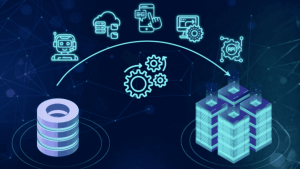
One of the most misunderstood aspects of modernization is the difference between cloud migration and platform migration.
They are not the same.
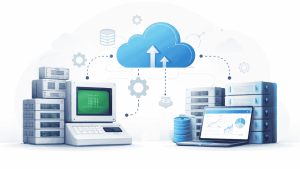
This typically refers to moving infrastructure workloads to the cloud.
Examples include:
While this improves scalability, it does not fundamentally change how data is used.
Platform migration goes deeper. It focuses on modernizing the data ecosystem itself.
This includes:
A true platform migration enables organizations to build data and AI capabilities that drive business decisions.
Key benefits include:
In other words, platform migration transforms data into a strategic asset rather than just an operational byproduct.
A successful cloud migration strategy requires more than technical execution. It demands architecture planning, governance frameworks, and cost controls.
Before moving workloads, enterprises must evaluate:
This step identifies which workloads should move first and which require redesign.
Modern data platforms require layered architectures.
Typical architecture components include:
When properly designed, this architecture supports advanced analytics, machine learning, and AI applications.
Security cannot be bolted on later.
Enterprises must establish:
These capabilities ensure that sensitive enterprise data remains protected even in multi-cloud environments.
Cost management should be part of the architecture itself.
Best practices include:
With these controls in place, organizations can maintain predictable cloud spending while scaling analytics capabilities.
Not all migration partners approach modernization strategically.
Many focus on infrastructure movement rather than data platform transformation.
CIOs evaluating partners should look for capabilities in four key areas.
A partner must understand:
Migration without architecture expertise leads to expensive technical debt.
The partner should design platforms that support:
Experienced partners implement cost governance through:
Cloud platforms should ultimately support AI-driven business innovation.
Capabilities should include:
At Team Computers, cloud migration is never treated as a simple infrastructure move.
The focus is on building AI-ready data platforms that are secure, scalable, and economically sustainable.
Our approach includes:
Before recommending any migration strategy, we assess:
This helps identify quick wins and long-term transformation opportunities.
Instead of moving workloads blindly, we design modern data platforms that support:
We help organizations implement:
This ensures enterprises retain full control over their data assets.
Our architecture frameworks help enterprises:
The result is a cloud platform that supports AI innovation without spiraling costs.
“Cloud migration only delivers value when it enables better data utilization. The real transformation happens when organizations redesign their platforms to support AI, governance, and scalable analytics from the start.”
— Head of IT Services, Team Computers
Enterprises are no longer debating whether to adopt the cloud. The real challenge lies in how to migrate strategically while maintaining control over costs, security, and data governance.
A well-executed cloud migration strategy transforms infrastructure into a modern data platform capable of supporting analytics and AI at scale.
Key takeaways:
Organizations that approach migration strategically will build platforms that support AI innovation, faster insights, and scalable growth.
Want to understand whether your current data platform is truly ready for the cloud and AI?
Book a free 30-minute Analytics Maturity Audit with Team Computers.
Our experts will evaluate your data architecture, cloud strategy, and analytics readiness to identify opportunities for cost optimization, platform modernization, and AI enablement.