
A single hour of downtime can cost your business more than an entire year of IT maintenance.
Yet for many enterprises, downtime is still treated as an occasional disruption rather than a predictable and preventable risk. If you’re responsible for IT infrastructure, you already know this: the real challenge is not just fixing outages, but learning how to reduce IT downtime before it impacts the business.
The problem is that downtime rarely comes from one major failure. It builds quietly through missed patches, delayed response times, infrastructure fatigue, and fragmented systems. And the cost of IT downtime for businesses is not limited to revenue loss — it extends to productivity, compliance, and customer trust.
In this blog, we break down seven proven strategies that leading enterprises use to minimize downtime, improve system resilience, and move from reactive firefighting to proactive control.
Most organizations don’t lack tools. They lack alignment.
Despite investments in infrastructure, downtime continues because monitoring tools are siloed, teams operate in isolation, vendors work without coordination, and maintenance remains reactive.
Downtime is often underestimated because its effects are distributed across the organization:
Key Stat: Enterprises lose an average of $300,000 per hour due to downtime, depending on industry and scale.
Even well-funded IT environments fail to reduce IT downtime when they lack proactive maintenance strategies, real-time visibility, and clear accountability. This is where the cost of IT downtime for businesses escalates — not from lack of spending, but from lack of structure.
You cannot fix what you cannot see.
Modern enterprises rely on 24/7 infrastructure monitoring, automated alerts for anomalies, and performance dashboards that surface issues before they escalate. Real-time monitoring is the single most effective first step to reduce IT downtime across complex environments.
Reactive maintenance waits for failure. Predictive maintenance prevents it.
By analyzing system behavior trends and identifying early warning signs, IT teams can schedule interventions before breakdowns occur. This approach directly reduces unplanned outages and extends the life of critical infrastructure.
Key Stat: Predictive maintenance can reduce downtime by up to 30%.
Unstructured processes slow down response time and create inconsistency across teams. Key areas to standardize include:
By implementing these foundational steps, enterprises begin to systematically reduce IT downtime instead of reacting to it case by case.
Single points of failure are the biggest structural risk in enterprise IT. Redundancy planning ensures that no one failure can bring down business-critical operations.
Key areas to address:
A robust disaster recovery (DR) strategy ensures business continuity when failures do occur. Key components include:
Without resilience planning, downtime lasts longer, data loss increases, and recovery becomes chaotic. The cost of IT downtime for businesses multiplies significantly when recovery is delayed or incomplete.
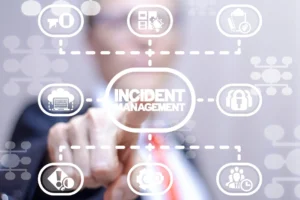
Manual processes are one of the biggest contributors to delayed incident response. Delayed ticket creation, human error in diagnosis, and slow escalation cycles all add unnecessary time to every outage.
Automation accelerates every stage of incident management:
The result is faster response times, reduced Mean Time to Resolution (MTTR), and consistent execution of processes at scale. Automation is critical if you want to sustainably reduce IT downtime across a growing enterprise environment.
Technology alone cannot solve downtime. Execution matters.
A structured AMC ensures continuous monitoring, preventive maintenance, faster response times, and accountability across vendors. When evaluating an AMC partner, look for:
At Team Computers, AMC is approached as a strategic function, not just a maintenance contract. The focus areas include predictive monitoring, automation-led workflows, multi-location support, and a zero-incident mindset across all engagements.
This is how enterprises successfully reduce IT downtime by combining the right technology with the right partner.
“Downtime is rarely caused by one major failure. It’s the result of small gaps in visibility, process, and response. Fix those gaps, and downtime reduces dramatically.”
— Head of IT Services, Team Computers
Downtime is not inevitable. It is manageable with the right strategy, tools, and partnerships.
Key takeaways:
To truly reduce IT downtime, enterprises must move beyond reactive fixes and build a structured, proactive IT ecosystem. The cost of IT downtime for businesses is too high to ignore — and too preventable to accept.
Discover how Team Computers can help you reduce IT downtime with a proactive, technology-driven AMC approach. Strengthen your IT resilience, improve uptime, and ensure your business never slows down when it matters most.