How a Modern IT AMC Provider Uses Technology to Improve Response Time
IT Annual Maintenance Contract
When a critical server goes down, how long does it take before someone even knows about it?
For many enterprises, the delay between issue occurrence and response is where the real damage begins. Not the failure itself—but the lag in detection, escalation, and resolution. This is precisely where modern IT AMC Services are redefining expectations.
Traditional AMC models relied heavily on manual intervention—tickets raised after failures, engineers dispatched after delays, and response times dependent on human coordination. The result? Downtime stretches, productivity drops, and the hidden costs of not having AMC—or having the wrong one—start to pile up.
Today, response time is no longer just an SLA metric. It is a direct reflection of how intelligently your IT ecosystem is managed.
In this blog, you’ll explore how modern AMC providers leverage technology—automation, monitoring, analytics, and centralized control—to drastically improve response time and ensure business continuity.
Why Traditional AMC Models Fail at Response Time
The biggest limitation of legacy AMC models is not capability—it’s approach.
The Problem: Reactive Support Systems
In a traditional setup:
Issues are detected manually
Tickets are raised after failure
Engineers are assigned sequentially
Root cause analysis begins late
This creates a delay loop that directly impacts response time.
The Business Impact
For CIOs and IT Heads, slow response time translates into:
Prolonged downtime
Missed SLAs
Escalations from business units
Increased operational stress
Nearly 70% of IT downtime escalations are linked to delayed detection and response rather than the issue itself.
Where It Breaks Down
No real-time visibility into infrastructure
Lack of centralized monitoring
Dependency on manual workflows
Fragmented vendor communication
These inefficiencies are often overlooked but form a major part of the hidden costs of not having AMC aligned with modern enterprise needs.
Without technology-driven IT AMC Services, response time remains unpredictable—and unpredictable systems are a risk no enterprise can afford.
How Technology Transforms IT AMC Services Response Time
Modern AMC providers are no longer just support vendors—they are technology-enabled service partners.
Modern IT AMC Services use technology not just to respond faster—but to ensure fewer incidents require response in the first place.
Why Faster Response Time Directly Impacts Business Outcomes
Response time is not just an IT KPI—it’s a business metric.
The Real Cost of Delayed Response
Every delay triggers a chain reaction:
Systems remain unavailable longer
Employees lose productive hours
Customers experience service disruption
Revenue opportunities are lost
A 10-minute delay in response can increase downtime impact by up to 40% in high-dependency environments.
Hidden Costs You May Not See
The hidden costs of not having AMC with strong response capabilities include:
Loss of customer trust
Increased churn risk
Internal inefficiencies
Brand reputation damage
Faster Response Enables
Business continuity
SLA adherence
Better user experience
Reduced operational risk
Example Scenario
A network failure in a multi-location retail setup:
Without AMC: Detection after 30 minutes, resolution in 3 hours
With modern AMC: Detection in 2 minutes, resolution initiated within 10 minutes
The difference is not just time—it’s business impact.
What to Look for in a Technology-Driven AMC Provider
Not all AMC providers deliver the same level of response efficiency.
Key Evaluation Criteria
When assessing IT AMC Services, focus on:
1. Proactive Monitoring Capabilities
Does the provider offer 24/7 monitoring?
Are alerts automated and real-time?
2. Automation & AI Integration
Is incident detection automated?
Are workflows optimized through AI?
3. SLA Transparency
Are response times clearly defined?
Is performance tracked and reported?
4. Multi-Vendor Expertise
Can they manage diverse infrastructure?
Do they act as a single point of contact?
5. Command Center Presence
Is there centralized visibility?
Are operations coordinated in real time?
Red Flags to Watch
Heavy reliance on manual ticketing
Lack of real-time dashboards
No predictive maintenance approach
Limited reporting capabilities
Choosing the right partner helps eliminate the hidden costs of not having AMC that stem from inefficiency and delays.
How Team Computers Enhances Response Time Through Technology
At Team Computers, response time is engineered—not left to chance.
Our Approach to IT AMC Services
We combine process, technology, and expertise to deliver faster outcomes.
1. Digital Command Centre
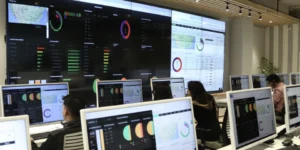
Centralized monitoring across infrastructure
Real-time alerts and escalation
Unified visibility for faster action
2. Predictive Maintenance Models
Data-driven insights to anticipate failures
Reduced incident frequency
Improved system stability
3. Automation-Led Workflows
Instant ticket creation and routing
Priority-based response handling
Reduced manual intervention
4. Multi-Location Support Capability
Standardized processes across sites
Faster on-ground response coordination
Consistent SLA adherence
The Result
Faster detection and resolution
Reduced downtime impact
Improved operational efficiency
This is how modern IT AMC Services evolve into a strategic enabler for enterprise IT.
CONCLUSION
Response time defines the effectiveness of your IT operations. And in enterprise environments, even small delays can lead to significant business impact.
Key Takeaways
Traditional AMC models fail due to reactive processes
Technology enables real-time detection and faster resolution
Faster response directly improves business continuity
Choosing the right AMC partner eliminates operational inefficiencies
Modern IT AMC Services reduce both visible and hidden risks
Discover how technology-driven IT AMC Services from Team Computers can drastically improve your response time and minimize downtime impact. Transform your IT operations from reactive firefighting to proactive control—before the next incident tests your systems.