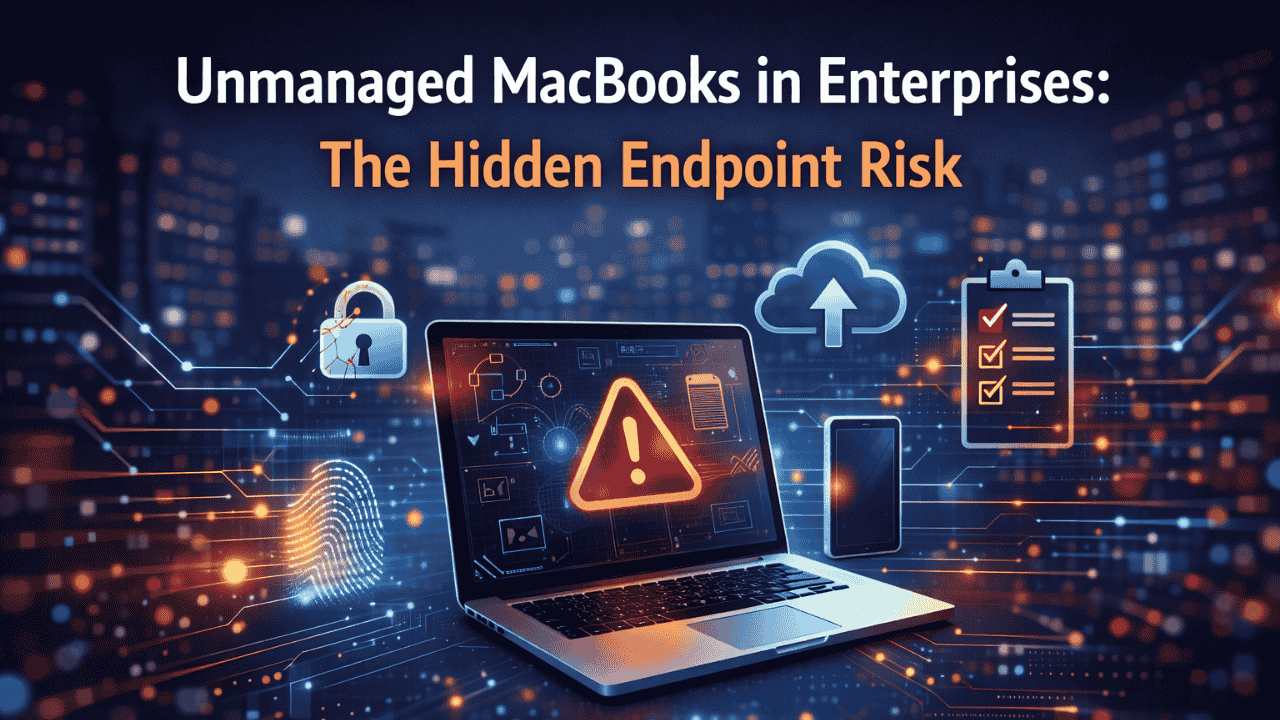
Many enterprises believe their Mac environments are secure simply because they standardized on Apple hardware. That assumption is dangerous.
Industry research indicates that between 20 to 30 percent of corporate endpoints operate outside formal management frameworks in hybrid environments. In Mac-heavy enterprises, shadow IT purchases, remote hiring, and BYOD MacBooks significantly increase this gap.
These unmanaged devices often access corporate email, SaaS platforms, and sensitive internal systems without enforced security controls. The result is a silent expansion of risk.
This is where structured macOS governance becomes critical. In MacBook-rich enterprises, unmanaged MacBooks represent one of the fastest-growing attack surfaces. Jamf, when deployed strategically, enables full lifecycle control, compliance enforcement, and automated security governance across Apple ecosystems.
In this blog, we examine:
In fast-growing organizations, device sprawl happens quietly.
Common scenarios include:
Studies across mid-to-large enterprises show that unmanaged endpoints can represent one in four devices accessing corporate systems. In Mac-centric organizations, this number often skews higher due to Apple’s strong adoption in design, engineering, and leadership teams.
Unlike Windows environments, where centralized management is often enforced by default, macOS adoption sometimes precedes governance planning.
The result is invisible risk.
Unmanaged does not mean inactive. These devices actively access sensitive data.
Without centralized management:
Attackers increasingly target macOS because its enterprise footprint has grown significantly. Delayed patching creates exploitable windows.
Corporate Macs should enforce:
Unmanaged MacBooks may lack one or more of these controls. Even a single misconfiguration can expose sensitive data.
Without device enrollment:
This blind spot prevents early detection and increases dwell time in case of compromise.
Unmanaged devices often:
For regulated industries, this introduces significant compliance violations. The danger is not theoretical. It is operational.
Many organizations attempt to manage Macs using generic endpoint tools not optimized for Apple ecosystems.
This leads to:
Apple devices require Apple-native management capabilities.
Jamf is purpose-built for macOS, iOS, and iPadOS environments. It understands Apple frameworks natively, enabling deeper visibility and control.
Jamf provides comprehensive lifecycle governance across Mac environments.
With Apple Automated Device Enrollment integrated into Jamf, enterprises can:
This eliminates the possibility of new unmanaged devices entering the ecosystem.
Jamf enables real-time enforcement of:
If a device drifts from compliance, remediation actions can trigger automatically.
This shifts security posture from reactive to proactive.
Jamf centralizes:
By enforcing timely patch cycles, enterprises reduce exposure windows significantly.
When integrated with identity providers, Jamf allows:
This ensures only trusted devices interact with sensitive data.
Beyond security, unmanaged endpoints create operational inefficiencies.
In MacBook-rich enterprises, unmanaged endpoints can quietly undermine governance efforts.
Leadership teams often discover the scope of the issue only after a compliance audit or security incident.
To reduce unmanaged device exposure, organizations should:
The objective is simple: eliminate blind spots.
Unmanaged MacBooks represent one of the most underestimated risks in modern enterprises.
Key takeaways:
In MacBook-rich environments, assuming security without centralized management is a costly mistake.
If your enterprise relies heavily on MacBooks, now is the time to assess how many devices operate outside formal management. Partner with experts who understand Apple-native ecosystems and can deploy Jamf strategically to secure, monitor, and govern your macOS environment at scale.