
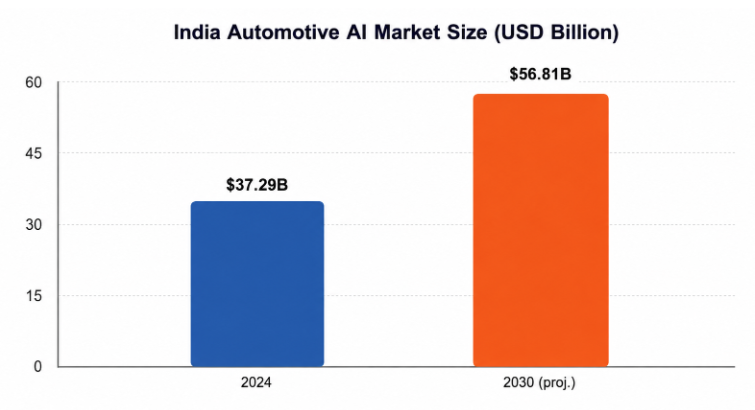
India’s automotive AI market was worth $37.29 billion in 2024 and is projected to reach $56.81 billion by 2030, growing at a 7.34% CAGR (U.S. International Trade Administration, 2025). That’s not a futuristic promise — it’s happening on plant floors and dealer lots across the country right now.
Tata Motors, Mahindra & Mahindra, and Maruti Suzuki are already weaving AI into design, manufacturing, and after-sales service. Behind many of these transformations sits a layer of IT infrastructure, analytics, and cybersecurity work that rarely makes headlines. This is where systems integrators like Team Computers, a 38-year-old New Delhi-based IT services firm, operate — building the cloud, data, and security backbone that lets automotive AI actually run in production.
This piece breaks down where AI is making the biggest dent in India’s auto industry, and what a firm like Team Computers actually does to support that shift.
Key Takeaways
- India’s automotive AI market is projected to grow from $37.29B (2024) to $56.81B by 2030 at a 7.34% CAGR (Trade.gov, 2025).
- The automotive sector leads global AI adoption at 26% in 2026, ahead of most other manufacturing verticals (Analytics Insight, 2026).
- AI-driven predictive maintenance deployments in India report unplanned downtime cuts of roughly 68%, with an average 8.4-month payback (industry deployment data, 2026).
- Team Computers, founded in 1987, supports Indian automotive brands with cloud migration, dealer analytics, predictive maintenance dashboards, and connected-vehicle cybersecurity.
- NASSCOM estimates AI-driven automation could add $60–70 billion annually to India’s manufacturing GDP by 2026, with automotive forming a significant share.
How Big Is AI’s Footprint in India’s Automotive Industry?
India is now the world’s third-largest car market, and its automotive industry is rapidly adopting artificial intelligence and generative AI across the entire value chain. The market was valued at $37.29 billion in 2024 and is projected to reach $56.81 billion by 2030, growing at a 7.34% CAGR, driven largely by rising incomes and demand for connected, personalized vehicles (Trade.gov, 2025).
Growth isn’t limited to vehicle features. A NASSCOM study suggests AI-driven automation could add $60–70 billion annually to India’s manufacturing GDP by 2026, with automotive forming a significant share (ElectronicsClap, 2026). Three forces are behind the acceleration: cheaper computing paired with local cloud infrastructure, safety regulations like Bharat NCAP, and a large pool of IT talent moving into automotive-specific roles.
By sector, automotive is setting the pace. The industry reached a 26% AI adoption rate in 2026, ahead of most manufacturing peers (Analytics Insight, 2026). Isn’t that a bit surprising for an industry people still associate with steel and assembly lines rather than software? It shouldn’t be — cars generate more sensor data per hour than almost any other consumer product.
What Role Does Team Computers Play in Automotive AI?
Team Computers doesn’t build self-driving software or EV batteries. Founded in 1987 by IIT-Kanpur alumnus Ranjan Chopra, it started as a hardware reseller in New Delhi (Team Computers, 2026) and has since grown into a broad IT services and systems-integration company with a turnover of over ₹7,000 crore, 750+ locations across India, and 5000+ employees serving 4000+ customers
Its automotive practice focuses on the plumbing that makes AI usable at scale. The company offers AI-powered supply chain insights and predictive maintenance with real-time dashboards built on Tableau and Google Cloud AI, and helps automotive businesses modernize IT infrastructure by integrating cloud platforms, managing device lifecycles, and accelerating innovation through managed cloud and DevOps services Concretely, that breaks down into a few workstreams:
- Cloud and ERP/MES integration. Connecting ERP and MES systems with cloud platforms enables real-time data flow and visibility across manufacturing plants, supporting migration to hybrid environments on AWS, Azure, and Google Cloud.
- Dealer and after-sales analytics. Team Computers builds scorecards to track dealer sales and service performance across India, determine incentive payouts, and analyze warranty incidents and the costs tied to extended warranty coverage (Team Computers – Automotive Analytics).
- Cybersecurity for plants and connected vehicles. The firm’s offering spans plant floors to connected vehicles, built around Zero Trust architecture, enterprise firewalls, and advanced threat detection, while keeping operations compliant with automotive data regulations.
- Staffing and specialist skills. It supplies dedicated IT professionals with expertise in embedded systems, MES, and connected-car technology — filling gaps OEMs struggle to hire for directly.
None of this replaces the AI research done inside OEM labs. It’s closer to the difference between designing an engine and building the factory that can actually manufacture it at volume — unglamorous, but nothing ships without it.
How Is Predictive Maintenance Changing Automotive Manufacturing?
Ask any plant manager what keeps them up at night, and unplanned downtime is near the top. Predictive maintenance is the AI use case doing the most to fix that.
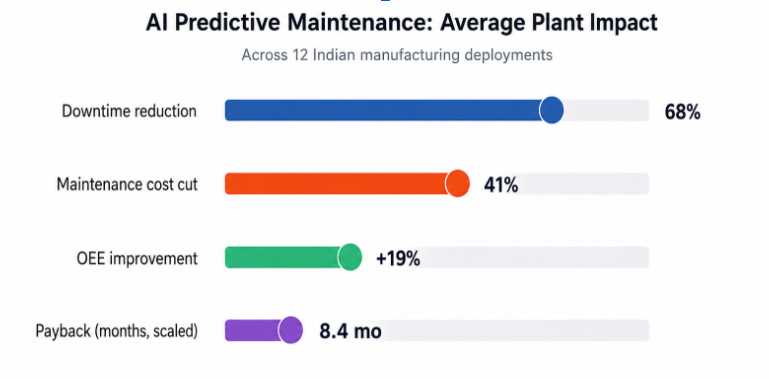
One documented case from an Indian automotive assembly plant shows the scale of impact: an AI predictive-maintenance module deployed on a 12-station rotary assembly line with recurring bearing failures predicted three impending failures 45 days in advance, letting the plant schedule maintenance during low-production windows and run zero unplanned stoppages over the following 12 months, with ROI payback in five months (iFactory App case data, 2026). Across a broader set of 12 manufacturing deployments, average results were a 68% reduction in unplanned downtime, a 41% cut in maintenance costs, a 19% improvement in overall equipment effectiveness, and an 8.4-month average payback.
The broader Indian market backs this up. The India AI in Manufacturing and Predictive Maintenance market is valued at roughly $1.3 billion, driven by rising adoption of AI to improve operational efficiency, reduce downtime, and strengthen predictive capabilities, with Bengaluru, Pune, and Hyderabad dominating due to strong technology ecosystems (Ken Research, 2025).
It isn’t frictionless, though. Initial investment in AI and predictive maintenance can exceed $1 million for mid-sized manufacturers, and only about 30% of Indian SMEs have adequate access to funding for such projects, per World Bank data cited in the same report. That funding gap is exactly the kind of problem managed-services and financing-support models — the sort Team Computers and similar IT partners offer — are designed to soften.
Why Are Automakers Investing So Heavily in AI Right Now?
Because the returns are already showing up on balance sheets, not just in pilot reports. The IBM Institute for Business Value found that OEM executives expect AI’s share of total revenue to rise from 5% today to 9% within three years, while executives separately expect AI to boost product value by 22% and digital service value by 37% over the same period (IBM, 2025).
Investment priorities within the sector are telling. The automotive industry is putting 41% of its AI investment toward operational efficiency, with addressing labor and skills gaps (21%) and improving product quality (18%) as the next priorities (Analytics Insight, 2026). And the appetite isn’t slowing: 78% of manufacturing companies plan to increase their AI budgets over the next two years.
On the innovation side, India is investing $134 billion in new manufacturing capacity across construction, automotive, renewable energy, and robotics, and Hero MotoCorp is already using Siemens Xcelerator paired with NVIDIA infrastructure to speed up its product development lifecycle through computer-aided engineering and virtual verification (NVIDIA Blog, 2026). Separately, TCS is using the NVIDIA Metropolis platform to convert standard factory camera feeds at Tata Motors into intelligent sensors for automated quality checks and real-time safety compliance.
What’s Slowing AI Adoption Down in India’s Auto Sector?
It’s not all smooth scaling. Three friction points show up again and again in industry research:
- Cost of entry. As noted above, predictive maintenance and AI tooling can require six- or seven-figure upfront investment, which is hard for small and mid-sized suppliers in a fragmented ancillary ecosystem.
- Data quality and legacy infrastructure. Many Indian plants still run on equipment that wasn’t built to output structured sensor data, so AI models need retrofit sensors and cleanup work before they can even start predicting anything useful.
- Skills and organizational readiness. High implementation costs, data privacy concerns, and regulatory limitations remain among the major challenges cited for India’s automotive AI market (MarketsandMarkets, 2026).
This is precisely the gap system integrators try to close — not by inventing new AI models, but by making existing ones deployable on real, messy, brownfield factory floors. It’s a less flashy job than building an autonomous-driving stack, but arguably a harder bottleneck to clear.
Where Is India’s Automotive AI Story Headed Next?
By 2026, digital twins and generative design tools have become standard practice, letting engineers simulate thousands of permutations for cost, weight, safety, and sustainability before assembly even starts. Looking past 2026, predictive maintenance, adaptive logistics, and advanced driver aids are expected to become mainstream by 2030, positioning India as more than a fast adopter — a global exporter of AI-engineered mobility solutions (ElectronicsClap, 2026).
For IT partners like Team Computers, that trajectory means more work at the intersection of infrastructure and intelligence: multi-cloud reliability, Zero Trust security for an increasingly connected vehicle fleet, and analytics platforms that turn dealer, plant, and vehicle data into decisions a human can actually act on.
Frequently Asked Questions
No. Team Computers is a systems integrator and managed IT services provider, not an AI model developer. It builds the cloud infrastructure, dashboards, and cybersecurity layer that let automotive businesses run AI-powered supply chain and predictive maintenance tools, working alongside platforms like Google Cloud AI rather than building AI from scratch.
India's automotive AI market was valued at $37.29 billion in 2024 and is projected to reach $56.81 billion by 2030, growing at a 7.34% CAGR according to the U.S. International Trade Administration's 2025 market intelligence report.
Cost and data readiness top the list. Upfront investment can exceed $1 million for mid-sized manufacturers, and only around 30% of Indian SMEs have adequate funding access for such projects, which slows adoption outside large, well-capitalized OEMs.
Major OEMs such as Tata Motors, Mahindra & Mahindra, and Maruti Suzuki are embedding AI across design, manufacturing, and service operations, with Hero MotoCorp specifically using Siemens Xcelerator and NVIDIA infrastructure to speed up product development.
In documented Indian deployments, yes and fairly quickly. One assembly-plant case reported ROI payback in five months, and a broader set of 12 deployments averaged an 8.4-month payback with 68% less unplanned downtime. Is Team Computers an AI research company?
How much is India's automotive AI market worth?
What is the biggest barrier to AI adoption in Indian auto manufacturing?
Which Indian automakers are furthest along with AI adoption?
Does predictive maintenance actually pay for itself?