

Most enterprise managed services deals are lost in the first three months, not the first three years. The technology usually works. What breaks is the handover: nobody agreed who owns the escalation path, the asset register was 40% wrong on day one, and the monthly report measures ticket closure instead of whether anyone can do their job.
This guide covers what managed IT services include at enterprise scale, what drives the buying decision now, how the contract should be structured, and the questions worth asking before you sign. It is written for the person who has to defend the decision to a CFO, not for the person writing the RFP boilerplate.
Key takeaways
IT services is the single largest slice of global technology spending, forecast by Gartner to pass $1.87 trillion in 2026, and managed services sits inside that number.
Cost is no longer the main reason enterprises outsource. A Global Outsourcing Survey found only 34% now name cost reduction as the primary driver, down from 70% in 2020.
Analyst estimates of the managed services market for 2026 range from roughly $430 billion to $460 billion. Treat any single figure in a vendor pitch as marketing, not evidence.
The contract matters more than the capability deck. Ask for the asset baseline, the exit clause, and the named escalation owner before you ask about tooling.
What managed IT services actually cover
A managed IT service is an ongoing contract where an external provider takes operational responsibility for part of your technology estate, against agreed performance targets, for a recurring fee. That is different from project work, which ends, and different from staff augmentation, where you rent people but keep the accountability.
At enterprise scale the scope usually falls into five buckets:
Digital workplace and end user support. Service desk, endpoint management, device lifecycle, onboarding and offboarding, asset tracking. This is the layer your employees actually feel.
Infrastructure and data centre operations. Servers, storage, virtualisation, backup, patching, capacity planning, disaster recovery testing. Often bundled with 24×7 remote infrastructure monitoring.
Network and connectivity. WAN and LAN management, SD-WAN, branch rollouts, wireless, firewall administration.
Managed security. Detection and response, SIEM operation, vulnerability management, identity and access administration, compliance reporting. MarketsandMarkets projects this as the fastest growing segment of the managed services market through 2031.
Cloud operations. Multi-cloud monitoring, cost governance, workload migration support, platform administration across AWS, Azure, GCP, or OCI.
Most enterprises do not buy all five from one provider, and they probably should not. But they should insist that whoever they buy from can show where their responsibility stops and someone else’s begins, in writing, with names attached.
Why enterprises are handing over more IT operations
Three pressures explain most of the current demand, and only one of them is money.
The people are not there
ManpowerGroup surveyed 39,063 employers across 41 countries for its 2026 Talent Shortage Survey, with fieldwork completed in October 2025. It found 72% reporting difficulty filling roles, and the information and technology services sector was the most constrained vertical. Companies with 1,000 to 4,999 employees reported the highest shortage rate at 75%, eleven points above the smallest firms.
The gaps are not evenly spread. A Robert Half survey of more than 350 technology leaders in the US, published in 2026, mapped where large enterprises and smaller companies feel the shortfall differently.
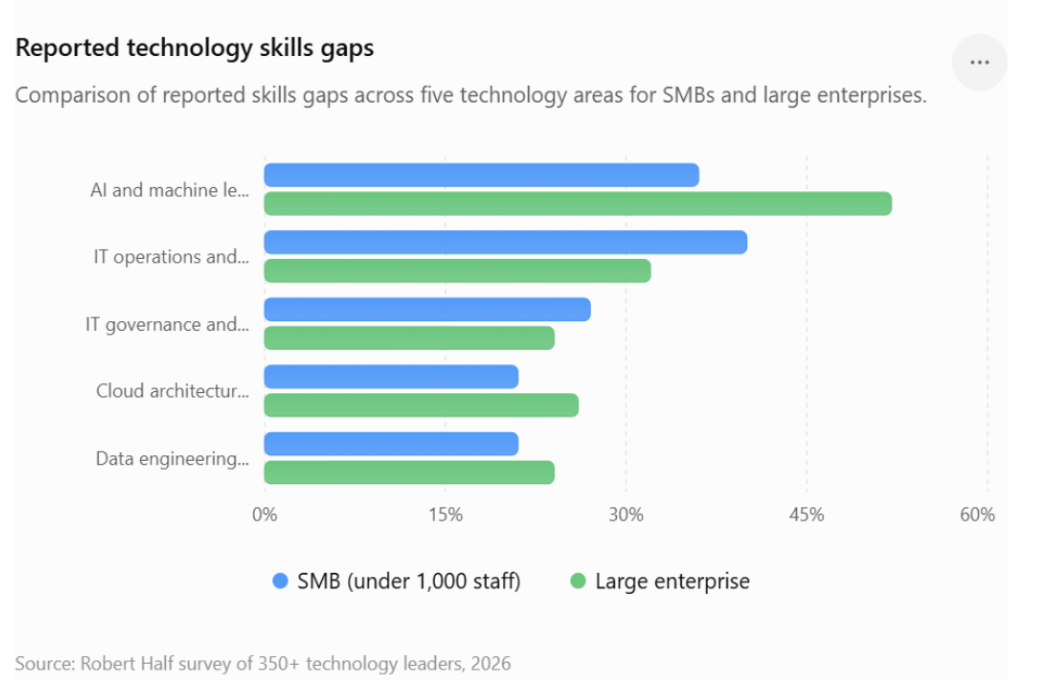
Notice the inversion in the second row. Large enterprises are short on AI skills but reasonably staffed on infrastructure. Smaller companies are the opposite. If you are a large enterprise, that is an argument for outsourcing infrastructure operations specifically so your scarce senior people can work on the AI and data problems you cannot hire for.
Downtime is expensive and the estimates keep climbing
New Relic’s 2025 Observability Forecast, which surveyed more than 1,700 IT and engineering professionals across 23 countries, put the median cost of a high impact outage at $2 million per hour. ITIC’s 2025 Hourly Cost of Downtime Survey found a median of $9,000 per minute for enterprises with 1,000 or more employees, and $2,400 per minute for mid-market companies between 200 and 1,000 employees.
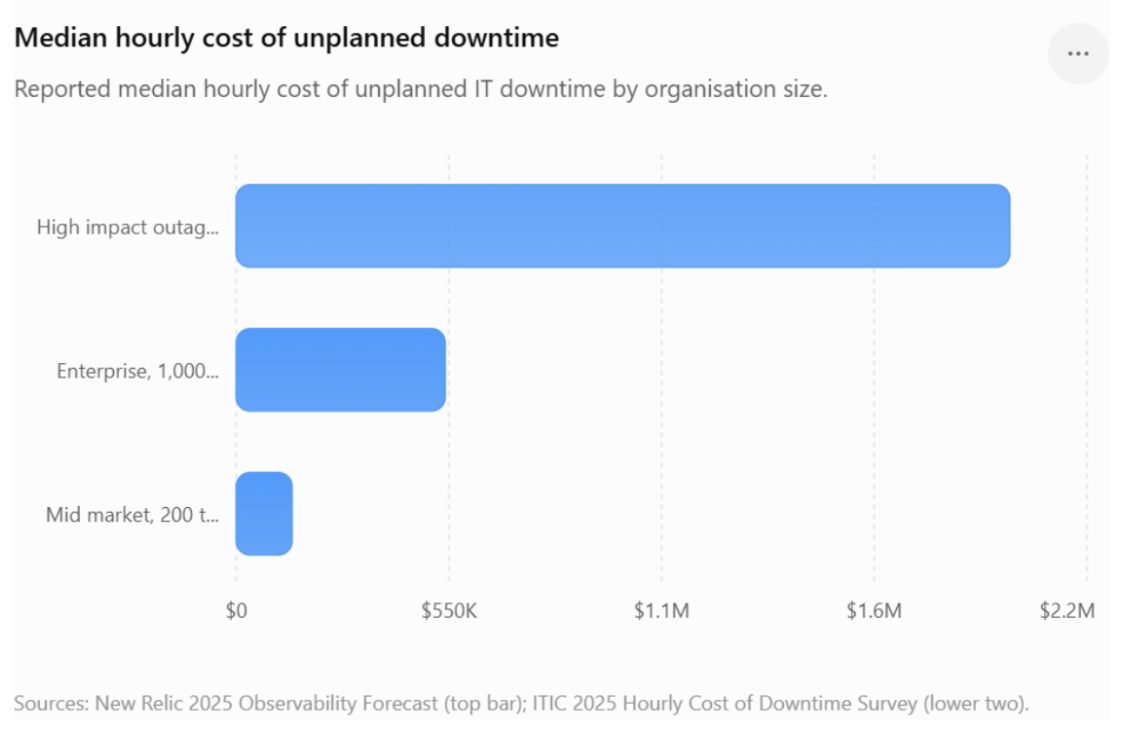
Two caveats before anyone puts this in a business case. These are self reported figures from surveys of IT professionals, not audited financials, and the definition of “high impact” varies. Use them to frame the order of magnitude, not to calculate a precise return. Your own number is better: annual revenue divided by operating hours, multiplied by the share of revenue that actually stops when the system stops.
The more useful finding from the same New Relic research is that organisations with full stack observability reported outage costs roughly half those of organisations without it. That is a monitoring argument, and monitoring is one of the easiest things to hand to a provider who runs it around the clock.
Security has outgrown most internal teams
An Industry Data Breach Report 2025, based on 600 breached organisations studied between March 2024 and February 2025, put the global average breach cost at $4.44 million, down 9% year on year. The decline came from faster containment. The average time to identify and contain a breach fell to 241 days, the lowest in nine years.
That number is still eight months. Organisations using security AI and automation extensively saved an average of $1.9 million per breach according to the same report. Running detection and response continuously, with people who look at alerts at 3am on a Sunday, is exactly the kind of function that gets thin when it sits inside a general IT team.
What it costs, and why the market figures are unreliable
Here is something most buyer’s guides will not tell you: the headline market numbers are soft, and vendors use them as social proof.
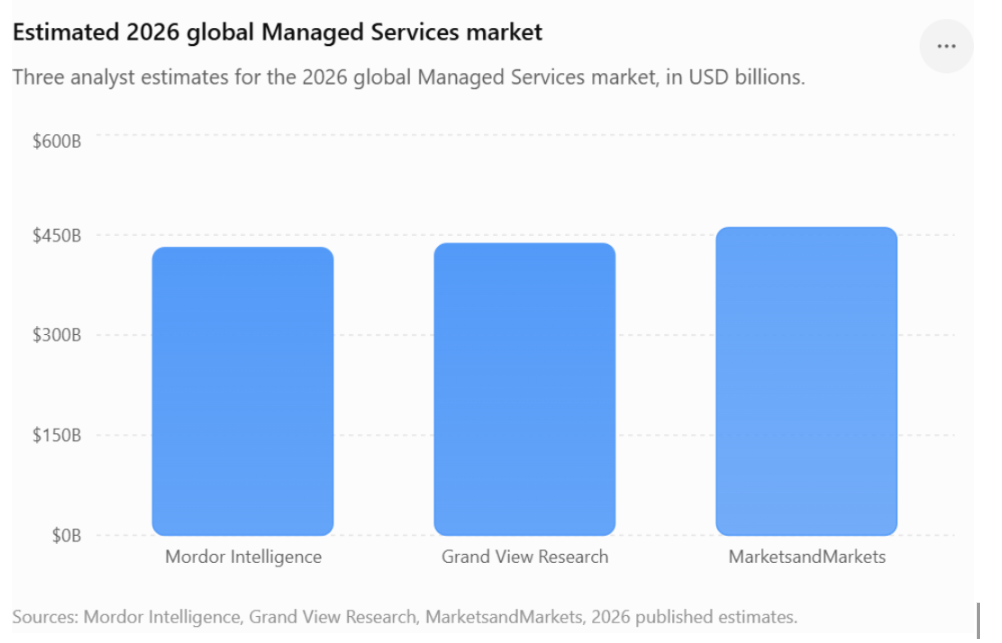
Three respected research firms put the 2026 global managed services market at $431 billion, $437 billion, and $461 billion. That is a 7% spread in the same year, because each firm draws the segment boundary somewhere different. When a provider opens a pitch with “the market is growing at X%,” the honest response is to ask which definition they are using and whether their own services sit inside it.
Pricing you can actually compare falls into four models:
- Per device or per user, per month. Predictable, easy to benchmark, and the most common structure for digital workplace and endpoint services. It rewards the provider for keeping the estate simple.
- Tiered or bundled. A fixed monthly fee for a defined scope, with anything outside it billed separately. Watch the definition of “outside it.”
- Consumption based. Common in cloud operations, where the managed fee tracks a percentage of underlying spend. This creates an obvious misalignment: the provider earns more when your cloud bill grows. Cap it or tie part of the fee to cost reduction targets.
- Outcome based. The fee is linked to agreed business results such as availability, resolution speed, or user productivity, rather than headcount or tickets. IDC’s FutureScape: Worldwide Services 2026 Predictions expects 30% of IT service contracts to be outcome based by 2029.
Whichever model you pick, price the transition separately. Discovery, asset baselining, tooling deployment, and knowledge transfer are real work, and a provider who offers to do them free is either bad at estimating or planning to recover the cost through change requests.
What Is AIOps? The Complete Guide for Enterprise IT Operations Teams
The contract is the product
Capability decks look similar across providers. Contracts do not.
A Global Outsourcing Survey found that only 34% of organisations now cite cost reduction as their primary outsourcing driver, down from 70% in 2020. Talent access and speed have taken over. That shift should change what you negotiate. If you are buying capability rather than savings, then a contract optimised purely for unit price is optimised for the wrong thing.
SLAs set the floor, XLAs describe the ceiling
A service level agreement measures what the provider delivered: uptime, first response time, mean time to repair, ticket resolution against target. These are contractually enforceable and they should stay.
An experience level agreement measures whether the delivery worked for the people receiving it, using satisfaction scores, effort ratings, and sentiment data. The distinction matters because a provider can hit every SLA target while your workforce feels underserved. A ticket closed inside the window, after the user chased it three times, is a green dashboard and an unhappy employee.
Most enterprises running XLAs in 2026 run them alongside SLAs rather than instead of them. ITIL 4 explicitly encourages experience centric service management. The practical version: keep the SLA for enforcement, add two or three XLA measures for steering, and review both in the same monthly meeting.
Eight questions before you sign
- Who owns the asset baseline on day one, and what happens if it is wrong? Bad CMDB data is the most common cause of a rough transition.
- Name the escalation owner. Not a role, a person, with a phone number and a named deputy.
- What is the exit clause? Ask for the transition-out obligations in writing, including data formats and the notice period.
- Which parts are delivered by subcontractors, and are those subcontractors bound by the same SLAs?
- How is scope change priced? Get the rate card for out-of-scope work before signing, not after.
- What does the monthly report contain? If it is a ticket volume chart, ask for something else.
- What happens in the first 90 days? A specific plan, with milestones, not a phase diagram.
- Can you speak to a reference customer who left and came back, or who is mid-transition right now? Happy three-year references tell you less.
Where these deals go wrong
Transitions fail more often than steady state operations do. The pattern is consistent enough to plan around.
Discovery is usually under-scoped. Providers price the transition on the asset list you gave them, and the asset list is wrong. Assume a 10% to 30% variance and negotiate what happens when it appears, rather than arguing about it in month two.
Knowledge sits with two or three people who are leaving. When operations move out, the internal staff who held the undocumented knowledge often move on within months. Capture the runbooks before the announcement, not after.
The retained organisation gets forgotten. Outsourcing operations does not remove the need for internal capability. You still need people who can hold the provider accountable, own architecture decisions, and make judgement calls the contract does not cover. Research shows that 70% of executives report their vendor management function is not fully mature. Budget for that function explicitly.
Reporting drifts toward what is easy to measure. Tickets closed is easy. Whether the finance team could close the books on time is hard. The second one is the thing your CFO cares about.
Frequently asked questions
What is the difference between managed IT services and IT outsourcing?
Outsourcing is the broad category of contracting work to a third party. Managed services is a specific model within it: an ongoing engagement where the provider takes operational responsibility for a defined scope against performance targets, for a recurring fee. Project outsourcing ends when the project does. A managed service is continuous.
How long should an enterprise managed services contract run?
Three years is the common middle ground, with an initial term long enough for the provider to recover transition costs and a break clause after year one or two. Shorter terms make providers reluctant to invest in automation for your estate. Longer terms without a renegotiation point leave you locked to pricing set before the technology changed.
Can managed services work alongside an internal IT team?
Yes, and in most enterprises that is the design. The provider runs and maintains work, the internal team keeps architecture, vendor governance, security policy, and anything close to the business. What does not work is leaving the split undefined and expecting it to settle naturally.
Does outsourcing IT operations increase security risk?
It changes the risk rather than removing it. You gain continuous monitoring and specialist skills most internal teams cannot staff around the clock. You add third-party access to your environment, which is why supply chain compromise remains a significant cybersecurity risk for organizations using external technology and service providers. Manage it with least privilege access, audited service accounts, and contractual breach notification timelines.
Where to start
If you are early in the process, do three things before you talk to providers. Get an accurate asset inventory, because everything downstream depends on it. Calculate your own cost of downtime rather than borrowing an industry average. Decide which functions you genuinely want to stop doing, as opposed to the ones that are simply annoying this quarter.
Then run a scoped pilot on one service tower before committing the whole estate. A six month engagement on end user support will tell you more about how a provider operates than any reference call.
Book a scoping conversation to map your current estate against a managed services model.