
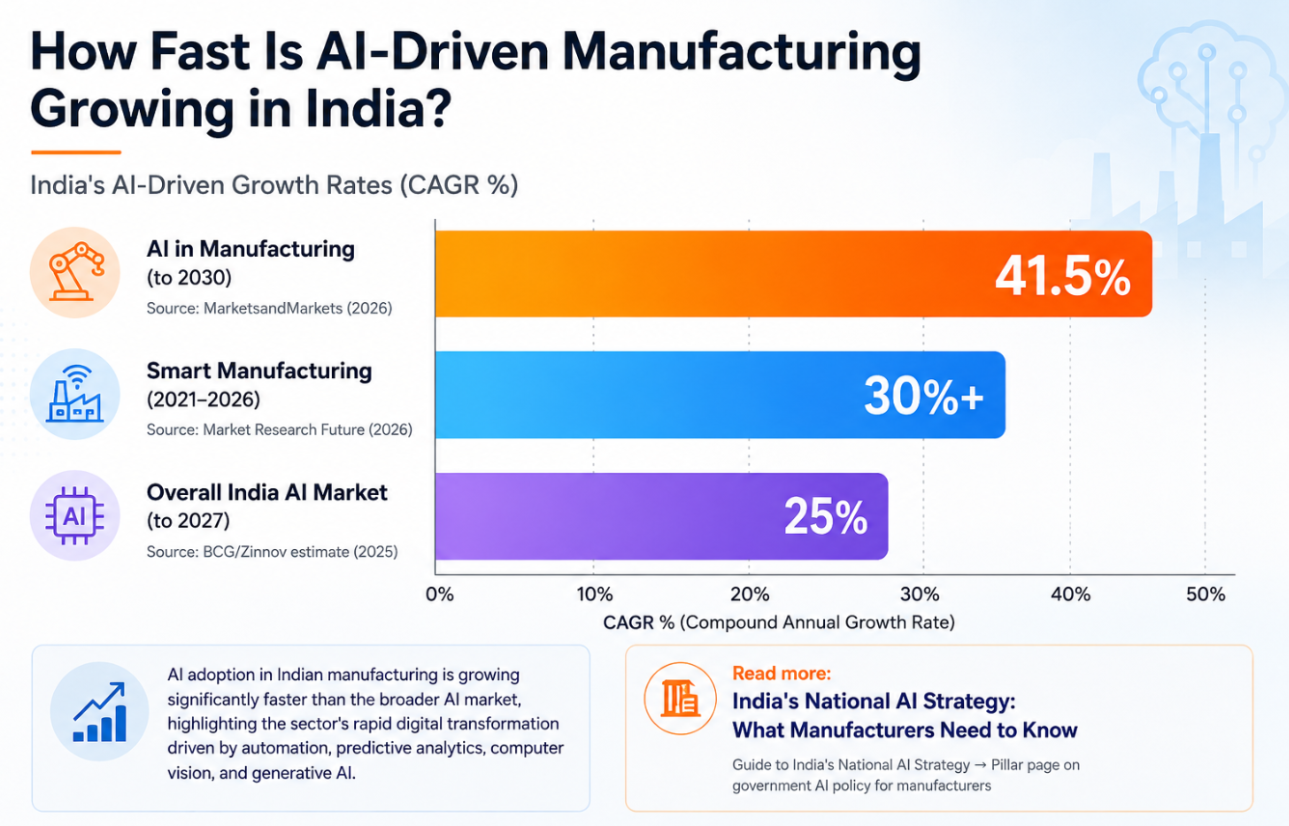
India’s factories are no longer just running machines — they’re starting to run models. In 2026, the India artificial intelligence in manufacturing market is projected to reach roughly $4.89 billion by 2030, expanding at a 41.5% compound annual growth rate (MarketsandMarkets, India AI in Manufacturing Market report, April 2026). That’s not a slow, cautious curve. It’s a sprint.
Yet the picture on the shop floor is messier than the market-size headlines suggest. Legacy machines, patchy sensor data, and a shortage of AI-literate engineers still slow things down in most plants. This guide walks through what’s actually driving AI adoption in Indian manufacturing right now, how system integrators like Team Computers are helping close the data-to-AI gap, and where the real barriers sit heading into the rest of 2026.
Key Takeaways
- In 2026, India’s AI-in-manufacturing market is projected to hit $4.89 billion by 2030 at a 41.5% CAGR.
- Industrials & Automotive is one of four sectors expected to drive 60% of India’s $500 billion net-new AI value by FY2026.
- Predictive maintenance and machine-vision quality inspection are the two most-deployed AI use cases on Indian factory floors today.
- Poor data integrity in legacy systems, not lack of ambition, is the single biggest barrier to scaling AI in Indian plants.
What’s Driving AI Adoption in Indian Manufacturing in 2026?
In 2026, government policy and market economics are pulling in the same direction. The IndiaAI Mission has earmarked roughly ₹10,300 crore (about $1.25 billion) over five years to build out the country’s AI ecosystem, spanning compute infrastructure, data platforms, and applied research (U.S. Department of Commerce trade.gov, September 2025). Layer that on top of the Production-Linked Incentive scheme for electronics and the AIRAWAT supercomputing platform, and manufacturers now have real infrastructure to build on, not just policy language.
What we’re seeing on the ground: manufacturers rarely start with a grand AI strategy. Most start with one painful, expensive problem — an unplanned line stoppage or a recurring defect — and build outward from there once the first model proves its worth.
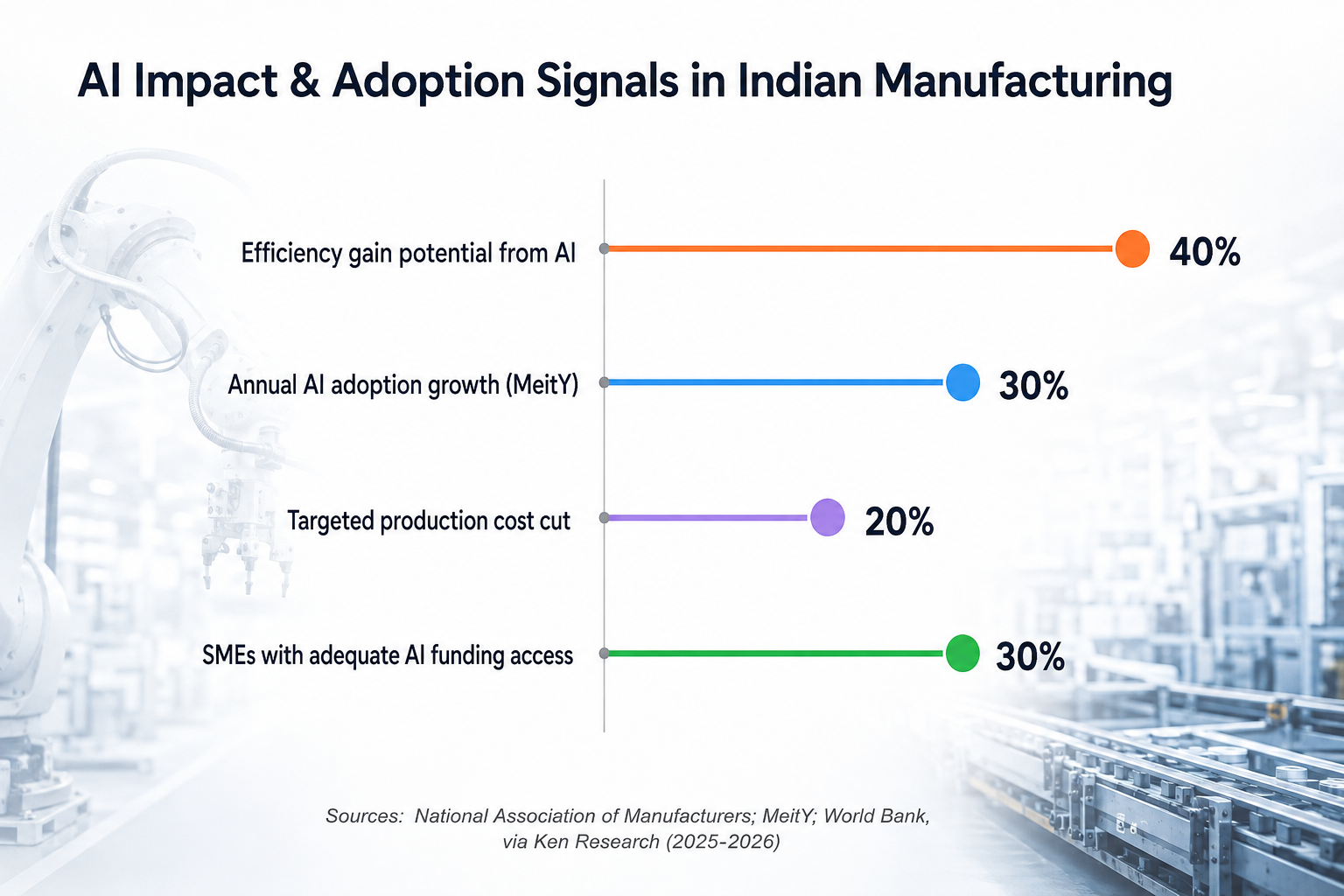
The broader numbers back this urgency. The smart manufacturing market in India is expected to grow at over 30% CAGR between 2021 and 2026 (Market Research Future, February 2026), and separately, the Ministry of Electronics and Information Technology projects AI technology adoption in manufacturing rising roughly 30% annually as unplanned downtime keeps getting more expensive to absorb (Ken Research, December 2025).
How Are Indian Manufacturers Actually Using AI on the Factory Floor?
Across Indian plants today, predictive maintenance and computer-vision quality control account for the largest share of active AI deployments, driven by aging industrial equipment and the high cost of unplanned stoppages (MarketsandMarkets, India AI in Manufacturing Market report, 2026). Instead of running maintenance on a fixed calendar, sensor data now feeds models that flag failure risk before a breakdown happens.
Three use cases dominate right now:
- Predictive maintenance. Vibration, temperature, and load sensors on rotating equipment feed models that forecast bearing or motor failure days in advance, letting teams schedule downtime instead of absorbing it.
- Automated defect detection. Computer-vision systems scan parts on the line, catching surface defects, dimensional errors, and assembly faults that a human inspector might miss on a fast-moving belt.
- Demand and supply-chain forecasting. Machine learning models digest sales history, inventory position, and supplier lead times to tighten production planning and cut both stockouts and excess inventory.
The automotive sector leads this shift in India, using AI to streamline assembly-line throughput and reduce rework, while pharmaceuticals are close behind, applying AI to drug discovery and production-line efficiency (Market Research Future, February 2026). Electronics manufacturers, riding the PLI scheme wave, are adopting AI-driven process control to hit tighter tolerances demanded by global buyers.
According to a 2026 MarketsandMarkets analysis, the predictive-maintenance-and-inspection segment holds the dominant share of India’s AI-in-manufacturing spend, driven by the rising cost of unplanned downtime across aging plants. This is the single clearest signal of where Indian manufacturers see the fastest payback on AI investment.
How Is Team Computers Supporting Data and AI for Indian Manufacturers?
Team Computers, a Delhi-headquartered IT services company with more than 39 years of experience, has developed its manufacturing Data & AI practice around a practical approach: helping organizations build a reliable data foundation before scaling analytics and AI initiatives. Rather than focusing solely on AI models, the emphasis is on integrating data from enterprise and operational systems to enable better business decisions.
For manufacturers, Team Computers brings together business intelligence, data engineering, and AI capabilities. Business analytics dashboards provide visibility into key operational metrics such as procurement costs, inventory, production efficiency, cost of goods sold (COGS), and quality performance. These insights help leadership teams monitor operations, identify trends, and make data-driven decisions.
Building on this foundation, the company supports AI and machine learning use cases such as predictive maintenance, quality analytics, demand forecasting, and supply chain optimization. The objective is to help manufacturers leverage operational data to improve equipment reliability, enhance product quality, and optimize production planning.
For organizations operating multiple plants, Team Computers also enables centralized reporting and monitoring through unified dashboards that consolidate data across locations. This provides decision-makers with a single view of operations and supports faster analysis of business and operational performance.
Overall, Team Computers positions its manufacturing Data & AI practice around helping enterprises modernize their data landscape, improve operational visibility, and implement AI use cases that align with business objectives.
What Are the Biggest Barriers to AI Adoption in Indian Factories?
In 2026, poor data integrity in legacy manufacturing systems remains the top obstacle to scaling AI, ahead of budget or leadership buy-in (MarketsandMarkets, India AI in Manufacturing Market report, 2026). Many Indian plants still run on inconsistent, manually logged data, which makes training a reliable model far harder than the algorithm itself.
Isn’t it strange that the hardest part of “AI transformation” usually turns out to be spreadsheet hygiene rather than machine learning? Four factors show up repeatedly in market research on Indian manufacturers:
- Legacy data infrastructure. Heterogeneous machines, inconsistent tagging, and manual logs make it hard to train models that generalize across a plant, let alone across sites.
- Skilled workforce shortage. Data scientists and ML engineers who also understand plant operations remain scarce outside India’s largest industrial hubs.
- High upfront cost. Initial AI and predictive-maintenance investment can exceed $1 million for mid-sized manufacturers, a steep ask for firms already running thin margins (Ken Research, December 2025).
- Constrained SME funding. Only about 30% of Indian SMEs have adequate access to funding for this kind of investment, according to World Bank data cited in industry research, which slows adoption outside large, well-capitalized manufacturers.
What Does the Future of AI in Indian Manufacturing Look Like?
Looking past 2026, four sectors — BFSI, CPG & Retail, Healthcare, and Industrials & Automotive — are expected to generate 60% of the net-new economic value AI adds across the Indian economy by FY2026, a combined figure NASSCOM puts at $500 billion (EY-NASSCOM AI Adoption Index). Industrials & Automotive sits squarely inside that group, which signals that manufacturing isn’t a side story in India’s AI push — it’s one of the core sectors carrying it.
Beyond FY2026, the trajectory is macro as much as sectoral: AI deployed systematically across India’s economy could add 1.0 to 1.5 percentage points to annual GDP growth, a meaningful step toward the government’s Viksit Bharat target of an $8.3 trillion economy by 2035 (Zinnov, Z47, and OpenAI, The India AI Adoption Edge 2026 report, May 2026). For manufacturers specifically, that means sovereign cloud infrastructure, PLI-linked electronics investment, and system integrators building out data pipelines are converging at the same time — a rare alignment that’s worth acting on before competitors close the gap.
Ready to see where your plant’s data pipeline stands today? A short data-readiness audit before an AI rollout usually saves more time than the AI project itself.
Frequently Asked Questions
What is the size of the AI in the manufacturing market in India?
In 2026, the India AI in Manufacturing market is projected to reach approximately $4.89 billion by 2030, growing at a 41.5% compound annual growth rate from its current base. Software leads the segment, ahead of hardware and services.
Which industries in India use AI the most in manufacturing?
Automotive currently dominates AI use in Indian manufacturing, followed closely by pharmaceuticals and electronics. Automotive firms use AI for assembly-line optimization, pharma companies apply it to drug discovery and production efficiency, and electronics manufacturers use it for process control under PLI-scheme quality requirements.
What is the biggest challenge to AI adoption in Indian factories?
Poor data integrity in legacy manufacturing systems is the most-cited barrier, ahead of cost or leadership buy-in. Many Indian plants still run on inconsistent, manually logged data, which makes training reliable AI models harder than building the models themselves.
How is the Indian government supporting AI in manufacturing?
The IndiaAI Mission has committed roughly ₹10,300 crore (about $1.25 billion) over five years, alongside the PLI scheme for electronics and the AIRAWAT supercomputing platform for AI research, all aimed at accelerating enterprise AI adoption including in manufacturing
Do Indian manufacturers need a data platform before starting AI projects?
Yes, most AI failures in Indian manufacturing trace back to weak underlying data, not weak algorithms. Providers like Team Computers structure their offering around building the analytics and data layer first, then layering predictive maintenance and quality-inspection AI models on top
Conclusion
AI in Indian manufacturing isn’t a future-tense story anymore, it’s already running predictive maintenance schedules, catching defects on live assembly lines, and reshaping how multi-plant operators see their own data. The market numbers back this up: a 41.5% CAGR toward $4.89 billion by 2030, government backing north of ₹10,300 crore, and Industrials & Automotive positioned as one of the four sectors carrying India’s next wave of AI-driven economic value.
The manufacturers that will win this decade aren’t necessarily the ones with the flashiest AI pilot. They’re the ones that fixed their data foundation first, then let predictive maintenance, computer vision, and demand forecasting compound on top of it. Whether that data layer gets built in-house or through a partner like Team Computers, the sequence matters more than the vendor logo.