For most Indian enterprises, the data center used to be a fairly settled decision. A server room, a handful of racks, an annual maintenance contract, and the conversation was closed for a few years. That approach no longer holds up.
AI and analytics workloads need far more compute and power density than a typical server room was ever designed for. Data localization requirements under India’s data protection framework are pushing organizations to rethink where and how data is stored. Boards expect uptime that borders on continuous availability, not “we’ll fix it by Monday.” And IT teams, already stretched thin, are being asked to manage infrastructure that is more distributed, more complex, and more business-critical than it was even three or four years ago.
This is why data center solutions have moved from being a back-office IT concern to a boardroom-level infrastructure decision. Getting the design, deployment, and ongoing management of a data center right directly affects how reliably a business runs, how well it protects data, and how efficiently it scales.
This guide walks through what modern data center solutions actually involve in the Indian context, from core infrastructure and design principles to deployment models and managed operations, and what enterprise IT leaders should evaluate before making decisions that will shape their infrastructure for years to come.
Why Data Center Decisions Matter More Now
A few forces are converging at the same time, and together they explain why data center planning has become urgent for CIOs, CTOs, and IT heads across Indian enterprises.
Data volumes are growing faster than most infrastructure plans anticipated. Digital transactions, customer applications, IoT devices, and everyday business systems are all generating more data, and that data increasingly needs to be processed closer to where it is created rather than shipped to a distant facility.
AI and analytics workloads have different infrastructure needs. Training and running AI models requires higher power density per rack, faster storage, and networking that can move large datasets without becoming a bottleneck. A data center designed a decade ago for standard virtualized workloads is rarely equipped to handle this kind of load without significant rework.
Regulatory expectations around data are tightening. With data protection regulations placing greater emphasis on how personal and sensitive data is stored, processed, and localized, enterprises in BFSI, healthcare, government, and e-commerce in particular need to be more deliberate about where their data physically resides and who can access it.
Business tolerance for downtime has shrunk. Customer-facing applications, payment systems, and internal operations are now expected to be available around the clock. A few hours of unplanned downtime can mean lost revenue, regulatory scrutiny, or reputational damage that outlasts the outage itself.
Skilled data center operations talent is hard to find and retain. Running a modern data center requires expertise across compute, storage, networking, power, cooling, and security simultaneously. For most enterprises, building and retaining that breadth of skill in-house is neither practical nor cost-effective at scale.
Individually, none of these forces is new. Together, they are why “we already have a data center” is no longer a sufficient answer on its own, and why design, deployment, and management increasingly need to be treated as a connected discipline rather than three separate, disconnected projects.
What Data Center Solutions Actually Cover
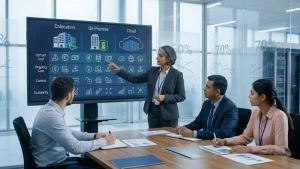
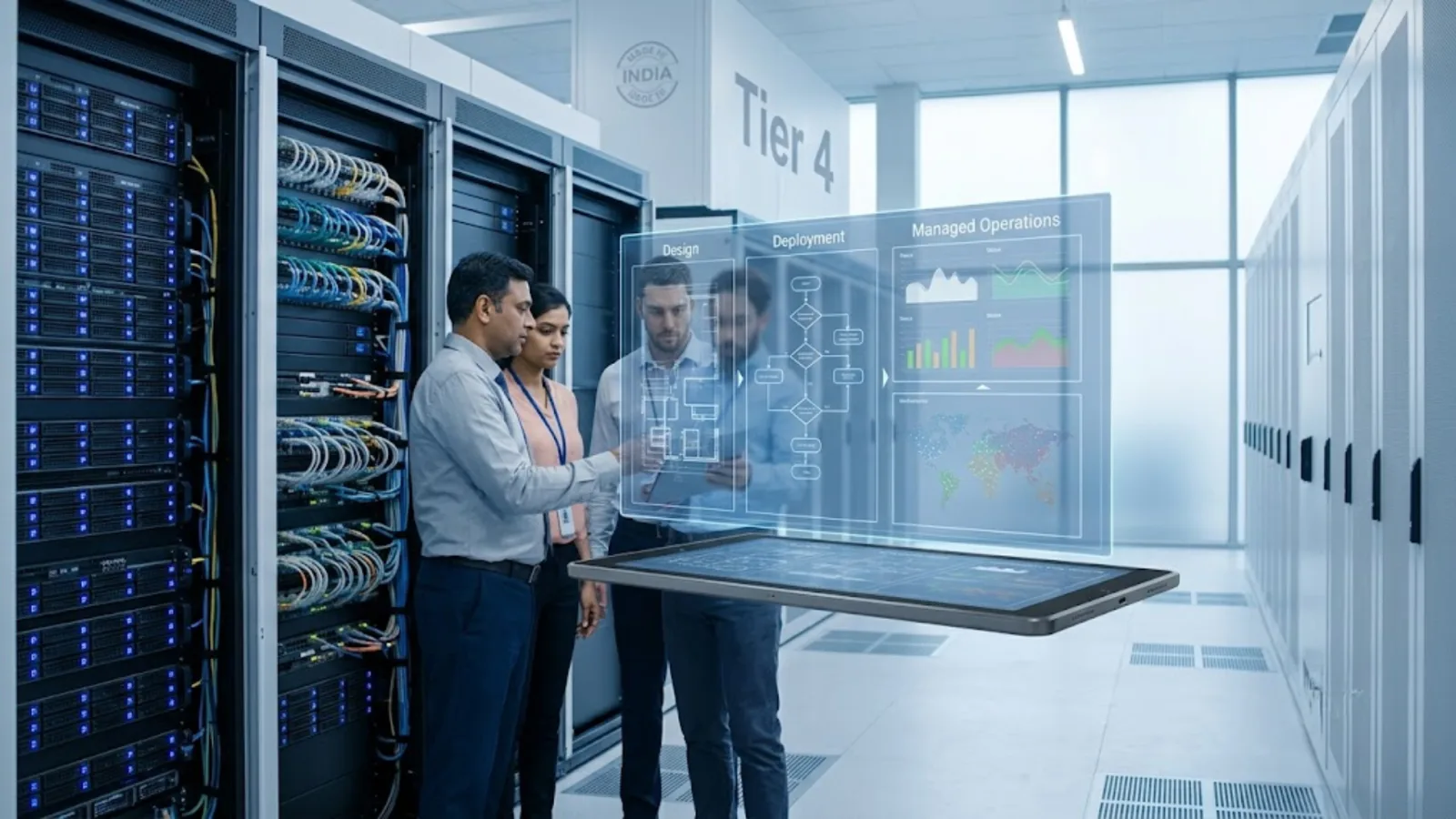
The term “data center solutions” is broad, and it helps to break it down into three distinct but connected phases.
Design is the planning stage. It involves deciding on capacity, redundancy levels, power and cooling architecture, physical layout, and the compute, storage, and networking stack that will support current and future workloads. Design decisions made early are the hardest and most expensive to reverse later, which is why this stage deserves the most scrutiny of the three.
Deployment is the execution stage. It covers procuring the right infrastructure, physically building or fitting out the facility (or provisioning cloud and colocation resources), integrating compute, storage, and networking components, and migrating workloads with minimal disruption to the business.
Managed operations is the ongoing stage. It includes monitoring performance and capacity, managing security and compliance, patching and updating systems, handling incidents, and planning refresh and scaling cycles over the data center’s operational life.
Enterprises often treat these as separate purchases: one vendor for the physical build, another for hardware, and an internal team, or a different partner altogether, for day-to-day operations. In practice, this fragmentation is where a lot of hidden cost and risk creeps in. A facility designed without operations in mind is harder to manage, and infrastructure deployed without a long-term operating model in place tends to accumulate technical debt quickly, often within the first year or two.
Core Components of Data Center Infrastructure
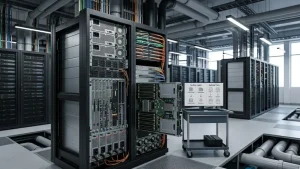
Regardless of whether a data center is on-premises, in a colocation facility, or part of a hybrid setup, the underlying data center infrastructure generally spans five layers. Our guide to what a data center is explains each one in more detail.
Compute. Servers that run applications, virtual machines, and increasingly, AI and GPU-accelerated workloads. Compute capacity needs to be planned not just for today’s applications but for the workload growth expected over the infrastructure’s lifecycle, typically five to seven years.
Storage. Systems that hold structured and unstructured data, ranging from high-performance storage for transactional systems to more cost-efficient storage tiers for archival and backup. Storage architecture has a direct impact on application performance and disaster recovery capability.
Networking. The switching, routing, and connectivity layer that moves data between compute, storage, users, and other locations. This includes both the core data center network and connectivity to branch offices, cloud environments, and the internet.
Power and cooling. Often the least visible but most operationally critical layer. Power redundancy through UPS systems and backup generation, efficient cooling architecture, and electrical distribution directly determine uptime and, increasingly, energy cost, a growing line item as rack densities rise with AI workloads.
Physical infrastructure and security. Racks, structured cabling, raised flooring, fire suppression, and access control systems that protect the physical environment, alongside logical security layers such as firewalls, encryption, and intrusion prevention that protect the data itself.
When people refer to data center IT infrastructure specifically, they are usually talking about the compute, storage, and networking layer: the systems that directly run and move workloads, as distinct from the facility infrastructure of power, cooling, and physical space that supports them. Both layers need to be planned together, because a mismatch between IT infrastructure capacity and facility capacity is one of the most common, and most expensive, design mistakes enterprises make.
Designing for What Comes Next, Not Just What Exists Today
A data center designed purely around current workloads tends to become a constraint within a few years. A few principles separate a data center that scales comfortably from one that requires disruptive rework down the line.
Scalability without over-provisioning. The goal is not to build maximum capacity upfront, since that ties up capital in infrastructure that may sit underused for years. Modular design approaches, where compute, storage, and power capacity can be added incrementally as demand grows, tend to align cost more closely with actual usage.
Redundancy matched to business criticality. Not every workload needs the same level of redundancy. Mission-critical systems such as payment processing, core banking, and patient records typically justify higher-tier, fully redundant infrastructure, while less critical workloads can run on leaner configurations. Applying uniform redundancy across all workloads regardless of criticality is a common source of unnecessary cost. Our guide to data center tiers explains what each level of redundancy buys.
Energy efficiency as a design input, not an afterthought. With power consumption rising alongside AI and compute-intensive workloads, cooling architecture and power distribution efficiency have moved from being a facilities concern to a cost and sustainability concern that IT leaders are increasingly held accountable for. Our guide to green data centers in India covers PUE, cooling efficiency and ESG reporting.
Compliance and data residency built in from the start. For regulated industries, decisions about where data physically resides, how it is encrypted, and how access is logged need to be part of the design conversation from day one, rather than a retrofit exercise after an audit finding.
Next-gen data center capabilities. Modern data center design increasingly accounts for AI-ready infrastructure, including higher power density and GPU-compatible racks and faster interconnects, software-defined and hyperconverged architectures that simplify management, and automation and AI-driven infrastructure monitoring that reduces manual intervention. A next-gen data center is not defined by any single technology. It is defined by infrastructure that can absorb new workload types without requiring a ground-up redesign.
On-Premises, Colocation, Cloud, or Hybrid: Choosing the Right Model
One of the most consequential early decisions is where the data center infrastructure should physically sit. There is no universally correct answer here. The right model depends on workload characteristics, compliance requirements, existing investments, and internal capability. For a detailed cost and control breakdown, see colocation vs on-premise vs cloud.
On-premises gives enterprises full control over infrastructure and data location, which matters for organizations with strict compliance or latency requirements. The tradeoff is that the enterprise bears full responsibility for capital investment, physical facility management, and operational expertise, on an ongoing basis.
Colocation shifts the physical facility, including power, cooling, physical security, and connectivity, to a third-party provider, while the enterprise typically retains its own compute and storage hardware within that facility. This reduces the burden of managing physical infrastructure while keeping more control over the IT stack than a fully cloud-based approach would allow.
Cloud shifts both infrastructure and much of the operational burden to a hyperscale provider, offering elasticity and reduced capital expenditure, at the cost of ongoing operating expense and, for some regulated workloads, additional compliance considerations around data location and shared infrastructure.
Hybrid, increasingly the default for larger Indian enterprises, combines these models: keeping latency-sensitive or compliance-bound workloads on-premises or in colocation, while running variable or less sensitive workloads in the cloud. The complexity of a hybrid approach lies less in any single environment and more in managing consistent security, monitoring, and operations across all of them at once.
The decision should not be made in isolation for each individual workload. It tends to work better as a documented framework, one that sets out which categories of workloads default to which environment and why, so that new applications and systems can be placed consistently as they arise rather than debated case by case.
Where Deployment Projects Commonly Go Wrong
Even well-designed data center infrastructure can run into trouble during deployment. A few patterns show up repeatedly across enterprise projects in India.
Underestimating integration complexity. Compute, storage, networking, and security components from different technology providers need to work together as a coherent system, not as isolated purchases stitched together after the fact. Integration issues discovered late in a deployment are far more expensive to fix than issues caught during the design stage.
Migration disruption. Moving workloads into a new or upgraded data center environment carries real risk to business continuity if it is not carefully sequenced, tested, and rolled back where needed. Migrations treated as a single big-bang cutover tend to carry considerably more risk than phased approaches that move workloads in planned stages. Our data center migration checklist sets out each phase, with risk controls and a rollback plan.
Underestimating timeline and resource needs. Data center deployment projects routinely take longer than initially planned, particularly when they involve physical facility work, multiple OEM technologies, and coordination across internal teams, contractors, and technology partners.
Skills gaps during transition. Internal IT teams may be well-versed in day-to-day operations but less experienced with large-scale infrastructure design and deployment, which is a fundamentally different skill set that is used far less frequently.
Vendor coordination overhead. When compute, storage, networking, power, and physical build-out are procured from separate vendors with no single party accountable for how they come together, project delays and finger-pointing between vendors during troubleshooting become far more likely.
These risks are manageable, but addressing them generally requires deployment expertise that goes beyond procuring and installing hardware. This is typically where the involvement of an experienced technology partner makes the most measurable difference to how smoothly a project actually runs.
Managed Operations: Where Long-Term Value Is Won or Lost
A data center is not a one-time project. It is an operating environment that needs continuous attention for as long as it remains in service. This is the phase where many enterprises underinvest, and where the cost of that underinvestment tends to show up later as downtime, security incidents, or infrastructure that has quietly fallen behind.
Effective managed operations typically cover:
- Continuous monitoring of compute, storage, network, and facility systems to catch performance degradation or failures before they escalate into outages.
- Security operations, including firewalls, encryption, intrusion detection, and access management, tuned to an evolving threat landscape rather than configured once and left unattended.
- Patch and update management across the infrastructure stack, balancing security currency against the operational risk of making disruptive changes to production systems.
- Capacity planning, so that compute, storage, and power headroom is tracked proactively rather than discovered only when a system runs out of room.
- Incident response and root-cause resolution, moving beyond reactive firefighting toward identifying and addressing the recurring issues behind repeat incidents.
- Lifecycle and refresh planning, since data center hardware, like enterprise devices, has a finite useful life, and unplanned end-of-life failures are considerably more disruptive than planned refresh cycles.
Enterprises that treat managed operations as a lighter afterthought to design and deployment often find that the real cost of a data center shows up in operational inefficiency, security gaps, or emergency remediation work, well after the initial project has been signed off and quietly forgotten by the business.
What to Look for When Evaluating Data Center Companies in India
Given how many moving parts a data center involves, most enterprises do not build and run this capability entirely in-house. The question then becomes what to look for among data center companies in India offering design, deployment, or managed services.
Multi-OEM expertise, not a single-vendor pitch. Data centers typically combine technology from multiple OEMs across compute, storage, networking, and security. A partner who can objectively evaluate and integrate across vendors, rather than steering every recommendation toward a single brand, is generally better positioned to design infrastructure around actual business needs.
Depth across design, deployment, and operations. A partner that is strong in physical build-out but thin on ongoing managed services, or the reverse, tends to recreate the same fragmentation risk that enterprises are usually trying to avoid by bringing in outside expertise in the first place.
Demonstrated experience with compliance-sensitive environments. Particularly for BFSI, healthcare, government, and other regulated sectors, a partner should be able to speak credibly to data residency, security practices, and audit requirements relevant to that specific industry.
National reach and consistent service delivery. For enterprises with operations across multiple Indian cities, a partner’s ability to deliver consistent design standards and support quality across locations, not just in a single metro, matters considerably for long-term reliability.
A genuine advisory posture. The most useful partners help enterprises make better infrastructure decisions, including telling them when a smaller or different configuration serves them better than a larger sale would. That advisory relationship is harder to evaluate upfront than a hardware price list, but it tends to matter far more over the life of the infrastructure.
The Technology Landscape Behind Modern Data Centers
Enterprise data centers today typically draw on a combination of specialized OEM technologies rather than a single-vendor stack.
On the compute side, server platforms from providers like Dell and HPE offer the processing power for everything from standard virtualized workloads to GPU-accelerated AI workloads, with configurations that scale from a handful of racks to large enterprise-scale deployments.
On the networking and security side, providers like Cisco supply the switching, routing, and network security infrastructure that connects compute and storage systems to each other and to the wider enterprise network, along with the segmentation and monitoring capabilities needed to secure that traffic effectively.
On the storage side, providers like NetApp offer platforms designed for performance, data protection, and hybrid cloud data management, helping enterprises manage growing data volumes across on-premises and cloud environments without duplicating effort or data.
Each OEM brings genuine engineering depth in its respective domain, but no single OEM relationship substitutes for the enterprise-level work of evaluating requirements, designing an integrated architecture, deploying it correctly, and managing it over its operational life. That connective layer, running from initial advisory through to day-to-day operations, is generally where the value of an experienced technology partner shows up most clearly, regardless of which specific OEMs are involved in a given deployment.
Where an Enterprise Technology Partner Adds Value
Building and running a modern data center touches nearly every enterprise IT discipline at once: infrastructure design, vendor evaluation, physical facility management, security, compliance, and ongoing operations. Very few internal IT teams are resourced to do all of this at real depth while also running the rest of the business’s technology day to day.
This is where working with an experienced technology partner changes the equation, not by replacing the enterprise’s IT function, but by extending it. A partner with multi-OEM expertise across compute, storage, networking, and physical infrastructure can help design a data center that matches actual business requirements rather than a generic template, manage the complexity of deployment and migration, and take on the operational load of monitoring, security, and lifecycle management on an ongoing basis.
Team Computers works with enterprises across India in exactly this role, acting as a single point of contact spanning data center design, infrastructure deployment, and managed operations, rather than requiring organizations to coordinate separately with facility contractors, hardware vendors, and internal or outsourced operations staff. Working across leading technology providers including Dell, HPE, Cisco, and NetApp, along with the broader infrastructure and security layers a data center depends on, the underlying goal stays consistent: help enterprises build data center environments that are reliable and compliant today, and flexible enough to absorb the workload demands, including AI and analytics, that are only going to keep growing from here.
Getting Started
Whether an organization is planning a new data center, modernizing an existing facility, moving toward a hybrid model, or looking to hand off day-to-day operations to a managed services partner, the starting point is broadly the same. It begins with a clear-eyed assessment of current infrastructure, workload trajectory, and compliance requirements, followed by a design and operating model built around where the business is actually headed rather than where it happens to stand today.
If your organization is evaluating its data center strategy, it is worth having that assessment conversation before the next infrastructure decision gets made by default, under deadline pressure, or by whichever vendor happens to be in the room. Talk to Team Computers about designing, deploying, and managing a data center built for what your enterprise needs next.
Related reading
- How to Choose an IT Infrastructure Services Company in India
- IT AMC vs Managed Services vs Staff Augmentation: Choosing a Support Model
- IT Infrastructure Security: A 12-Point Checklist for Enterprise IT