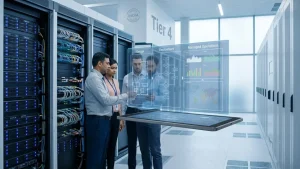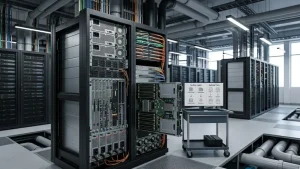
Most enterprise data centers currently in operation were designed for a world that no longer quite exists. They were built around racks drawing somewhere between 5 and 15 kilowatts, cooled by conventional air handling, and sized for standard virtualized workloads. AI compute doesn’t fit that template, and the gap between what these facilities were designed for and what AI workloads actually require has become one of the more consequential infrastructure questions enterprise IT leaders are facing right now.
This isn’t a distant, hyperscaler-only problem. As enterprises across India move from experimenting with AI to running it in production, whether that’s training custom models, fine-tuning existing ones, or simply running inference at meaningful scale, the infrastructure question becomes immediate: what does “AI-ready” actually mean for compute, power, and cooling, and how much of it does a given enterprise genuinely need to build for itself?
The stakes of getting this wrong run in both directions. Underestimating what AI infrastructure requires leads to facilities that hit power and cooling limits mid-deployment, forcing costly retrofits or stalled projects. Overestimating it, building extensive AI-ready capacity an organization doesn’t yet need, ties up capital that might have been better deployed elsewhere, or consumed more efficiently through cloud-based AI services. Neither extreme serves the business well, which is why understanding what’s actually changing, in specific and practical terms, matters more than reacting to the general sense that “AI needs different infrastructure.”
Why AI Workloads Break the Assumptions Behind Traditional Data Centers
Traditional enterprise data center design rests on a set of assumptions that AI compute quietly invalidates. Standard virtualized workloads spread relatively evenly across many moderately powered servers. Power draw per rack stays within a fairly narrow, predictable band. Cooling is designed around that predictable band, with enough headroom to handle normal fluctuation.
AI workloads, particularly GPU-based training and high-throughput inference, behave differently on nearly every one of these dimensions. Instead of spreading load across many lower-power servers, AI infrastructure concentrates enormous processing power into comparatively few, extremely dense racks. The result is that a handful of AI racks can draw as much power, and generate as much heat, as an entire row of traditional enterprise racks. A facility engineered around the old assumptions simply doesn’t have the electrical capacity or thermal headroom to absorb that concentration without significant rework.
This is why “AI-ready” has become a specific, technical qualifier rather than a marketing phrase. It refers to infrastructure purpose-built, or substantially reworked, to handle GPU compute density, the power delivery it demands, and the cooling architecture required to remove the resulting heat.
GPU Compute: What AI/ML Optimized Compute Actually Requires
At the center of this shift is the GPU server for AI, the workhorse of most modern AI infrastructure. Unlike traditional CPU-based servers, which handle a wide variety of general-purpose workloads reasonably well, GPU servers are built around parallel processing architecture that’s exceptionally well suited to the matrix operations underlying machine learning, but comparatively wasteful for standard business applications.
AI/ML optimized compute typically differs from standard enterprise compute in a few specific ways:
Processor architecture. GPUs (and increasingly, specialized AI accelerators) handle the highly parallel computation that neural network training and inference require far more efficiently than general-purpose CPUs, which remain better suited to sequential, logic-heavy workloads.
Interconnect speed. AI training workloads, particularly large model training distributed across multiple GPUs and servers, depend heavily on extremely fast interconnects between processors. A bottleneck in interconnect bandwidth can leave expensive GPU capacity sitting idle, waiting for data, which makes network design as important as compute selection for AI-optimized infrastructure.
Memory bandwidth and capacity. Large models require substantial, fast memory to hold model parameters and intermediate computation results. Memory constraints, more than raw processing power alone, are often what actually limits how large a model a given piece of infrastructure can practically train or run.
Storage throughput. Training workloads in particular need to feed large volumes of data to GPUs continuously. Storage systems that can’t sustain the required throughput become a bottleneck regardless of how much GPU capacity is available.
The practical implication for enterprise IT leaders is that AI compute isn’t simply “more powerful servers.” It’s a different architecture, optimized for a different computational pattern, and evaluating it purely on the basis of familiar server specifications tends to miss the factors that actually determine real-world AI performance.
This has a direct procurement implication as well. Selecting a GPU server for AI workloads generally requires closer engagement with OEM technical teams than a standard server refresh, since the right configuration depends heavily on the specific workload, whether that’s large-scale model training, fine-tuning smaller models, or high-volume inference, each of which places different demands on the compute, memory, and interconnect balance described above. Enterprises that treat this selection process the same way they’d approach a routine server purchase often end up with infrastructure that’s mismatched to their actual workload profile, either overprovisioned for the AI use case they actually have, or undersized for the one they’re planning to grow into.
Rack Power Density: The New Design Constraint
Rack power density, how much power a single rack draws, has quietly become one of the defining constraints in modern data center design. Traditional enterprise racks were commonly designed around 5 to 15 kW of draw. Current-generation AI training racks routinely draw well over 100 kW, and the newest platforms entering production push considerably beyond that, with some next-generation systems specified in the 200 kW-plus range per rack.
This isn’t a marginal increase. It’s an order-of-magnitude shift that has direct implications for facility design:
Electrical infrastructure. Delivering this much power to a small physical footprint requires substantially reworked electrical distribution, often well beyond what older facilities were built to support without significant capital investment.
Physical floor loading and layout. Concentrating this much equipment and power delivery infrastructure into a smaller footprint changes floor loading and rack spacing requirements compared with traditional, more evenly distributed layouts.
Facility power availability. At the extreme end, power availability itself, not just facility design, is becoming a genuine constraint. Securing sufficient grid capacity for large AI deployments has, in some markets, become a longer lead-time item than the physical construction of the facility itself.
For most enterprises, this doesn’t mean every future data center needs to support 200 kW racks. It means rack power density needs to be an explicit, deliberate design input rather than an assumption carried over from previous facility planning, particularly for any organization anticipating meaningful in-house AI infrastructure over the next several years.
It’s also worth understanding power usage effectiveness (PUE), a measure of how much of a facility’s total power consumption actually reaches IT equipment versus being consumed by overhead like cooling and power conversion losses. As power costs rise alongside AI-driven density increases, a lower PUE translates directly into lower operating cost for the same amount of usable compute, making it a meaningful factor when comparing facility or colocation options, not just a technical efficiency metric.
Why Air Cooling Hits a Wall, and What Liquid Cooling Solves
Air is a genuinely poor medium for removing heat at the density AI racks now generate. Conventional air cooling systems were designed around the older 5 to 15 kW range and become impractical, and eventually physically incapable, of managing heat loads much beyond roughly 20 to 30 kW per rack, well below what current AI racks require.
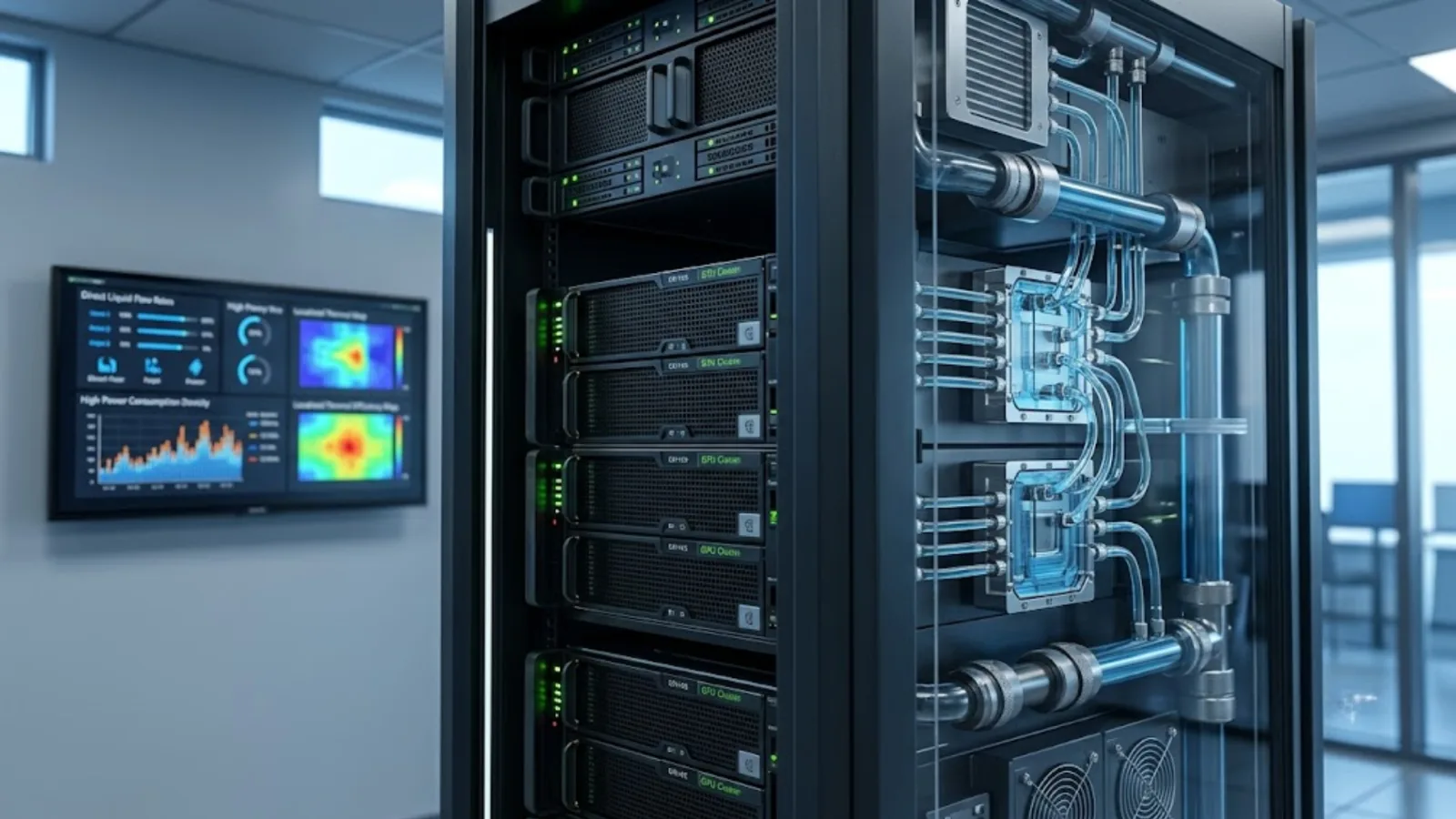
Liquid cooling data center architecture addresses this directly, by using liquid, which transfers heat far more efficiently than air, to remove heat directly from or near the chip itself. A few approaches have become common:
Direct-to-chip liquid cooling. Coolant is circulated through cold plates mounted directly on the processor, removing heat at the source before it enters the surrounding air at all. This has become the dominant approach for high-density AI racks, handling heat loads that air cooling simply cannot.
Rear-door heat exchangers. Liquid-cooled doors mounted on the back of a rack capture heat as air exits the servers, offering a middle-ground approach that requires less redesign than full direct-to-chip systems but has more limited capacity than direct-to-chip cooling at the highest densities.
Immersion cooling. Servers are submerged directly in a thermally conductive but electrically non-conductive fluid. This offers strong cooling capacity but requires more significant changes to facility design and, historically, has seen more variable adoption than direct-to-chip approaches.
The shift toward liquid cooling has moved from an emerging trend to something close to a baseline requirement for meaningful AI infrastructure. Analyst estimates on the pace of adoption vary, but the direction is consistent: the share of AI servers deployed with liquid cooling has grown sharply over the past two to three years and continues to rise as GPU power draw increases further.
In practice, most facilities don’t move to liquid cooling wholesale. A hybrid approach, retaining air cooling for standard enterprise workloads while adding liquid cooling capability specifically for high-density AI zones, tends to be the more common and more capital-efficient path, particularly for enterprises whose overall infrastructure mix still includes a substantial base of traditional, non-AI workloads.
India’s Data Center Cooling Market Is Repricing Around AI
The India data center cooling market has shifted meaningfully as a direct consequence of this trend. Cooling, once a relatively predictable, secondary line item in a data center build, has become one of the fastest-growing and most strategically important components of new data center investment in India, as facilities are increasingly designed and priced around the assumption that at least some portion of their capacity will need to support high-density, liquid-cooled AI infrastructure. Industry estimates place India’s data center cooling segment among the faster-growing components of the broader data center market, tracking closely with the pace of AI infrastructure buildout across the country’s major data center hubs.
This has practical implications for Indian enterprises evaluating their own data center strategy. New facility builds, colocation contracts, and infrastructure refresh projects increasingly need to account for cooling architecture as a first-order design decision rather than a downstream engineering detail, particularly for any organization planning to run AI workloads on infrastructure it owns or leases directly, rather than consuming AI capabilities purely through cloud or SaaS platforms. Enterprises evaluating colocation options are increasingly finding it worthwhile to ask providers directly about liquid cooling readiness for specific halls or suites, rather than assuming a facility’s general marketing around “AI-ready” capacity extends uniformly across its entire footprint.
What “AI-Ready” Actually Means in Practice
Pulling these threads together, an AI-ready data center generally involves:
- Electrical infrastructure capable of delivering significantly higher power density to specific zones or racks than traditional enterprise design would call for.
- Liquid cooling capability, at minimum direct-to-chip cooling for the highest-density racks, rather than relying entirely on conventional air handling.
- High-throughput networking, sized for the interconnect demands of distributed AI training and large-scale data movement, not just standard enterprise traffic patterns.
- Storage systems capable of sustained high throughput to keep GPU compute fed with data rather than idling.
- Facility power availability sufficient to support current and reasonably anticipated future AI capacity, evaluated explicitly rather than assumed.
Not every organization needs all of this today. But understanding what “AI-ready” actually requires, in specific, technical terms rather than as a general aspiration, is what allows an enterprise to plan deliberately rather than discovering the gap mid-project, whether that gap shows up as a stalled deployment, an unplanned cooling retrofit, or a facility that simply can’t secure the power capacity a project assumed would be available.
Does Every Enterprise Need to Build AI-Ready Infrastructure?
Not necessarily, and this is worth stating plainly, since building high-density, liquid-cooled infrastructure represents a genuinely significant investment. Many enterprises will consume the majority of their AI capabilities through cloud platforms or AI-enabled SaaS applications, where the underlying GPU infrastructure, power, and cooling challenges are the cloud provider’s responsibility, not theirs.
Building or upgrading owned or colocated infrastructure for AI compute tends to make sense for organizations with specific, sustained, and often data-sensitive AI workloads: proprietary model training on confidential data, latency-sensitive inference at meaningful scale, or workloads where the ongoing cost of cloud GPU consumption exceeds what owned infrastructure would cost over its operational life. For many other enterprises, the more practical near-term step is simply understanding this landscape well enough to make an informed decision, rather than defaulting to either extreme of building extensive AI infrastructure prematurely or ignoring the question until it becomes urgent.
Planning for AI Readiness, Even Before You Need It
For enterprise IT leaders who aren’t yet deploying dedicated AI infrastructure but expect to within the next few years, a few steps are worth taking now rather than later. They build on the design principles in our guide to data center solutions in India.
Assess current facility constraints honestly. Understand what power and cooling headroom an existing facility, whether owned or colocated, actually has available for future high-density deployment, rather than assuming capacity will simply be there when needed.
Build power availability into longer-term planning. Given how long securing additional power capacity can take in some markets, this is often the least flexible constraint in the entire AI infrastructure equation, and the one most worth addressing early.
Evaluate colocation and cloud options in parallel with any owned infrastructure plans. Given the pace of change in GPU and cooling technology, committing entirely to one model years in advance carries real risk of being locked into infrastructure that ages out of relevance faster than a traditional enterprise refresh cycle would suggest.
Treat this as a cross-functional decision. AI infrastructure planning touches facilities, procurement, IT operations, and often data governance and compliance functions simultaneously. Involving these stakeholders early avoids decisions made in a single silo that don’t hold up once the full picture is considered.
Where an Experienced Technology Partner Helps
Navigating GPU compute selection, power density planning, and cooling architecture decisions requires a breadth of expertise that spans server hardware, facility engineering, and evolving OEM technology roadmaps simultaneously, an unusually wide combination for most internal IT teams to maintain at depth, particularly given how quickly this specific area of technology continues to evolve.
Team Computers works with enterprises across India to evaluate AI infrastructure requirements against actual business needs, across leading OEM compute and infrastructure providers, whether that means assessing readiness within an existing facility, planning a colocation strategy that accommodates future AI density, or right-sizing an AI compute investment against real workload requirements rather than general industry pressure to build. If your organization is starting to think seriously about AI infrastructure, it’s worth having that conversation before a specific project forces the timeline. Talk to Team Computers about assessing your organization’s AI infrastructure readiness.
Related reading
- How to Choose an IT Infrastructure Services Company in India
- IT AMC vs Managed Services vs Staff Augmentation: Choosing a Support Model
- IT Infrastructure Security: A 12-Point Checklist for Enterprise IT