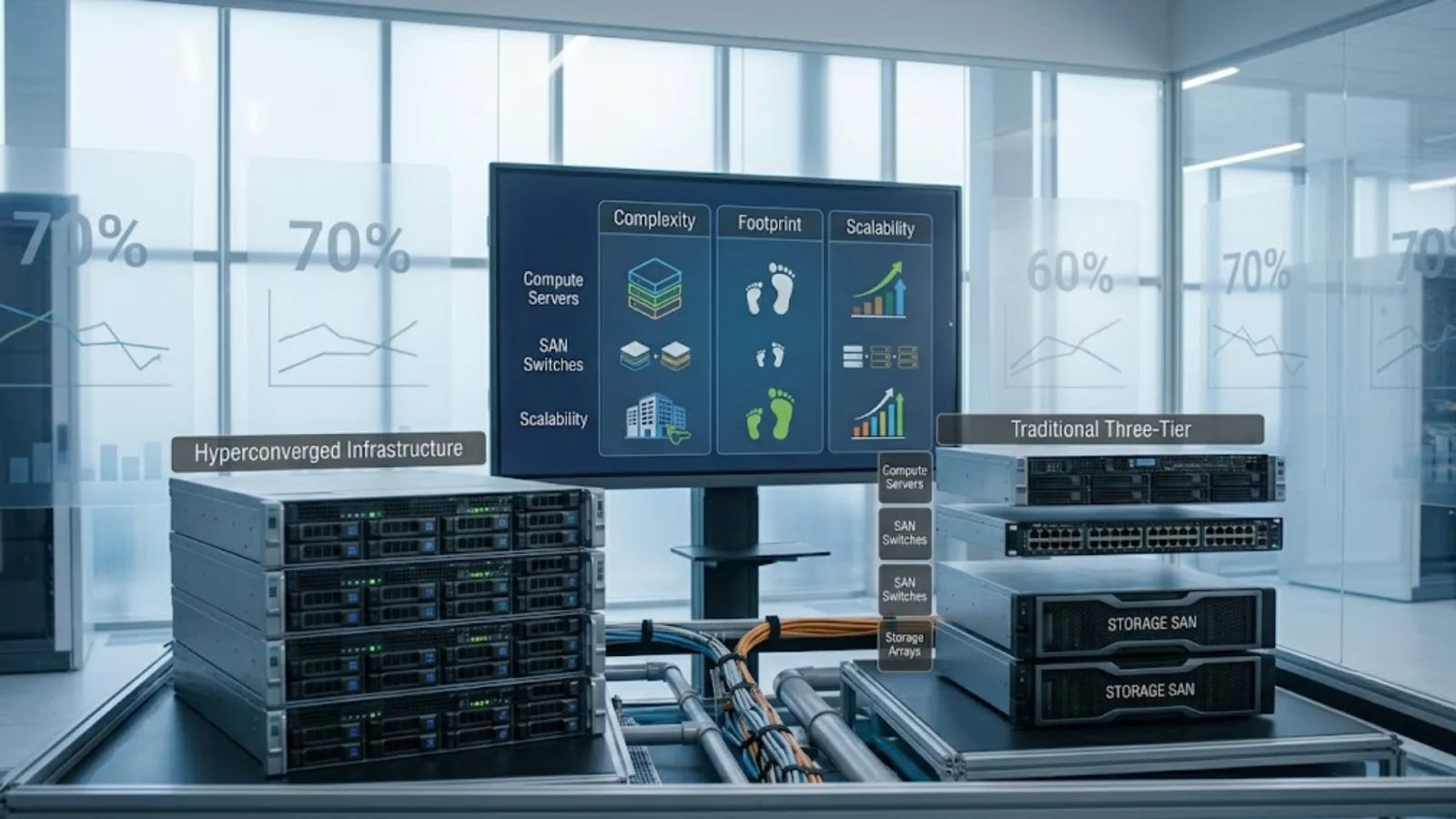
Enterprise infrastructure teams increasingly face a genuine architectural choice, not just a vendor choice: build on traditional three-tier infrastructure, where compute, storage, and networking are managed as separate layers, or move to hyperconverged infrastructure (HCI), where those layers are combined into a single, software-defined system. Both approaches remain widely used, and the right answer depends heavily on the workloads involved, not on which architecture is currently more talked about.
The decision has become more consequential as infrastructure refresh cycles increasingly coincide with broader modernization goals: reducing data center footprint, simplifying operations for smaller IT teams, and accommodating a more diverse mix of workloads than many environments were originally designed around. Choosing an architecture without a clear view of how each model actually performs against these goals tends to lead either to over-engineered infrastructure that’s harder to manage than it needs to be, or to a simplified platform that doesn’t hold up under workloads it was never well suited to in the first place.
This comparison breaks down how each model actually works, where they differ on cost, scalability, and management complexity, and how to think about which one, or which combination, fits a given enterprise’s workload mix.
What Is Traditional Three-Tier Architecture?
Traditional three-tier infrastructure separates compute, storage, and networking into distinct layers, each typically built from dedicated hardware and managed somewhat independently. Servers handle processing, a storage area network (SAN) or network-attached storage (NAS) system handles data storage, and a separate networking layer connects everything together.
This architecture has been the enterprise standard for decades, and for good reason. It allows each layer to be scaled, upgraded, and specialized independently, which suits environments with very specific performance requirements for a given layer, such as workloads that need high-end, dedicated storage performance distinct from compute capacity. The tradeoff is complexity: managing three distinct layers, often from different vendors, requires more specialized expertise and generally more manual coordination when scaling or troubleshooting.
What Is Hyperconverged Infrastructure (HCI)?
Hyperconverged infrastructure combines compute, storage, and virtualization (and often networking) into a single, software-defined system, typically running across a cluster of standard servers rather than specialized, dedicated hardware for each layer. Storage, in an HCI environment, is virtualized and distributed across the cluster’s nodes rather than sitting on a separate, dedicated storage system.
The practical result is a simpler operating model. Instead of managing compute, storage, and networking as separate systems with separate management tools, HCI environments are typically managed through a single, unified interface, and capacity is added by adding more nodes to the cluster rather than separately scaling compute and storage. This simplicity is HCI’s central appeal, particularly for organizations that want to reduce the specialized expertise required to run day-to-day infrastructure operations.
HCI also tends to shrink the physical footprint required for a given amount of infrastructure, since it consolidates functions that traditionally required separate hardware into standard server nodes, which has made it a common choice for organizations consolidating from multiple smaller facilities, or looking to reduce rack space and power consumption without sacrificing overall capacity.
HCI vs SAN: Rethinking the Storage Layer
The HCI vs SAN comparison gets to the heart of what actually changes in this architecture shift. In a traditional environment, a SAN is a dedicated, centralized storage system, often high-performance and highly available, that multiple servers connect to over a storage network. It’s specialized, well understood, and capable of very high performance for demanding, storage-intensive workloads.
In an HCI environment, that dedicated storage layer disappears. Storage is instead distributed across the same nodes providing compute capacity, managed in software, and typically replicated across multiple nodes for resilience rather than relying on the hardware-level redundancy built into a traditional SAN.
This has real tradeoffs. HCI storage is generally easier to manage and scales more predictably alongside compute, since adding a node adds both compute and storage capacity together. A dedicated SAN can offer higher, more finely tunable storage performance for specific, demanding workloads, and allows storage capacity to scale independently of compute, which matters for workloads with storage needs that don’t grow in lockstep with processing needs. Enterprises with a small number of very storage-intensive applications sometimes retain a traditional SAN for those specific workloads even while adopting HCI more broadly for general virtualized infrastructure.
Cost comparisons between the two also depend heavily on scale and existing investment. A SAN environment already in place, and still meeting performance needs, may represent a sunk cost that’s more economical to retain than replace. For new deployments, HCI often has a lower initial cost of entry and lower ongoing management overhead, though very large-scale or highly specialized storage requirements can sometimes be served more cost-effectively by a purpose-built SAN, particularly at the higher end of performance and capacity requirements.
Server Virtualization: The Foundation Both Models Depend On
Server virtualization, running multiple virtual machines on a single physical server, underpins both traditional and hyperconverged architectures, though it plays a somewhat different role in each. In a traditional three-tier environment, virtualization typically runs on the compute layer, drawing storage from the separate SAN or NAS layer. In HCI, virtualization is more deeply integrated into the platform itself, with the hypervisor often managing not just compute virtualization but the distributed storage layer as well.
This deeper integration is part of what allows HCI to offer a simpler management experience, but it also means the choice of hypervisor and the choice of infrastructure architecture are more closely linked in an HCI environment than they typically are in a traditional three-tier setup, where compute virtualization and storage systems are more loosely coupled.
VMware vs Hyper-V: Hypervisor Choice Across Both Architectures
The choice of hypervisor, the software layer that creates and manages virtual machines, matters regardless of whether an enterprise runs traditional or hyperconverged infrastructure, and VMware and Microsoft Hyper-V remain the two most widely deployed options in enterprise environments.
VMware has historically been recognized for its maturity, broad third-party ecosystem, and deep feature set built up over more than two decades in enterprise virtualization, though recent licensing and ownership changes in the VMware product line have led some enterprises to actively reassess their virtualization strategy and evaluate alternatives more seriously than in the past.
Microsoft Hyper-V offers tight integration with the broader Microsoft ecosystem, including Windows Server and Azure, which can simplify licensing and management for organizations already heavily invested in Microsoft infrastructure and tooling. It has also matured significantly as a platform, though its ecosystem of third-party integrations has generally been considered less extensive than VMware’s.
Neither is a universally superior choice. The right hypervisor decision depends on existing infrastructure investments, licensing considerations, in-house expertise, and how well each platform integrates with an enterprise’s broader technology stack, factors that are worth evaluating specifically for a given environment rather than defaulting to whichever platform is more familiar. This decision also interacts directly with the three-tier versus HCI question, since some HCI platforms support multiple hypervisor options while others are more tightly coupled to a specific one, which can either broaden or narrow the practical choice depending on which HCI platform is under consideration.
Converged vs Hyperconverged Infrastructure
It’s worth distinguishing converged infrastructure (CI) from hyperconverged infrastructure (HCI), since the terms sound similar but describe meaningfully different approaches. Our overview of the types of IT infrastructure places both alongside traditional and cloud models.
Converged infrastructure pre-integrates compute, storage, and networking hardware into a single, vendor-validated package, sold and supported as a unit. The components are still distinct, compute and storage remain separate systems, but they’ve been pre-configured and validated to work together, reducing the integration effort compared with assembling a traditional three-tier environment from separate components.
Hyperconverged infrastructure, by contrast, doesn’t just pre-integrate separate hardware components. It virtualizes and abstracts them into a single, software-defined system where the distinction between compute and storage hardware becomes largely invisible to how the system is managed.
The practical difference is in flexibility and management model. Converged infrastructure still allows compute and storage to be scaled somewhat independently, since they remain distinct systems, while hyperconverged infrastructure typically scales compute and storage together as nodes are added, trading some independent scalability for a simpler, more unified management experience.
The HCI Platform Landscape: Nutanix vs vSAN
Among HCI platforms, Nutanix and VMware vSAN are two of the most widely deployed options, and enterprises evaluating HCI often compare them directly.
Nutanix built its platform around HCI from the outset, and is generally recognized for a strong, unified management interface and hypervisor flexibility, supporting its own native hypervisor (AHV) as well as options to run VMware or other hypervisors on top of the Nutanix storage and infrastructure layer.
VMware vSAN, by contrast, extends VMware’s existing virtualization platform with hyperconverged storage capability, which can be a natural extension for organizations already standardized on VMware virtualization, since it integrates directly into familiar VMware management tools rather than introducing a separate platform.
Choosing between them, or evaluating other HCI platforms in the market, generally comes down to existing virtualization investments, specific feature and performance requirements, and licensing considerations, rather than one platform being categorically superior to the other across all use cases. This is a decision worth working through against actual workload requirements and existing infrastructure rather than general platform reputation alone.
Three-Tier vs HCI: A Side-by-Side View
| Factor | Traditional Three-Tier | Hyperconverged Infrastructure |
|---|---|---|
| Architecture | Separate compute, storage, networking layers | Combined, software-defined single system |
| Scalability | Compute and storage scale independently | Typically scales as unified nodes |
| Management | Multiple tools across layers | Usually a single, unified interface |
| Initial complexity | Higher integration effort | Generally lower, faster deployment |
| Storage performance tuning | Highly tunable, specialized options available | Good for general workloads, less granular tuning |
| Best suited for | Storage-intensive, highly specialized workloads | General virtualization, VDI, edge and remote sites, consolidated data center footprints |
Which Architecture Fits Your Workload?
The decision isn’t necessarily binary. Many enterprises run both architectures side by side, matching each to the workloads it suits best.
HCI tends to fit well for general enterprise virtualization, virtual desktop infrastructure (VDI), edge and branch locations where simplified management matters more than maximum tunable performance, and organizations looking to consolidate infrastructure footprint and reduce the specialized expertise required for day-to-day operations. It also tends to suit organizations planning to scale their infrastructure incrementally over time, since adding nodes to an HCI cluster is generally a more straightforward, predictable process than expanding a three-tier environment across multiple separate layers.
Traditional three-tier tends to fit well for workloads with very specific, high-end storage performance requirements, environments where compute and storage capacity needs grow at very different rates, and organizations with substantial existing investment in specialized SAN infrastructure that still meets their performance needs effectively. It can also be the more practical choice for highly specialized applications with unusual infrastructure requirements that don’t map cleanly onto a standardized HCI node architecture.
Rather than treating this as an all-or-nothing architectural commitment, it’s often more useful to evaluate workload by workload, or at least by workload category, which model actually serves the business need best, and to recognize that infrastructure strategy can reasonably include both approaches operating in parallel.
Getting the Architecture Decision Right
Choosing between traditional three-tier and hyperconverged infrastructure, and selecting the right hypervisor and HCI platform if that’s the direction chosen, involves technical tradeoffs that are easy to evaluate incorrectly without hands-on experience across multiple platforms and enterprise environments. Architecture is one of several design decisions covered in our guide to data center solutions in India.
Team Computers works with enterprises across India to evaluate infrastructure architecture decisions against actual workload requirements, across leading virtualization and hyperconverged infrastructure technologies, helping organizations choose, deploy, and manage the combination of traditional and hyperconverged infrastructure that genuinely fits their environment rather than defaulting to whichever approach is currently most discussed in the market. If your organization is evaluating an infrastructure refresh or consolidation project, it’s worth mapping the decision to your specific workloads before committing to an architecture. Talk to Team Computers about finding the right infrastructure fit for your enterprise.
Related reading
- How to Choose an IT Infrastructure Services Company in India
- IT AMC vs Managed Services vs Staff Augmentation: Choosing a Support Model
- IT Infrastructure Security: A 12-Point Checklist for Enterprise IT