

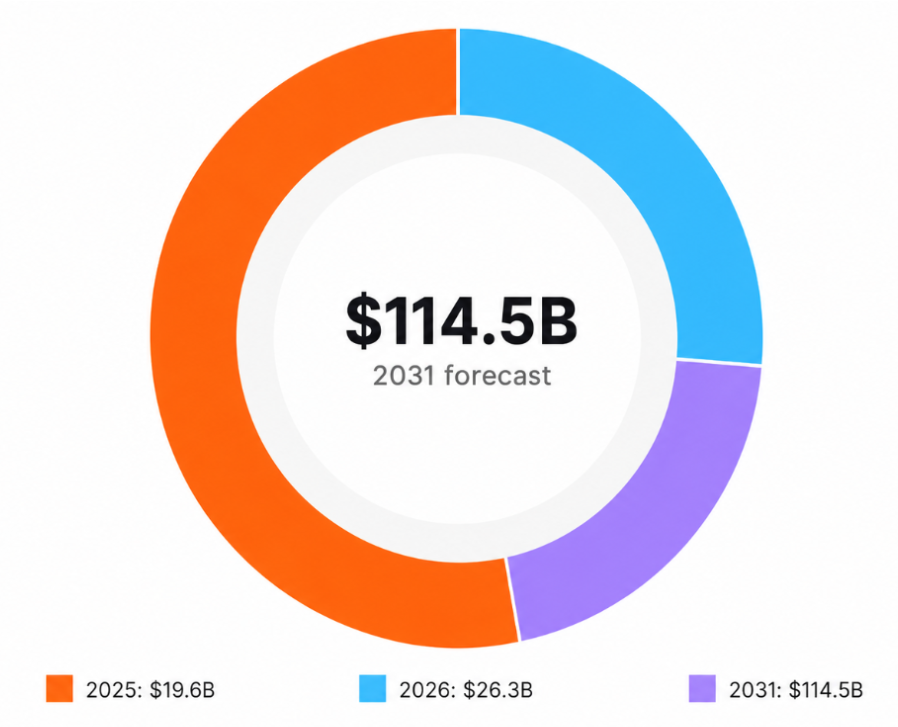
The global AI in insurance market crossed roughly USD 26 billion in 2026 and is growing at a 34% compound annual rate (Mordor Intelligence, 2026). That is not a distant forecast. It is happening inside underwriting desks, claims teams, and call centers across Mumbai, Gurugram, and Bengaluru right now.
Indian insurers are past the “should we try AI” conversation. The Insurance Regulatory and Development Authority of India (IRDAI) set up a seven-member working group on artificial intelligence in June 2026, tasked with mapping how far insurers have already gone and building India’s first formal AI governance framework (Business Standard, 2026). Regulation is catching up to practice, not the other way around.
This piece walks through where AI is actually creating value in both life insurance and general (non-life) insurance, what that looks like in the Indian market specifically, and what insurers need in place before AI delivers anything more than a pilot deck.
Key Takeaways
- The global AI in insurance market is projected to grow from roughly $19.6 billion in 2025 to $26.3 billion in 2026, reaching $114.5 billion by 2031.
- IRDAI formed a dedicated AI working group in June 2026 to build a governance framework for claims, fraud, and underwriting use cases.
- Life insurers are using predictive models for underwriting, persistency, and cross-sell; general insurers lean on AI for motor claims, health fraud detection, and property risk scoring.
- India faces a real skills gap — roughly 416,000 AI professionals against demand for 629,000 — which is pushing insurers toward experienced analytics partners rather than building everything in-house.
Why Is AI Suddenly Central to Insurance, Not Just a Pilot Project?
Large insurers now report 82% of carriers have already integrated or are piloting machine learning models in core operations, and predictive analytics is influencing an estimated 74% of underwriting decisions in life and health lines (Precedence Research / industry survey data, 2026). Insurance has always been a data-heavy business — actuarial tables and risk pools are decades-old statistical exercises. What has changed is the volume and messiness of the data insurers can now use: medical notes, telematics feeds, satellite imagery, call transcripts, claim photos.
Traditional business intelligence answers “what happened last quarter.” Predictive analytics and generative AI answer “what is about to happen, and what should we do about it.” That distinction is why insurers are moving budget out of static reporting dashboards and into AI-powered decision layers that sit on top of policy administration systems rather than replacing them.
Property and casualty lines still account for the majority of AI spend — about 58% of 2025 revenue — but life and health AI investment is growing faster, at roughly a 33.6% CAGR through 2031 (Mordor Intelligence, 2026). That is worth pausing on: life insurance, historically the more conservative, compliance-heavy line, is now where the growth curve is steepest.
What Are the Real AI Use Cases in Life Insurance?
Life insurance is a long-duration, trust-heavy product. AI does not change what life insurance sells — protection and savings — but it changes how fast and how accurately insurers can price, service, and retain that promise.
Underwriting. Traditional life underwriting leans on manual reviews, medical exams, and multi-stage approvals, which slows policy issuance and adds cost. Machine learning models now assess age, occupation, lifestyle, medical history, financial behaviour, and family history simultaneously rather than one variable at a time, producing a sharper risk picture and cutting issuance timelines.
Claims and mortality/morbidity risk. On the claims side, models trained on historical claims, medical records, and transaction history flag anomalies that rule-based systems miss — using anomaly detection, graph analytics, and behavioural pattern recognition — so genuine claims settle faster while suspicious ones get prioritized for review.
Persistency and lapse prediction. Policy lapses are one of the most expensive problems in life insurance. Predictive models identify policyholders likely to discontinue a policy months before it happens, giving retention teams a window to intervene with the right offer or outreach, rather than finding out only when a premium payment is missed.
Cross-sell and customer 360. By stitching together sales, servicing, claims, and policy administration data, insurers get one unified view of a customer instead of five disconnected ones. Machine learning then recommends the next product a policyholder is actually likely to buy, which lifts advisor productivity and customer lifetime value at the same time.
Conversational and executive analytics. Instead of waiting for a monthly PDF report, business leaders can now ask a natural-language question — “which advisors have the highest persistence ratio this quarter?” — and get a contextual answer pulled from governed enterprise data, not a manually built spreadsheet.
Where Is AI Making the Biggest Difference in Non-Life (General) Insurance?
General insurance — motor, health, property, crop — deals in higher claim volumes and shorter policy cycles than life insurance, so speed and fraud control dominate the AI conversation here.
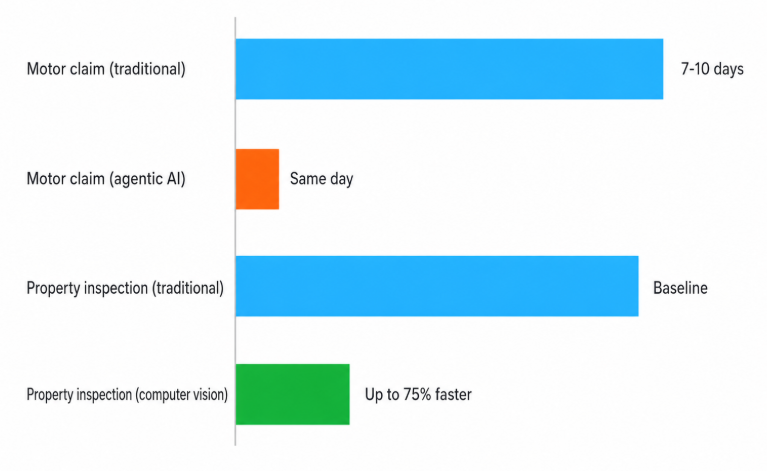
Motor claims. A motor claim in India traditionally takes 7-10 days to settle; agentic AI systems that assess accident photos and verify policy details automatically are pushing that toward same-day or even near-instant settlement in early deployments (GIC Council, 2026). Computer vision alone has cut property and vehicle inspection time by up to 75% in some deployments by reading damage directly from photos instead of scheduling a physical surveyor visit (Mordor Intelligence, 2026).
Health insurance fraud detection. This is where India’s public health data infrastructure is genuinely ahead of the curve. Ayushman Bharat PMJAY covers more than 500 million beneficiaries across over 28,000 empanelled hospitals, and the Ayushman Bharat Digital Mission has issued over 670 million health IDs, giving the National Health Authority and insurers claims-history visibility that did not exist five years ago (Mobisoft, 2026). Private general insurers are running similar AI/ML fraud models on motor and health claims to generate real-time alerts as claims are processed, rather than auditing them after payout (GI Council, 2026).
Property and catastrophe risk. Computer vision and geospatial imagery now assess roof condition, vegetation, and building attributes for underwriting and catastrophe modelling without an on-site inspection — useful in a market where large parts of the country are still under-penetrated for home insurance.
Customer service and chatbots. The lowest-friction, highest-volume use case remains AI-driven chat and voice assistants handling policy queries, renewal reminders, and basic claim status updates around the clock — freeing human agents for the complex, judgment-heavy conversations.
Crop and embedded insurance. Applications under India’s institutional crop insurance schemes grew from 80.45 million to 108.5 million between 2022 and 2025, a jump of nearly 35% (IBEF, 2026), and AI-driven satellite and weather data analysis is increasingly used to assess crop risk and speed up payout decisions at that scale.
How Is the Indian Insurance Market Approaching AI Differently?
India brings a few conditions that make its AI story distinct from the US or European market.
First, scale and penetration. India’s insurance market is projected to touch roughly USD 222 billion by 2026 (IBEF, 2026), but insurance penetration is still low relative to GDP compared to developed markets, which means AI-driven personalization and embedded distribution are as much about growing the market as optimizing an existing book.
Second, regulation is arriving in real time rather than after the fact. IRDAI’s working group — chaired by Sandeep Shukla of IIIT Hyderabad, with members drawn from SBI Life, Star Health, ICICI Lombard, and CERT-In — has a three-month mandate to map current AI deployment and propose an ethical, explainable AI framework, with claims processing and fraud detection named explicitly as priority areas (Business Standard, 2026). This follows IRDAI’s April 2026 information and cyber security guidelines, which already required regulated entities to begin compliance this financial year (Insurance Business, 2026). Combined with the Digital Personal Data Protection (DPDP) Act, insurers deploying AI in India are operating under real audit-trail obligations, not vague best-practice guidance.
Third, a genuine skills gap. India has around 416,000 AI professionals against demand for roughly 629,000, a 51% shortfall that is expected to widen past a million unfilled roles by 2026, with the steepest gaps in ML engineering, data science, and DevOps (Bimabazaar, 2025). That gap is precisely why insurance-specific analytics accelerators — pre-built models, governed data platforms, and domain expertise — matter more in India than a from-scratch build strategy.
India’s AI talent gap sits at roughly 51%, with 416,000 professionals available against demand for 629,000 — a shortage expected to exceed one million roles by 2026, concentrated in ML engineering, data science, and compliance-aware AI roles. (Bimabazaar, 2025)
Isn’t it a bit ironic that the industry most built on predicting risk is still working out how to govern the risk of its own prediction engines? That tension is exactly what IRDAI’s working group now has to resolve.
What’s Actually Getting in the Way of AI Adoption?
Even with strong momentum, insurers repeatedly run into the same blockers:
- Legacy core systems. Many Indian insurers still run policy administration on systems that cannot support real-time scoring or straight-through claims processing without a modern data layer sitting on top.
- Fragmented, siloed data. Sales, servicing, claims, and underwriting data often live in separate systems, which is exactly what a customer 360 layer is built to solve.
- Explainability and hallucination risk. As insurers adopt generative AI for policy summaries and claim explanations, hallucinated or plausible-but-wrong outputs create real regulatory and reputational exposure, which is why human-in-the-loop review remains non-negotiable for anything customer-facing (Bimabazaar, 2025).
- Governance before scale. Industry commentary increasingly frames the real obstacle as a systems problem, not a modelling problem — a fraud model here, a claims bot there, each working in isolation, but breaking down when insurers try to scale AI across an entire policy lifecycle (Insurance Edge, 2025).
Frequently Asked Questions
Is AI replacing underwriters and claims adjusters in India?
No. Across the industry, AI is used to support human decision-making, not replace it — automating data gathering and flagging risk so underwriters and adjusters focus on complex, judgment-heavy cases. IRDAI's proposed framework specifically emphasizes human oversight and explainability rather than full automation.
How is AI used differently in life insurance versus general insurance?
Life insurance AI centers on underwriting risk scoring, persistency prediction, and cross-sell, since policies are long-duration and relationship-driven. General insurance AI focuses on claims speed and fraud detection at high volume — motor, health, and property claims that need same-day or near-instant decisions.
What is IRDAI doing to regulate AI in insurance?
IRDAI formed a seven-member AI working group in June 2026 with a three-month mandate to map current AI deployment across insurers and propose a framework for ethical, transparent, explainable AI, with specific focus on claims processing and fraud detection.
Why do Indian insurers need an analytics partner instead of building AI in-house?
India's AI talent gap — roughly 416,000 professionals against 629,000 in demand — makes in-house-only builds slow and expensive, especially for a regulated, audit-intensive sector like insurance. Partners with insurance-specific data platforms and pre-built accelerators shorten that path meaningfully
How much is the AI in insurance market expected to grow?
The global AI in insurance market is projected to grow from about $19.6 billion in 2025 to $26.3 billion in 2026, reaching roughly $114.5 billion by 2031 at a 34.2% CAGR.