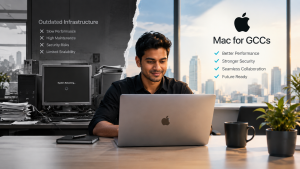

Why CIOs Must Stop Managing Devices and Start Driving Business Transformation?
Monday morning. Your IT team isn’t discussing AI adoption, cloud optimization, or the next phase of digital transformation.
Instead, they’re configuring laptops.
A new batch of devices has arrived. Each one needs to be unboxed, manually configured, secured, assigned to an employee, updated with applications, and documented before it can be handed over. Meanwhile, support tickets continue to pile up, software updates need attention, and another office is waiting for new devices.
If this sounds familiar, you’re not alone.
For many CIOs, enterprise device management has quietly become one of the biggest drains on IT productivity. Teams that should be enabling innovation are consumed by repetitive operational work.
The question isn’t whether your IT team can manage devices manually.
The real question is whether they still should.
Here’s why forward-looking enterprises are moving away from manual device management—and how they’re creating more time for innovation instead.
The Hidden Cost of Manual Device Management
Device management has evolved dramatically over the last decade.
Yet many organizations continue using processes designed for a much smaller workforce.
Every new employee often means:
- Manual device imaging
- Software installation
- Security configuration
- Asset tagging
- Multiple approval workflows
- Manual documentation
- Individual user setup
Individually, these tasks don’t appear significant.
Collectively, they consume hundreds of IT hours every year.
What makes this even more challenging is the pace of enterprise growth.
India continues to witness rapid expansion of Global Capability Centers (GCCs), hybrid work environments, and distributed teams. As organizations onboard employees across multiple cities, manual deployment becomes increasingly difficult to sustain.
Technology should reduce operational effort—not create more of it.
Manual Work Doesn’t Scale. Automation Does.
Consider a rapidly growing engineering company expanding across Bengaluru, Hyderabad, and Pune.
Every month, hundreds of new employees joined the organization.
The IT team had become experts at provisioning laptops.
Ironically, that became the problem.
Instead of focusing on improving security, evaluating AI initiatives, or modernizing workplace infrastructure, experienced engineers spent most of their week preparing devices manually.
Growth exposed the limitations of their process.
The turning point wasn’t hiring more IT administrators.
It was changing how devices were deployed altogether.
Instead of touching every device individually, they moved to automated provisioning and centralized management.
New employees received devices that were ready to work almost immediately.
The IT team finally had time to focus on projects that moved the business forward.
This isn’t an isolated story.
It’s becoming the standard for modern enterprises.
Enterprise Device Management Is No Longer an IT Function
The role of the CIO has changed.
Success is no longer measured by how many tickets IT closes.
It’s measured by how quickly technology enables business growth.
That shift changes the way organizations should think about device management.
Modern enterprise device management isn’t simply about deploying laptops.
It’s about enabling:
- Faster employee onboarding
- Standardized security policies
- Consistent user experiences
- Lower operational effort
- Scalable IT operations
When devices become easier to deploy and manage, IT teams regain something far more valuable than time.
They regain strategic focus.
Why Apple’s Enterprise Platform Changes the Conversation
Apple has redefined what enterprise deployment can look like.
Instead of relying on manual configuration, Apple Business Manager enables organizations to automate enrollment, configure devices remotely, and prepare Macs before employees even open the box.
Combined with zero-touch deployment, organizations can provision devices at scale without requiring IT administrators to configure every machine individually.
The result is simple.
Employees become productive faster.
IT teams spend less time on repetitive tasks.
Organizations maintain consistency across every deployment.
That’s the difference between managing devices and managing an enterprise.
Where Team Computers Fits In
Technology alone doesn’t transform an enterprise.
Execution does.
That’s where Team Computers helps organizations move beyond device procurement and into true workplace modernization.
Rather than beginning with products, we begin with understanding your existing environment through our Mac Assessment Program. We evaluate your infrastructure, deployment processes, user personas, and business goals before recommending the right migration strategy.
From there, our experts help enterprises simplify every stage of the Apple journey through:
- Assessment Program to evaluate readiness and build a migration roadmap
- Apple Business Manager implementation for automated provisioning
- Zero-touch deployment for faster onboarding
- Switcher & Refresh Programs to transition from legacy environments
- Order Tracking Portal for enterprise procurement visibility
- TCPL CarePack for ongoing lifecycle support and enterprise service management
Because successful device management isn’t about deploying one Mac.
It’s about creating a repeatable system that works for thousands.
[INTERNAL LINK: /apple/cio — Anchor Text: Explore Apple’s CIO Solutions]
What This Means for Indian Enterprises
India’s enterprise technology landscape is changing rapidly.
Organizations are expanding across cities, hiring faster, supporting hybrid workforces, and preparing for AI-driven workplaces.
The CIO’s responsibilities have expanded alongside that growth.
Simply keeping devices operational is no longer enough.
Forward-thinking organizations are asking different questions:
- How quickly can we onboard employees?
- Can we deploy devices without manual intervention?
- How much IT effort can we eliminate?
- Are our teams spending time on maintenance—or innovation?
These aren’t operational questions anymore.
They’re business questions.
And the organizations answering them well are creating a competitive advantage.
The CIO’s Competitive Advantage Isn’t Better Device Management
It’s Less Device Management.
The best IT organizations aren’t necessarily the ones with larger teams.
They’re the ones that have removed unnecessary manual work.
When repetitive device management disappears, IT leaders gain the freedom to focus on:
- AI readiness
- Digital workplace transformation
- Enterprise security
- Business innovation
- Employee experience
That’s where the real value of modern IT lies.
Not in configuring devices.
But in enabling the business.
Conclusion
Enterprise technology will only become more distributed, more intelligent, and more connected over the next few years. CIOs who continue relying on manual device management risk slowing down both their IT teams and the broader business.
Instead, focus on building systems that scale.
Start by asking a few simple questions:
- Audit how much time your IT team spends manually provisioning and managing devices each month.
- Evaluate whether your current deployment process can support future growth across locations and teams.
- Assess if Apple Business Manager and zero-touch deployment can simplify your device lifecycle.
- Identify opportunities to reduce operational effort so IT can focus on strategic initiatives.
Enterprise device management should empower innovation—not consume it. The sooner manual processes give way to automation, the sooner your IT organization can become the strategic business partner it’s meant to be.
Get an Apple Enterprise Assessment
Planning to modernize your workplace? Team Computers’ Mac Assessment Program helps you evaluate your current environment, identify deployment opportunities, and build a roadmap for enterprise-scale Apple adoption.
The sooner you understand where manual effort is slowing your IT operations, the sooner you can redirect your team’s focus toward innovation.