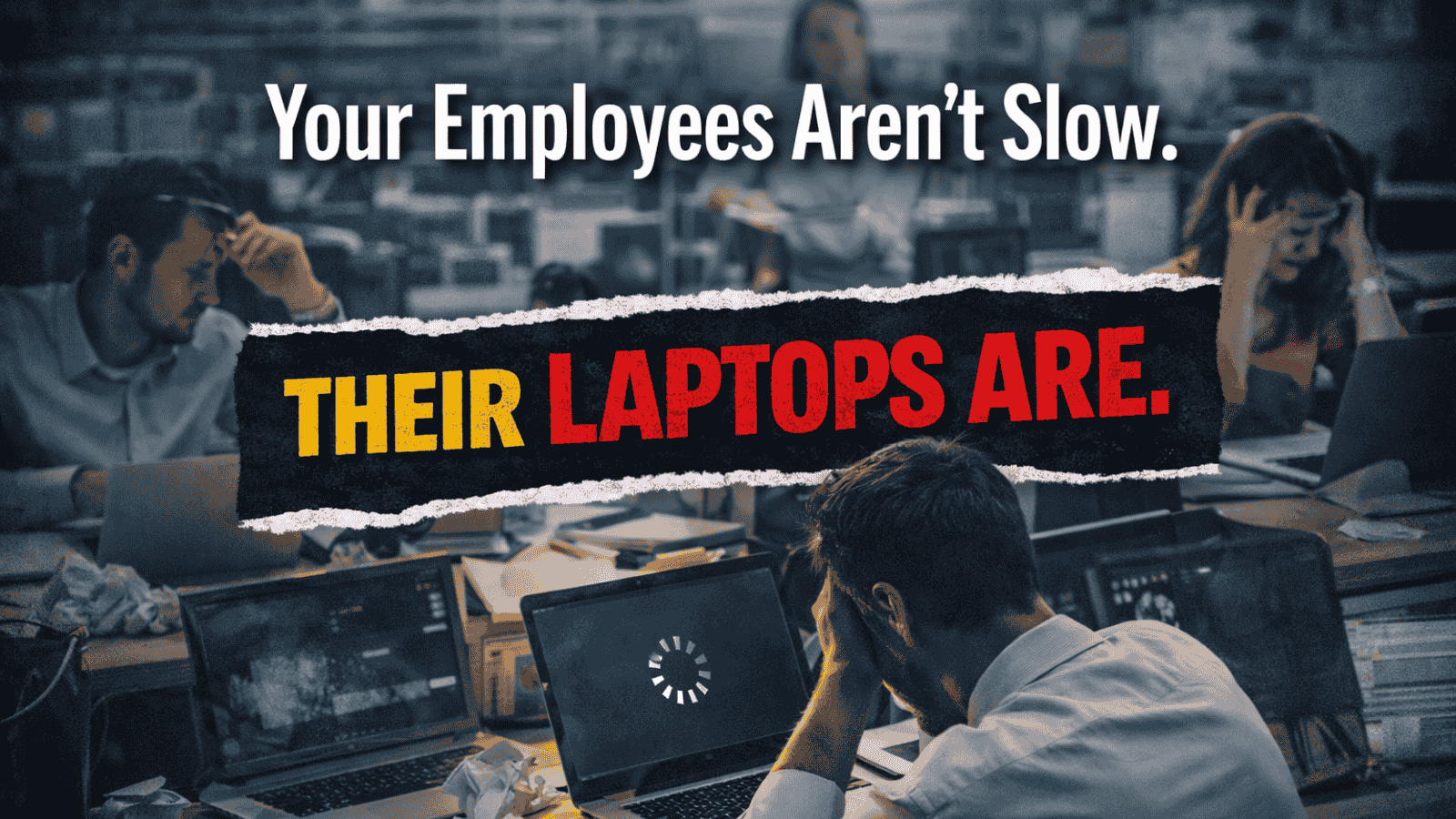
That laggy laptop on your employee’s desk? It’s not just annoying. It’s costing you money, security, and talent — quietly, every single day.
Here’s what’s actually happening when enterprises hold onto aging devices too long.
A laptop that takes 4 minutes to boot. Apps that freeze mid-presentation. A video call that pixelates every 30 seconds.
Individually, these feel like minor inconveniences. Collectively, they add up to hours of lost productivity per employee per week. Multiply that across 500 people and you’re not looking at a hardware problem — you’re looking at an operational crisis hiding in plain sight.
The number: Employees on underperforming devices lose an average of 40+ minutes of productive time daily. That’s nearly 200 hours a year. Per person.
Here’s what most IT teams don’t say out loud: outdated devices can’t run modern security software properly. They miss patches. They can’t support the latest endpoint protection tools. And they become the easiest entry point into your entire network.
One unpatched laptop. One phishing email. One breach.
The average cost of a data breach in India crossed ₹17 crore in 2024. That’s not a risk you want sitting on 300 desks because the refresh budget got pushed to next quarter.
This one stings — but it’s true.
Top talent notices the tools they’re given. A slow, unreliable laptop signals one thing clearly: we don’t invest in you. For high performers who have options, that signal is enough.
In a world where competitors are handing out MacBooks and high-spec ThinkPads on day one, sending a new hire a 4-year-old refurbished machine is a retention risk dressed up as a cost saving.
Every old device is a support ticket waiting to happen. Driver issues. Overheating. Random shutdowns. Compatibility failures with new software.
Your IT team ends up spending the majority of their week fixing yesterday’s problems instead of building tomorrow’s infrastructure. The hidden cost isn’t just the repair — it’s the strategic work that never gets done because the team is too busy keeping ancient hardware alive.
Regulated industries — BFSI, healthcare, pharma — face a particular kind of pain with old devices. Older laptops struggle to support full-disk encryption, modern MDM policies, and audit trail requirements.
During compliance reviews, these gaps become findings. Findings become penalties. Penalties become headlines. No CIO wants to explain to the board why a data audit failed because of a ₹60,000 laptop that should have been replaced two years ago.
Here’s the maths nobody does:
| Factor | Old Laptop | New Laptop |
|---|---|---|
| Upfront cost | ₹0 | ₹65,000 |
| Annual repairs | ₹8,000/yr | ₹0–1,000/yr |
| Daily productivity | 40 min/day lost | Full productivity |
| Security exposure | High risk | Modern endpoint protection |
| Employee experience | Frustration | Satisfaction |
Holding onto old devices feels like saving money. It’s actually deferring a much larger cost — in repairs, breaches, attrition, and lost output.
AI tools. Collaboration platforms. Cloud-native apps. Modern enterprise software is built for modern hardware. Trying to run today’s workloads on a 2019 laptop is like running a highway through a bullock cart road — the business wants to move fast, but the devices won’t let it.
As enterprises scale across new offices, new hires, and new geographies, the device fleet needs to scale with them. Old hardware doesn’t scale. It compounds.
Not a one-time bulk purchase. A managed device lifecycle.
The goal isn’t newer laptops. It’s a device ecosystem that never becomes a liability.
Old laptops aren’t a hardware problem. They’re a business problem — wrapped in a productivity problem, a security problem, and a people problem.
The enterprises winning on efficiency aren’t holding onto devices until they die. They’re managing the enterprise device lifecycle deliberately, so the fleet always works as hard as the team using it.
Team Computers manages end-user device lifecycles for enterprises across India — from procurement and deployment to refresh and responsible recycling. Reach us at sales.india@teamcomputers.com