
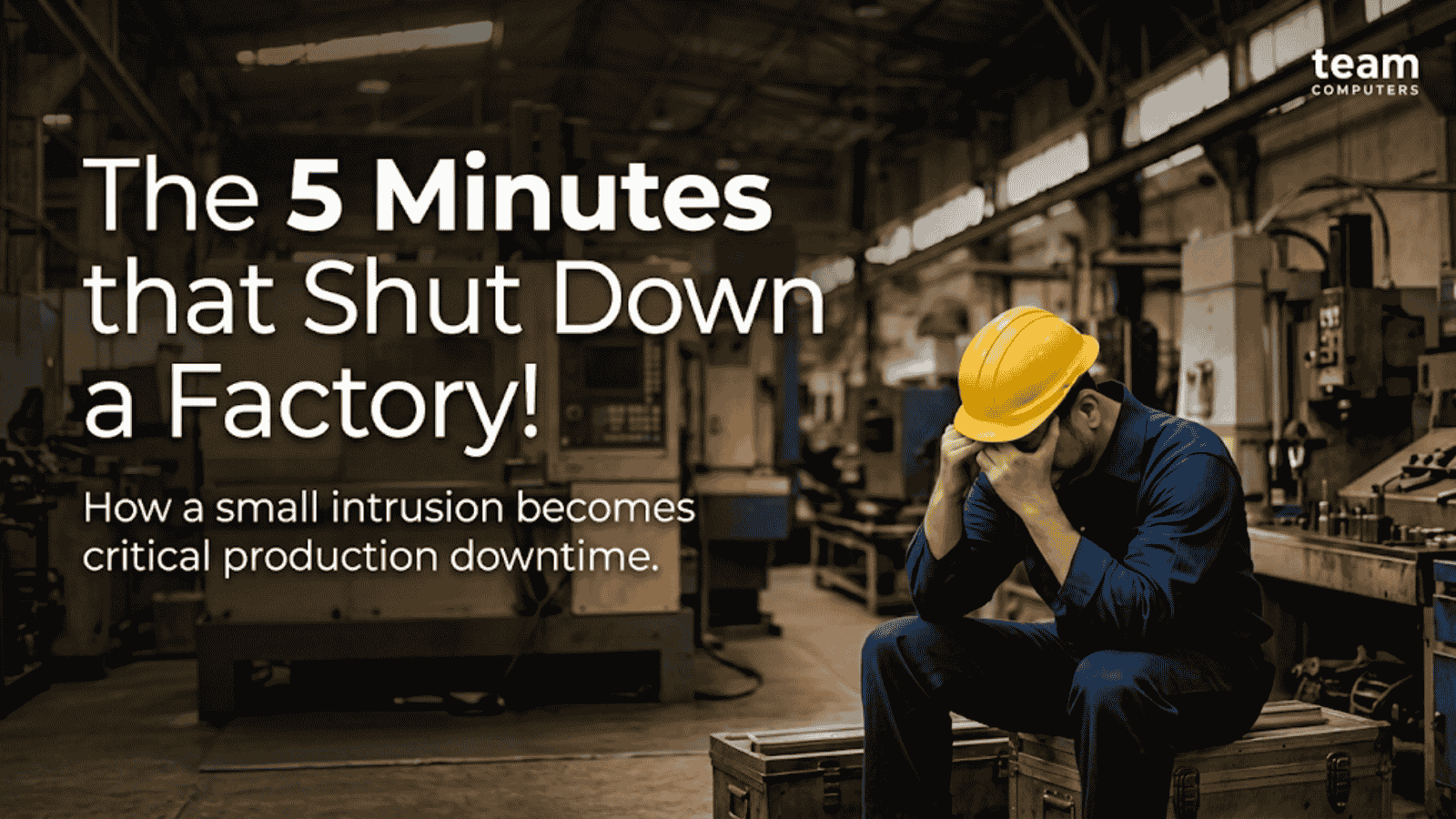
Manufacturing doesn’t stop.
Until it does.
And when it does, it rarely starts with ransomware.
Minute 0 — The Login
A vendor logs into a remote access system.
Credentials are valid.
No alarms.
No suspicion.
Minute 2 — The Mapping
The attacker identifies:
- Production systems
- OT and IT connections
- Backup servers
- Critical dependencies
They don’t attack yet.
They observe.
Minute 5 — The Weak Link
A legacy system.
Unpatched.
Connected to both IT and OT environments.
This is the bridge.
Minute 11 — Lateral Movement
The attacker moves quietly:
- From IT networks to operational systems
- From monitoring tools to control environments
Still no disruption.
Because disruption is not the goal yet.
Minute 18 — Backup Compromise
Backups are located.
Access is tested.
Recovery paths are analyzed—and quietly disabled.
Minute 27 — Encryption Triggered
Now it begins.
Production systems freeze.
Machines stop responding.
Dashboards go blank.
The plant doesn’t slow down.
It stops.
Why Manufacturing Is a Prime Target
- High cost of downtime
- Legacy systems still in use
- IT-OT convergence
- Limited visibility across environments
Attackers understand one thing clearly:
Every minute of downtime increases pressure to pay.
The Real Risk
It’s not just ransomware.
It’s:
- Operational shutdown
- Supply chain disruption
- Safety risks
- Revenue loss
The Real Question
If your production line stopped right now:
- How fast could you isolate the attack?
- Can you recover without paying ransom?
- Are your OT systems monitored like IT systems?
Final Thought
Ransomware in manufacturing is not an IT problem.
It’s a business continuity problem.
And it starts long before the machines stop.