
Most IT leaders track procurement costs carefully.
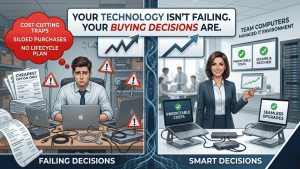
But what if the real cost of devices isn’t the purchase price?
Across large organizations, outdated laptops, unmanaged endpoints, and poorly tracked devices quietly drain IT budgets every year. Individually, these issues appear minor—a slow laptop here, a support ticket there. But across hundreds or thousands of employees, the hidden cost can quickly escalate into lakhs lost annually.
For CIOs and IT leaders responsible for enterprise infrastructure, this isn’t just an operational issue. It’s a financial one.
The challenge is simple: most of these losses remain invisible in traditional IT budgeting.
Devices don’t usually fail overnight. They degrade slowly.
Performance drops. Boot times increase. Applications crash more frequently. Batteries deteriorate. Security vulnerabilities grow.
Each problem seems manageable in isolation.
But across an enterprise environment, aging devices often create four major hidden costs.
Slow devices directly affect employee productivity.
Imagine an employee losing 10 minutes per day due to slow boot times, freezing applications, or system crashes.
Across a workforce of 500 employees, that equals:
Multiply that by average employee cost, and the impact becomes clear. What looks like a small inconvenience quickly becomes a major operational expense.
Older devices generate more support tickets.
Common issues include:
IT teams often spend a disproportionate amount of time managing devices that should have been refreshed years earlier.
Instead of focusing on strategic initiatives like digital transformation or security upgrades, IT teams become stuck in constant troubleshooting cycles.
For large organizations, this means higher support costs and slower innovation.
Outdated devices also create serious security exposure.
Older systems are more vulnerable because they often:
In regulated industries like BFSI, healthcare, and manufacturing, unmanaged devices can create compliance issues.
Security breaches today are rarely caused by sophisticated attacks alone. In many cases, they exploit old devices that were never upgraded or monitored properly.
One of the biggest financial surprises in IT budgets comes from reactive replacements.
When devices fail unexpectedly, organizations must replace them urgently. This leads to:
Reactive replacements are always more expensive than planned refresh cycles.
Without a structured device lifecycle strategy, organizations often find themselves replacing large numbers of devices suddenly—creating unpredictable budget spikes.
The biggest challenge is visibility.
Most organizations track procurement spending, but very few track the total cost of ownership (TCO) of their devices.
Hidden costs such as:
are rarely captured in traditional IT reporting.
As a result, companies may believe they are saving money by delaying device upgrades—when in reality they are spending far more in indirect costs.
Forward-thinking enterprises are moving away from reactive device management and adopting structured device lifecycle strategies.
Instead of treating devices as one-time purchases, they manage them as long-term assets with measurable performance and cost impact.
Here are four approaches leading IT teams are using today.
Large enterprises often operate across multiple offices, cities, or even countries.
Without proper tracking systems, devices can easily become invisible assets.
Lifecycle tracking helps IT teams monitor:
This visibility allows organizations to identify underperforming devices before they become operational problems.
Modern endpoint management tools allow IT teams to monitor device performance in real time.
Metrics such as:
can indicate when a device is approaching failure.
Instead of reacting after employees experience issues, IT teams can resolve problems proactively.
Leading organizations typically follow structured 3-4 year refresh cycles for enterprise devices.
Planned refresh programs allow companies to:
Most importantly, planned refresh cycles ensure that devices never reach the point where they significantly affect productivity.
Another major improvement comes from device standardization.
When organizations deploy too many device models, IT teams face increased complexity.
Standardized deployments provide:
This approach significantly reduces long-term support costs.
For companies managing hundreds or thousands of devices, the real opportunity isn’t just buying devices smarter.
It’s managing them smarter.
Device lifecycle management focuses on the full journey of enterprise devices:
When managed strategically, this lifecycle approach helps organizations reduce hidden costs while improving operational efficiency.
Workplaces today are more digital than ever.
Employees depend on reliable devices for:
A slow or failing device is no longer just an inconvenience—it directly impacts business outcomes.
That’s why enterprises are increasingly investing in structured device lifecycle management frameworks to ensure every device performs optimally throughout its life.
Sometimes the biggest IT savings don’t come from negotiating a better device price.
They come from eliminating the hidden costs that outdated devices create.
For organizations managing large device fleets, improving lifecycle visibility can reveal where money is quietly leaking—and help stop those losses before they affect productivity or budgets.
Because the real question isn’t just: “How much did we spend on devices?”
It’s: “How much are those devices costing us every day?”
If your organization manages hundreds or thousands of devices, it may be time to evaluate the hidden costs inside your device ecosystem.
A structured device lifecycle assessment can help identify:
Talk to the Team Computers experts to explore how smarter device lifecycle management can reduce IT costs and improve operational efficiency.