
Indian enterprises are consolidating a decade of scattered data tools — Power BI here, Synapse there, a Data Factory pipeline nobody fully documented — into one platform. Microsoft Fabric is usually the reason why. Globally, Microsoft has reported that more than 30,000 organizations have adopted Fabric since its launch, and Microsoft’s own Fabric partner lead has called it the fastest-growing analytics platform ever built. This guide breaks down what Fabric actually is, what it costs from an India billing perspective, how it holds up against Databricks and Synapse, and what a realistic adoption path looks like for an Indian enterprise in 2026.
Key Takeaways
- Microsoft Fabric has crossed 31,000 customers globally as of mid-2026, driven largely by real-time intelligence and “chat with your data” use cases (Microsoft Fabric, Adastra podcast, April 2026).
- India-region Fabric capacity carries roughly a 33% pricing premium over US East — about $0.24/CU-hour vs. $0.18/CU-hour on pay-as-you-go.
- DPDP Act compliance and RBI payment-data residency rules make Fabric’s India-region OneLake deployment a practical requirement, not a preference, for BFSI and regulated enterprises.
- Most large enterprises don’t pick Fabric or Databricks — they run Fabric for BI/governance and keep Databricks or Synapse for heavy engineering, connected through OneLake shortcuts.
What Is Microsoft Fabric, Exactly?
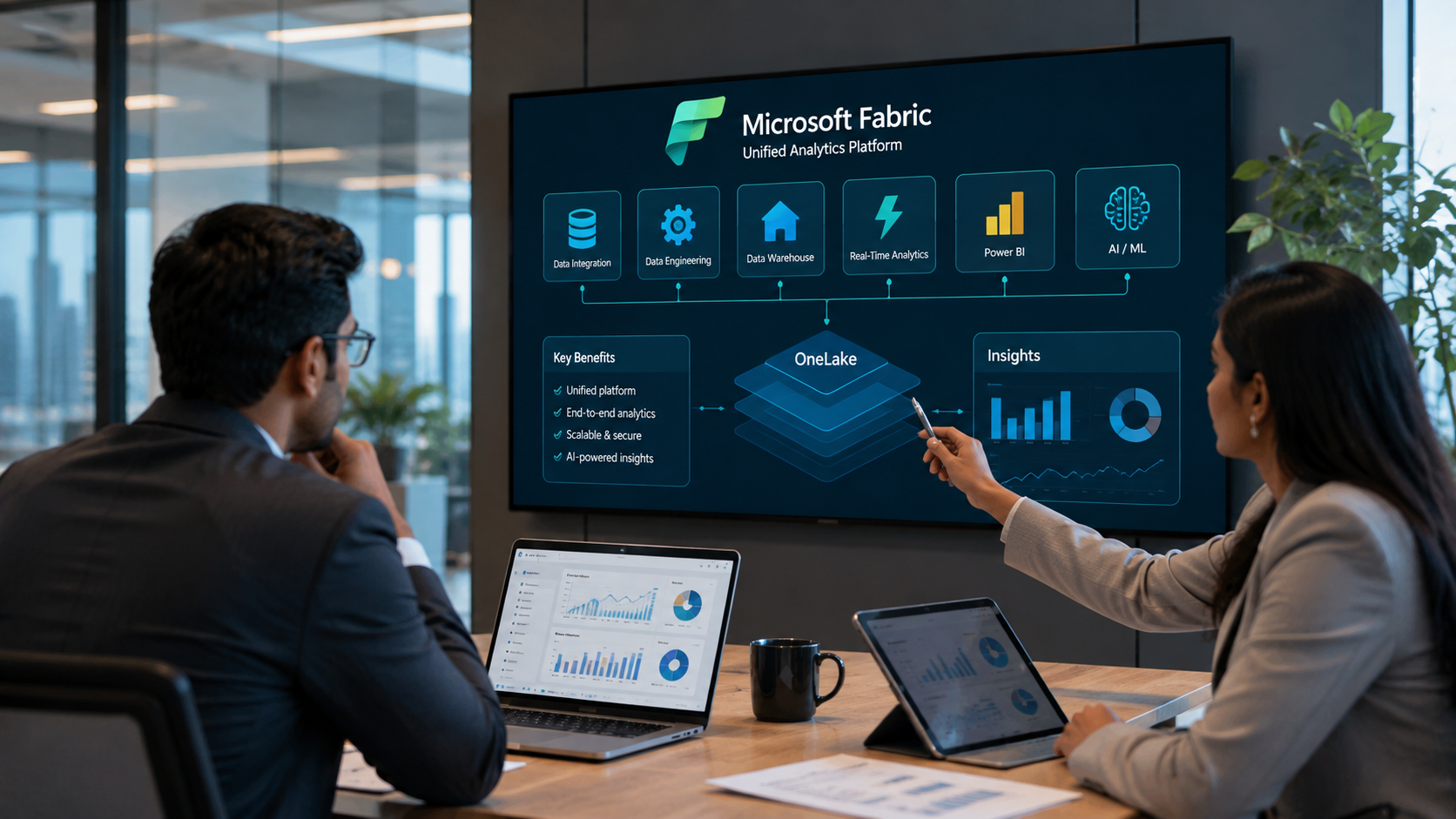
Microsoft Fabric is a single SaaS platform that merges data engineering, data warehousing, real-time analytics, data science, and Power BI reporting into one capacity-based service, rather than a collection of separately licensed Azure tools. In 2026, that consolidation is the whole point: enterprises are no longer asking how much data they can store, but how quickly they can turn that data into a decision, with governance and AI built in from the start.
Everything in Fabric sits on top of OneLake, a single logical data lake shared by every workload — SQL, Spark, and KQL engines all read and write the same Delta/Parquet files instead of copying data between systems. That single-copy design is why Fabric can offer Direct Lake mode: Power BI reports query OneLake data directly, without a separate import or a dedicated compute engine sitting in between, which is a real advantage Databricks doesn’t natively replicate.
For Indian enterprises coming off a mix of on-prem SQL Server, Power BI Premium, and ad hoc Azure Synapse projects, Fabric is best understood as the next stage of that same Microsoft stack — not a rip-and-replace platform, but a consolidation layer that most Microsoft-centric organizations will eventually sit on top of.
Why Are Indian Enterprises Adopting Fabric Now?
Two forces are driving 2026 adoption in India specifically: real-time operational analytics and the shift from historical dashboards to embedded AI. Microsoft’s Fabric partner lead notes that real-time intelligence — once mostly a manufacturing and IoT use case — is now in demand across banking, healthcare, and financial services, and enterprises are increasingly asking to “chat with their data” rather than build a new report for every question.
For India’s largest verticals — BFSI, manufacturing, retail, and auto — this maps directly onto existing pain points: dealer and supply-chain data trapped in silos, fraud and risk models that run too slowly to be useful, and Power BI estates that have outgrown their original architecture. Fabric’s pitch is that these all live on one governed platform instead of five disconnected ones.
The trade-off enterprises should go in aware of: Fabric adoption is not purely a technology rollout. Technology adoption often outpaces organizational readiness, and adopting Fabric successfully requires far more than provisioning licenses or migrating workloads — governance maturity, workspace ownership, and a realistic coexistence plan with existing systems matter as much as the platform itself.
What Does Microsoft Fabric Actually Cost in India?
Fabric is licensed through Capacity Units (CUs), purchased either as pay-as-you-go or reserved capacity, and every workload in a tenant draws from the same shared pool rather than being billed per engine. You buy a capacity, and every workload draws from that same pool — there’s no separate line item for Power BI or the data warehouse engine. That matters for two reasons: adding a new workload doesn’t automatically add a new bill, but several heavy jobs running concurrently compete for the same CUs, so sizing is about peak load, not feature-counting.
For Indian enterprises, the region matters to the invoice. India regions (Central India, South India) carry roughly a 33% premium over the US East baseline — about $0.24 per CU-hour versus $0.18 per CU-hour on pay-as-you-go pricing. Reserved capacity substantially changes that math: 2026 pricing guidance points to roughly 41% savings when reservation is combined with workload smoothing, which is where most of the real enterprise cost engineering now happens.
| Consideration | What it means for India deployments |
| Pay-as-you-go rate | ~$0.24/CU-hour (India regions) vs. ~$0.18/CU-hour (US East) |
| Reserved capacity | Up to ~41% savings when combined with workload smoothing |
| OneLake storage | Flat, ADLS Gen2-equivalent rate (~$0.023/GB/month) regardless of engine |
| F64 threshold | At F64 and above, report viewers don’t each need a separate Power BI Pro license — a major factor for large reporting audiences |
| SKU range | F2 (entry) up to F128+ for enterprise workloads |
The practical guidance from enterprise Fabric partners: run a proof-of-value on pay-as-you-go first, then move to reserved capacity once workload patterns stabilize — an SKU sizing error at enterprise scale can cost an organization hundreds of thousands of dollars.
Is Microsoft Fabric DPDP Act and RBI Compliant?
Fabric can be deployed inside India-region boundaries, but compliance is a configuration and governance responsibility, not something that happens automatically by choosing Microsoft. Azure’s India geography spans Central India and South India regions, which are grouped together for data residency purposes distinct from Europe or other geographies — and Fabric inherits this multi-geo model, letting tenants deploy specific workspaces to India-region capacity.
Two regulatory layers matter here. First, the DPDP Act, 2023 — with DPDP Rules 2025 notified by MeitY in November 2025 and phased compliance deadlines running through May 2027 — governs how personal data of Indian residents is collected, processed, and transferred, and designates organizations as Data Fiduciaries or Data Processors depending on their role. Second, for BFSI specifically, the RBI’s Storage of Payment System Data Direction (2018) requires that the entire data relating to payment systems be stored only in India — a stricter requirement than DPDP alone.
One nuance enterprises frequently miss: even with a workspace pinned to an India-region capacity, certain tenant metadata — dashboard names, semantic model credentials, and permissions — always remains in the platform’s home region for operational purposes, so compliance officers need to evaluate whether that metadata retention fits their specific cross-border interpretation. This is exactly the kind of detail that gets missed in a self-led Fabric rollout and surfaces later in a regulatory audit.
Microsoft Fabric vs. Databricks vs. Synapse: Which Fits Your Enterprise?
The honest 2026 answer is that most large enterprises don’t pick one platform outright — they run Fabric for governed BI and reporting while keeping Databricks or Synapse for the workloads each does better. As one comparison puts it plainly: Fabric gives Microsoft-focused companies an all-in-one, simple analytics experience, while Databricks leads in advanced data engineering and AI, and Synapse still handles traditional enterprise data warehousing.
The deciding factors, by workload:
- Choose Fabric when your organization is already Microsoft 365 and Power BI-centric, reporting scale is the priority, and you want Direct Lake mode querying OneLake data without import or extra compute — an advantage Databricks cannot natively match.
- Choose Databricks when you run Spark-heavy engineering, build custom ML at scale, or need multi-cloud flexibility; Databricks holds a stronger position for advanced machine learning, complex ML pipelines, and large-scale production ML workflows.
- Run both when ML engineering needs Databricks’ depth while the rest of the business needs Fabric’s governance and reporting speed — increasingly common since open APIs since late 2025 allow zero-copy data sharing between Databricks’ Unity Catalog and OneLake, making a hybrid architecture practical rather than a compromise.
For Indian enterprises with an existing Azure Synapse footprint, migration is usually incremental: Synapse-style workloads reappear as Fabric items (Data Warehouse, Data Engineering, Real-Time Intelligence) rather than requiring a full re-platform.
How Should an Indian Enterprise Approach Fabric Adoption?
Skip the “migrate everything on day one” instinct. A realistic Fabric adoption path involves a documented implementation framework, clear maturity levels, and awareness of common challenges before committing — and the platforms enterprises are replacing (on-prem warehouses, legacy Synapse pipelines, disconnected Power BI workspaces) rarely disappear overnight.
A pragmatic sequence that works well for Indian enterprise IT teams:
- Assess readiness first. Map your current data estate — governance maturity, existing Microsoft licensing, and regulatory posture — before sizing capacity.
- Run a scoped proof-of-value. Start on pay-as-you-go with one business domain (finance, sales, or supply chain) rather than a tenant-wide rollout.
- Decide the coexistence model. Most enterprises adopt Fabric alongside existing systems using OneLake shortcuts rather than forcing an immediate migration.
- Lock India-region residency and governance early. Configure workspace region assignment and Microsoft Purview policies before onboarding regulated data, not after.
- Move to reserved capacity once patterns stabilize. This is where the ~41% cost advantage becomes real rather than theoretical.
Team Computers’ Data & AI Practice: A Fabric Delivery Partner for Indian Enterprises
Choosing Fabric is a platform decision; making it work in production is an implementation one — and that’s where most Fabric rollouts in India either accelerate or stall. Team Computers has run a dedicated Data & AI practice for close to two decades, and the same team that has delivered analytics for Maruti Suzuki, Tata Motors, KIA, Mercedes, Hyundai, Honda Cars, and Volkswagen — 100+ analytics projects, 12,000+ end users — now applies that delivery experience directly to Microsoft Fabric engagements.
The practice covers the full Fabric stack an enterprise actually needs, not just the reporting layer:
- Data strategy and modernization — data lakehouse and data lake architecture, data engineering, real-time data integration, and master data management, built around OneLake from day one.
- Governance and quality — lineage tracking, metadata cataloging, PII masking, and data quality frameworks aligned to DPDP Act obligations.
- Predictive and advanced analytics — forecasting, churn, and anomaly-detection models built with regression, classification, and time-series techniques in Python, R, and Azure ML.
- Visual analytics — dashboards and self-service reporting in Power BI, built to take advantage of Fabric’s Direct Lake performance rather than legacy import models.
- Generative AI — LLM-powered copilots for document summarization, intelligent search, and workflow automation, built on Azure OpenAI, LangChain, and secure vector databases.
That practice sits inside a company with 38 years of enterprise IT delivery, 2,500+ customers across enterprise, mid-market, and government/PSU segments, and formal technology partnerships spanning Microsoft, Databricks, Qlik, Tableau, and Google — which is precisely the kind of multi-platform fluency an honest Fabric-vs-Databricks decision requires, rather than a single-vendor sales pitch.
Frequently Asked Questions
Is Microsoft Fabric available in India-region Azure data centers?
Yes. Fabric follows Azure's India geography, which spans Central India and South India regions, and tenants can pin workspaces to India-region capacity for residency purposes — though some tenant-level metadata still remains in the platform's home region.
Does Microsoft Fabric replace Power BI Premium licensing?
Largely, yes. Power BI Premium per-capacity SKUs were consolidated into the Fabric F-SKU range; Power BI Pro per-user licensing remains separate for self-service report consumers.
Is Fabric cheaper than running Databricks and Power BI separately?
It depends on the workload shape. Fabric's capacity model favors predictable workloads, while Databricks' consumption model favors variable ones, a real comparison requires modeling storage, licensing, and idle capacity together, not just headline rates.
Can Fabric and Databricks run together?
Yes, and increasingly this is the default enterprise pattern, Fabric handling BI and governance, Databricks handling engineering and ML, connected via OneLake shortcuts and Unity Catalog zero-copy sharing.
How long does a typical Fabric adoption take for a mid-size Indian enterprise?
Most structured engagements run a phased model: a readiness assessment, a scoped proof-of-value on one business domain, then broader rollout, typically spanning several months rather than a single big-bang migration.