
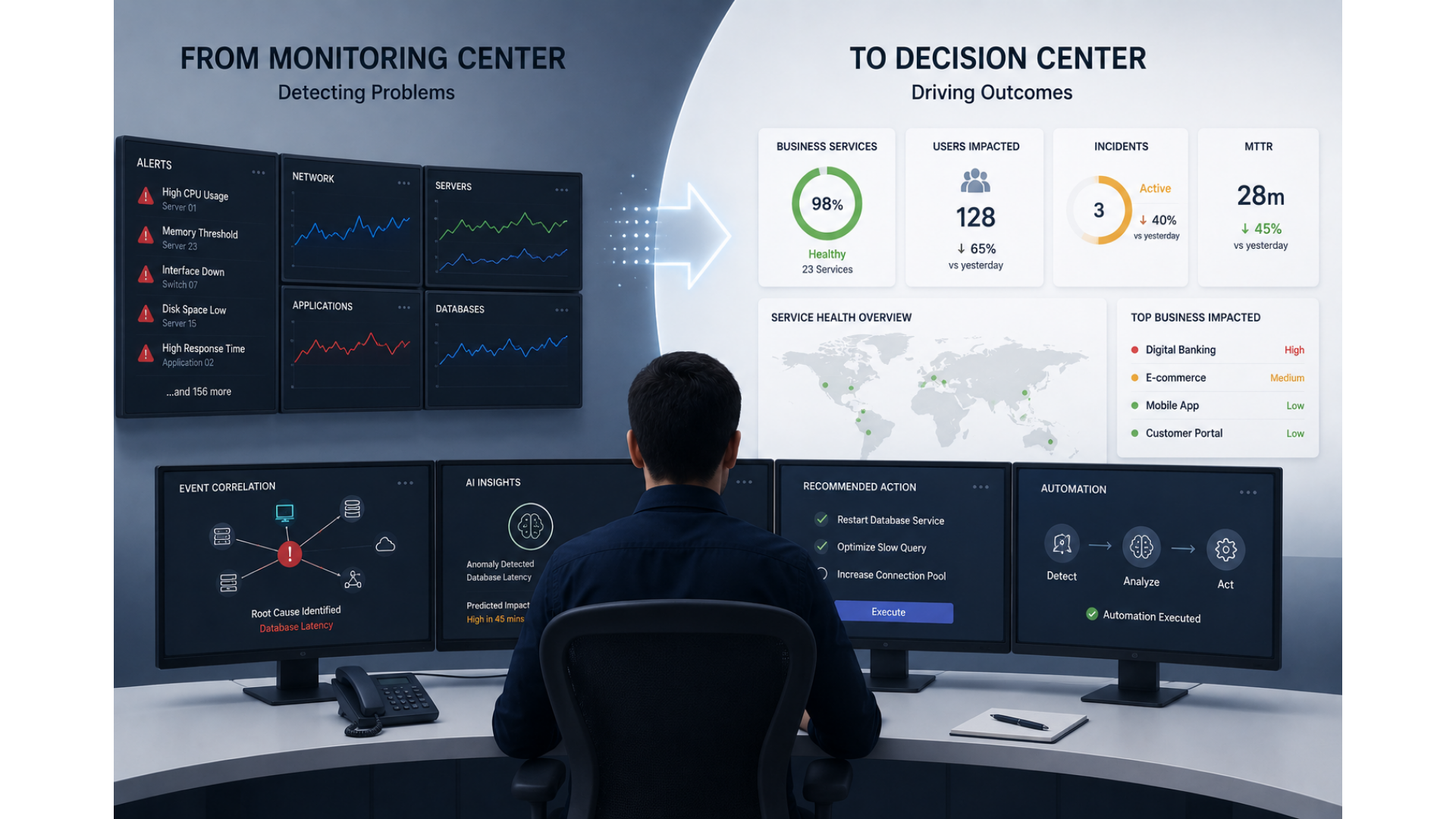
Walk into a traditional Network Operations Center (NOC) and you’ll likely see the same scene that’s existed for years. Large screens displaying dashboards, engineers monitoring alerts, teams responding to incidents as they occur.
At first glance, everything appears under control, yet modern enterprises are discovering an uncomfortable truth:
More monitoring doesn’t automatically create better operations.
The volume of infrastructure, applications, cloud environments, endpoints, and digital services has grown faster than human operators can manage.
Today’s challenge isn’t collecting data. It’s making decisions quickly enough to prevent business impact. That’s why the future of the NOC is changing.
The next-generation NOC is no longer a monitoring center, it’s becoming a decision center and that shift is redefining how enterprise IT operations function.
The traditional NOC model is reaching its limits
For decades, NOCs were designed around a simple objective: Detect issues and respond quickly. The model worked well when infrastructure environments were relatively predictable. A centralized data center, a limited number of applications, defined network boundaries.
Today, the situation looks very different.
Most enterprises operate across:
- Hybrid cloud environments
- Distributed branch locations
- Remote workforces
- SaaS applications
- Edge infrastructure
- Multi-vendor ecosystems
As complexity grows, the number of operational events grows with it.
Research into AIOps and modern IT operations consistently highlights the challenge of handling massive volumes of operational telemetry, events, logs, and alerts across increasingly complex environments.
The result?
Many NOC teams spend more time managing alerts than understanding what actually matters.
And that’s becoming unsustainable.
Why dashboards alone are no longer enough
Most NOCs today have visibility. What they often lack is context.
An engineer may see:
- A network latency spike
- Increased CPU utilization
- Application performance degradation
- A flood of alerts
The challenge isn’t identifying the event.
The challenge is understanding:
- Is this a real issue?
- How many users are affected?
- What business service is impacted?
- What should happen next?
Traditional monitoring platforms excel at presenting data, they struggle to explain relationships between events, that’s why many organizations still experience long investigation cycles despite investing heavily in monitoring tools.
Visibility without context creates operational noise. Decision-making requires correlation.
The rise of AIOps is changing NOC operations
When Gartner introduced the concept of AIOps, the objective was not simply to automate monitoring. The goal was to help IT operations teams transform operational data into actionable intelligence. AIOps applies machine learning and analytics to identify anomalies, correlate events, determine causes, and support automated responses.
This is where the NOC begins its evolution.
Instead of:
Alert → Investigation → Escalation
Modern operations increasingly follow:
Signal → Correlation → Insight → Action
AIOps platforms can:
- Correlate thousands of events
- Identify root-cause patterns
- Predict potential failures
- Recommend remediation actions
- Trigger automated workflows
This dramatically reduces the time spent manually analyzing operational data.
More importantly, it allows NOC teams to focus on decisions rather than detection.
The best NOCs are becoming business-aware
One of the biggest changes occurring inside enterprise operations is the shift from infrastructure-centric monitoring to business-centric monitoring.
Historically, a NOC measured:
- Device health
- Network status
- Server availability
- Infrastructure performance
Those metrics remain important but executives increasingly want answers to different questions:
- Which business service is affected?
- How many customers are impacted?
- What is the operational risk?
- What revenue exposure exists?
This changes the role of the NOC significantly. Instead of managing infrastructure events, teams begin managing business outcomes.
A payment gateway slowdown, for example, becomes more important than a server warning because the business impact is greater.
The future NOC understands that difference automatically.
A real-world example: When monitoring wasn’t enough
A large retail organization operating hundreds of locations experienced intermittent transaction delays during peak sales periods.
The NOC dashboards showed:
✔ Healthy network performance
✔ Available infrastructure
✔ No major service outages
Yet store teams continued reporting transaction slowdowns. After deeper analysis, the issue was traced to application dependencies creating latency during high-volume periods. The lesson was simple. The NOC had visibility, what it lacked was operational context.
Once application performance, infrastructure health, and business transaction data were connected, the issue became obvious.
The future NOC is designed to make those connections automatically.
Why Global Delivery Centers are becoming critical
As enterprises move toward 24×7 digital operations, the NOC itself is evolving.
Organizations increasingly require:
- Round-the-clock monitoring
- Specialized expertise
- Multi-technology visibility
- Faster response cycles
This is where Global Delivery Centers (GDCs) are becoming strategically important.
A modern GDC-supported NOC enables:
- Continuous operational coverage
- Centralized expertise
- Standardized processes
- Faster incident management
Combined with automation and AIOps, GDCs help organizations move from reactive monitoring to intelligent operations management.
What the next-generation NOC will look like
The NOC of the future will look very different from today’s monitoring environments.
Key capabilities will include:
Predictive Operations
Identifying risks before incidents occur.
Automated Remediation
Resolving common operational issues without manual intervention.
Experience Monitoring
Measuring employee and customer impact—not just infrastructure health.
AI-Assisted Decision Support
Helping operators prioritize actions based on business impact.
Unified Visibility
Connecting infrastructure, applications, networks, endpoints, and cloud environments into a single operational view.
The focus shifts from managing alerts to managing outcomes.
What this means for Indian enterprises
India’s enterprise technology landscape is becoming significantly more complex.
Organizations are supporting:
- GCC operations
- Hybrid workforces
- Multi-location branch networks
- Digital customer platforms
- Cloud-first environments
In this environment, traditional monitoring models struggle to keep pace. The organizations that will succeed are not necessarily those with the largest NOCs. They will be the ones with the smartest operational models.
The future belongs to NOCs that can:
- Understand business impact
- Reduce operational noise
- Accelerate decisions
- Automate routine actions
- Improve resilience
That’s what separates a monitoring center from a decision center.
Conclusion
The role of the NOC is changing, monitoring remains important but monitoring alone no longer creates operational excellence. As IT environments become more complex, organizations need operations teams capable of turning visibility into action.
To prepare for the next generation of IT operations:
- Move beyond alert-centric monitoring
- Connect infrastructure events to business outcomes
- Invest in AIOps and operational intelligence
- Reduce manual investigation through automation
- Build decision-centric operational models
Because the most valuable NOCs of the future won’t be the ones that see everything.
They’ll be the ones that know what to do next.
Transform Your NOC Into a Decision Center
Discover how intelligent monitoring, automation, AIOps, and 24×7 managed operations can help your organization improve visibility, reduce response times, and strengthen operational resilience.
The future of IT operations belongs to organizations that can make better decisions before business disruption occurs.