When was the last time someone from your technology team openly told you that your decision was wrong? Not politely disagreed. Not hinted. Actually told you — clearly — that the direction didn’t make sense.
If your answer is “never,” that’s not necessarily a sign of alignment. It might be a warning.
Because when engineers stop challenging business decisions, it often means one of two things: either they don’t feel safe speaking up, or they’ve learned that feedback won’t change anything anyway. And that’s where many IT delivery failures truly begin.
A familiar pattern plays out in many organizations. A large technology initiative runs into trouble. It’s delayed, exceeds budget, or doesn’t deliver expected outcomes. The review meeting begins. Within minutes, attention shifts toward the technical team.
The developers underestimated complexity. The architects over-designed the solution. The technology leaders lacked business understanding.
The assumption is simple: technology execution failed.
Sometimes that’s true. But more often, it’s only half the story — and not the most important half. In many cases, the real issue is that the business didn’t define what it actually needed, didn’t engage consistently, or didn’t understand how to buy technology effectively.
Organizations spend enormous effort improving engineering productivity. They debate delivery frameworks, invest in automation tools, track velocity metrics, and modernize infrastructure. All of this focuses on improving how technology is built.
But technology delivery is not just about supply. It’s also about demand — what the business asks for, how clearly it communicates, and how engaged it remains during execution.
Engineers often work with vague requirements that sound more like aspirations than specifications. Business stakeholders may be unavailable for clarification. Strategy may not be clearly articulated. Operational realities are rarely shared in full detail.
Despite this, expectations remain high: deliver something perfect.
This isn’t a setup for engineering underperformance. It’s a setup for misalignment — where technology becomes the easiest scapegoat.
Organizations often pursue ambitious strategic initiatives — new services, new markets, new operating models. These efforts require technology investment. Systems are built. Platforms are launched.
But if the business strategy doesn’t succeed — due to market conditions, pricing, timing, or sales execution — the narrative subtly shifts. Suddenly, the conversation focuses on the technology:
A business gamble that didn’t pay off gets reframed as a technology execution issue. Over time, this erodes trust. Technical teams become cautious. Engineers stop raising early concerns. And organizations lose the valuable feedback that could have prevented issues in the first place.
Instead of asking “Why did IT fail?”, organizations should start with a different question:
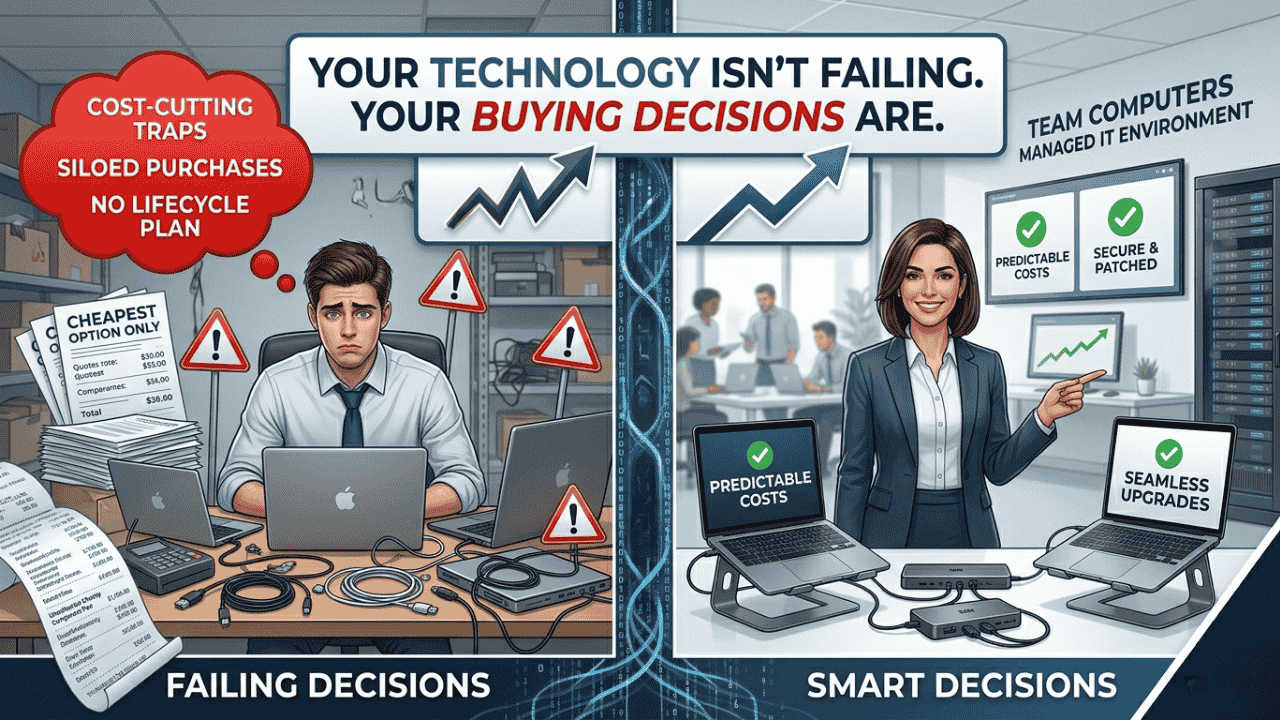
Are we being a good customer of technology?
Being a good customer means more than approving budgets. It means providing clarity, availability, and context:
When these elements are missing, even strong engineering teams struggle to deliver outcomes that match business expectations.
Healthy technology environments encourage challenge. Engineers should be able to question assumptions, highlight risks, and suggest alternatives. Early pushback saves time and avoids costly rework.
But in many organizations, pushback is interpreted as resistance. Teams are expected to simply deliver. Over time, technical professionals learn to stay quiet.
This dynamic is especially common in globally distributed teams, where cultural norms may discourage direct disagreement with senior stakeholders. That makes leadership behavior critical. If leaders want honest feedback, they must actively invite it, respond constructively, and demonstrate that raising concerns is valued — not penalized.
If your technology team never challenges decisions, it doesn’t mean everything is perfect. It may simply mean issues are being absorbed silently.
Improving technology outcomes doesn’t start with hiring more developers. It starts with improving how the business engages with technology. This includes:
It’s easy to assume technology problems originate in technology teams. It’s harder — but more productive — to examine how decisions are made, communicated, and managed across the business.
Organizations that improve this relationship often see better outcomes without changing their engineering teams at all.
Better technology delivery doesn’t start with better developers. It starts with better customers of technology.
So the next time a project struggles, pause before asking what went wrong in IT. Instead, ask a more uncomfortable — but far more useful — question:
Did we set them up to succeed?
The answer might change everything.
At Team Computers, we help organizations build the delivery discipline, governance structures, and business-technology alignment needed to ensure that ambitious initiatives actually succeed — from strategy to scale.