
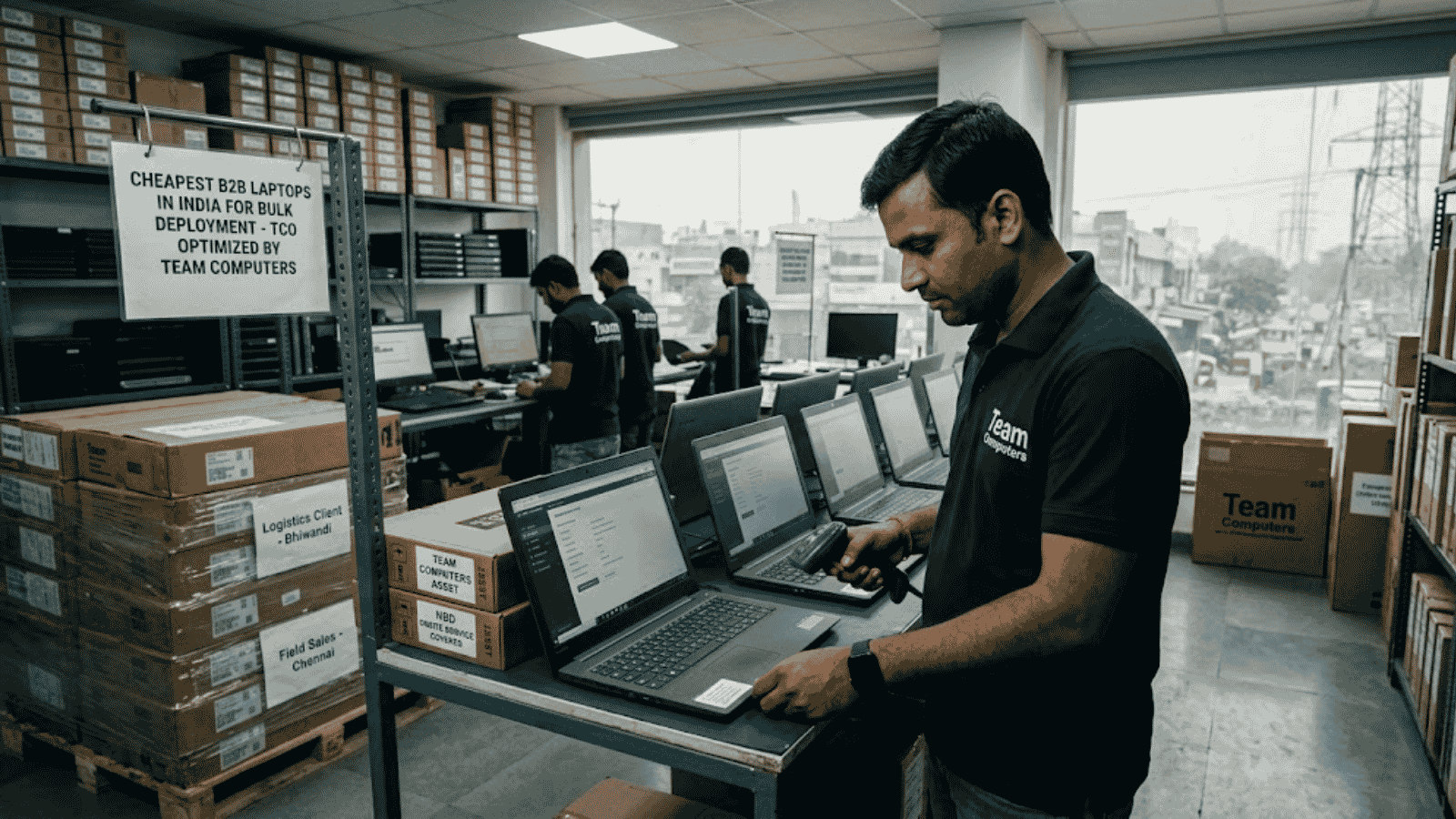
When the procurement mailer goes out for a 500-unit refresh, the instruction from Finance is usually singular: find the lowest price. But for the IT Head sitting in Delhi or Bangalore, “cheap” is a terrifying word. We’ve seen enterprises save ₹2,000 per unit on the sticker price of Cheapest B2B Laptops in India for Bulk Deployment, only to lose ₹10,000 per unit in productivity when those machines spend three weeks in a service center.
In 2026, the Indian market is flooded with entry-level silicon that looks great on a spreadsheet but fails the moment it hits the dusty, high-heat reality of a logistics hub or a field sales office. Selecting a laptop for business requires a shift from “Price at Purchase” to “Cost at Retirement.” This guide breaks down how to squeeze every rupee of value without sacrificing your team’s sanity.
Why “Cheap” is harder than it looks in 2026
Most procurement teams treat a laptop for business like a commodity—no different from office chairs or stationery. This is the first mistake. A laptop is a live entry point into your network; if it’s poorly constructed, it’s a security risk and a support vacuum. In the Indian context, the challenge is compounded by geography. A cheap device might work fine in a climate-controlled HQ in Gurgaon, but how does it handle the humidity of Chennai or the power fluctuations in a Tier-3 town?
Furthermore, the “L1 bidding” culture often ignores the software ecosystem. Entry-level consumer laptops, often mistaken for business laptops, come bloated with trialware and lack the TPM 2.0 hardware security needed for modern enterprise encryption. When you deploy 1,000 units, the time your team spends “de-bloating” and manually imaging these machines costs more than the price gap between a consumer unit and a proper B2B model.
The 3 things most teams get wrong in bulk buying
Rarely does a bulk deployment fail because of the CPU speed. It fails because of the “unspoken” specs that don’t make it onto the primary comparison sheet.
- The Build Quality Trap: Many budget-friendly b2b laptops use plastic chassis that lack internal reinforcement. After 12 months of being shoved into backpacks and opened 20 times a day, the hinges fail. 27% Percentage of hardware failures attributed to physical chassis/hinge damage in non-MIL-STD laptops.
- Warranty Ghosting: Buying from a portal might give you the lowest price, but try getting a technician to a warehouse in Bhiwandi on a Tuesday afternoon. Most “cheap” warranties are “carry-in,” meaning your employee stops working while the laptop travels to a center.
- The OS Mismatch: Procurement often flags “DOS” or “Linux” models as a way to save ₹4,000. But by the time you buy a volume license for Windows 11 Pro and spend man-hours installing it, you’ve spent more than if you’d bought the Pro-preloaded model from the start.
A step-by-step approach that actually works
If you want to secure the Cheapest B2B Laptops in India for Bulk Deployment without it blowing up in your face, you need a process that filters for durability as much as price.
- Demand a “Soak Test” Sample: Never buy 1,000 units based on a PDF. Get two samples, give them to your heaviest users for a week, and check for thermal throttling. If the fan sounds like a jet engine during a Zoom call, the motherboard won’t last three years.
- Verify Onsite Support Pin-codes: Before signing, ask the vendor for their direct service coverage map. If they don’t have an ASP (Authorized Service Provider) within 50km of your branch offices, that model is a “no-go.”
- Standardize the Ports: Ensure the “budget” model doesn’t skimp on essential connectivity. Having to buy ₹1,500 dongles for every employee because the laptop only has one USB-C port immediately erases your “savings.”
- Look for “E” and “V” Series: Brands like Lenovo and HP have specific lines (like the Lenovo V-series or HP 250 series) designed for the budget-conscious Indian SME. They strip away the carbon fiber and 4K screens but keep the enterprise-grade WiFi cards and keyboards.
- Check for Autopilot Compatibility: Ensure the BIOS supports cloud-based deployment. This allows you to ship a factory-sealed box to a remote hire; they login, and the laptop self-configures over the air.
What to look for in an external partner
Most vendors in India are simply “box-movers.” To succeed in a bulk rollout, you need a partner who understands the lifecycle, not just the transaction. A true partner should offer “Buffer Stock” management—keeping 2% of your fleet in their warehouse, ready to be dispatched the moment a user reports a critical failure.
They should also be able to handle “Green Disposal.” In 2026, E-waste regulations in India are stricter than ever. Your partner should provide a certified data-wiping and disposal path for your old fleet, potentially offering a buy-back credit that lowers the cost of your new bulk business desktops or laptops. Don’t just ask “how much is the laptop?” Ask “how much will you charge to keep it running for 1,000 days?”
How to know if it’s working
Metrics for a successful bulk purchase go beyond the initial invoice. You’ll know you’ve made the right choice when your “Out-of-Box Failure” (OOBF) rate stays below 0.5%. If you’re seeing 2% or 3% of new machines failing in the first month, your “cheap” choice was a mistake.
Monitor your “Ticket Density.” If the new laptops are generating a spike in “slow performance” or “WiFi dropping” calls, it’s a sign the internal components (like the SSD or network card) are sub-standard. A successful deployment is silent. When the IT desk isn’t hearing about the new hardware, you’ve won.
Practitioner’s Insight: The “Refurbished” Contingency
For non-critical roles or temporary project staff, many CIOs are now looking at “Enterprise-Grade Refurbished” units. A 2-year-old ThinkPad T-series often outperforms a brand-new “budget” consumer laptop in terms of keyboard feel, screen longevity, and port durability. If the goal is purely cost, a high-quality refurbished B2B unit is often a smarter play than the cheapest new retail unit.
B2B Laptop Purchase India: The Long View The goal of a B2B laptop purchase in India shouldn’t be to find the lowest number on a quote. It should be to find the most reliable tool for your workforce at a price point that doesn’t compromise your security posture. By focusing on serviceability, build quality, and modern deployment features, you can satisfy the Finance team’s budget while ensuring your infrastructure remains resilient.
- Audit your “Hidden Costs”—include shipping, imaging, and downtime in your next procurement comparison.
- Prioritize NBD (Next Business Day) Onsite Warranty as a non-negotiable line item in your RFPs.
- Test the thermal performance of budget models specifically in non-AC environments to simulate real-world India usage.
- Explore DaaS (Device as a Service) to convert a massive Capex burden into a manageable, per-user monthly fee.
Don’t let a low sticker price blind you to the operational risks of sub-par hardware.
Find Laptop for Your Business
We specialize in balancing tight budgets with enterprise-grade reliability. Let us help you navigate the bulk deployment landscape with devices that actually last.