
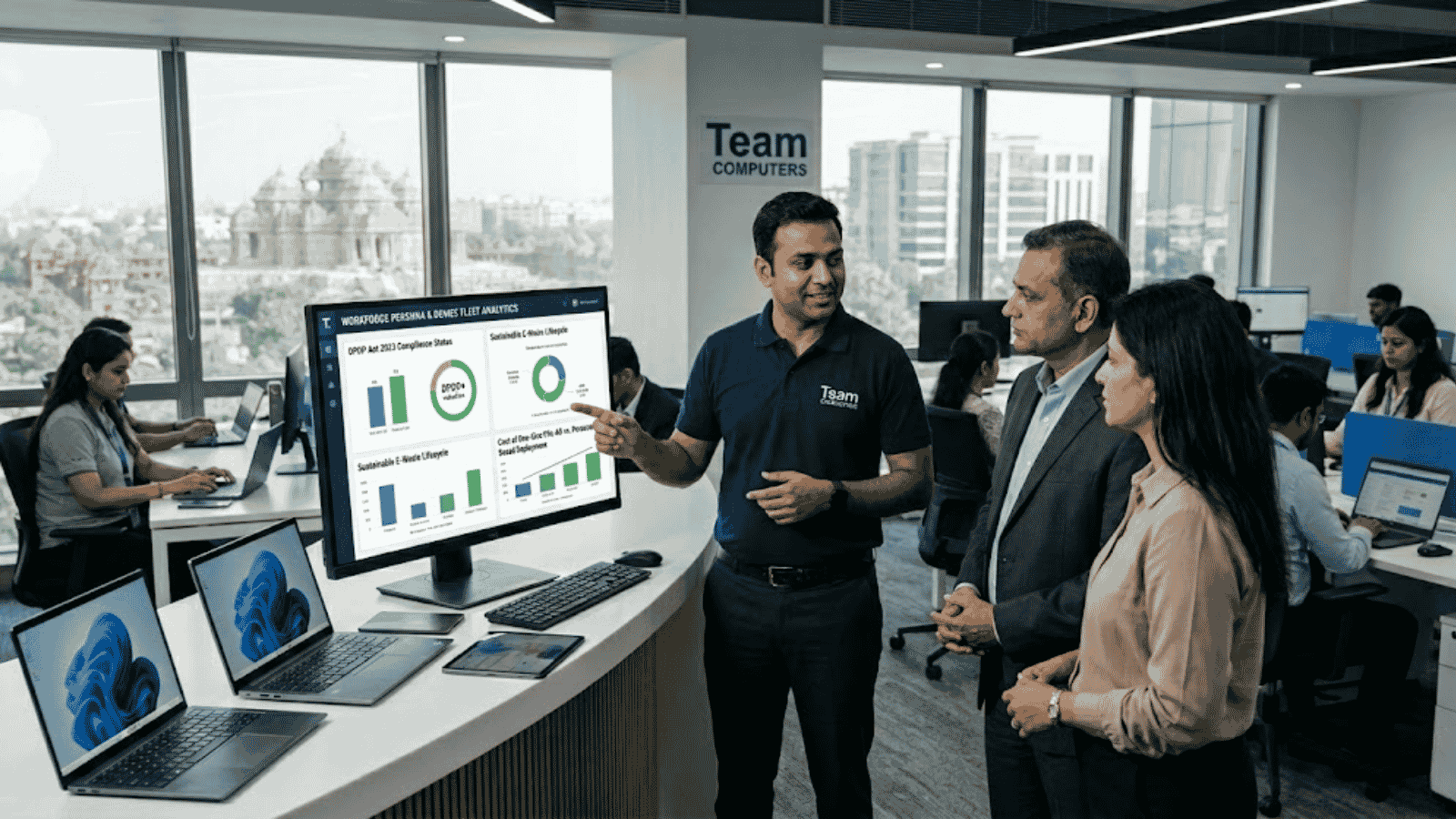
Walk onto any floor of a high-growth GCC in Bengaluru or a financial hub in Mumbai, and you’ll see a curious sight: high-performing engineers struggling with thermal throttling on sleek but underpowered ultrabooks. You’ve spent millions on hardware, yet the helpdesk is drowning in “my laptop is slow” tickets. This friction isn’t just an IT annoyance; it’s a direct drain on your company’s bottom line. If your correct device strategy still relies on bulk-buying three standard configurations for 5,000 people, you aren’t just behind the curve—you’re actively leaking productivity and risking regulatory non-compliance. In 2026, the device is no longer just a tool; it’s the primary environment where your business happens. This guide examines why IT leaders must pivot from procurement-led models to persona-driven ecosystems to drive real value.
The conventional wisdom (and why it’s wrong)
For decades, the gold standard for IT infrastructure was “standardization at all costs.” The logic seemed sound: buy one model in bulk to get the steepest discount from the OEM and simplify the life of your imaging team. Most organizations believed that as long as the RAM was sufficient, the form factor or specific hardware features didn’t matter.
What we’re seeing now is the spectacular failure of this “bulk-buy” mentality. When you give a data scientist the same machine as a sales executive, you’re paying for capabilities the salesperson doesn’t use while throttling the person responsible for your AI models.
The “standard” laptop has become the “mediocre” laptop. By trying to please everyone with a single SKU, you’ve pleased no one. It leads to shadow IT, where departments use their own budgets to buy unauthorized hardware because the official kit can’t handle the load. This breaks your security posture and makes asset tracking a nightmare.
What the data is actually telling us
Recent shifts in work patterns show that the relationship between hardware and retention is tightening. High-end talent in India’s competitive tech market views their toolkit as a reflection of how much the company values their time.
Furthermore, the data indicates a massive gap in “effective uptime.” A device might be “on,” but if it spends 15% of its cycle time on background updates or cooling down, that’s 15% of your payroll being burned. Modern telemetry now allows us to see that the cost of a “cheaper” device often exceeds the cost of a premium one within just 18 months due to increased support calls and decreased output.
The approach that forward-thinking CIOs are taking
Rarely do the best leaders start with a catalog. Instead, they start with a persona map. They categorize their workforce not just by department, but by “compute intensity.” A “Power User” in 2026 isn’t just someone who uses Excel; it’s someone running local LLMs or complex data visualizations.
These leaders are also moving toward “Device as a Service” (DaaS) models, but with a twist. It isn’t just about the financing; it’s about the lifecycle. They’ve realized that trying to manage 10,000 devices across 50 cities in India—from Tier 1 hubs to remote towns—is a logistical sinkhole for their internal teams. By partnering with a provider that has a deep local footprint, they ensure that a faulty motherboard in Coimbatore is replaced as fast as one in Gurugram. This is about moving from “owning assets” to “guaranteeing productivity.”
What this means for Indian enterprises specifically
Here’s the reality: the Digital Personal Data Protection (DPDP) Act has changed the stakes for end-user computing in India. Every device is now a potential point of liability for personal data breaches. You can no longer afford to have “old laptops” floating around the secondary market with poorly wiped drives, nor can you ignore the security features of the hardware itself..
The Indian enterprise landscape is also unique because of our geography. A correct device strategy here must account for the “dust and heat” factor which affects hardware longevity differently than in European or North American climates. We’ve seen countless instances where “global standard” laptops fail prematurely in Indian industrial hubs because the cooling systems weren’t designed for 45°C ambient temperatures. Local insights matter.
Why the “Good Enough” device is your biggest risk
Many CFOs still argue that the current fleet is “good enough.” But “good enough” is a silent killer of innovation. When your devices can’t support the latest collaboration tools or AI-assisted workflows, your team starts to lag behind competitors who can.
Moreover, sustainability is no longer a PR checkbox. With India’s growing focus on e-waste management and circular economy mandates, how you retire your devices is as important as how you buy them. A sophisticated strategy includes a clear plan for refurbishing or ethically recycling hardware, ensuring that your “correct device” today doesn’t become a legal or environmental headache tomorrow.
The Practitioner’s Insight
Many organizations forget that the “correct device” isn’t just the hardware; it’s the out-of-the-box experience. In 2026, if your employee has to spend four hours “setting up” their laptop, you’ve already lost. Zero-touch deployment—where a device goes from the factory to the employee’s home and configures itself—is the only way to scale without blowing up your IT headcount.
What we’ve learned over 38 years at Team Computers is that the most expensive device is the one that stays in the box or sits on a desk waiting for a technician. Most Indian firms are over-provisioning for some and under-provisioning for others. By balancing the fleet based on actual telemetry and persona needs, you’ll likely find that you can provide better hardware to those who need it without increasing your total budget.
Moving forward, the focus must shift to IT asset lifecycle management. This means tracking the health of a device in real-time and replacing it before it fails. It’s the difference between being a reactive fire-fighter and a proactive enabler of business growth.
The path to a more efficient workplace doesn’t start with a massive hardware refresh—it starts with a clear-eyed assessment of what your people actually do all day. If you don’t know the delta between your “standard” laptop’s specs and the software requirements of your most critical teams, you have a blind spot that will eventually show up in your turnover stats.
Key Takeaways for IT Leaders:
- Audit your personas: Stop buying by job title; start buying by application load and mobility requirements.
- Prioritize DPDP compliance: Ensure your device management layer can remotely wipe data and enforce hardware-level encryption across the entire fleet.
- Evaluate your “Last Mile” support: Confirm your partner can actually reach your remote employees in Tier 2 and Tier 3 cities within 24–48 hours.
- Move to Telemetry-driven refreshes: Use data to identify which devices are actually failing rather than relying on a rigid 3-year calendar.
Your hardware strategy is the foundation of your digital transformation. If the foundation is shaky, no amount of expensive software or cloud infrastructure will fix the lag in your organization’s performance. It’s time to stop treating devices as a commodity and start treating them as the strategic assets they are.