
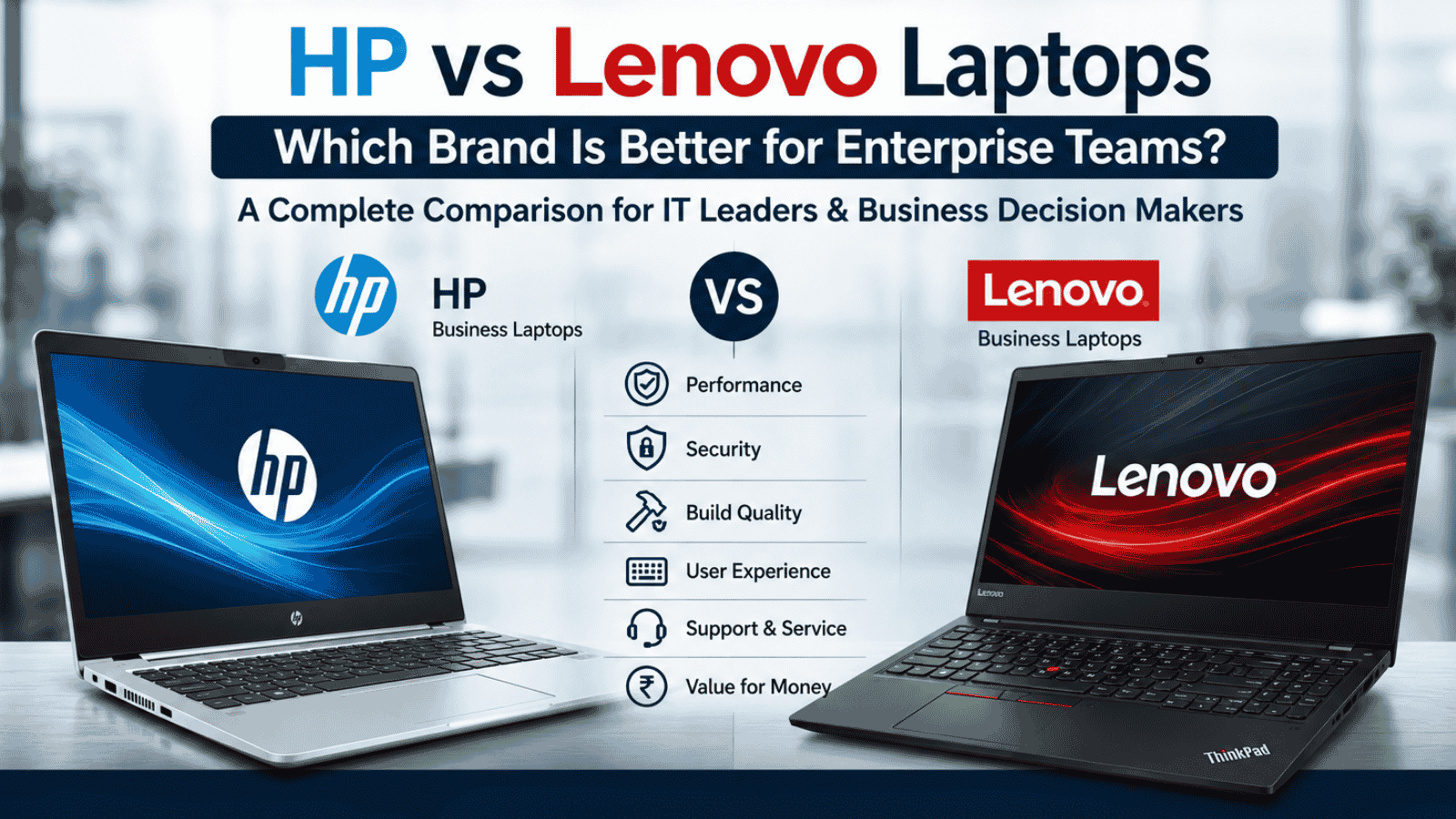
Choosing business laptops at scale is rarely just about specifications.
For IT heads and procurement teams, the real questions are:
- Which brand performs better over time?
- Which devices are easier to manage?
- Which offers better reliability across large deployments?
- Which creates fewer support tickets six months later?
Two brands dominate most enterprise discussions in India: HP and Lenovo.
Both offer strong enterprise portfolios, but they serve slightly different priorities depending on workforce needs, budgets, and deployment scale.
This comparison breaks down the key differences IT leaders should actually care about before making a bulk device decision.
Product Overview
HP Business Laptops
HP business laptops are widely used across enterprises, BFSI environments, consulting firms, and hybrid workplaces. The brand is known for sleek enterprise devices, strong security capabilities, and a broad service ecosystem in India.
Popular business series include:
- HP EliteBook
- HP ProBook
- HP 240/250 Series
HP devices are often preferred by organizations looking for premium user experience and strong enterprise security features.
Lenovo Business Laptops
Lenovo has built a strong reputation for durability, keyboard quality, and large-scale enterprise deployment. Its ThinkPad lineup remains one of the most recognized business laptop series globally.
Popular business series include:
- Lenovo ThinkPad
- Lenovo ThinkBook
- Lenovo V Series
Lenovo is commonly chosen for operational reliability, bulk deployment environments, and long-term enterprise usage.
Feature Comparison
1. Build Quality and Durability
HP
HP business laptops typically offer a more modern and premium appearance. EliteBook devices especially feel polished and executive-friendly.
Lenovo
Lenovo devices, particularly ThinkPads, are known for ruggedness and long-term durability. Many enterprises prefer them for heavy daily usage and operational environments.
Verdict
- HP: Better premium design
- Lenovo: Better rugged reliability
2. Keyboard and Employee Comfort
HP
HP keyboards are clean and comfortable for general business usage.
Lenovo
Lenovo ThinkPads are widely considered among the best laptop keyboards for long working hours.
Verdict
For employees working extensively on spreadsheets, reports, coding, or documentation, Lenovo often gets the edge.
3. Enterprise Security Features
HP
HP strongly focuses on endpoint security with features like:
- HP Wolf Security
- BIOS protection
- Self-healing firmware
Lenovo
Lenovo also provides enterprise-grade security tools but tends to focus more on operational stability and device management.
Verdict
HP has a stronger perception in advanced enterprise security positioning.
4. Pricing and Bulk Procurement
HP
HP premium business devices can sometimes be priced slightly higher, especially in EliteBook ranges.
Lenovo
Lenovo generally offers aggressive enterprise pricing across large deployments.
Verdict
Lenovo often provides better value for large-scale procurement.
5. Service and Enterprise Support in India
HP
HP has a strong enterprise presence and wide service coverage across Tier 1 and Tier 2 cities.
Lenovo
Lenovo has significantly expanded enterprise support capabilities and performs strongly in large deployments.
Verdict
Both brands perform well, though support experience can vary depending on deployment partner and SLA structure.
6. Best Fit by Business Type
| Business Need | Better Choice |
| Premium executive workforce | HP |
| Large operational deployments | Lenovo |
| Security-focused environments | HP |
| Budget-conscious enterprise rollouts | Lenovo |
| Long-term heavy usage | Lenovo |
| Modern premium experience | HP |
Final Recommendation
There is no universal winner between HP and Lenovo.
The right choice depends on your workforce, deployment scale, and operational priorities.
Choose HP if your organization prioritizes:
- Premium employee experience
- Advanced endpoint security
- Executive and hybrid workforce deployments
Choose Lenovo if your focus is:
- Large-scale deployments
- Operational durability
- Cost efficiency over long lifecycle usage
For most enterprises, the smarter approach is not just choosing the right laptop brand — but choosing the right deployment and lifecycle strategy around those devices.
Because even the best laptops perform poorly when deployment, management, and support are inconsistent.
CTA
Looking to compare HP and Lenovo devices for your organization?
Explore enterprise deployment, bulk procurement, lifecycle management, and end-user device solutions with Team Computers.
Get the right devices deployed faster, managed better, and optimized for long-term business use.