

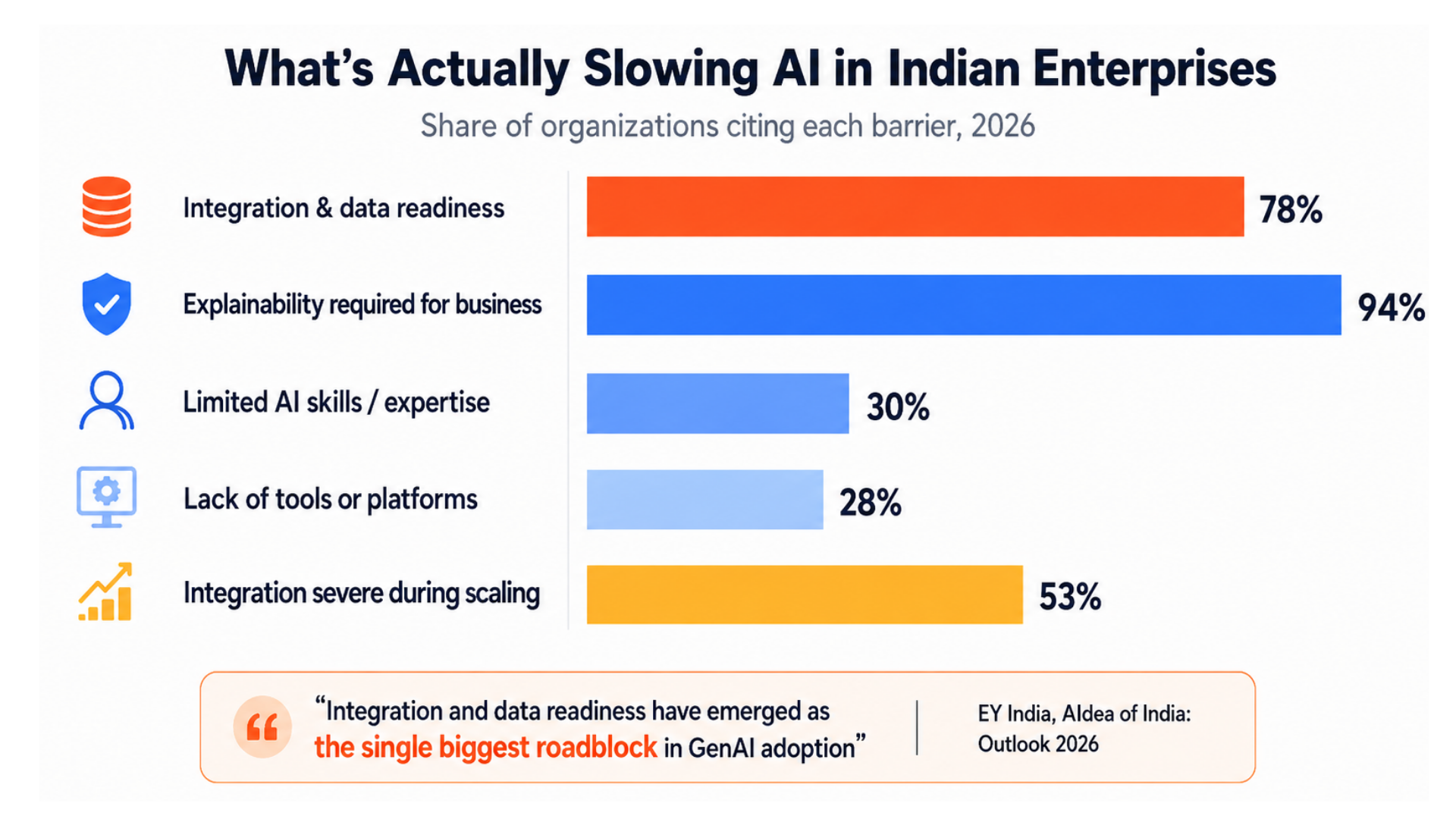
Integration and data readiness are now the single biggest roadblock to scaling GenAI in India, cited by 78% of organizations as their top barrier (EY India, AIdea of India: Outlook 2026). That statistic sits at the center of a strange paradox: Indian enterprises are moving faster than almost anywhere else on adoption, yet the foundation underneath that speed is often thinner than leadership assumes.
Can Indian enterprises actually hand agents the keys to real decisions, or are they racing ahead of what their data can support? That’s no longer a hypothetical question. It’s the one CIOs and CDOs across BFSI, manufacturing, and IT services are being asked in board meetings right now.
This piece looks at where India’s agentic AI shift actually stands, why trusted, governed data is the real constraint, and what the DPDP Act and RBI’s new AI oversight expectations mean for anyone building AI for enterprises in this market. [ORIGINAL DATA]
Key Takeaways
- 78% of Indian organizations cite integration and data readiness as their top barrier to scaling GenAI (EY India, 2026).
- 24% of Indian leaders are already deploying agentic AI, and over 80% are exploring autonomous agents (EY India; Deloitte India).
- India’s DPDP Act penalties reach ₹250 crore per violation, with full enforcement from May 13, 2027 (EY India DPDP Guide).
- The RBI’s FREE-AI framework now mandates board-approved AI policies and active oversight for regulated entities deploying autonomous systems (EY India).
Where Does India Actually Stand on Agentic AI Adoption?
India isn’t lagging on agentic AI — it’s moving into it faster than the global average on several measures, but the depth of that adoption varies sharply by function. EY India’s C-suite survey of 200 enterprises found 24% of leaders are already deploying agentic AI, with 47% running multiple GenAI use cases and nearly half reporting that over 10% of their proofs of concept have reached production (EY India, 2026).
Deloitte’s India research pushes that further: more than 80% of Indian organizations are exploring autonomous agent development, and half have flagged multi-agent workflows as a core focus area for the year ahead (Deloitte via CXOVoice, 2026). IBM’s India data adds useful texture: 59% of enterprise-scale Indian organizations have AI actively in use, and 74% of early adopters accelerated their AI investment over the prior 24 months (IBM via CXOVoice, 2026).
Isn’t it interesting that a market known for cost discipline is also one of the fastest to experiment? That combination — pragmatic ROI focus plus aggressive piloting — is fairly unique to India’s enterprise AI story.
Team Computers Data & AI Consulting
Why Is Trusted Data the Real Constraint for AI for Enterprises in India?
Data readiness, not model access, is what’s actually slowing Indian enterprises down. EY India’s survey found integration challenges cited by 78% of respondents as a top barrier, with 53% rating integration as a “severe” challenge specifically during scaling — not during the pilot stage (EY India, 2026). That detail matters: Indian enterprises aren’t struggling to start AI projects. They’re struggling to take them past the point where a human is still checking every output.
IBM’s India research names the same pattern from a different angle. The top three barriers Indian enterprises report are limited AI skills and expertise (30%), lack of tools or platforms (28%), and difficulty integrating and scaling AI (27%) (IBM via CXOVoice, 2026). Notably, 94% of Indian respondents said being able to explain how an AI system reached a decision matters to their business — among the highest explainability demands recorded anywhere in IBM’s global study (IBM, 2026).
How Are the DPDP Act and RBI’s FREE-AI Framework Changing the Governance Bar?
India now has enforceable rules that directly shape how enterprises can build agentic AI, and 2026 is functionally the “build year” before penalties apply. The Digital Personal Data Protection Rules, 2025 were notified on November 13, 2025, and roll out in three phases, with full compliance — including consent operations, breach notification, and data principal rights — required by May 13, 2027 (EY India; Fisher Phillips, 2026). Penalties for non-compliance can reach ₹250 crore per violation, and unlike GDPR, the DPDP Act offers no cure period before a fine can be imposed (Matters.ai, 2026).
Two provisions matter most for AI-specific data pipelines. First, Significant Data Fiduciaries — organizations processing high volumes or particularly sensitive personal data — must appoint an India-based Data Protection Officer, run independent data audits, and complete Data Protection Impact Assessments before deploying data-intensive AI systems (EY India, 2025). Second, the Consent Manager framework goes operational in November 2026, adding a formal intermediary layer for how enterprises capture and prove consent for the data feeding their models (Fisher Phillips, 2026).
On top of DPDP, regulated sectors face an additional layer. The RBI’s FREE-AI framework now mandates board-approved AI policies and active oversight for financial entities deploying autonomous systems — shifting AI governance from an IT decision to a board-level accountability item (EY India, 2026). One research group found 83% of organizations have not yet begun comprehensive DPDP implementation, and only 16% of Indian consumers currently understand the law well enough to exercise their rights under it (Responsible AI Labs, 2026) — a gap that will close fast once enforcement begins.
“RBI’s FREE-AI framework mandates board-approved AI policies and oversight” for regulated entities deploying agentic systems — EY India, AIdea of India 2026″
Real-World Example: What Happens When Agents Meet Ungoverned Data
EY India’s research offers a useful gut-check on where the ambition-versus-readiness gap actually shows up. While 76% of Indian leaders believe GenAI will have a significant business impact and 63% feel ready to leverage it, over a third openly admit they lag in readiness (EY India, 2026). That third isn’t failing because they picked the wrong model — it’s the same integration and data-readiness gap showing up again, just from the confidence side this time.
This is the pattern Team Computers’ Data & AI practice sees repeatedly across engagements with Indian enterprises and GCCs: a proof of concept works cleanly on a curated dataset, then stalls the moment it’s asked to run against the messier, fragmented, multi-system reality of production data — customer records split across CRM and legacy core systems, inconsistent product hierarchies, regional-language data that doesn’t map cleanly to English-first pipelines.
Sector matters too. Financial services and healthcare in India are scaling agentic AI more cautiously than IT services or retail, largely because RBI and sector-specific compliance expectations raise the bar for explainability and audit trails before an agent is trusted with a live customer decision. That caution isn’t a weakness — EY India’s own data shows it correlates with organizations that are further along, not further behind, once they do scale.
What Should an India-Ready Data Foundation Look Like?
An AI-ready data foundation in the Indian context needs everything a global enterprise needs — unified access, embedded governance, quality monitoring, semantic consistency — plus three things specific to operating here: DPDP-aligned consent infrastructure, India-based data residency planning for Significant Data Fiduciaries, and multilingual data handling across the 22 scheduled languages the DPDP Rules require notices to support (Matters.ai, 2026).
Practically, that breaks down into disciplines a Data & AI practice needs to run together, not sequentially:
- Consent-aware data pipelines — capturing and tracing consent at the record level so agentic systems only act on data with a valid, current legal basis
- Data residency and SDF readiness — mapping which datasets may trigger Significant Data Fiduciary obligations and preparing DPIAs before scale, not after
- Governance-by-design — access permissions, lineage, and audit trails embedded into the pipeline, especially where RBI or sector regulators require board-level sign-off
- Explainability by default — given that 94% of Indian enterprises say explainability is a business requirement, not a nice-to-have, agent decisions need traceable reasoning built in from day one
Where Team Computers’ Data & AI Practice Fits In
We’ve watched the same failure pattern play out across Indian enterprises that global research keeps confirming: the technology usually isn’t the reason a project stalls. It’s fragmented data ownership across legacy systems, consent and lineage that exist in a policy document but not in the actual pipeline, and governance that gets bolted on only after a regulator or an incident forces the issue.
Team Computers’ Data & AI practice is built to close exactly that gap for the Indian market — data engineering and platform modernization designed around DPDP and sector-specific compliance from the start, governance frameworks that satisfy both RBI-style board oversight and everyday operational needs, and structured delivery with real user adoption rather than a proof of concept that never leaves the sandbox. The aim isn’t another dashboard. It’s a data foundation Indian enterprises can actually hand a decision to, one governed workflow at a time.
That’s the quiet thesis underneath all the agentic AI momentum in India: the enterprises that win this decade won’t be the ones with the boldest agents. They’ll be the ones whose data — and whose compliance posture — earned the right to be trusted with a decision in the first place.
Explore Team Computers’ AI-Powered Analytics Solutions
Frequently Asked Questions
How far along is India in agentic AI adoption compared to the rest of the world?
India is ahead of many markets on experimentation, with 24% of leaders already deploying agentic AI and over 80% exploring autonomous agents. But EY India's research shows integration and data readiness — not appetite — is the biggest barrier to scaling those pilots into production
What does the DPDP Act require of enterprises building AI systems?
The DPDP Act and its 2025 Rules require consent-centric data handling, with Significant Data Fiduciaries needing an India-based Data Protection Officer, independent audits, and Data Protection Impact Assessments. Full enforcement, with penalties up to ₹250 crore per violation, begins May 13, 2027
Why do Indian enterprises rate explainability so highly for AI?
Explainability is rated as important by 94% of Indian survey respondents, among the highest globally, largely because sector regulators like RBI and the DPDP framework's accountability requirements demand that organizations can justify how an automated decision was reached
What's the first step for an Indian enterprise trying to become AI-ready?
Most Data & AI practitioners recommend starting with an honest data and compliance readiness assessment — mapping where personal data actually lives, whether it meets DPDP consent requirements, and which workflows have the data quality and governance to support agentic action today rather than in two years.