Quick answer: Data center tiers are a four-level classification system, developed by the Uptime Institute, that describes how much redundancy a facility has for power, cooling, and other critical systems, and correspondingly, how much downtime it’s designed to experience in a typical year. Tier 1 is the most basic, with no redundancy, while Tier 4 is fully fault-tolerant, with multiple independent systems that can absorb a component failure without any disruption.
Tier ratings come up constantly in conversations about colocation contracts, cloud SLAs, and data center design proposals, but the specific engineering differences behind each tier, and what the resulting uptime figures actually translate to in hours and minutes, are less commonly understood. That gap matters, because choosing a tier isn’t just a technical decision. It has direct, sometimes significant, cost implications, and getting it wrong in either direction, over-building or under-building, carries real business consequences.
The rest of this guide walks through what each tier actually means in practice, what the uptime percentages behind them represent, and how to think about choosing the right tier for a given workload rather than assuming higher is always better. If you’re new to the topic, start with what a data center is and how its components fit together.
What Is the Uptime Institute Tier Classification?
The Uptime Institute Tier Classification is the most widely referenced global standard for evaluating data center reliability and redundancy. It defines four tiers, Tier I through Tier IV, based on specific, measurable criteria: how many power and cooling distribution paths a facility has, whether those paths are active simultaneously or in standby, whether maintenance can be performed without shutting systems down, and how the facility responds to an unplanned component failure.
A few things are worth understanding about how this classification actually works. Formal tier certification is awarded by the Uptime Institute after a review of a facility’s design, construction, and, for the highest level of certification, its operational performance over time. Certification applies to a specific facility, and sometimes to a specific data hall or suite within a larger campus, rather than automatically extending to a provider’s entire portfolio. It’s also worth noting that the term “tier” is used loosely across the industry, including by providers that haven’t gone through formal certification, so it’s reasonable to ask a provider directly whether their tier claim reflects an awarded Uptime Institute certification or an internal self-assessment.
Tier I: Basic Capacity
A Tier I data center has a single, non-redundant distribution path for power and cooling. There’s no backup capacity for these systems, which means a failure in a critical component, or planned maintenance on one, can result in a full facility shutdown.
Expected availability for Tier I sits around 99.671%, which works out to roughly 28.8 hours of downtime per year. This is the simplest and least expensive tier to build and operate, which makes it a reasonable fit for workloads where downtime has limited business consequence, such as internal development environments or non-critical archival systems.
Tier II: Redundant Capacity Components
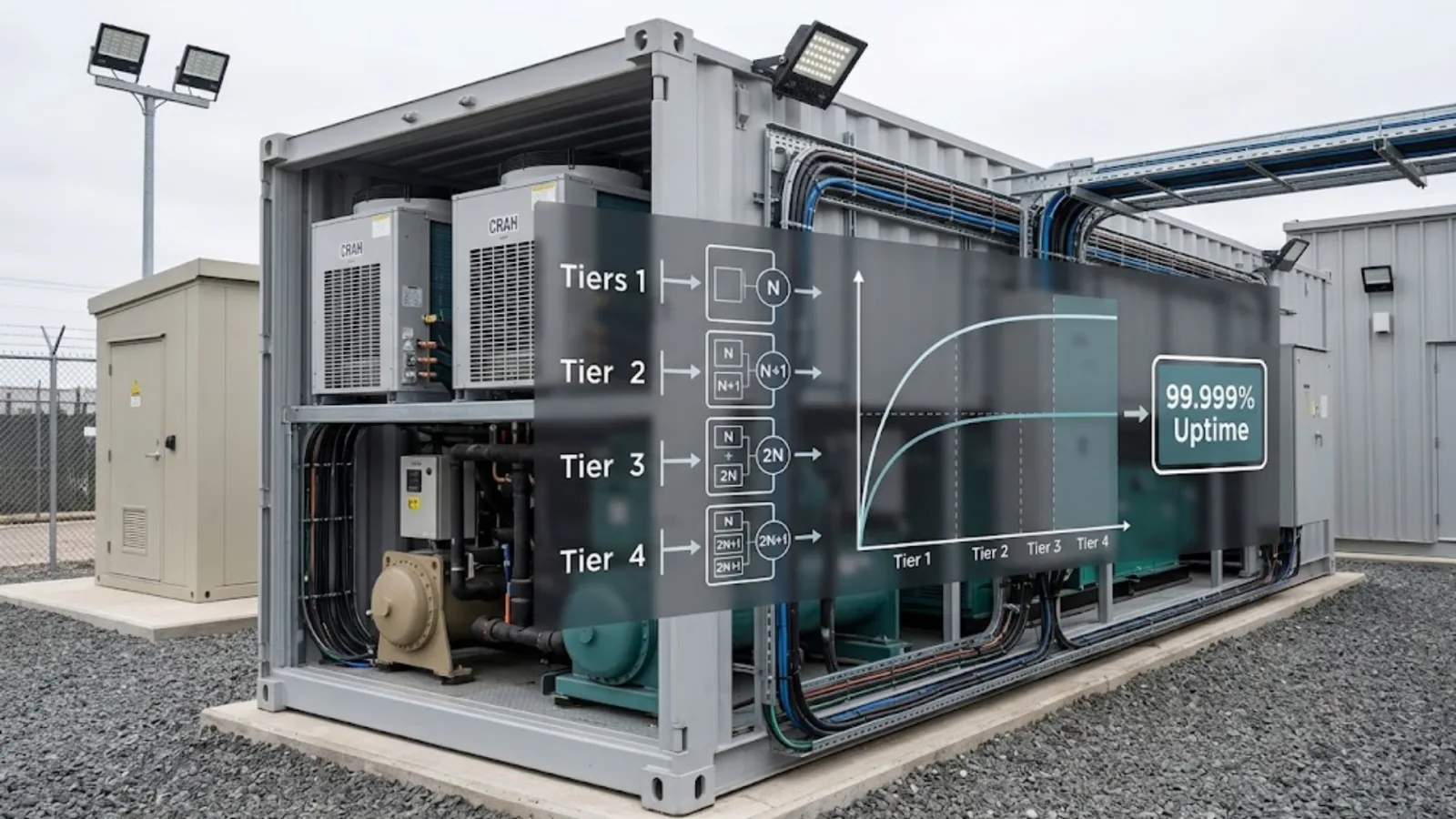
Tier II builds on Tier I by adding redundant capacity components, engine generators, additional cooling units, or energy storage, for example, while still relying on a single distribution path. This is often referred to as an N+1 model: baseline capacity, plus one additional backup unit.
Expected availability improves to around 99.741%, roughly 22 hours of downtime per year. Tier II facilities still require some downtime for maintenance on the single distribution path, since there’s no redundant path to shift load onto while work is performed. In practice, this tier suits organizations that want meaningfully better protection than Tier I without the cost and complexity of a fully redundant distribution architecture, such as smaller enterprises running standard business applications with moderate, rather than extreme, availability requirements.
Tier III: Concurrently Maintainable
A Tier III data center introduces multiple distribution paths for power and cooling, though typically only one path is actively serving load at any given time, with the other available as a maintenance and failover path. This is what makes a Tier III facility concurrently maintainable: routine maintenance can be performed on any component without shutting down the systems it supports.
Expected availability for a tier 3 data center reaches approximately 99.982%, or about 1.6 hours of downtime per year. Tier III is a common choice for enterprises running business-critical applications that need strong reliability but don’t carry the extreme cost of full fault tolerance. It’s worth noting that Tier III isn’t completely immune to unplanned outages. If a failure occurs while the backup path is already in use for maintenance, the facility has reduced protection until that maintenance work is complete, which is a meaningful, if often overlooked, nuance of this tier.
Tier IV: Fault Tolerant
A tier 4 data center is the highest classification, built around multiple, independent, and physically isolated distribution paths for power and cooling that are simultaneously active, not just available as standby. This is typically described as a 2N or 2N+1 model. The isolation between systems is deliberate: it ensures that a single event, whether a component failure or a maintenance activity, cannot compromise both systems at once.
Expected availability for Tier IV is approximately 99.995%, roughly 26 minutes of downtime per year. This level of resilience comes at significantly higher construction and operating cost than Tier III, which is why Tier IV is typically reserved for workloads where availability is close to non-negotiable, such as core financial transaction systems, critical national infrastructure, or applications where even brief outages carry outsized financial or safety consequences.
Data Center Uptime Percentage: What the Numbers Mean
Data center uptime percentage is usually expressed in “nines,” referring to how many nines appear in the availability figure. Each additional nine represents a meaningfully smaller amount of allowed downtime, not a proportionally smaller one, which is an important distinction when comparing tiers.
| Tier | Availability | Approximate annual downtime |
|---|---|---|
| Tier I | 99.671% | ~28.8 hours |
| Tier II | 99.741% | ~22 hours |
| Tier III | 99.982% | ~1.6 hours |
| Tier IV | 99.995% | ~26 minutes |
The jump from Tier III to Tier IV looks small on paper, from 99.982% to 99.995%, but it represents roughly a 73% reduction in allowed downtime. This is a useful reminder that availability percentages compress a large amount of engineering and cost difference into a figure that can look deceptively similar at a glance.
What Does Five Nines Availability Really Mean?
Five nines availability refers to 99.999% uptime, which equates to roughly 5.26 minutes of downtime per year. It’s worth being precise about this, because “five nines” gets used somewhat loosely in marketing conversations, and it doesn’t map directly onto any single Uptime Institute tier. Tier IV, at 99.995% (often called “four and a half nines”), is close to but not the same as true five nines.
Achieving genuine five nines availability, in practice, usually requires more than facility-level redundancy alone. It typically involves application-level architecture, such as active-active deployment across multiple, geographically separate data centers, so that even a catastrophic failure at one facility doesn’t take the service down. This is why organizations that need five-nines-level reliability for a specific application often architect for it explicitly, rather than assuming that placing infrastructure in a Tier IV facility automatically delivers that outcome on its own.
It’s also worth remembering that availability figures are design targets and contractual commitments, not guarantees against every possible failure scenario. Human error, software bugs, and events outside a facility’s control (such as a wide-area network outage) can affect availability regardless of the underlying facility’s tier. Uptime is also only one measure of service quality, as we explain in why uptime is no longer the most important IT metric.
How to Choose the Right Tier for Your Workloads
A common mistake is assuming every workload should run in the highest tier available. In practice, tier selection works better as a deliberate exercise matched to business impact. It is one of the earliest design decisions covered in our guide to data center solutions in India.
Start with business impact of downtime, not technical preference. An hour of downtime for an internal reporting dashboard has very different consequences than an hour of downtime for a customer-facing payment system. Tier level should track that difference.
Consider cost scaling, not just uptime scaling. The cost difference between tiers doesn’t scale linearly with the uptime improvement. Moving from Tier III to Tier IV often costs considerably more than the incremental availability improvement alone would suggest, which is worth weighing explicitly rather than assuming higher tier is automatically worth it.
Recognize that different workloads can sit in different tiers. There’s no requirement that an entire enterprise environment sit in a single tier. Segmenting workloads by criticality, and placing each in the tier that matches its actual availability requirement, is generally a more cost-effective approach than a uniform, one-size-fits-all decision.
Verify claims rather than relying on marketing language. When evaluating a colocation or managed facility, ask specifically whether the tier claim reflects a current, formally awarded Uptime Institute certification, and whether that certification applies to the specific hall or suite your infrastructure will occupy.
Choosing a Tier That Fits Your Business
Understanding tier standards is useful, but the more practical question for most enterprises is which tier, for which workloads, actually makes sense given their specific availability requirements, compliance obligations, and budget. That decision is easier to get right with support from a partner who has evaluated it across many different enterprise environments.
Team Computers works with enterprises across India to assess workload criticality and match it to the right data center tier, facility, and infrastructure design, whether that means an owned facility, a colocation partnership, or a hybrid approach. If your organization is evaluating tier requirements for a new deployment or reassessing an existing one, it’s worth having that conversation with an experienced partner before the decision gets made by default.
Related reading
- How to Choose an IT Infrastructure Services Company in India
- IT AMC vs Managed Services vs Staff Augmentation: Choosing a Support Model
- IT Infrastructure Security: A 12-Point Checklist for Enterprise IT
Frequently Asked Questions
Can a data center be certified at different tiers for design and for operations?
Yes. The Uptime Institute offers separate certifications for a facility's design documents, its as-built construction, and its ongoing operational sustainability. A facility can be certified for design at one tier level and later pursue operational certification to confirm it's actually performing to that standard in practice.
Is Tier IV always the safest choice?
Not necessarily the most practical one. Tier IV offers the highest resilience, but its cost is only justified for workloads where near-total availability is genuinely business-critical. For many enterprise workloads, Tier III offers a reasonable balance of reliability and cost.
Does a higher tier guarantee zero downtime?
No. Even Tier IV facilities have a small amount of expected downtime built into their availability target, and no facility, regardless of tier, is immune to failures outside the scope of its redundancy design, such as human error or external network outages.
How is data center uptime percentage actually calculated?
It's the share of total time a system is available: available hours divided by total hours in the period, multiplied by 100. A year has 8,760 hours, so 99.982% availability allows about 1.6 hours of downtime and 99.995% allows about 26 minutes. These are design targets, and real-world performance can vary from them.
Do colocation providers usually operate at a single tier across their entire facility?
Not always. Larger colocation campuses sometimes offer multiple tier options across different halls or suites within the same site, which is why it's worth confirming the specific tier that applies to your allocated space rather than assuming it matches the facility's overall marketing claim.