Data center energy consumption has moved from a facilities-department concern to a boardroom one, and for good reason. Power is typically the single largest ongoing operating cost for a data center, rising further as AI and high-density computing push energy demand higher across the industry. At the same time, ESG disclosure obligations are pulling infrastructure decisions directly into corporate sustainability reporting, in ways many IT leaders weren’t accountable for even a few years ago.
For enterprises operating or evaluating data center infrastructure in India, understanding what actually makes a green data center, how to measure and improve its efficiency, and how that data now feeds into formal ESG reporting has become a genuinely cross-functional responsibility, spanning IT, facilities, and increasingly, sustainability and compliance teams. What used to be a conversation confined to facility engineers is now, in many organizations, a data point that ends up in an annual report reviewed by the board, institutional investors, and regulators.
What Makes a Data Center “Green”?
A sustainable data center is one designed and operated to minimize energy consumption, water use, and carbon emissions relative to the computing capacity it delivers, without compromising the reliability enterprises depend on. This isn’t a single feature or certification. It’s a combination of design choices, operational practices, and measurement discipline that together determine how efficiently a facility converts power into usable compute.
The practical drivers behind this shift are straightforward. Energy costs represent a substantial and growing share of data center operating expenditure, so efficiency improvements translate directly into lower operating costs. Regulatory and investor pressure around emissions disclosure is intensifying, particularly for listed companies. And enterprise customers themselves are increasingly asking vendors and partners about the sustainability of the infrastructure supporting their services, making data center efficiency a factor that extends beyond an organization’s own balance sheet, into how it’s evaluated by the customers and partners it works with.
PUE: The Core Efficiency Metric
Power Usage Effectiveness (PUE) is the most widely used metric for data center energy efficiency, and understanding the PUE calculation is a reasonable starting point for evaluating any facility’s efficiency claims.
PUE is calculated as:
PUE = Total Facility Energy ÷ IT Equipment Energy
Total facility energy includes everything the data center consumes: IT equipment (servers, storage, networking) plus supporting infrastructure like cooling, lighting, and power conversion losses. IT equipment energy is just the power delivered to the actual computing hardware. A PUE of 1.0 would mean every unit of power consumed goes directly to IT equipment, with zero overhead, which is a theoretical ideal rather than something achieved in practice.
A lower PUE indicates a more efficient facility. Older or poorly optimized data centers commonly operate with a PUE in the 2.0 range or higher, meaning roughly as much energy is consumed by overhead (primarily cooling) as by the IT equipment itself. Well-designed, modern facilities can achieve a PUE closer to 1.2 to 1.4, and some of the most efficient hyperscale facilities report figures approaching 1.1, though these tend to benefit from scale and purpose-built design that’s harder to replicate in smaller, more typical enterprise or colocation environments.
PUE is a useful benchmark, but it’s worth understanding its limits. It measures overhead relative to IT load, not absolute energy consumption or the source of that energy, so a facility with a strong PUE that still draws entirely from carbon-intensive grid power isn’t necessarily a low-carbon facility in the broader sense. PUE should be treated as one input into a sustainability assessment, not the entire picture.
It’s also worth noting that PUE measurement methodology isn’t always consistent across facilities or providers, since it can be reported as an instantaneous snapshot, an average over a defined period, or measured at different points in the electrical distribution chain. When comparing PUE claims between facilities or colocation providers, it’s reasonable to ask specifically how the figure was measured and over what time period, rather than treating a headline number as automatically comparable across different sources.
Cooling Efficiency: Where Most of the Overhead Lives
Of the total overhead captured in a PUE figure, cooling is typically the single largest contributor, which is why cooling efficiency has an outsized effect on overall data center energy performance. In many conventional, air-cooled facilities, cooling alone can account for a substantial share of total non-IT energy consumption, which makes it the most consistently productive place to focus efficiency efforts, ahead of smaller-impact measures elsewhere in the facility.
A few approaches have become central to improving cooling efficiency:
Hot aisle/cold aisle containment. Physically separating hot exhaust air from cold intake air prevents mixing that forces cooling systems to work harder than necessary, one of the simplest and most cost-effective efficiency improvements available to most facilities.
Free cooling and economization. Using outside air or water, when ambient conditions allow, to supplement or replace mechanical cooling reduces the energy load on chillers and compressors. This is more climate-dependent than other approaches, and its effectiveness varies considerably across India’s different regional climates.
Liquid cooling for high-density workloads. As covered in our guide to AI-ready data centers, liquid cooling removes heat far more efficiently than air for high-density racks, which increasingly includes AI compute, and can meaningfully improve overall facility PUE as high-density workloads become a larger share of total capacity.
Right-sized cooling capacity. Cooling systems oversized relative to actual IT load run inefficiently. Matching cooling capacity closely to actual and near-term projected demand, rather than building excess headroom “just in case,” improves efficiency without compromising reliability if done with reasonable planning discipline.
Intelligent, sensor-driven cooling management. Modern facilities increasingly use real-time monitoring and automated adjustment of cooling output based on actual thermal conditions, rather than static settings that don’t respond to fluctuating load.
Beyond PUE: Water and Carbon Metrics
PUE gets the most attention, but two additional metrics are increasingly relevant for a complete picture of data center sustainability, particularly as reporting expectations mature beyond a single headline efficiency figure.
Water Usage Effectiveness (WUE) measures water consumed, often significant for facilities using water-based cooling, relative to IT energy consumption. This has particular relevance in India, where water scarcity is a serious concern in several of the regions where data center capacity has concentrated, making water-efficient cooling design a genuine operational and reputational consideration, not just an environmental one.
Carbon Usage Effectiveness (CUE) measures the carbon emissions associated with total facility energy consumption relative to IT energy use, which accounts for the source of the power, not just how efficiently it’s used. A facility with excellent PUE running entirely on carbon-intensive grid power has a very different CUE than a similarly efficient facility drawing a meaningful share of its power from renewable sources.
Understanding a Data Center’s Carbon Footprint
A data center’s carbon footprint spans several categories that map onto the standard greenhouse gas accounting framework used in most corporate ESG reporting.
Scope 1 emissions are direct emissions from sources the facility owns or controls, primarily backup generator fuel consumption during testing or outages, and any on-site fuel combustion.
Scope 2 emissions come from purchased electricity, typically the largest component of a data center’s carbon footprint, and the one most directly influenced by PUE improvements and the carbon intensity of the local power grid or any renewable energy sourcing in place.
Scope 3 emissions cover indirect emissions across the value chain, including the embodied carbon in manufacturing IT hardware and construction materials, upstream fuel and energy-related emissions, and end-of-life disposal of equipment. This category is often the least measured but, over an asset’s full lifecycle, can represent a meaningful share of total impact, which is part of why responsible hardware lifecycle management, refresh planning, and disposal practices are increasingly part of sustainability conversations, not just IT operations. As Scope 3 disclosure requirements continue to expand under frameworks like BRSR Core, enterprises that haven’t historically tracked this category in detail are likely to find it requires closer coordination with OEM and technology partners to source accurate embodied-carbon data for the hardware they procure.
ESG Reporting for IT Infrastructure in India
For Indian enterprises, ESG reporting for IT infrastructure has moved from voluntary best practice to a formal regulatory obligation for a growing set of organizations. The Securities and Exchange Board of India’s Business Responsibility and Sustainability Report (BRSR) framework requires India’s largest listed companies to disclose standardized environmental data, including energy consumption and greenhouse gas emissions across Scope 1 and Scope 2, with Scope 3 disclosure expanding over a phased implementation timeline. A more focused subset, BRSR Core, applies stricter, externally assured reporting requirements to an expanding set of companies over time.
Data center and broader IT infrastructure energy consumption typically falls squarely within these disclosure requirements for enterprises of meaningful scale, which means the efficiency of an organization’s data center operations, whether owned, colocated, or cloud-based, has a direct line to formal ESG disclosures reviewed by regulators, investors, and increasingly, customers and business partners.
This creates a practical planning implication: IT infrastructure decisions, including facility choice, cooling architecture, and hardware lifecycle management, increasingly need to be made with an awareness of how they’ll be reflected in ESG reporting, not treated purely as a technical or operational matter isolated from broader corporate disclosure obligations. For enterprises whose data center capacity sits with a colocation or cloud provider rather than in an owned facility, this also raises a practical question worth addressing directly with providers: whether they can supply the granular energy, PUE, and emissions data needed to support the enterprise’s own disclosure requirements, since gaps in this data can complicate accurate Scope 2 and Scope 3 reporting further down the line.
Building Toward an Energy Efficient Data Center
A few practical steps consistently show up in how organizations improve data center energy efficiency over time.
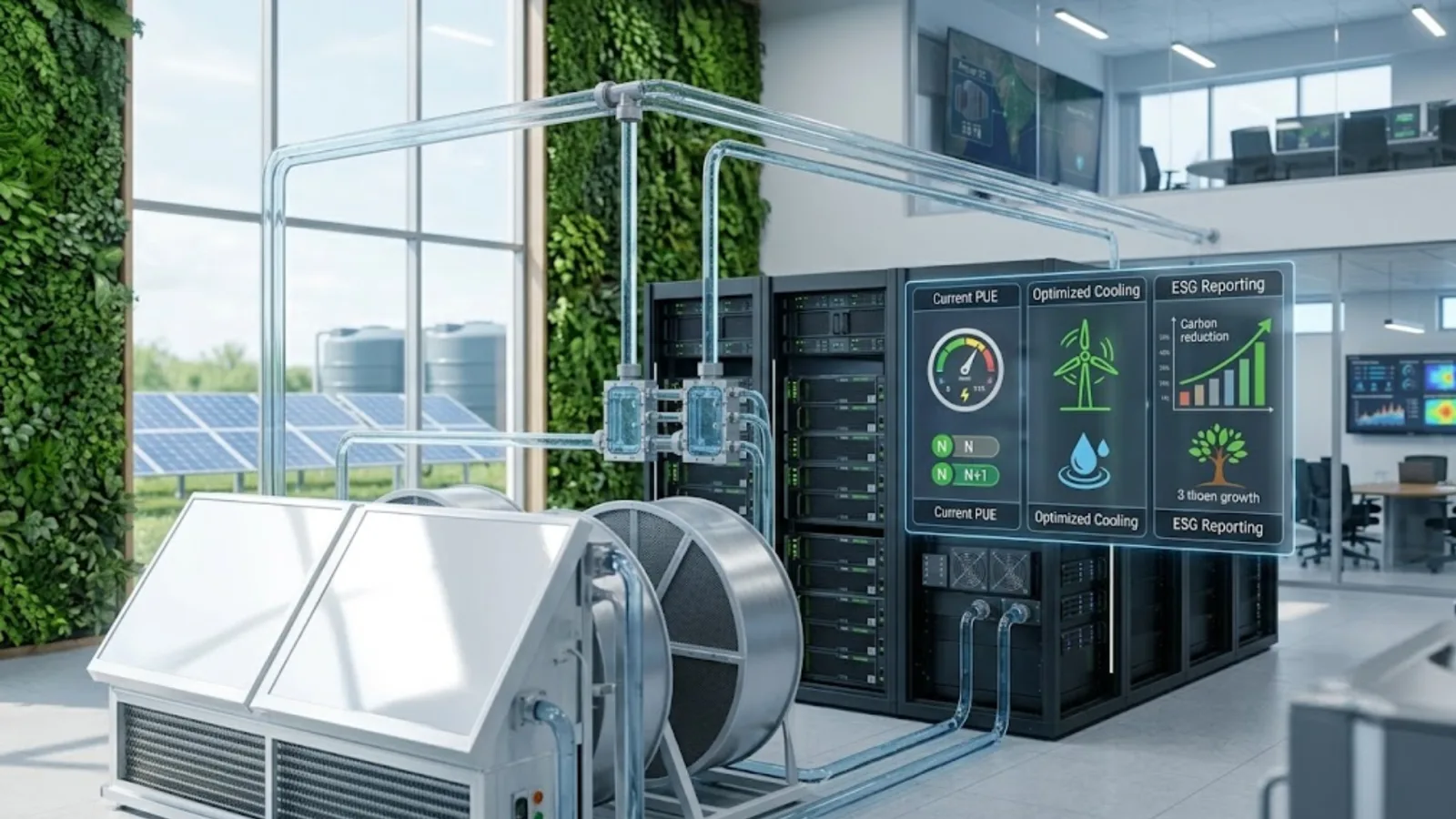
Measure before optimizing. Establishing an accurate current-state PUE, and tracking it consistently over time, is the foundation for any efficiency improvement effort. Without a reliable baseline, it’s difficult to demonstrate genuine improvement or prioritize where investment will have the most impact.
Prioritize cooling improvements first. Given how much of typical facility overhead comes from cooling, efficiency investments here tend to offer the strongest return relative to cost, particularly containment and right-sizing improvements that don’t require a full infrastructure overhaul.
Evaluate renewable energy sourcing. Whether through direct on-site generation, power purchase agreements, or providers offering renewable energy options, the source of a facility’s power increasingly matters as much as how efficiently that power is used, particularly for carbon-focused disclosure requirements. Renewable availability varies by region within India, which makes location a relevant factor in this evaluation alongside the more commonly cited factors of connectivity and cost.
Factor sustainability into colocation and facility selection. For enterprises weighing colocation against on-premise or cloud, PUE, renewable energy sourcing, and water usage practices are worth evaluating as explicit selection criteria, alongside the more traditional considerations of cost, connectivity, and reliability.
Extend the lens to hardware lifecycle. Given the significant Scope 3 contribution from IT hardware manufacturing and disposal, responsible procurement, extended and planned refresh cycles, and proper end-of-life disposal all contribute meaningfully to an organization’s broader IT sustainability profile, beyond facility-level metrics alone.
Where an Experienced Partner Helps
Building genuinely efficient, well-documented data center infrastructure, and connecting that infrastructure’s performance data to formal ESG reporting requirements, requires coordination across facility design, IT operations, and sustainability reporting functions that many enterprises haven’t historically needed to align this closely. Getting it right increasingly means treating energy efficiency and reporting readiness as a design input from the start of a data center project, rather than a compliance exercise layered on afterward. It is one of the design principles in our guide to data center solutions in India.
Team Computers works with enterprises across India to design and manage data center infrastructure with efficiency and sustainability as explicit considerations, from facility and cooling architecture decisions through hardware lifecycle management. If your organization is working to improve data center efficiency or align IT infrastructure decisions with ESG reporting obligations, it’s worth having that conversation as part of your next infrastructure decision, not as a retrofit after the fact. Talk to Team Computers about building infrastructure that performs well operationally and reports well against your sustainability commitments.
Related reading
- How to Choose an IT Infrastructure Services Company in India
- IT AMC vs Managed Services vs Staff Augmentation: Choosing a Support Model
- IT Infrastructure Security: A 12-Point Checklist for Enterprise IT