In today’s always-on world, downtime is not just an IT headache, it’s a direct hit to business performance. A single outage can halt revenue streams, freeze productivity and frustrate customers. In fact, a recent study found businesses lose about $2 million for every hour of downtime (roughly $76M per year on average). Yet many organizations still use reactive “break-fix” models where issues only surface after a user complaint. This old-school approach is dangerous. Modern enterprises are shifting to Remote Infrastructure Monitoring a continuous visibility model that uses real-time alerts and automation to spot problems before they cause impact. You’ll see how 24×7 monitoring and intelligent tools turn outages into uptime.
Why Reactive IT Models Are No Longer Enough
Traditional IT ops work like this: something fails, alerts (or users) raise tickets, then teams scramble to fix it. Every step is on-the-clock. This leads to late issue detection and all of us playing catch-up. For example, 41% of IT issues are still reported only via user tickets or manual checks. Engineers then waste ~33% of their time firefighting. The result? High downtime and stressed IT teams.
- Late detection: Critical failures often aren’t noticed until after an impact.
- Manual overload: Teams rely on people to notice and report issues, a recipe for missed alerts.
- Poor visibility: Siloed infrastructure (data centers, cloud, networks) means hidden blind spots.
- Alert storms: Outdated systems flood you with noise, making it easy to miss the real crisis.
As environments grow distributed (on-prem, multi-cloud, edge), a reactive “midnight page” model simply can’t scale. You need continuous oversight instead.
The Shift: From Midnight Alerts to Continuous Monitoring
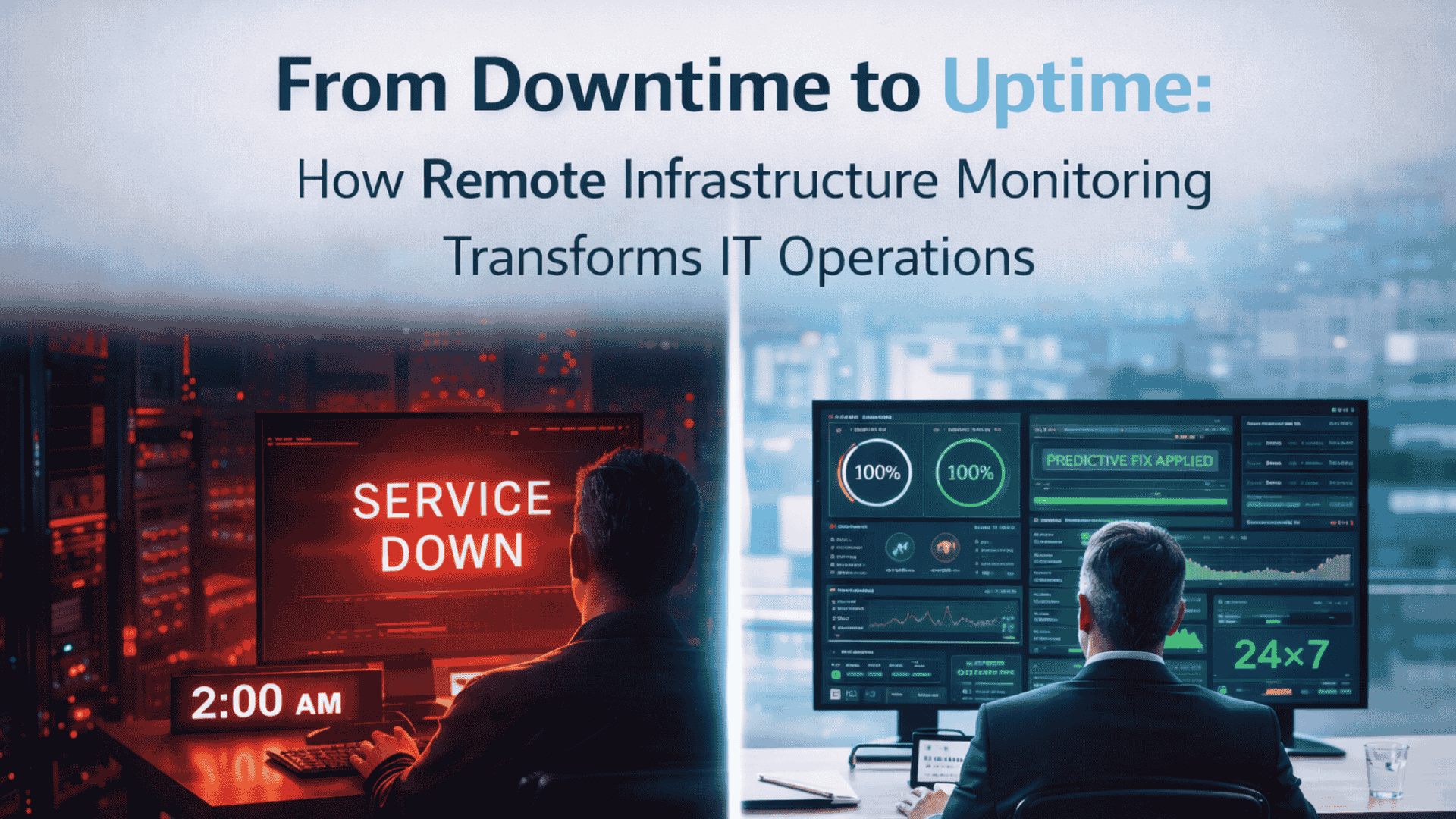
The Problem: The “Midnight Page”
Even a few years ago, many IT teams only learned of outages via pagers or angry users. The damage was already done: business was disrupted, SLAs broken, and recovery costly.
The Transformation with Remote Monitoring
Remote Infrastructure Monitoring Services give you real-time insight across your entire IT stack: servers, storage, networks, clouds and even applications. Instead of waiting for a failure, you can detect early warning signs like rising latency, disk bottlenecks, or unusual traffic patterns. For example, if a database’s response time slowly degrades, a good monitoring system will alert you long before users notice slowness. This shift means:
- Faster response: Team Computers’ clients now see alerts hours before any user impact.
- Proactive fixes: Minor issues (e.g. nearing capacity) can be resolved on the spot.
- Clear prioritization: Instead of 500 low-level alerts, you get a few high-value warnings.
One Indian e-commerce firm told us that after deploying remote monitoring, critical issues dropped by 60%. They resolved bottlenecks in minutes—before customers even knew. This is the difference between catching a problem in development vs. in production.
Reducing Alert Fatigue with Intelligent Monitoring
The Problem: Too Many Alerts, Too Little Context
Basic monitoring tools often emit a blizzard of alerts. This leads to “alert fatigue”: teams start ignoring non-critical alarms or getting overwhelmed. Meanwhile, the real incidents can slip through.
The Transformation
Modern monitoring platforms especially those with AI/Ops triage alerts for you. For instance, Team Computers’ ZerofAI platform (our AI-led monitoring) automatically correlates events across systems, filters out noise, and highlights only the critical ones. These smart platforms provide context (e.g. “CPU spiked on server X due to backup job”), so your team can act with confidence.
- Noise reduction: Only actionable alerts reach your phone.
- Automated insights: Correlated events show true root cause.
- Faster troubleshooting: You see why an alert happened, not just that it happened.
This means your ops team spends less time digging and more time solving. In practice, customers using intelligent monitoring report up to 40% faster incident resolution.
Enabling Global IT Operations with Centralized Monitoring
The Problem: Distributed Infrastructure, Limited Expertise
Enterprises today often span multiple cities or countries. Managing such a dispersed IT landscape requires expert eyes in every location, an impractical demand. Too often, smaller sites suffer from oversight gaps or inconsistent tools.
The Transformation
Remote Monitoring enables centralized control. Through 24×7 NOCs (Network Operations Centers) and Global Delivery Centers (GDCs), providers can keep watch over everything, anywhere. In other words, you get global expertise on demand. Key benefits:
- Continuous coverage: Local issues in Mumbai or Bangalore get the same attention at 2 AM as those in New York at noon.
- Standardized tools: One pane of glass for all sites ensures uniform tracking.
- Scalable support: You don’t need on-site experts everywhere; the provider’s team handles it centrally.
Consider a multinational IT firm with hubs in India and Europe. By leveraging a centralized NOC, they maintained 24×7 visibility over all data centers. When a critical router failure occurred in Pune at midnight, the offshore team in India was on it immediately fixing the issue within minutes instead of hours.
This model also helps meet compliance or regulatory demands. For instance, many Indian financial regulators expect demonstrable uptime. A central NOC can provide audit-ready logs showing every system’s health in real time.
Moving Toward Proactive and Self-Healing IT Operations
Remote monitoring isn’t the end it’s the enabler of automation. The future is “self-healing” infrastructure. Today’s top IT departments are already using monitoring data to trigger automated responses. For example:
- If disk space reaches 90%, automatically provision more storage.
- If a microservice crashes, spin up a fresh instance instantly.
- If malicious traffic is detected, firewall rules update themselves.
Over time this means far fewer manual tickets. Some Team Computers clients see 50% fewer service tickets after adding automated remediation. Essentially, IT shifts from “replacing fuse” to “designing smart systems.”
The outcome is clear: Lower downtime, faster fixes, and IT teams free to work on innovation instead of routine.
How Managed Services Strengthen Remote Monitoring
Remote monitoring reaches full power when paired with managed IT services. A provider like Team Computers combines:
- 24×7 NOC monitoring and incident response
- Data center and cloud infrastructure management
- Network monitoring and performance optimization
- Automation tools (like ZerofAI) for proactive resolution
This integrated approach means alerts don’t just stop at notification, they’re routed to experts who diagnose and fix issues immediately. For example, if monitoring spots a surge in CPU usage, Team Computers’ engineers can remotely rebalance workloads or upgrade capacity on-the-fly.
In short, managed services ensure your monitoring insights lead to action. They make your infrastructure not just visible, but also resilient and self-optimizing.
Conclusion: Turning Uptime into a Competitive Advantage
Reactive IT models lead to firefighting and costly downtime. By contrast:
- Continuous monitoring catches issues early.
- Intelligent alerting cuts noise and focuses teams.
- Centralized NOCs give 24×7 global oversight.
- Automation and MSP support turn insights into fixes before outages occur.
Together, these elements build a proactive IT operations model. Organizations that adopt this approach spend less on outages and more on innovation.
Your IT infrastructure can become a business enabler, not a bottleneck. And that starts with shifting from “we’ll fix it when it breaks” to “we prevent it from breaking in the first place.”