

A managed service provider is a company you pay a recurring fee to run part of your IT for you. That much most buyers already know. What trips them up is everything after the definition: whether an MSP is the same thing as an MSSP, why one quote is half the price of another, and what happens to accountability when the systems holding your customer data are operated by somebody else’s staff.
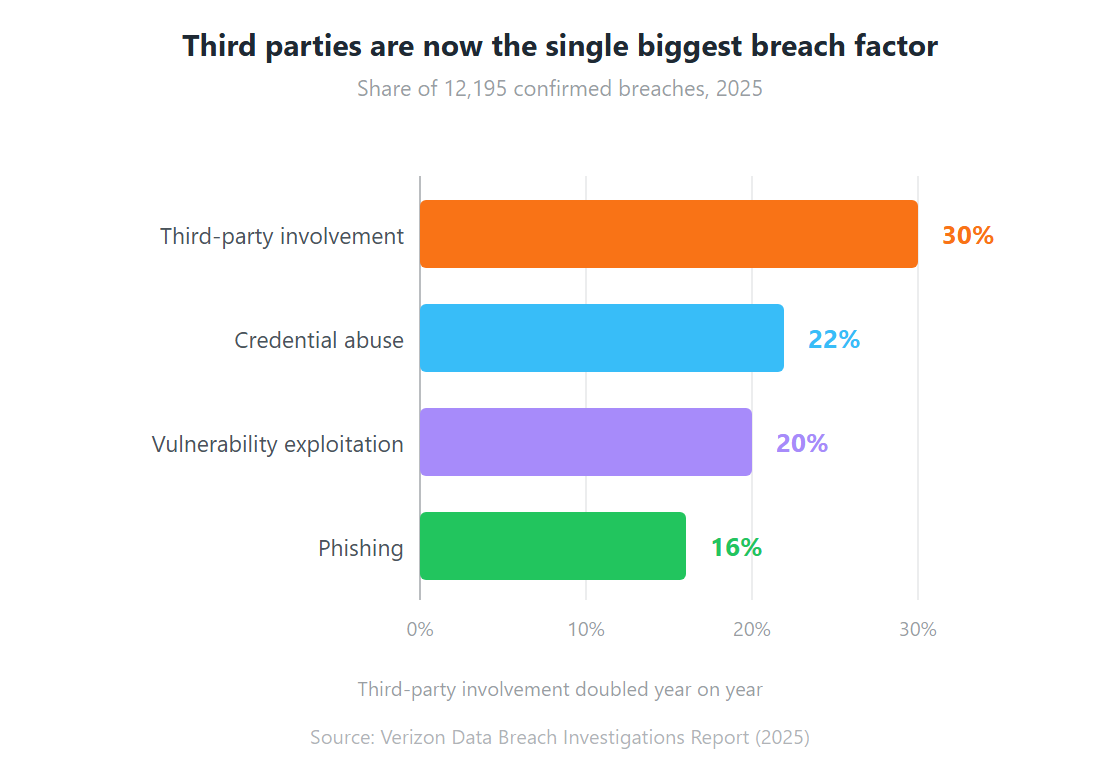
That last question is not theoretical. Verizon’s 2025 analysis of 12,195 confirmed breaches found the share involving a third party had doubled in a year, to 30% (Verizon, April 2025). Your MSP is a third party. Choosing one well is a security decision, not just a procurement one.
This guide covers what an MSP is, how the business model works, how MSPs differ from MSSPs and from resellers, what they cost, and how to evaluate one before signing. If you want the wider model rather than the provider, start with what managed services covers and come back here.
Key Takeaways
An MSP runs a defined slice of your IT for a recurring fee, under an SLA, continuously rather than on call.
MSP and MSSP are not synonyms. An MSSP runs a SOC and hunts threats; a general MSP mostly keeps things running.
Third-party involvement in breaches doubled to 30% in a year, so your provider is part of your attack surface.
The flat-fee model only aligns incentives if the contract is flat-fee. Hourly billing pays the provider for your outages.
Vet the provider’s own security posture before you vet their service catalogue.
What Is a Managed Service Provider?
A managed service provider is a third-party company that takes operational ownership of defined IT functions for a client, delivered continuously under a Service Level Agreement and billed on a recurring basis rather than per incident. The distinguishing feature is not the work itself but the timing: an MSP is contracted to prevent problems, and a break-fix vendor is contracted to arrive after one. That distinction has a measurable price attached, since ITIC found an hour of unplanned downtime costs more than USD 300,000 for 91% of mid-sized and large enterprises (ITIC).
Two pieces of tooling make the model possible, and it’s worth knowing their names because every provider will use them in a pitch.
Remote Monitoring and Management (RMM) is the agent software deployed across your endpoints and servers. It reports health, performance, patch status, and anomalies back to the provider continuously. This is what lets an engineer replace a failing disk on Thursday rather than rebuild a dead array on Saturday.
Professional Services Automation (PSA) is the provider’s own operating system: ticketing, SLA timers, asset records, billing. If an MSP cannot show you how PSA and RMM are wired together, their reporting is probably manual, and manual reporting tends to be optimistic.
A provider that meets the definition will offer all four of the following. Anything less is a support contract with a subscription attached.
- Continuous monitoring, not scheduled check-ins
- Recurring fixed pricing, not hourly billing
- Contractual service levels with defined consequences
- Named accountability for outcomes, not just for effort
How Does the MSP Business Model Actually Work?
The economics explain the behaviour, and they’re simpler than most buyers assume. Under a fixed monthly fee, every incident an MSP resolves costs it money, so its margin improves when your environment is stable. Under hourly billing the reverse holds. That inversion is the single most useful thing to understand before reading any proposal, because it predicts how a provider will behave once the honeymoon period ends.
An MSP makes money three ways. It spreads specialist salaries across many clients, so you rent a fraction of a cloud architect instead of employing one. It automates repetitive work, so an engineer who once handled 40 endpoints handles 400. And it buys tooling and licences at volume you cannot reach alone.
This is also why provider quality varies so widely at similar price points. Two MSPs can charge the same and deliver very different outcomes depending on how much of their delivery is automated versus how much is a person reading a dashboard. When you ask about automation depth later in the evaluation, this is the number you’re actually probing, and the mechanics of how that automation works are covered in our piece on AIOps in managed services operations.
What Does an MSP Do Day to Day?
Most engagements resolve into four repeating workstreams, and the reason they matter is speed of detection. IBM’s 2025 research put the global mean time to identify and contain a breach at 241 days, a nine-year low driven mainly by faster detection (IBM, 2025). Every one of the four workstreams below exists to pull that number down.
Service desk. L1 to L3 user support, ticket triage, and request fulfilment. This is the visible layer and the one your staff will judge the provider on, fairly or not.
Monitoring and alerting. Agents watch infrastructure and endpoints around the clock. Automation clears routine alerts. Engineers handle anything requiring judgement. Where this is delivered off-site rather than from your premises, it is usually sold as remote infrastructure management.
Maintenance. Patch cycles, firmware, backups, capacity planning, and lifecycle management. Unglamorous, and the first thing an under-resourced provider quietly lets slip.
Reporting and review. Monthly SLA reporting and quarterly business reviews. If you are chasing your provider for these, you have already learned something about them.
Backup and disaster recovery usually sits alongside these rather than inside them, and it’s worth confirming which. Plenty of contracts monitor a backup job’s completion without ever testing a restore.
MSP vs MSSP: What Is the Difference?
An MSP keeps IT running; an MSSP defends it. The gap between those two jobs is wider than most buyers expect, and getting it wrong is expensive: Verizon found ransomware present in 44% of all breaches analysed, rising to 88% of breaches at small and medium businesses (Verizon, 2025). A general MSP with antivirus and a patch schedule is not staffed to answer that.
| Dimension | MSP | MSSP |
| Primary objective | Availability, performance, user productivity | Threat detection, containment, compliance |
| Core facility | Network operations centre (NOC) | Security operations centre (SOC), staffed 24/7 |
| Typical tooling | RMM, PSA, backup, patch management | SIEM, EDR/XDR, MDR, threat intelligence feeds |
| Measured on | Uptime, ticket resolution time, SLA adherence | Mean time to detect, mean time to respond, dwell time |
| Trade-off accepted | Will favour user convenience | Will accept user friction to reduce risk |
| Regulatory role | Supports audits with operational evidence | Owns control implementation and evidence generation |
Some providers deliver both under one contract, typically pairing general operations with a dedicated managed cybersecurity practice. Many advertise both and staff only one. The question that settles it: ask whether the SOC is theirs, and if so, how many analysts are on shift at 3am on a Sunday. A provider subcontracting its SOC is not disqualified, but you should know before signing, not after an incident.
Regulated sectors rarely have a choice here. Banking under RBI supervision, insurers under IRDAI, and any organisation handling personal data under the DPDP Act need the evidence trail an MSSP produces as a matter of course.
MSP vs VAR vs System Integrator: Who Does What
These three get used interchangeably in Indian enterprise procurement and they describe genuinely different businesses. The distinction matters because the commercial model determines whose interests the vendor serves after the sale.
| Managed Service Provider | Value-Added Reseller (VAR) | System Integrator (SI) | |
| What you buy | Ongoing operation of your IT | Hardware and software, plus advice | A designed and built solution |
| Revenue model | Recurring subscription | Product margin, transaction based | Project fees, fixed or time and materials |
| Engagement shape | Continuous, multi-year | Transactional, repeat purchases | Finite, ends at handover |
| Incentive after delivery | Keep it stable, margin depends on it | Sell the next refresh cycle | Win the next project |
| Who runs it afterwards | The provider | You | You, or an MSP you appoint |
Many Indian vendors are two or three of these at once, which is fine as long as you know which hat is being worn in which conversation. The failure mode is buying an integration project from a company you assumed would also operate the result.
Is Your MSP a Security Risk? The Third-Party Problem
Yes, and the data is unambiguous about it. Verizon’s 2025 report found third-party involvement in breaches had doubled year on year to 30% of all confirmed breaches (Verizon, 2025). An MSP holds privileged credentials across your estate, which makes it one of the highest-value targets an attacker can reach through you, and one of the highest-value routes to you that an attacker can reach through someone else.
So ask the provider about their own posture before you ask about yours. Specifically:
- How privileged access to client environments is segmented, and can one compromised engineer account reach more than one client?
- Is MFA enforced on every administrative account, including the RMM console?
- What happened the last time they had a security incident, and what changed afterwards?
- Who holds ISO 27001 certification, the group entity or the delivery unit that will actually serve you?
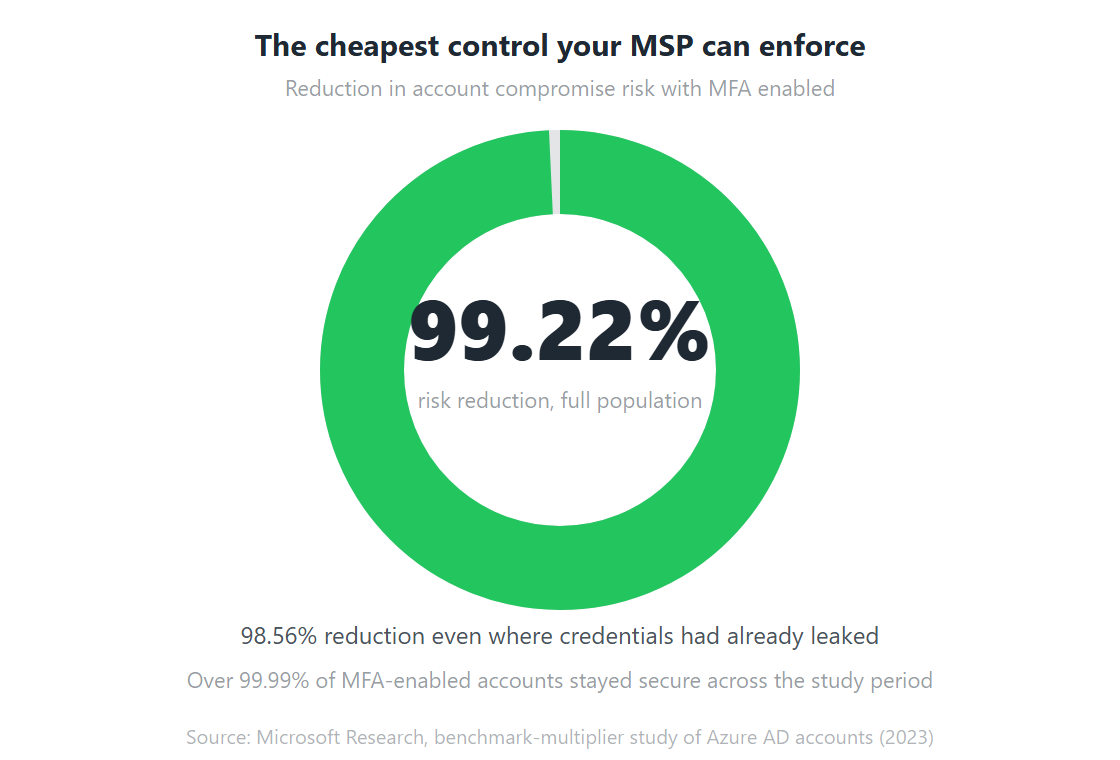
The MFA question is not a box-ticking exercise. Microsoft’s study of Azure Active Directory accounts showing suspicious activity found MFA reduced the risk of compromise by 99.22% across the population, and by 98.56% even where credentials had already leaked (Microsoft Research, 2023). A provider that has not enforced it on its own admin consoles is telling you how it will run yours.
How Are MSPs Staffed and Certified?
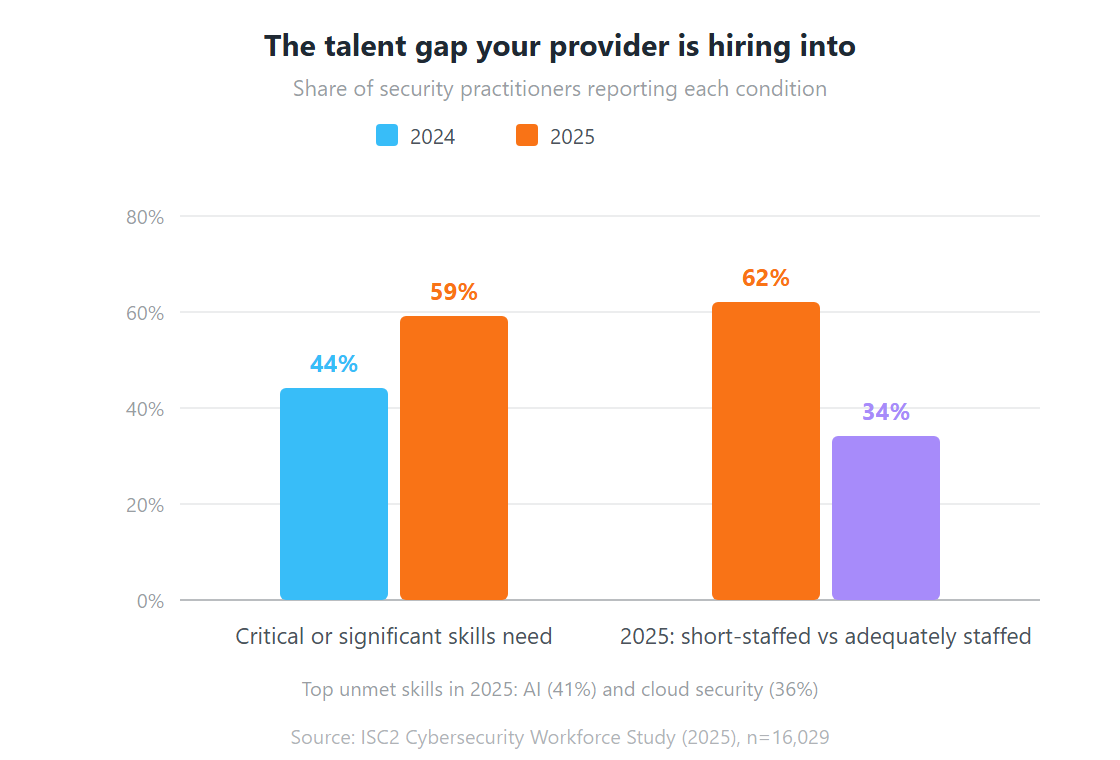
An MSP is a people business wearing a technology business’s clothes, and the labour market it hires from is tight. ISC2’s 2025 study of 16,029 practitioners found only 34% of security teams reported appropriate staffing, while 62% reported shortages, and 59% cited critical or significant skills gaps, up from 44% a year earlier (ISC2, December 2025). Every provider you evaluate is competing for the same scarce engineers you are.
What to look for on the people side:
Certification depth, not certification presence. One certified architect on a slide deck is marketing. Ask how many engineers hold the relevant certification and how many will be assigned to your account.
Named versus pooled resourcing. Will you get a named account engineer who learns your environment, or a rotating pool? Both models work. Pooled is cheaper and only works if documentation is genuinely good.
Attrition. Ask for engineering attrition over the last two years. High churn in a pooled model means your environment knowledge keeps walking out of the building.
Where the work is done. For 24/7 coverage, ask which centre covers which hours. A single delivery location covering “24/7” usually means a thin night shift. The same question applies to physical facilities if the scope includes colocation and data centre operations, where a night shift on site is not optional.
What Does an MSP Cost?
Pricing follows one of four shapes: per user, per device, all-inclusive flat fee, or a tiered baseline with add-ons. Which one fits depends on whether your complexity comes from people or from infrastructure. A manufacturer with a large plant floor and few office users is a per-device business; a professional services firm where everyone carries three devices is a per-user business.
The full breakdown of each model, including where costs creep, is in the managed services pricing section of our main guide. Two points specific to provider selection are worth making here.
First, check what “unlimited support” excludes. On-site visits, after-hours escalation, project work, and onboarding are the four things most commonly carved out of an unlimited contract.
Second, a lower monthly rate frequently signals thinner monitoring, and thinner monitoring shows up later as incidents. Given ITIC’s finding that 44% of enterprises put a single hour of downtime above USD 1 million, the difference between two quotes is rarely the largest number in the decision.
The 5 Mistakes Businesses Make When Choosing an MSP
These come up repeatedly in provider evaluations and each one is avoidable.
- Choosing on price alone. The cheapest quote usually buys the least monitoring. You pay the difference back in downtime, on a schedule you do not control.
- Treating the SLA as the whole contract. An SLA without defined penalties, an independent measurement source, and an escalation path is a statement of intent. Ask who adjudicates a missed target.
- Ignoring scalability. A provider sized for your current estate may not absorb a 300-person acquisition or a new site. Ask what the largest client they onboarded last year looked like.
- Overlooking automation maturity. Two providers at the same price deliver very differently depending on how much resolution is automated. Ask what percentage of standard incidents close without human intervention.
- Buying a provider instead of an operating model. The bigger decision is how IT gets run: fully outsourced, hybrid with an internal team, or co-managed. Settle that first, then shortlist providers who are genuinely good at that shape.
How Do You Evaluate an MSP Before Signing?
Run the commercial evaluation and the security evaluation as two separate exercises, because they fail for different reasons. The security one is the harder of the two, and given that a third of breaches now involve a third party, it deserves at least equal weight.
Work through these in order:
- Define the operating model first. Fully outsourced, co-managed, or augmentation. Write the RACI before you take a single sales call.
- Write your own SLA targets. Uptime, response and resolution by priority, reporting cadence. Then compare providers against your document rather than theirs.
- Audit their security posture. Privileged access segmentation, MFA on admin consoles, ISO 27001 scope, incident history.
- Probe automation depth. What share of tickets close without a human, and which tools produce that.
- Check delivery geography. Which centre covers which hours, and what the continuity plan is if one goes dark.
- Take references at your size and in your sector. Ask referees what went wrong once and how it was handled.
- Read the exit clause before the service catalogue. Notice period, data return format, transition assistance, and who owns the documentation. Contracts are easiest to leave when you negotiated the exit while they still wanted your signature.
That last point is the one buyers skip and later regret. Documentation ownership in particular decides whether switching providers takes six weeks or six months.
The Bottom Line on Managed Service Providers
An MSP is worth buying when your IT is business critical, your internal team is stretched, and you would rather pay a predictable fee than absorb unpredictable failure. It is worth buying carefully because the same contract that gives a provider the access to help gives them the access to hurt, and third-party involvement in breaches is now running at 30% and rising.
The providers worth shortlisting will answer the awkward questions directly: how their own admin access is segmented, what their engineering attrition looks like, what their last incident was. The ones to avoid will redirect to the service catalogue.
Team Computers operates managed services across infrastructure, cloud, digital workplace, and security for enterprises and GCCs in India. If you want to test any provider against the seven checks above, that list works on us too.
Frequently Asked Questions about MSPs
What does MSP stand for?
MSP stands for managed service provider. It describes a company that operates defined IT functions for a client on an ongoing basis, under a service level agreement, for a recurring fee. The term is used across infrastructure, cloud, end-user computing, and application support. When the same model is applied specifically to security, the provider is usually called an MSSP, a managed security service provider.
What is the difference between an MSP and an MSSP?
An MSP is measured on availability and user productivity; an MSSP is measured on threat detection and response. The MSP runs a network operations centre using RMM and patch tooling. The MSSP runs a security operations centre using SIEM, EDR or XDR, and threat intelligence, staffed around the clock by analysts. Some providers offer both. Many advertise both and only staff one, so ask specifically whether the SOC is theirs and how many analysts are on shift overnight.
Is an MSP the same as IT outsourcing?
No. Outsourcing usually transfers a whole function, sometimes including the staff who ran it. An MSP model is modular: you define which functions are in scope, the provider operates them under an SLA, and you keep governance. MSP delivery also leans much harder on monitoring tooling and automation, where traditional outsourcing is predominantly labour based.
Does hiring an MSP transfer my compliance liability?
No. Under frameworks such as India's DPDP Act, accountability stays with you as the data fiduciary regardless of who operates the systems. What a competent provider changes is your ability to evidence compliance: documented patch cycles, maintained access controls, and audit-ready incident logs. Read the liability and indemnity clauses closely, because an SLA credit is compensation for poor service, not cover for a regulatory penalty.
How do I check whether an MSP is secure enough to trust?
Ask four questions before the service catalogue. How is privileged access to client environments segmented, and can one compromised engineer account reach multiple clients? Is MFA enforced on every administrative account including the RMM console? What was their most recent security incident and what changed after it? And does the ISO 27001 certificate cover the specific delivery unit that will serve you, or only the group entity? Verizon put third-party involvement at 30% of confirmed breaches in 2025, so these are proportionate questions.
How long does onboarding with an MSP take?
Typically 4 to 12 weeks from signature to steady state, driven by scope and environment complexity. A single-site service desk can be live in 2 to 4 weeks. Full infrastructure and security coverage across multiple locations usually needs 8 to 12 weeks, because discovery, agent deployment, documentation, and knowledge transfer all have to finish before the SLA can start. Ask for a written onboarding plan with named milestones.
Can a small business use an MSP, or is it enterprise only?
Small businesses are well served by the model, usually starting with service desk and endpoint management on per-user pricing. The relevant question is whether the provider has packages built for your size or whether their minimum engagement is designed for enterprises. Ask about their smallest active client. Verizon's 2025 data found ransomware present in 88% of breaches at small and medium businesses, so the risk case for smaller organisations is if anything sharper than for large ones.