
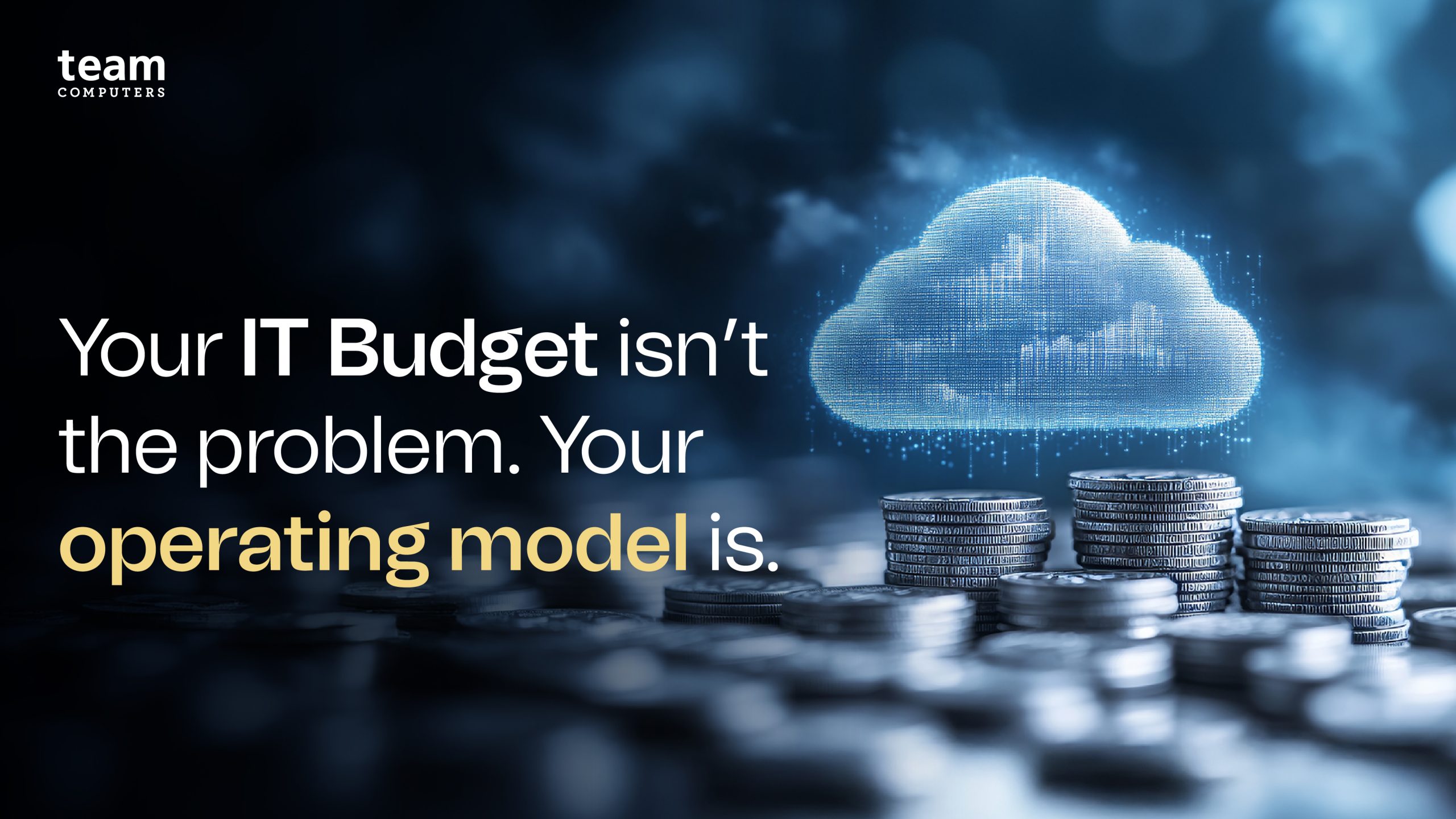
There was a time when the CIO’s mandate was simple: keep systems running.
Today, the mandate is sharper and far less forgiving—control cost, ensure uptime, secure the enterprise, enable growth, drive innovation, and report measurable impact at the board level, all while complexity compounds.
Hybrid cloud, distributed workforce, application sprawl, security mandates, data gravity, and AI ambitions have turned IT into the nervous system of the enterprise. Yet many operating models are still built for a slower, centralized, pre-cloud world. That mismatch is where cost inflates, incidents multiply, and innovation slows down.
This is why outsourcing managed services, when executed correctly, is no longer about delegation; it is about operational reinvention.
The Silent Drain on Enterprise IT
Most enterprises do not overspend because of one large decision; they overspend gradually. Cloud workloads expand without governance, manual processes persist because “that’s how it’s always been done,” support teams scale linearly with user growth, and incident volumes plateau instead of declining.
IT leaders find themselves managing activity instead of outcomes, resulting in rising operational expenditure without proportional business value.
This is the inflection point where CIOs must ask a tougher question: are we running IT, or engineering performance?
From Ticket Management to Performance Engineering
Outsourcing managed services should never mean exporting tickets to a third party, because if that is the model, nothing fundamentally changes.
The right model redesigns how IT operates by replacing reactive firefighting with proactive monitoring, manual repetition with automation, post-incident analysis with predictive intelligence, internal ambiguity with SLA-backed accountability, and static cost structures with continuous optimization.
When executed strategically, enterprises often achieve 15–30% operational optimization, not through cuts but through structural correction. Stability improves, uptime strengthens, resolution cycles shorten, and operational noise declines—allowing the CIO to move from explaining outages to leading transformation.
Uptime Is Now a Financial Metric
Downtime is no longer a technical inconvenience; it is a revenue variable. In digital-first enterprises, availability defines brand trust because customers do not distinguish between application failure and company failure.
A mature managed services ecosystem builds resilience through real-time visibility across environments, structured escalation frameworks, predictive anomaly detection, and continuous performance tuning. The outcome is not just higher availability but operational confidence.
For CFOs, this reduces financial exposure. For CEOs, it protects reputation. For CIOs, it creates strategic breathing room.
Cost Optimization without Compromising Capability
Cost optimization is often misunderstood as cost reduction, when in reality it means spending smarter. It involves eliminating waste in cloud consumption, reducing repetitive ticket volumes through automation, shortening Mean Time to Resolution (MTTR), improving first-contact resolution, and scaling services without proportionally scaling headcount.
The objective is not to shrink IT but to make it economically intelligent, embedding financial discipline into daily operations rather than addressing it during quarterly reviews.
Why the Right Partner Changes the Equation
Team Computers Pvt Ltd approaches managed services as a transformation discipline rather than a staffing model, focusing not on filling seats but on engineering measurable outcomes.
With expertise spanning digital workplace, data center and cloud infrastructure, application managed services, and global delivery centers, Team Computers integrates governance, scalability, and automation into a unified operational framework. Its engagement model is aligned to business metrics such as cost per user, cost per workload, automation ratio, and incident reduction trends, ensuring that value is defined by performance rather than volume.
Modern enterprises do not need vendors; they need performance partners.
The ZerofAI Advantage: Intelligence at the Core
ZerofAI introduces an AI/ML-powered automation layer that shifts IT operations from reactive to predictive. Instead of waiting for failures, anomalies are identified early; instead of escalating repetitive tickets, workflows self-heal; instead of discovering cost overruns after the fact, cloud anomalies are flagged in real time.
The measurable impact includes a significant reduction in repetitive incidents, faster root cause correlation, lower manual intervention dependency, stronger SLA adherence, and smarter cloud cost governance. Automation stops being a roadmap ambition and becomes embedded intelligence within everyday operations, which is where true competitive advantage begins.
What This Means for CIOs, CEOs, and CFOs
For CIOs, it delivers operational clarity and strategic focus. For CFOs, it ensures predictable and optimized cost structures. For CEOs, it enables technology to actively support growth rather than merely sustain it.
Outsourcing managed services, when engineered correctly, is not an operational adjustment but a leadership decision that determines whether IT remains a cost center struggling with scale or evolves into a high-performance engine aligned with business velocity.
The Strategic Question
Complexity will continue to increase, cloud adoption will deepen, automation expectations will intensify, and board scrutiny will sharpen.
The real question is whether your current operating model can sustain tomorrow’s demands without eroding cost efficiency or strategic momentum.
IT itself is not expensive. Inefficiency is.