
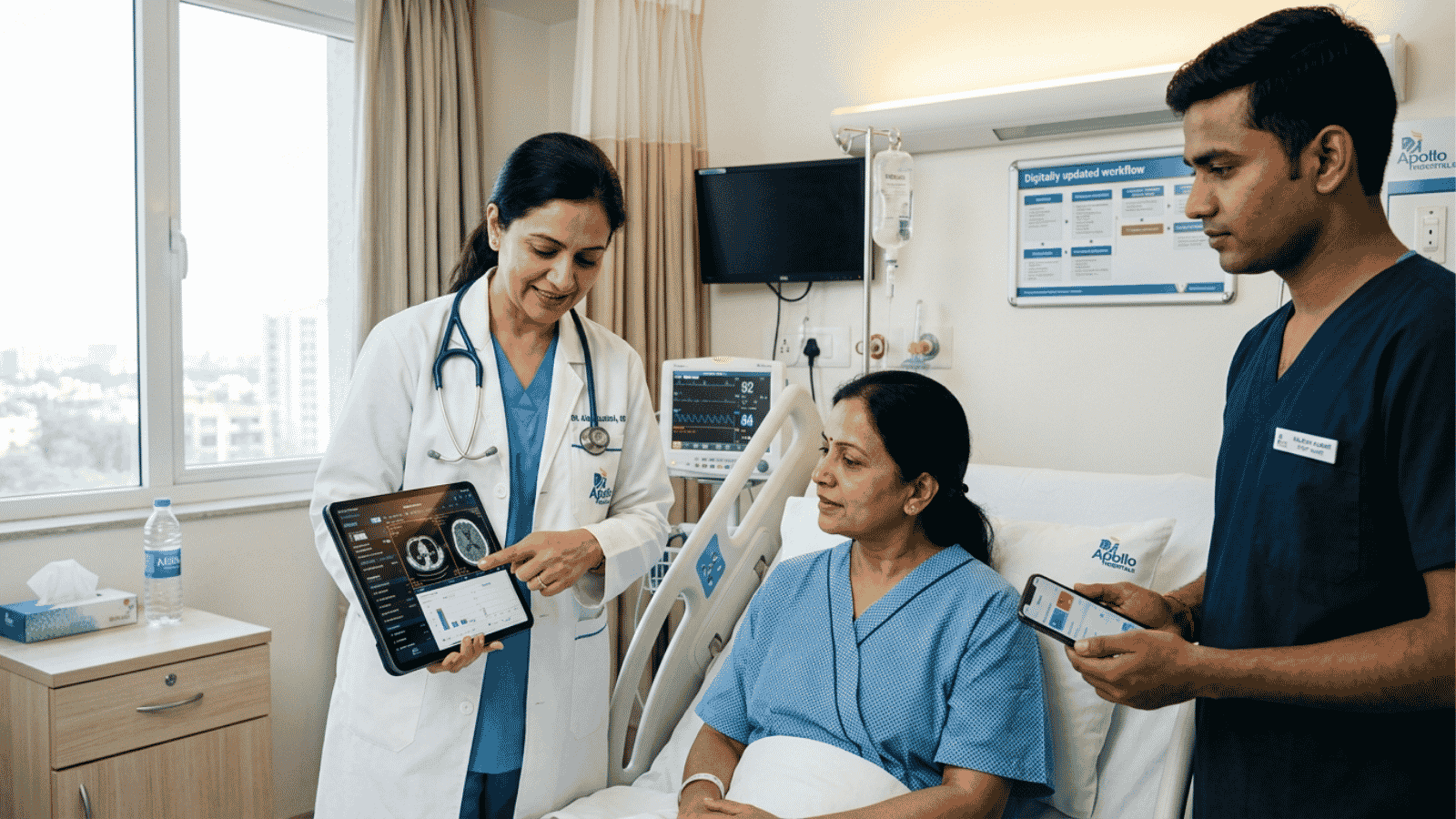
A senior doctor at a multi-specialty hospital in Delhi recently pointed out a recurring issue — not clinical, but operational. “We lose time moving between systems, not treating patients.”
If you’re managing IT in healthcare, that hits close to home. Systems are in place. Investments have been made. Yet, workflows remain fragmented — especially at the point of care.
Across India, hospitals and healthcare networks are now rethinking how technology supports clinicians, nurses, and administrative teams in real-time. The focus is shifting from backend systems to front-line usability.
That’s where Apple devices are starting to play a bigger role. With Team Computers as your India top Apple business partner, healthcare organisations are not just deploying devices — they’re reshaping how care is delivered, accessed, and managed.
Here are seven ways this transformation is happening.
1. Enabling real-time access to patient data at the point of care
Doctors and nurses no longer need to move back and forth between workstations.
With iPads and iPhones, patient records, test results, and treatment plans can be accessed instantly at the bedside. This reduces delays and helps clinicians make faster, more informed decisions.
In high-pressure environments, access speed directly impacts care quality.
2. Improving mobility across hospital environments
Healthcare isn’t static. Staff move constantly — between wards, departments, and emergency units.
Traditional desktop-based systems limit flexibility. Mobile devices remove that constraint.
Apple devices allow healthcare professionals to stay connected to systems while on the move, reducing dependency on fixed workstations and improving workflow continuity.
3. Supporting faster and more efficient clinical workflows
Time lost in navigation, system lag, or repeated logins adds up quickly.
With intuitive interfaces and optimised performance, Apple devices help streamline routine tasks such as:
- Updating patient records
- Ordering tests
- Reviewing reports
- Coordinating between departments
Even small improvements in speed can significantly impact overall efficiency.
4. Enhancing patient engagement and communication
Patients today expect clarity and involvement in their care journey.
iPads are increasingly being used to:
- Explain procedures visually
- Share reports and results
- Capture patient consent digitally
This creates a more transparent and engaging experience, improving patient confidence and satisfaction.
5. Strengthening data security and compliance posture
Healthcare data is highly sensitive — and increasingly regulated.
With India’s growing focus on data protection, including frameworks like the DPDP Act 2023, healthcare providers are under pressure to strengthen security practices.
Apple’s architecture and controlled ecosystem help reduce certain vulnerabilities at the device level. Combined with enterprise security policies, this supports a more resilient endpoint environment.
6. Reducing dependency on paper-based processes
Despite digitisation efforts, many hospitals still rely on paper for certain workflows.
Apple devices are helping reduce this dependency by enabling:
- Digital forms and documentation
- Electronic signatures
- Real-time data entry
This improves accuracy, reduces manual errors, and enhances record-keeping efficiency.
7. Simplifying device management at scale
Healthcare environments often operate across multiple locations — hospitals, clinics, and diagnostic centres.
Managing devices across such distributed setups can be complex.
With the right approach, Apple devices can be:
- Centrally managed
- Securely configured
- Easily updated
This ensures consistency across locations and reduces operational overhead for IT teams.
What this means for healthcare IT leaders
Most healthcare organisations aren’t replacing everything overnight. They’re starting with targeted use cases — specific departments, workflows, or roles — and expanding based on outcomes.
That’s the pattern we’re seeing across India.
The shift isn’t about technology adoption for its own sake. It’s about making systems work better for the people who rely on them the most.
Conclusion
Healthcare IT is no longer just about systems — it’s about experience, speed, and reliability at the point of care.
Indian healthcare providers are recognising that improving clinical workflows doesn’t always require new infrastructure. Sometimes, it requires better access, better mobility, and better integration.
Here’s what you should focus on:
- Identify where delays occur in clinical workflows
- Enable mobility for frontline staff
- Reduce dependency on manual processes
- Strengthen device-level security and compliance
When these pieces come together, the impact is immediate — not just for IT teams, but for patient care.
With Team Computers as your India top Apple business partner, this transition becomes structured, scalable, and aligned with the realities of healthcare environments in India.
Delaying these improvements doesn’t just maintain the status quo — it continues to slow down the very workflows that healthcare depends on.