
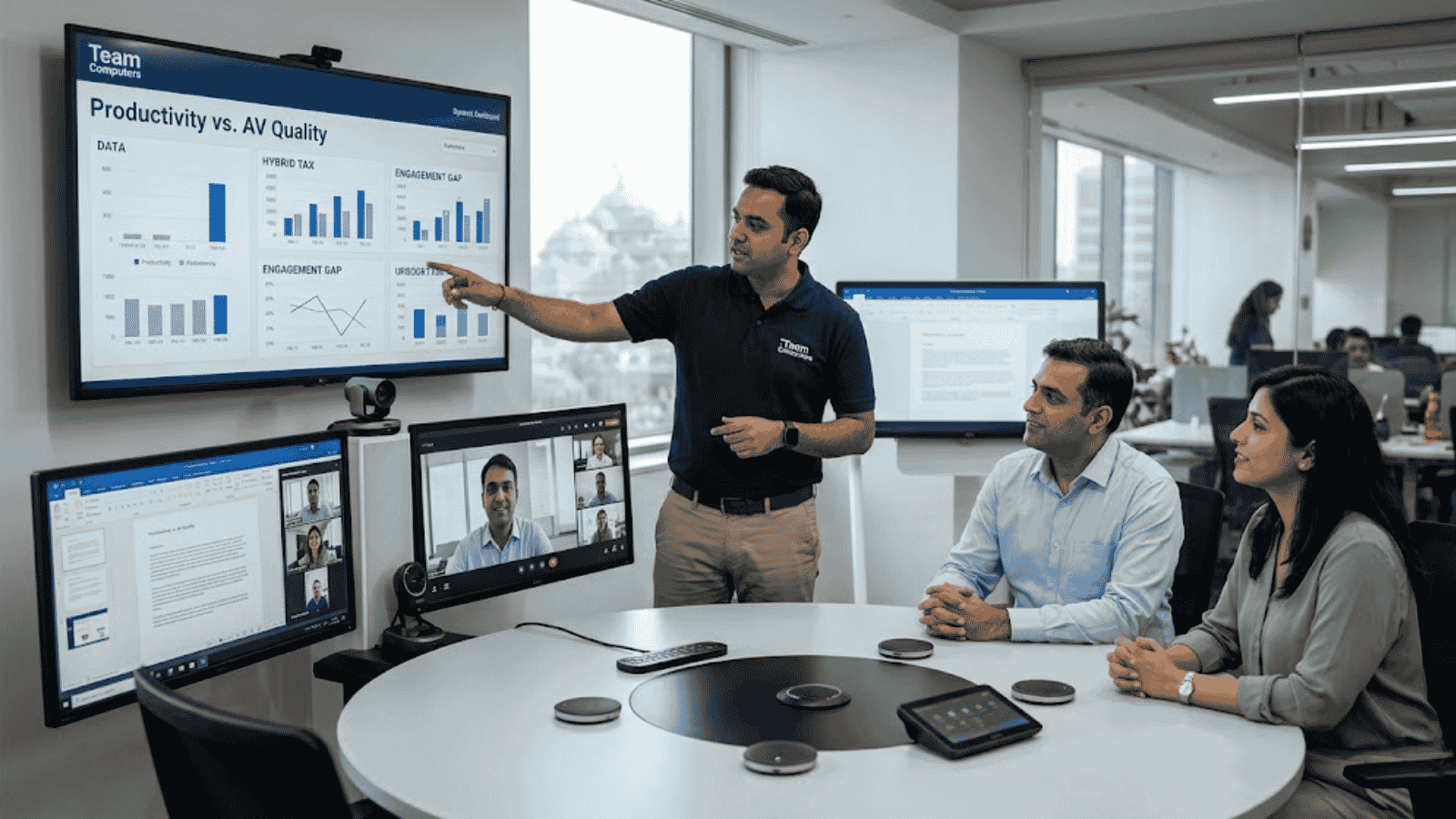
Imagine this: You’re dialing into a crucial strategic review with your GCC leadership in Bengaluru. Half your team is in a conference room in Mumbai, and your key stakeholder is calling from home. The meeting starts, and the familiar dance begins. “Can you hear me?” “We can’t see the screen.” “There’s an echo.” Ten minutes are lost just on tech troubleshooting. When the presentation finally loads, it’s blurry, and the Mumbai team’s audio is so garbled that their critical input is lost in a sea of distortion. This isn’t just an inconvenience; it’s a failure. In 2026, where hybrid collaboration is the default, the meeting room is no longer just a physical space—it’s the critical digital bridge. Yet, most large organizations still view audio-visual (AV) infrastructure as a “facility” cost, not a “productivity” investment. This guide examines why prioritizing high-quality AV is an essential pillar of any correct device strategy and a non-negotiable requirement for organizational health.
The hybrid friction (and why it’s not normal)
For decades, meeting room AV was about a projector, a static polycom phone, and perhaps a wall-mounted TV. It was designed for a world where “in-person” was the standard and a remote caller was an anomaly. What’s happened is that the dynamic has completely flipped, but the infrastructure hasn’t kept pace.
What we’re seeing now is a “hybrid tax” on collaboration. We often hear from Indian IT heads that while they’ve updated laptops, their meeting rooms still use gear that can’t handle dynamic video feeds or distinguish voices in a large room. It’s creating a fragmented workforce. Remote participants feel like second-class citizens, unable to contribute fully, and in-room participants are distracted, constantly repeating themselves. Poor AV doesn’t just annoy people; it erodes trust. When you can’t see eye contact or interpret tone of voice because of audio lag, communication breaks down.
What the data is actually telling us
Recent studies confirm that the physical meeting room is the new “hybrid blind spot.”. This disengagement directly correlates with missed deliverables and employee dissatisfaction.
Furthermore, the “cost of wasted time” is staggering. When you multiply those lost minutes by thousands of meetings across a large organization, you are looking at millions of rupees in lost payroll hours every month. Clear audio and visuals are not a luxury; they are an operational necessity.
The approach that forward-thinking CIOs are taking
Rarely do the best leaders simply “install more TVs.” Instead, they map user journeys and meeting archetypes. They recognize that a board room requires a different AV setup than a spontaneous “huddle room” or a large training hall.
They are investing in “intelligent audio.” We’re seeing massive demand from Indian enterprises for acoustic intelligence—microphones that automatically detect and focus on the current speaker while filtering out background typing or rustling papers. This isn’t science fiction; it’s essential in India’s bustling business environment.
These leaders are also converging AV with their overall device strategy. Instead of disparate, hard-to-manage “boxes” in every room, they are adopting centralized, software-defined AV systems. This allows IT to monitor room health, push updates, and troubleshoot issues remotely before a critical meeting is affected, moving from a reactive “ticket” model to proactive management.
What this means for Indian enterprises specifically
Here’s the reality: Indian organizations are scaling and diversifying at an unprecedented rate. We are opening GCCs, managing cross-city teams from Ahmedabad to Kolkata, and collaborating globally. This requires seamless communication that transcends location.
Furthermore, as we mentioned in our analysis of correct device strategy, compliance is crucial. Modern, networked AV systems can track utilization and even incorporate AI to summarize meetings, but they must also be designed with data privacy in mind, particularly concerning the DPDP Act. Local expertise is essential to navigate these distinct compliance and environmental factors that simply aren’t as prevalent in other markets.
Why “Good Enough” is your biggest risk
Many CFOs still argue that as long as there is “a screen and sound,” it’s “good enough.” But “good enough” is a silent killer of collaboration. When you can’t see nuance or hear the fine detail of a conversation, you miss innovation. You miss the subtle objections that could derail a project.
Moreover, poor AV is a reputational risk. It reflects poorly on your brand when client or partner presentations are plagued by poor tech. It signals a lack of investment in your own culture. In a competitive Indian market where employee NPS is closely tied to the digital workplace, a frustrating meeting room experience is a retention issue.
The Practitioner’s Insight
Often overlooked is that the meeting room itself is an end-user device. It’s not just a “room”; it’s an integrated, shared asset. The AV in that room must be as secure, manageable, and performant as any employee’s laptop. If you manage your endpoint devices but leave your meeting rooms as isolated islands, you haven’t solved the hybrid challenge; you’ve just moved it.
What we’ve learned over 38 years at Team Computers is that most Indian firms have a “patchwork” of AV solutions. We see different brands, incompatible software, and differing user experiences across different floors. Proactive lifecycle management isn’t a nice-to-have; it’s how you ensure that a meeting room built in 2024 is still viable for the collaboration tools of 2026.
Moving forward, the focus must shift from “buying hardware” to “delivering a meeting experience.” This means measuring meeting room NPS and uptime, not just asset depreciation. It’s the difference between managing infrastructure and enabling a highly productive, connected workforce.
The path to better collaboration doesn’t start with an expensive overhaul—it starts with understanding where your employees are most frustrated. If you don’t know which of your conference rooms are “known broken” among your staff, you have a critical blind spot that is directly impacting organization-wide alignment.
Key Takeaways for IT Leaders:
- Audit your spaces: Stop thinking in terms of “room sizes”; map rooms by meeting complexity and participant archetypes.
- Prioritize “Meeting Equity”: Evaluate AV systems based on how effectively they bridge the gap between in-room and remote participants.
- Integrate with Device Management: Centralize AV monitoring and troubleshooting to move from reactive to proactive support.
- Budget for Acoustics: Recognize that acoustic treatment and intelligent microphones are just as important as high-definition screens.
Your meeting room is the new boardroom. If the foundation is shaky, no amount of expensive software or global ambition will fix the breakdown in your team’s communication. It’s time to stop treating AV as a facility cost and start treating it as the critical collaboration platform it is.
Optimize Your Collaboration Ecosystem
Get a comprehensive analysis of your current meeting room audio-visual setup to identify bottlenecks and disengagement points. We’ll help you design a consistent, secure, and productive hybrid meeting experience for your entire organization.