5 Biggest Announcements from Apple’s ‘Peek Performance’ Event

The recently hosted ‘peek performance’ event was unlike other Apple events, but, at the same time, much more was expected. The event was organized with an aim to reveal all that the Apple team had been working on for the past few months. The Apple community gathered for insightful sessions, a handful of keynotes, and a bit of partying. The entire day was brimming with energy and was later termed “the Apple day”.

If you missed attending Apple’s ‘peek performance’ event in 2022 or wanted to get the details of the events once again, here are the most exciting highlights.


Apple M1 Ultra 

This time, Apple went a mile ahead with the announcement of the newest edition to its Apple Silicon lineup called the Apple M1 Ultra processor. Rather than hopping from M1 to M2, they decided to expand the already existing M1 line with M1 Ultra, which indeed is exciting. So there it is now! M1, M1 Pro, M1 Max and M1 Ultra. It is 8 times faster and better than the M1 chip. 

With ultra-high efficiency, mind-blowing performance, and 128GB of RAM, Apple M1 Ultra is here with a bang. Are you excited to unbox the sleek Apple M1 Ultra?

The Mac Studio 

The next exciting announcement that made the crowd jump off their seats was regarding the Mac Studio. With 7.7×7.7×3.7 inches, the newly launched Mac Studio looks like a mini version of the Mac, which, let’s face it, isn’t so mini. Thanks to M1 Ultra, the Mac Studio is 2.5x faster on the CPU front when compared to the fastest 27-inch iMac. Also, it is 50% faster than a Mac Pro and features a 16-core Xeon processor.

At the back, the Mac Studio features a 10-gigabit ethernet port, four Thunderbolt ports (4/USB-C), two USB-A ports, an audio jack, and an HDMI port. However, at the front, the Mac Studio features an SD slot and two more USB-C ports.

Apple’s New iPad Air 

With custom-built silicon, another classic launch is the New iPad Air. This gadget has been designed and developed for the generation of tomorrow, especially great for those who love to stick to their laptops for hours.

The new iPad Air has a wide-angle, front-facing camera, which keeps your face at the center during video calls.

New iPhone SE 3

Do you find Apple products out of your budget? The newly launched Apple iPhone SE 3 is more budget-friendly, making it easier for more people to invest in it. The iPhone SE 3 runs an A15 processor (Bionic), which means it promotes things such as live text. It also offers better battery life and 5G connectivity.

With a 4.7″ display and the same durable glass, the iPhone SE 3 is the ultimate edition of your Apple collection. What are you waiting for? Get your hands on it!

Studio Display 

Wanted a new and better Apple Studio Display? Apple knows what its customers are waiting for. So, here it is; the newly launched Apple Studio Display! A 27-inch 5K display with an ultra-wide 12-megapixel built-in camera, a six-speaker sound system, and a three-mic array. It also features Thunderbolt 4 ports along with 3 USB-C ports at the back. Apple claims that their new Studio display has several mounting options, including a tilt/height-adjustable stand, a tilting stand, and the VESA-mount option.


Conclusion 

In addition, Apple has launched an array of digital products that have become must-have gadgets. People who were a part of the Apple ‘peek performance’ event believe that it was one of the best events held to date.

The day-long Apple ‘peek performance’ event also featured several talks, which made people discover the horizons of Apple as a company. To find out more about the ‘peek performance’ event 2022, visit our website now!

Team Computers is Apple Authorized Enterprise Reseller (AAER). We have been Apple’s preferred partner in India for more than 30 years now & have successfully built a dedicated team for Apple business.

If you want to learn more about How team computers can help you succeed with Apple visit https://www.teamcomputers.com/Apple

Tech Companies Going Political Amidst Russian Ukrainian Conflict

The five leading tech companies of the world, including Google, Apple, Meta, Amazon, and Microsoft, have taken significant steps to impose voluntary sanctions on Russia amidst the Russian Ukrainian conflict. However, this decision wasn’t taken overnight. The Prime Minister of Ukraine successfully lobbied these companies in the same way it gained assistance from NATO, European Union, and the US government. Since these companies were nation-states, Ukraine directly appealed to these big names in the tech world.

Was there an impact of these sanctions? Or does Russia face any outset? Let’s find out.


Google

Undoubtedly, Google, now known as Alphabet, is one of the leading tech companies that responded to the Russian Ukrainian conflict in two parts. Firstly, there have been finance-related issues. The company has imposed restrictions on the usage of Google Play in Russia for merchants as well as customers. Google leaders have also decided to restrict online advertisements of its services in Russia. Also, YouTube monetization is blocked in Russia. However, Maps and Google Search are still available.

Amazon

Andy Jassy, the chief executive of Amazon, has decided to support cybersecurity efforts in Ukraine and offers logistical support. However, Amazon has not taken countable steps to reduce its revenues from Russia.

Meta

Another major tech company is Meta who is also the owner of both Sputnik and RT. It has removed the access of Sputnik and RT on Instagram as well as Facebook. Further, it is not allowed for state media to monetize content.

Apple

Apple is another big name in the tech world that has gone several steps ahead of Google when it comes to imposing restrictions on Russia as a result of the Russian Ukrainian Conflict. The company has stopped the sale of any Apple product in the country. Also, services offered by Apple, such as Apple Pay, are limited. Also, Sputnik and RT have been blocked from the Apple App Store in Russia.

Microsoft

Another tech-leader playing from the front is Microsoft, which has blocked RT and Sputnik advertisements across its ad network and banned access to channels in Russia.


Other consequences in front of Russia

Apart from direct restrictions imposed on Russia, there are several indirect restrictions as well. Google has restricted new reviews in Ukraine and Russia. This is done to avoid potential disinformation delivery from both sides. Both Google and Meta have decided to restrict certain location-based services in Ukraine with an aim to limit military use.


What will be the impact?

The steps taken by both leading companies, Google and Meta, will not have an immediate impact to a certain extent; however, the impact from the direct financial sanctions will be much larger. Also, not being able to use Apple pay or Google Pay is still not a bigger deal in Russia; however, citizens will be greatly affected by imposing restrictions on the use of ATMs. Team Computers, Digital Engineering segment is ensuring we have a seamless experience for our clients amidst this conflict. We feel proud to be associated with some of the top partners in the digital segment for the products like Google Workshop, Google Chrome Enterprise, Tableau, Qlik, Microsoft Power Bi, Alteryx, Workspace by Meta, Automation Anywhere, Snowflake, IceWrap and many more.


Conclusion

Russia’s untimely invasion of Ukraine has left the world in a state of shock; however, the world’s biggest tech companies, including Google, Apple, Meta, Amazon, and Microsoft, have acted bravely in the Russian Ukrainian Conflict. The tech platforms have somewhere transformed into battlefields where everyone is rooting against Russia and imposing strict restrictions, which might trigger Russia to step back. Hopefully, the results of these steps by the tech giants will be positive.


How Scheme Analytics can be a game changer for effective Dealer Management ?

What is Scheme Analytics?

The pandemic has provided unexpected challenges and opportunities for innovation in the industrial business. Team Computers can help you react to today’s changing business environment and confidently think about the future with the help of scheme management.

A transparent and efficient process that assists in distributing sales incentives to trade partners by analyzing sales data.


Why is it essential in Manufacturing Industries?

This new feature gives you a solid framework for recording information about a collection of connected initiatives and opportunities. Scheme Analytics connects possibilities, including their connected relationships, organizations, and activities, under a unified platform.

Scheme dashboards can be used as command centers for massive, more significant projects than a single opportunity or customer.

This is a one-of-a-kind opportunity in the manufacturing industry. To create a solid addition for our Scheme Management program, Team Computers worked closely with the client in the manufacturing industries.

With the Scheme Management Program by Team Computers:

  • Obtain a comprehensive picture of reliability across people, locations, and processes.
  • Gather, evaluate, and act on customer feedback.
  • Identify, prioritize, and characterize concerns with warranty and service performance.
  • Also, manage your supply chain in an integrated, market-driven manner.

What are some of the key challenges?

  • Market conditions are constantly changing, so what works in one area/product may not work in another.
  • Trade Partners must develop the right plans to win market share as multi-brand retailers.
  • Targets are the driving force behind the Sales Incentives and meddled with on the go.
  • Schemes are created regularly and involve a variety of parties.
  • In terms of compensation, there is a lack of transparency and compliance.
  • The system is mainly based on Excel, with many versions circulating.

But, now, Scheme managers may track their sales teams’ actions against their scheme goals and maximize scheme value by keeping an overview of the performance of their schemes’ goals at a glimpse. It will result in practical benefits, such as increased sales, sales incentive management, and cost control.


Process Flow Making the process efficiently using analytics

  • Budget Creation: Making this budget creation lets you know ahead of time if you will have enough money to do the things you need or want to do. Budgeting is simply the process of matching your expenses and revenue.
  • Scheme Creation: Following that, create a scheme or a plan that has the plan of action, designated roles, goals to be achieved, and other key metrics.
  • Scheme Distribution: Distribute the scheme created to effectively allocate the resources and designated roles. Keep a check on the progress and send routine feedback.
  • Automated Payout Calculation: Control the automated payout timeline for your linked accounts. Now no manual efforts are required to maintain calculations and reduce the chances of errors.
  • Exception Management: Streamline the entire management procedure via exception submission, exception approval, and directly move to process the finance and settle all the creditors’ accounts.
  • Payout Processing: Instantly settle all the pending payments. The payout processing is streamlined, and accounts get settled on time.

Why Team Computers?

Today’s manufacturing leaders are innovators, pioneering increasingly sophisticated means of producing and transporting physical items while looking beyond performance, cost reductions, and reducing risk. Manufacturers are leveraging technology to become flexible, AI-driven businesses that minimize risk and capture possibilities via profound operational perceptions and predictive decision making to survive in the future.

Team Computers as one of the preferred partners has helped multiple top companies in their digital journey to optimize production operations for low cost and risk while leveraging advanced analytics as a resource that enables you to create new services and high-quality goods achievable only in a connected economy. We provide proven value. And we can assist you in realizing the tremendous potential of your digitalization.

With Team Computers, you can:

Achieve Manufacturing Excellence

  • Increase the yield and throughput of your production.
  • Enhance the quality of the final result.
  • Reduce the risk of unplanned downtime and equipment breakdowns, as well as the costs associated with them.

Well-Connected Organization

  • Processes should be improved, as well as business reliability.
  • Predict upkeep difficulties and save money by avoiding costly breakdowns.
  • Boost your performance and the efficiency of your equipment as a whole (OEE).

Reduction of Warranty Costs

  • Reduce the expense of warranties.
  • Improve the quality of the product and the level of consumer happiness.
  • Increase the profitability of service contracts.

Optimization of the Supply Chain

  • Recognize demand signs that imply market shifts quickly.
  • Adapt your supply chain to demand swings more quickly.
  • Easy distributor and dealer management.
  • Inventory, waste, and expenditures are all reduced, while customer satisfaction is increased.

Moreover, we offer “one-on-one” instruction on video calls and screen sharing to assist you in getting started quickly and easily with our website along with onsite support if needed. Get  timely responses to any questions you may have from our pool of certified resources.


Conclusion

With the help of advanced analytics platforms built on a robust, cloud-native framework, you can enable digitization and drive innovation in your manufacturing industry.
Team Computers has it all.

Visit us to know more about our work in the manufacturing vertical.

Why Is Cloud-First Strategy the Need for Your Business?

Thinking of Adopting A Cloud-First Strategy? 10 Reasons Why You Should  

The evolving automation has propelled technology to help businesses to succeed. 73% of organisations have adopted cloud and run their applications on it. This is how it is completely evident how organisations have undergone a digital transformation and have turned technological by the end of 2000.

A Cloud-First Strategy helps in overcoming business system complexities and streamlining the business operations with a software solution, expediting the time for business to market and a competitive edge over the others for achieving a digital transformation.

According to a recent Gartner survey, cloud services in the worldwide market are anticipated to grow from $182 billion to $331 billion by 2022. The SaaS cloud application services have grown remarkably, and the revenue has enhanced by 80%. This gives a clear indication of why enterprises are moving towards Cloud-First Strategy no matter what their company size is for a smooth IT framework and cloud migration.

In this article, we will put up some top reasons why businesses must adopt the Cloud-First Strategy and how it empowers your business for rapid and reliable growth. Before that, let us first give you a detailed glimpse of a cloud-first strategy.

A Brief Introduction to the Cloud Solutions and Cloud-First Strategy

Today’s era is technology-oriented with faster and cheaper communication, faster transportation and perfect resource utilisation, and maximum output efficiency. Due to this, cloud computing has gained traction.

Using a cloud-first strategy, businesses can save money on infrastructure, platforms, and software. They can subscribe to a service provider for premium services at cheaper costs in place of building their technology stack and getting access to high-end cloud services with a fraction of the market cost.

Parts of Cloud Architecture

Cloud computing covers an extensive range of cloud services. In general, cloud computing is made of three main tiers:

  • Iaas (Infrastructure as a service): Encompasses hardware and software including the OS, networks, servers, and storage;
  • Paas (Platform as a service): Set of tools and cloud services that ensures application deployment over the cloud space quickly and efficiently;
  • Saas (Software as a service): End-user web software and applications delivered through cloud computing.

The Purpose of a Cloud Strategy

Although the cloud strategy is beneficial when implemented correctly in an organization, here is the core purpose behind implementing it:

  • To communicate with the approved service providers and associated services.
  • To communicate the service provider process
  • To determine the services built internally and consumed from a public cloud provider
  • To determine how the organization offers consistent policy and governance across diverse services
  • To determine protections for reducing the data privacy, resources availability, service costs, and other risks and implementing an “on-premise”, private cloud strategy to provide users with the requisite resources.
  • To identify the benefits cloud services offer to the organization
  • To identify the organization partnerships with public cloud providers for the approved service providers
  • To state the resources utilization risk from a non-approved provider and service consumption

In the next section, we will discuss the prominent reasons why a cloud-first strategy is needed for your business.


Top Ten Reasons Why Cloud-First Strategy Is the Utter Need for Your Business

Owing to the advantages it offers, there are several reasons why businesses choose a cloud-first strategy. It is important to know the benefits of implementing a cloud-first strategy for making an informed decision, as below:

  • Better Scalability
    A cloud solution offers an auto-scaling feature with which a cloud services supplier can scale the application resources. If the CPU of the application or memory usage is high, the user moves to the following resource tier. If configured rightly, the provider can do it automatically. In the event of a huge traffic spike, it upgrades the server hardware not letting customers down.
    As the companies’ IT demands change, they must have an infrastructure to expand their capacity for new demands. With cloud computing, the company can expand its capacity almost instantly, launching new applications and managing increasing customer needs. The entire company infrastructure is virtual in the cloud and the cloud provider’s resources, which are quite expansive, limit the growth.
  • Holistic Security
    The cloud services provide a secure business network. The cloud enables a secure data infrastructure in a protected security environment and ensures crucial security factors. Cloud adoption is an excellent approach to protect your company data and user information. It offers a secure network at affordable rates. In addition, cloud adoption and cloud migration are relatively cheaper.
    The constantly evolving world of cybersecurity makes it difficult for IT departments to be updated for the latest threats. Enterprise-level organizations have a squad aligned to cybersecurity; smaller companies are coerced to rely upon third-party services or software updates. The nature of cloud computing is conventionally public that forces cloud providers to ponder over their security and how it affects their customers. They have the requisite resources for the latest cybersecurity strategies implemented to tackle cyber threats. By keeping the systems updated and patching known vulnerabilities regularly, the cloud providers can build a safer environment for customers.
  • A Necessity not Luxury
    Cloud computing can be executed with minimal financial and physical resources for the company’s IT operations and for bringing a digital transformation in the organization system. Cloud enhances agility in business operations and an infrastructure service model for reducing IT costs. From the CIO’s perspective, a Cloud-First Strategy offers a better on-demand self-service, enhances scalability, resources pooling, network access, with other technical benefits. Cloud services are a proven business solution rather than developing a technology yourself.
    Thus, it is apparent that Cloud has become a necessity for every SMB and large-scale organization and not a luxury.
  • Lesser Investment
    Cloud-First Strategy can be implemented with lesser investment and offers higher performance. As compared to the edges it offers, the cost incurred is secondary.
    Utilizing virtual computing resources does not require investing in hardware such as cables, routers, and servers. In addition, the infrastructure costs for equipment management are reduced. With an on-premise solution such as a dedicated server, building infrastructure and cooling management, maintenance, and power costs are beyond the small-to-medium companies’ capabilities. Collaborating with a cloud provider offers organizations to convert the capital into operating expenses and use the savings in innovations and creating better customer experiences.
  • Easy Configuration
    In a cloud-first strategy, you need not control the hardware, and getting new online services requires capital spend approval. Many teams code rightly to define their infrastructure. A cloud-first strategy determines what the team requires for their software. The APIs exposed are an add-on benefit to cloud computing.
    For operating dedicated hardware, a plethora of applications and log sources of devices are interlinked. For the cloud, software tools integrate with the cloud service providers natively. Instead of plugging disparate applications, the software combines the logs on a dashboard and your team tracks your application performance, giving you insights into the software and keeping you informed when any issues occur.
  • A Reliable Approach
    With a cloud-first strategy, the maintenance of hardware and server is performed by the cloud computing provider. They make sure that the connected power supplies are uninterrupted. In the event when an entire data center goes offline, the cloud providers configure automatic failover to create a data center backup. A cloud-first strategy beats dedicated hardware when the application availability is critical for the business.
    It offers flexibility in business operations for the employees and management team, improves resource utilization, reduces annual financial spending, and facilitates seamless business scaling. For the organization CIOs, following the tech trends of leading organizations can be possible no matter whatever the scale of the business is!
  • Multi-Access
    For organizations, an all-time availability of data is crucial as customers access services in many more ways because of the surge of mobile platforms and IoT devices. In addition, the present-day workplace is getting virtual with employees who are accessing IT networks from remote locations. Cloud computing allows organizations to access cloud services from multiple locations and devices, and facilitate greater collaboration between people working concurrently. The increasingly complex workloads can be migrated to the cloud for unprecedented efficiency and performance.
    Cloud computing offers additional benefits if your business is located in the exterior of a city as all cloud computing centers are near internet setup. Even for small towns, there is no need to pay for office connectivity.
  • Redundancies Implementation
    At times, there can be some mishappening in an organization when you are on the verge of losing data. The cost incurred in the data loss and services at any time is humongous and incurs a hefty budget spend. Any event of natural disasters, infrastructure fallout, or malicious cyberattacks, can lead to system downtime demanding a redundancy implementation for safeguarding critical organisation data and applications.
    Using cloud computing, organizations can back up the essential company assets easily. With it, the data can be stored in the cloud rather than purchasing backup servers to automate the data backup process. This overhauls the organization’s redundancy and makes it ready for adversities. Also, since it’s in the cloud, it can be accessed from any place, at any time.
  • Infrastructure Modernization
    Keeping the IT infrastructure as per the latest standards can be challenging for organizations, especially when the next-gen server comes into the market, and you need to invest in a piece of new equipment. Cloud service providers always want to deliver the best possible computing resources as they are working consistently to build an efficient and flexible infrastructure.
    Cloud services assure that an enterprise gets the best technology platform for building its solutions. This mitigates the issues related to compatibility and performance encountered in outdated infrastructure and the need for cloud providers to buy their updated hardware.
    For any cloud or on-premise business, cloud computing is an affordable and transparent solution for hosting infrastructure, connectivity, cooling, and power.
  • Maintaining Control
    An organization has so many choices in how it builds and manages the cloud environment when it moves its data and workload to the cloud environment. For deploying a private cloud for an organization, companies can perpetuate the control and visibility for their on-premise infrastructure. For accessing the extended public cloud services, a hybrid cloud environment can be installed, which involves the private cloud controls and the public cloud versatility.
    Cloud security control protects the cloud environment from vulnerabilities. It encompasses the best practises and procedures implemented for achieving, addressing, and evaluating complete security in the cloud landscape. Organisations must comprehend how cloud security is different from data centre security before making a cloud migration and implement security controls once the migration is done.

How to Make a Cloud Adoption?

Now that we have highlighted the reasons for implementing a cloud-first strategy, here we will explain how you can actually make a cloud adoption:

  • Cloud-first Migration Roadmap
    Planning is key when performing cloud migration. Build a roadmap centred on your organization, which includes cloud solutions. Define the steps in your cloud migration process. Set a path for migration for all the applications in your organization – from recently updated applications to the oldest legacy applications. Determine the cloud deployment you would choose among public, private, or hybrid.
  • Frame a Cloud-First Culture
    Cloud-first transformation demands a culture shift to the cloud-first approach. Let your employees know your plans and make them understand the value of this culture and how cloud migration will make their jobs easier.
  • Analyse Competitors
    Learn from others’ experiences when you are building a cloud-first strategy. Research about organizations who have navigated their cloud migration journey. Also, know their long-term vision for their cloud solution.

The Bottom Line

A cloud-first approach helps organisations obtain the maximum of their investment by exploring the possibilities of the cloud in the existing or new processes. Its ultimate goal is to remove the constraints of costly and inefficient legacy infrastructure and outdated applications, making your organization innovate and scale in the long term.

There are several reasons that we have mentioned here why businesses must adopt this strategy. Every cloud computing platform eases to start on its service. Looking at the advantages it offers, its benefits outweigh the cost it incurs for the setup, which is also quicker and easier. Cloud, now, can never be an aspirational innovation. It has become an imperative investment for staying competitive. Organizations should view the cloud as an opportunity to strive and thrive in a cloud-first digital transformation.

Thinking about moving your business to the cloud? There has never been a better time to start; the best is now, and you can make the most of it today!

How is Metaverse Changing Businesses?

Metaverse has become a buzzword in the technology sphere. By rebranding its name to Meta, Facebook has captured all the news headlines in a strategic move.

Furthermore, Microsoft has also joined the Metaverse party by incorporating Mesh for Microsoft Teams. It announced that it will blend quasi-Metaverse ability into its prevalent video collaboration tool.

But what is Metaverse? Why is it expected that Metaverse will change the future? Well, it is expected to revolutionise businesses; let’s have a quick precap of the Metaverse in 2022.


What is Metaverse?

Metaverse is a portmanteau of Meta and Universe. It is a virtual world that will work as an interactive internet.

It will support persistent online 3D virtual environments via personal computing experiences and augmented reality headsets. It will revolutionise the next generation web, also known as web 3.0.

It has conglomerated different technological aspects such as video, multimedia, virtual reality (VR), augmented reality (AR), and mixed reality (MR).

It will help users co-exist within a digital world. Now, the question is how the Metaverse will change the future and the way today’s businesses work.

According to Mark Zuckerberg, CEO of Facebook, the Metaverse environment will take years to develop. However, people can expect a prototype within the next five years. By 2031, Zuckerberg is expecting to sign on a billion users to the Metaverse platform.


How will Metaverse change businesses?

The Metaverse will render a 3D virtual space where users can come together and interact with digital entities through avatars. These avatars will resemble the person whosoever entered the Metaverse plus mimic their movements and actions as that of the physical world.

It will enable immersive problem-solving abilities across a broad range of industries and businesses.

  • Metaverse in retail
    In the physical world, users measure the value of an item through various factors. Among these, factors like scarcity, authenticity, and ownability.
    With the advent of the Metaverse in retail, consumers can virtually go to the shop and check on all the factors before buying retail items. Metadata will also include NFT (non-fungible tokens) and blockchain for rendering retail item authenticity and ownability, which will then be delivered to your doorstep. This is how Metaverse will change businesses and its approaches.
  • Metaverse in advertising
    Advertising will take a new form in the Metaverse. Organizations will render immersive and clickable advertisements landing customers to their desired brands, businesses, and marketers. Hence, it will give rise to in-world advertising.
    In-world advertising will capture more customer attention as companies render ads through digital billboards. Companies will perform advertising through story-telling via 3D models and immersive videos. Consumers will also receive interactive ads based on users’ behaviour & historical datasets.
  • Metaverse in healthcare
    Metaverse in healthcare will bring a revolutionary change through rich visuals and collaboration. Doctors and researchers can train medical students, fellow doctors, and staff members on various critical medical complications.
    Through Metaverse, researchers in the pharmaceutical businesses can visualise different chemical compounds while developing medicines. Doctors can experience 360-degree visuals of a patient’s ailment and replicate surgery and other procedures before applying them in the real world.
    That is how metaverse will change the future of the healthcare industry.
  •  Metaverse in e-commerce
    In today’s e-commerce market, customers can only read the product description before buying it. But imagine a situation where you can hold the product in your hand or try it before buying. Yes, this is how the Metaverse is expected to change the future of e-commerce.
    Customers will touch, feel, and wear (through avatars) the item from that virtual shop. Every account will have associated digital wallets, and once the customer buys something online, the amount of money gets automatically deducted from that account associated with the customer.
  •  Virtual property, malls, and art galleries
    Metaverse is virtual reality-driven universes that won’t change every time you wear the VR kit and log into it. It will shape the new form of business where people from different parts of the world can buy property, house, rent them, build a virtual casino, hotel, sports stadium, art galleries, etc.
    Other OTT and on-demand entertainment platforms will shift their business to 3D entertainment. Such entertainment companies may even create a separate & customized room or cinema hall for providing their shows.
    Such a form of business can bring more customers through 3D effects and enriched visuals.

Through Metaverse, innovative, lightweight, and multifunctional VR kit manufacturing industries will grow. IT and other industries can also present their projects or deliver their meetings through this virtual world under one roof, even though they sit at different corners of the world.

The auto manufacturing industries can also leverage Metaverse for planning, strategy building, meeting new automobile engineers across the globe through this breakthrough technology to bring more innovations in the automobile industry.

Various Information Technology Enabled Services (ITES) operations can also enjoy the benefit of metaverse by providing virtual meetings, collaborations, virtual webinars, ultimately improving the efficiency of an organization.

Also, Metaverse can bring friends, relatives, and families closer by enhancing business communication through rich visuals, irrespective of their geolocation.


How will Metaverse change the world?

This breakthrough technology draws its potency from a vision where users can work, play, and stay tuned with others or any business. It ranges from conferences, work events, buying & selling, virtual vacations, entertainment, etc.

Risk of accomplishing businesses in the Metaverse

  • Different users react differently when it comes to VR sets. It’s because they are bulky, and wearing the headset for a long time can cause visual impairment.
  • In the Metaverse, transactions will employ cryptocurrencies or non-fungible tokens by leveraging blockchain technology. And, as we know, cryptos fluctuate to a broad spectrum that might generate a span of economic flux in the metaverse.
  • Developing virtual prototypes can be costly unless there is some efficient way of modelling them

Conclusion

The Metaverse can bring people closer and increase business communication irrespective of their geolocation. It will enhance business innovation, advertising, marketing strategies, etc., and make companies predict the manufacturing requirement way before time.

Reimagining Security to the new normal

Since the onset of the pandemic, organizations are increasingly adopting a work-from-home model. That calls for shifting from an in-office workspace with stricter security features to an in-home scenario with lesser restrictions.

But, cloud computing ensures a seamless transition of business data to the cloud servers. Your team can do away with manual documents and maintain all the digital documents on a single platform. Also, collaboration is much easier on a cloud platform. Every team member can drop their comments or share files, ensuring smooth communication.

However, cloud computing also comes with certain security risks. Your data is no more in an on-premise platform with enough firewalls and encryption. Reports suggest that in the last 18 months, 98% of organizations have faced a data breach in one form or the other. That’s a whopping amount!

Hence, you need to put additional security measures in place for your cloud platform to ensure that your business data is not compromised.


How Can You Modify Your Organizational Security to Meet these Challenges?

To ensure organizational security, you can adopt various techniques like layered approach, end-point protection, and using a mix of both human and artificial intelligence.

Use a Mix of Both Artificial Intelligence and Human Intelligence

Cybercriminals can mimic even machine behavior to break into your cloud systems. Hence, you cannot solely rely on artificial intelligence-powered cloud platforms. You need to employ a set of cyber experts to monitor your cloud data continuously. By interpreting these data at a regular interval, you can prevent major cyberattacks.

Go for Wholistic Data Protection

Many devices, like mobiles, printers, smartphones, laptops, etc., connect to the cloud. Hence, your organizational data is scattered all over the web. Therefore, you need additional encryption techniques to protect the distributed data. Ensure that you employ advanced technologies like data encryption and tagging to ensure protection against all your devices, be it on-premise or on cloud platforms.

Integrate all the Network Infrastructure

Your cloud infrastructure consists of various devices from different vendors. Many of them may not communicate due to a lack of integration. This aspect can be a challenge when it comes to cybersecurity. Once you integrate all the cloud devices and services, you can easily monitor threats from a centralized platform. Eventually, the cyber risks will be much lower.

Effective Control of All the End-points

Your cloud ecosystem comes with multiple connected devices. Separately monitoring all the end-points can be challenging. You require a central agent who can connect to all cloud and on-premise solutions. This multilayered approach uses techniques like machine learning, real-time sandboxing, behavioral analysis, etc.


Final Thoughts: Use a Managed IT Service Provider to Protect Your Cloud

A managed IT service provider like Team Computers has the expertise to track and prevent any IT risk for your organization. We provide the latest cloud solutions, data analytics, and infrastructure solutions. Partner with us to completely protect both your on-premise and cloud infrastructure.

To speak to our IT experts, email us at rashi.verma@teamcomputers.com.

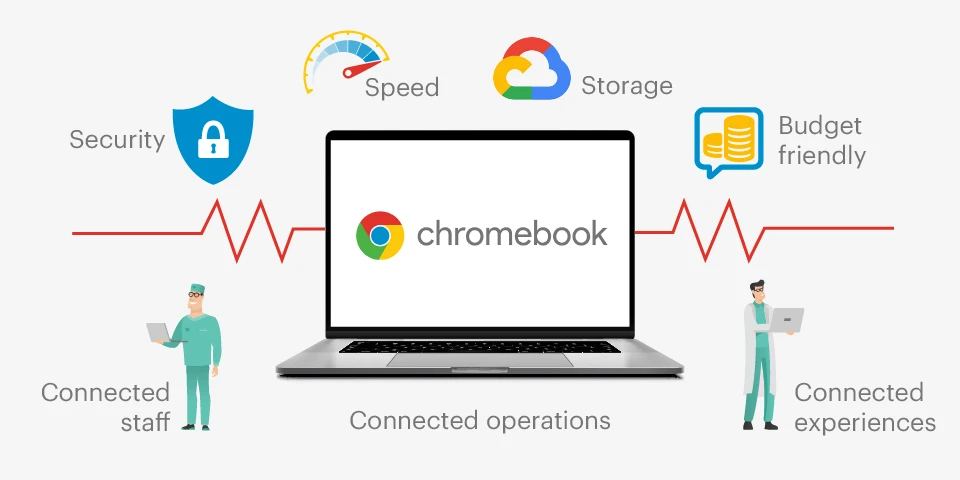
Chrome OS for Pharma & Healthcare Industries

In today’s disruptive healthcare industry, the need for modern technology and innovation has skyrocketed. With smartphones within an arm’s reach, millions in the country are now digitally literate. Therefore, when it comes to emergency services, faster information access, digital appointments, tracked medical records, and secured patient history is the need of the hour.

The ultimate challenge for the healthcare sector is to transform seamlessly into the digital suite without increasing its operational costs. The quest is to provide a rich, fast-paced, and on-cloud doctor-patient experience.

The shift from traditional PCs to a cloud-centric workflow seems expensive and cumbersome. But this has been made super simple with Chrome OS.

Benefits of Using Chrome OS

Chrome OS comes with a range of benefits for Indian pharmaceutical and healthcare institutions.

But why should you migrate to Chrome OS today?

1. Increased mobility and speed

The patient-doctor relationship is as crucial as the diagnosis. Meaningless paperwork, long queues, fixed workstations, etc., hinders the effective procurement of patient history and check-ups.

But with Chromebooks or Google Cloud, patients can book their visit on the go, anytime, anywhere. Chrome OS can bring the amount of time wastage to zero. Monitoring and accessing patients’ records can be done in seconds now.

2. Cloud-based enhanced security

The cloud-based console of Chrome OS allows quicker deployments with built-in security, keeping your data confidential.

Multi-tiered security layers of the OS protect critical medical records and financial data. The end-to-end integration protects against external malware. Besides, there is no need to spend a penny on antivirus protection with Chrome devices.

3. Cost Reduction by Shared OS

Cloud’s pay-as-you-go service offers effective cost reduction. The shared workspaces promote the tracking of information among the health staff network.

Comparatively, Chrome devices’ yearly upgrade costs less. The shared OS makes the day-to-day operations hassle-free, allowing increased productivity among the workers. It reduces operational costs as well.

4. High Productivity & Improved Connectivity

The maintenance of Chrome OS devices requires 75% less time as it is cloud-based. The real-time monitoring and deployment of patient data have increased productivity hours by tenfold.

Shared kiosks connect you to your doctor with faster check-ins, seamless collaboration, and a personalized experience. Remote connectivity with staff and tap-and-go virtual care can propel the efficiency of the medical industry.

5. Migrate your sluggish old systems into Chromebooks today! 

This cloud-based operating system requires much less processing power and is simple to set up.

Saving time, money, and effort with Chrome OS lets you give back your precious time to the patients and the people in need.

Dive into the world of Chrome OS with Team Computers!

5 Years since Demonetisation: What has changed?

November 8, 2016, will remain etched in the memory of every Indian. The launch of demonetization by the Indian government changed the face of our financial sector forever. Cancellation of Rs 1000 and Rs 500 notes and the unavailability of newer denominations forced the population to reduce their dependence on cash transactions and go digital. The transition, which in any other circumstance would have taken years, happened in a fortnight. Since then, digital transactions have witnessed massive growth, especially with the government and banking regulators striving to make India a cash-independent economy in the coming decade.

The government’s push towards the digital economy has opened the doors for various startups such as Paytm, Google Pay, Phone Pe, Amazon Pay, etc. These startups use Unified Payment Interface (UPI) technology as their base to transfer money digitally. As per the National Payments Corporation of India, transactions made through UPI stand at Rs 7.7 Lakh Crores. From street-side vegetable vendors to big grocery stores, everyone has jumped on the bandwagon of digital transactions, even if it’s for a meager amount.

Chart Courtesy: https://www.npci.org.in

While the rise in digital transactions is great for the economy, it has also increased the occurrences of digital crime. As per industry reports, suspected digital fraud has risen by 89% when comparing the last 4 months of 2020 with the first 4 months of 2021. With millions of digital transactions happening every day, the government has put its focus on increasing digital security to counter fraud.

The government, in tandem with RBI, has mandated all banks, fintech companies, and payment apps to offer secure network gateways for transactions, as well as raise awareness on various kinds of digital frauds and how one can prevent them.

The popularity of digital transactions doesn’t mean that Indians have discarded cash. It is still the king with over Rs 29 trillion of currency in circulation as of November 2021, 65% up by the pre-demonetization era. Yet, it doesn’t hold the charm anymore. People in cities and villages, millennials and baby boomers — all are finding it easier, safer, and more convenient to transact digitally. The COVID-19 pandemic also created an urge among people to migrate towards contactless online transactions, as it was the need of the hour.

Demonetization paved the way for Indians to usher in a new era of digital. The ease of using smartphones, along with better network connectivity in far regions, empowered people to take on the journey of contactless transactions. It is not uncommon to find people with more digital transaction apps on their phones and less cash in their wallets, signifying the importance of demonetization in making India a lesser cash-based economy.

With the increase in digital transactions the increase in security concerns are increasing. To know more about securing your digital transactions, reach out to our security experts https://www.teamcomputers.com/information-cyber-it-security

MacBook vs. Windows Laptops: Which Is Best for Your Business?

Planning to get a new laptop for your business but confused about which one to choose? It happens to the best of us when we’re presented with a confusing range of the most lucrative options. While most of us go with customer reviews and total cost, a few of us have a taste for the right operating system.

Windows and Apple both provide a premium range of laptops. Each of them comes with its advantages. The popular models are the Windows 11 and MacBook Air for business. While Windows has better login and gaming options, MacBooks have better integration with Apple mobiles.

Through this blog, let us analyze the different parameters to select a business laptop. We shall compare Windows and MacBook for business purposes. Based on how they fare and their unique requirements, you can make the final choice.

MacBook Vs. Windows: Parameters of comparison

While choosing between a Windows and MacBook laptop, ensure that you keep the critical factors in mind, like integrations, compatibility with different software, voice features, navigation, and overall costs.

  • Initial setup
    It is easy to install initial setup software in both Windows and MacBook. The OS automatically downloads the driver software for ports and drives. With Microsoft Cortana, you can give voice commands for installation. In either case, you do not need to sign in to an Apple or Microsoft account separately.
  • Third-party software compatibility
    Both Windows and MacBook are compatible with many third-party apps. The inbuilt app store lets you download business apps of your choice. For example, you can download video recording software, Photoshop, etc., on either laptop. But, do not expect these platforms to provide you with the same comfort level as your mobile devices.
  • Hardware integrations
    When it comes to external hardware for your business laptop, Windows has the upper hand. You can easily integrate graphics cards, CPUs, and other storage systems. However, MacBook has an upscale look and design options, especially with the optional 5K screens on iMacs. Windows 11 for business gives the option to connect superior-quality VR Headsets or HoloLens.
  • Touch options
    Windows provides superior touch inputs, as compared to the MacBook. For example, with the Windows tablet mode, you can navigate between the keyboard and screen for inputs. In addition, you can use a pen to input data. Your handwriting is automatically recognized and converted to text. With MacBook, the touch option is available only via MacBook Pros using the Touch Bar option.
  • Search functionality
    Both Windows and MacBook have equally good search functionality. You can either use the search bar or utilize the voice search functionality. The search bar in Windows is more versatile and displays results like apps, weather, stock prices, etc.
  • Voice integration
    When it comes to voice commands between MacBook vs. Windows, MacBook has Siri, while Windows has Cortana. Both Cortana and Siri are good at giving results of daily weather, YouTube videos, stock prices, map directions, etc. But, Cortana is superior to Siri in the case of the logging off feature. You can use Cortana to log out of your system, but the same is not applicable for Siri. Similarly, Cortana can easily integrate with Amazon’s Alexa and send voice commands to it.
  • Safety and security features
    In the case of safety and security, MacBook has the upper hand. It is less prone to cybersecurity threats like phishing, malware, and ransomware. However, both Windows and MacBook have robust VPN support. Since MacBook has its native hardware ecosystem, they are more stable. Windows’ instability here is due to its overdependence on third-party drivers.
  • Gaming functionality
    Gaming functionality is more developed in a Windows ecosystem. Many top titles on Steam are compatible with the Windows OS. You can even stream PlayStation games through the Xbox app. You can also stream or record your gaming activities to Microsoft’s mixer community using the Windows 10 Game Bar.
  • Desktop and file navigation
    It is much easier to go for desktop navigation using Windows. You can easily open multiple tabs and navigate between these. Be it a webpage or a folder, you can arrange it side-by-side on a single screen for compelling viewing. In addition, both MacBook and Windows help you create multiple virtual desktops.
    Both Windows and MacBook Air for business have relatively efficient file searching features. With Windows, you can easily track your last saved file, while MacBook allows you to use multiple tabs while searching for your favorite file.
  •  Overall costs
    Windows laptops have more versatile options and are comparatively less priced. While MacBook has competitive and stylish models, they are in the higher price range.

MacBook vs. Windows debate: Which one to choose?

Whether MacBook Air or Windows 11 for business, selecting the right laptop can majorly impact your business decisions. While shortlisting either Windows or MacBook for business, focus on speed, flexibility, third-party devices’ compatibility, etc. Ensure that you review your requirements thoroughly to get a cost-effective laptop for your workplace.

Are you looking for more guidance to select the right business laptop? Team Computers is an authorized partner for all devices brands like Apple, MS Surface, Dell, Lenovo, HP, and Acer. If you are still confused about making a decision, feel free to email us at wsmarketing@teamcomputers.com for expert advice!

Cloud Mining : Method Behind The Cryptocurrency Model

What is Cloud Mining?

A technique to earn cryptocurrencies without owning any hardware. This method helps miners source hardware equipment, i.e., the mining rigs from any facility. A cloud miner simply registers the hardware in their name remotely or virtually and gets started with the minting process.

But before that, let’s understand Blockchain

In simplest terms, a blockchain is a decentralized ledger for all transactions made across a P2P network. Usually publicly available, and the nodes can generally be operated worldwide. Blockchain is completely transparent as everyone in the network owns the data. It is impossible to modify data without catching attention. Blockchains are immutable; once a transaction is made, it is added to the ledger permanently, solving the double-spending problem.

What is a Cryptocurrency model?

Cryptocurrency is a digital coin graded with encryption, and each such coin has a business model. There are millions of crypto-driven small businesses with a unique value proposition. Cryptocurrency acts as a medium of exchange explicitly created to transact in the blockchain network, and bitcoin stands as the first representation.

How does crypto mining work?

Crypto mining is a process of adding blocks to the network by solving complex mathematical equations. Like mining in rigs, crypto miners are responsible for solving such cryptographic equations with the help of high-powered computers.

Miners are in a race against each other to solve the problem, the first to get a fraction as a reward. A new set of coins is introduced into the network for every successful completion by miners.

How does cloud mining work?

Cloud miners work similarly, but they outsource their computing needs to avoid the hassle and avoid overhead costs of maintaining the equipment.

Pros of using cryptocurrency

  • Secure encrypted end-to-end transactions
  • Individual ownership
  • Removal of added middlemen costs
  • Adaptive networks
  • Global access.

Cons

  • Volatile markets
  • No ownership and authority
  • Exposure to illegal payment activities
  • The risk of loss is high

Market trends

Major organizations worldwide are now looking into adopting the crypto-financial ecosystem. Also, financial bodies are keen to enable smooth transactions for customers worldwide.

  • DeFi(Decentralized Finance) was introduced recently to facilitate financial transactions by using smart contracts. DeFi has witnessed exponential growth by registering contracts valuing $15 billion in 2020.
  • Rise of Decentralized exchanges- Data accumulated in the past year showed decentralized exchanges were responsible for transacting above $50 Billion. Paypal/ Venmo, CoinDesk, and others are growing in volumes of newly registered users.
  • NFTs- With NFT, you can now own certificates of ownership of any digital entity, which can be traded into fractions. NFT transactions have made many people financially profitable this year.

Security Lapses 

In recent times, hackers used Google cloud to gain unauthorized access and mine cryptocurrencies. Exposing the system’s vulnerabilities and highlighting customer security lapses by falling prey to third-party applications.

Some cryptocurrencies have already been affected by such attacks; here are some notable aspects-

Missing credentials- User identity can be manipulated, and accounts can be accessed by stealing private keys and digital signatures.

Code exploitation- Ethereum recorded a loss of $ 60 Million as hackers managed to break into the system, exposing the vulnerable side of the blockchain network.

Future of cloud mining

Cloud mining has gained extreme popularity in the past few years, and cloud mining platforms have enabled users to earn coins without any equipment. Mining is still profitable if done smartly. A significant chunk of miners have witnessed increased expenses with power usage and supporting hardware. As each coin has a capped limit, miners should be aware that the reward size will continue to depreciate as they get close to the number.

Profitability in today’s time is still variable concerning the coin, cost of power, hash rate, time, and the coin value.