
From Downtime to Uptime: How Remote Infrastructure Monitoring Transforms IT Operations

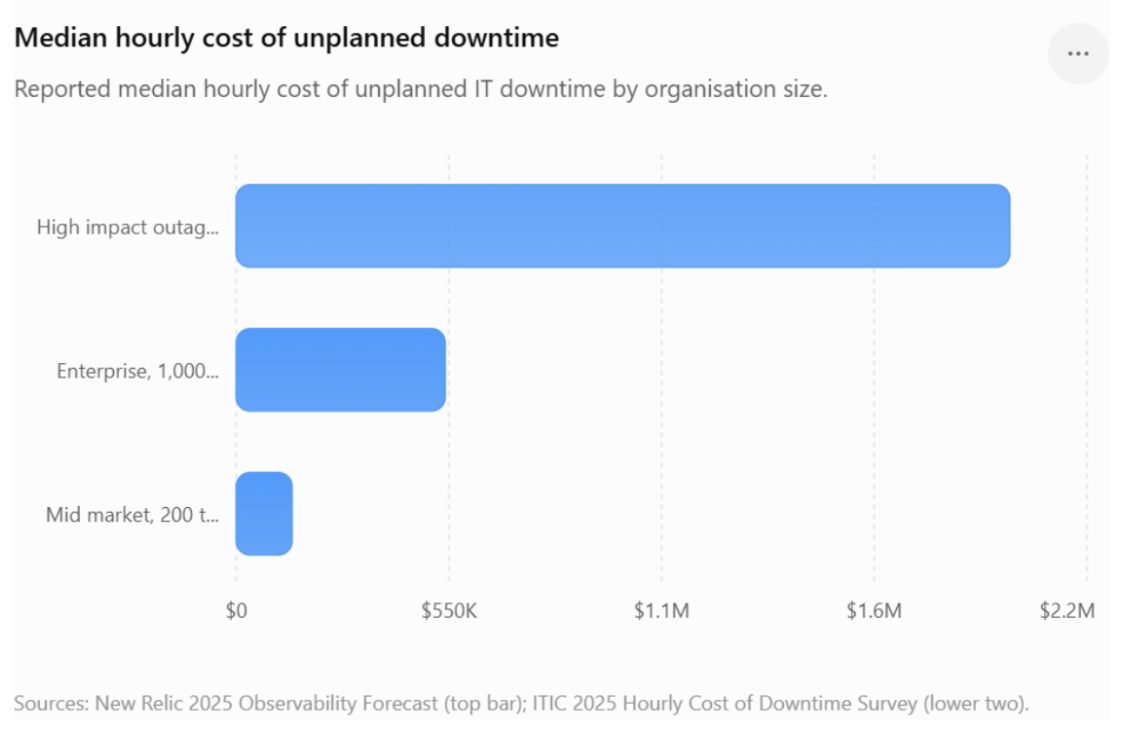
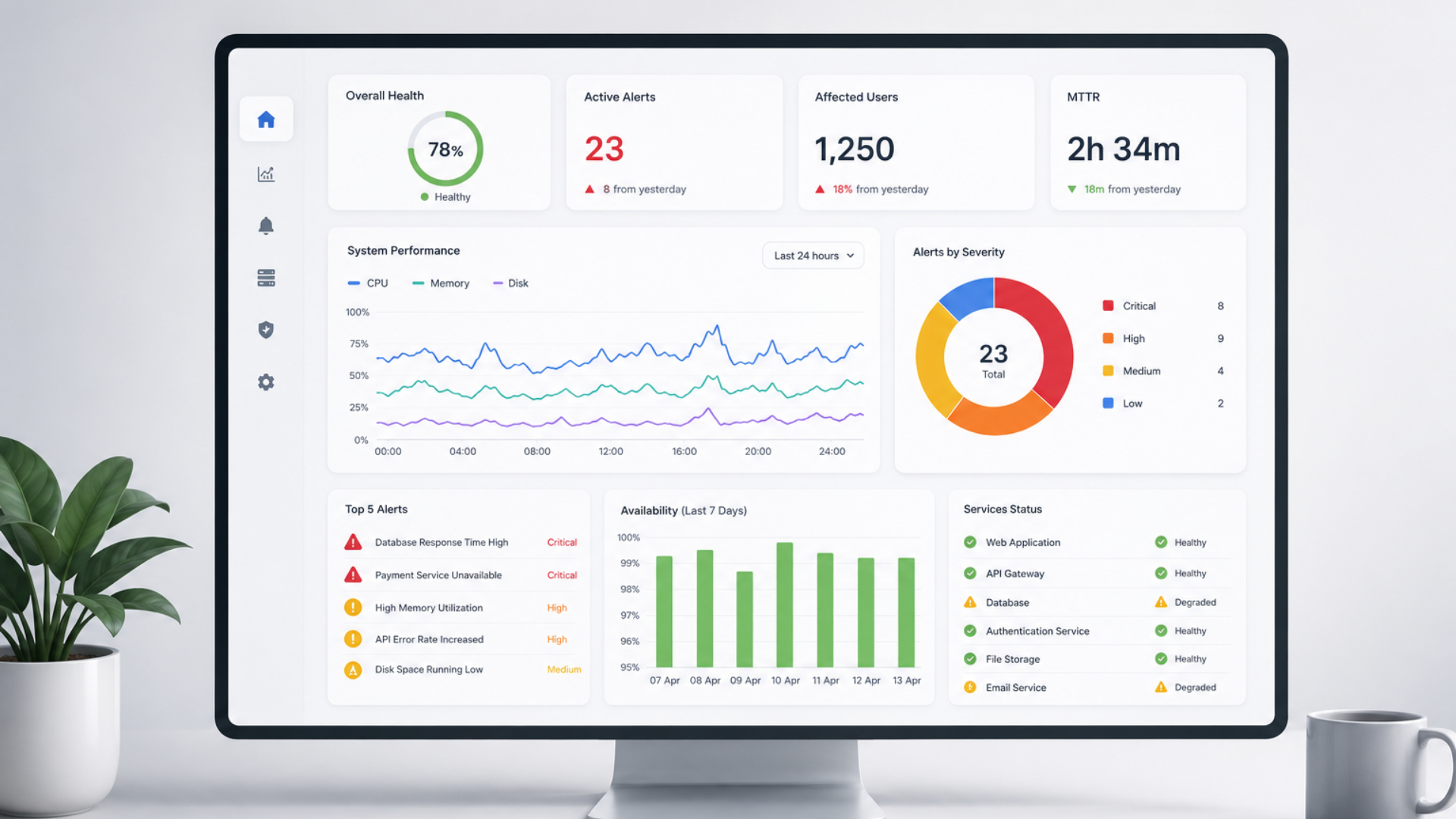
In today’s always-on world, downtime is not just an IT headache, it’s a direct hit to business performance. A single outage can halt revenue streams, freeze productivity and frustrate customers. In fact, a recent study found businesses lose about $2 million for every hour of downtime (roughly $76M per year on average). Yet many organizations still use reactive “break-fix” models where issues only surface after a user complaint. This old-school approach is dangerous. Modern enterprises are shifting to Remote Infrastructure Monitoring a continuous visibility model that uses real-time alerts and automation to spot problems before they cause impact. You’ll see how 24×7 monitoring and intelligent tools turn outages into uptime.

Why Reactive IT Models Are No Longer Enough

Traditional IT ops work like this: something fails, alerts (or users) raise tickets, then teams scramble to fix it. Every step is on-the-clock. This leads to late issue detection and all of us playing catch-up. For example, 41% of IT issues are still reported only via user tickets or manual checks. Engineers then waste ~33% of their time firefighting. The result? High downtime and stressed IT teams.

  • Late detection: Critical failures often aren’t noticed until after an impact.
  • Manual overload: Teams rely on people to notice and report issues, a recipe for missed alerts.
  • Poor visibility: Siloed infrastructure (data centers, cloud, networks) means hidden blind spots.
  • Alert storms: Outdated systems flood you with noise, making it easy to miss the real crisis.

As environments grow distributed (on-prem, multi-cloud, edge), a reactive “midnight page” model simply can’t scale. You need continuous oversight instead.

The Shift: From Midnight Alerts to Continuous Monitoring

The Problem: The “Midnight Page”

Even a few years ago, many IT teams only learned of outages via pagers or angry users. The damage was already done: business was disrupted, SLAs broken, and recovery costly.

The Transformation with Remote Monitoring

Remote Infrastructure Monitoring Services give you real-time insight across your entire IT stack: servers, storage, networks, clouds and even applications. Instead of waiting for a failure, you can detect early warning signs like rising latency, disk bottlenecks, or unusual traffic patterns. For example, if a database’s response time slowly degrades, a good monitoring system will alert you long before users notice slowness. This shift means:

  • Faster response: Team Computers’ clients now see alerts hours before any user impact.
  • Proactive fixes: Minor issues (e.g. nearing capacity) can be resolved on the spot.
  • Clear prioritization: Instead of 500 low-level alerts, you get a few high-value warnings.

One Indian e-commerce firm told us that after deploying remote monitoring, critical issues dropped by 60%. They resolved bottlenecks in minutes—before customers even knew. This is the difference between catching a problem in development vs. in production.

Reducing Alert Fatigue with Intelligent Monitoring

The Problem: Too Many Alerts, Too Little Context

Basic monitoring tools often emit a blizzard of alerts. This leads to “alert fatigue”: teams start ignoring non-critical alarms or getting overwhelmed. Meanwhile, the real incidents can slip through.

The Transformation

Modern monitoring platforms especially those with AI/Ops triage alerts for you. For instance, Team Computers’ ZerofAI platform (our AI-led monitoring) automatically correlates events across systems, filters out noise, and highlights only the critical ones. These smart platforms provide context (e.g. “CPU spiked on server X due to backup job”), so your team can act with confidence.

  • Noise reduction: Only actionable alerts reach your phone.
  • Automated insights: Correlated events show true root cause.
  • Faster troubleshooting: You see why an alert happened, not just that it happened.

This means your ops team spends less time digging and more time solving. In practice, customers using intelligent monitoring report up to 40% faster incident resolution.

Enabling Global IT Operations with Centralized Monitoring

The Problem: Distributed Infrastructure, Limited Expertise

Enterprises today often span multiple cities or countries. Managing such a dispersed IT landscape requires expert eyes in every location, an impractical demand. Too often, smaller sites suffer from oversight gaps or inconsistent tools.

The Transformation

Remote Monitoring enables centralized control. Through 24×7 NOCs (Network Operations Centers) and Global Delivery Centers (GDCs), providers can keep watch over everything, anywhere. In other words, you get global expertise on demand. Key benefits:

  • Continuous coverage: Local issues in Mumbai or Bangalore get the same attention at 2 AM as those in New York at noon.
  • Standardized tools: One pane of glass for all sites ensures uniform tracking.
  • Scalable support: You don’t need on-site experts everywhere; the provider’s team handles it centrally.

Consider a multinational IT firm with hubs in India and Europe. By leveraging a centralized NOC, they maintained 24×7 visibility over all data centers. When a critical router failure occurred in Pune at midnight, the offshore team in India was on it immediately fixing the issue within minutes instead of hours.

This model also helps meet compliance or regulatory demands. For instance, many Indian financial regulators expect demonstrable uptime. A central NOC can provide audit-ready logs showing every system’s health in real time.

Moving Toward Proactive and Self-Healing IT Operations

Remote monitoring isn’t the end it’s the enabler of automation. The future is “self-healing” infrastructure. Today’s top IT departments are already using monitoring data to trigger automated responses. For example:

  • If disk space reaches 90%, automatically provision more storage.
  • If a microservice crashes, spin up a fresh instance instantly.
  • If malicious traffic is detected, firewall rules update themselves.

Over time this means far fewer manual tickets. Some Team Computers clients see 50% fewer service tickets after adding automated remediation. Essentially, IT shifts from “replacing fuse” to “designing smart systems.”

The outcome is clear: Lower downtime, faster fixes, and IT teams free to work on innovation instead of routine.

How Managed Services Strengthen Remote Monitoring

Remote monitoring reaches full power when paired with managed IT services. A provider like Team Computers combines:

  • 24×7 NOC monitoring and incident response
  • Data center and cloud infrastructure management
  • Network monitoring and performance optimization
  • Automation tools (like ZerofAI) for proactive resolution

This integrated approach means alerts don’t just stop at notification, they’re routed to experts who diagnose and fix issues immediately. For example, if monitoring spots a surge in CPU usage, Team Computers’ engineers can remotely rebalance workloads or upgrade capacity on-the-fly.

In short, managed services ensure your monitoring insights lead to action. They make your infrastructure not just visible, but also resilient and self-optimizing.

Conclusion: Turning Uptime into a Competitive Advantage

Reactive IT models lead to firefighting and costly downtime. By contrast:

  • Continuous monitoring catches issues early.
  • Intelligent alerting cuts noise and focuses teams.
  • Centralized NOCs give 24×7 global oversight.
  • Automation and MSP support turn insights into fixes before outages occur.

Together, these elements build a proactive IT operations model. Organizations that adopt this approach spend less on outages and more on innovation.

Your IT infrastructure can become a business enabler, not a bottleneck. And that starts with shifting from “we’ll fix it when it breaks” to “we prevent it from breaking in the first place.”

9 Ways AI Is Helping Reduce IT Downtime in Large Enterprises

IT downtime is no longer just a technical issue, it is a direct business risk. From lost revenue to degraded customer experience, even short disruptions can have significant consequences. Many enterprises still rely on reactive monitoring, where issues are identified only after systems fail.

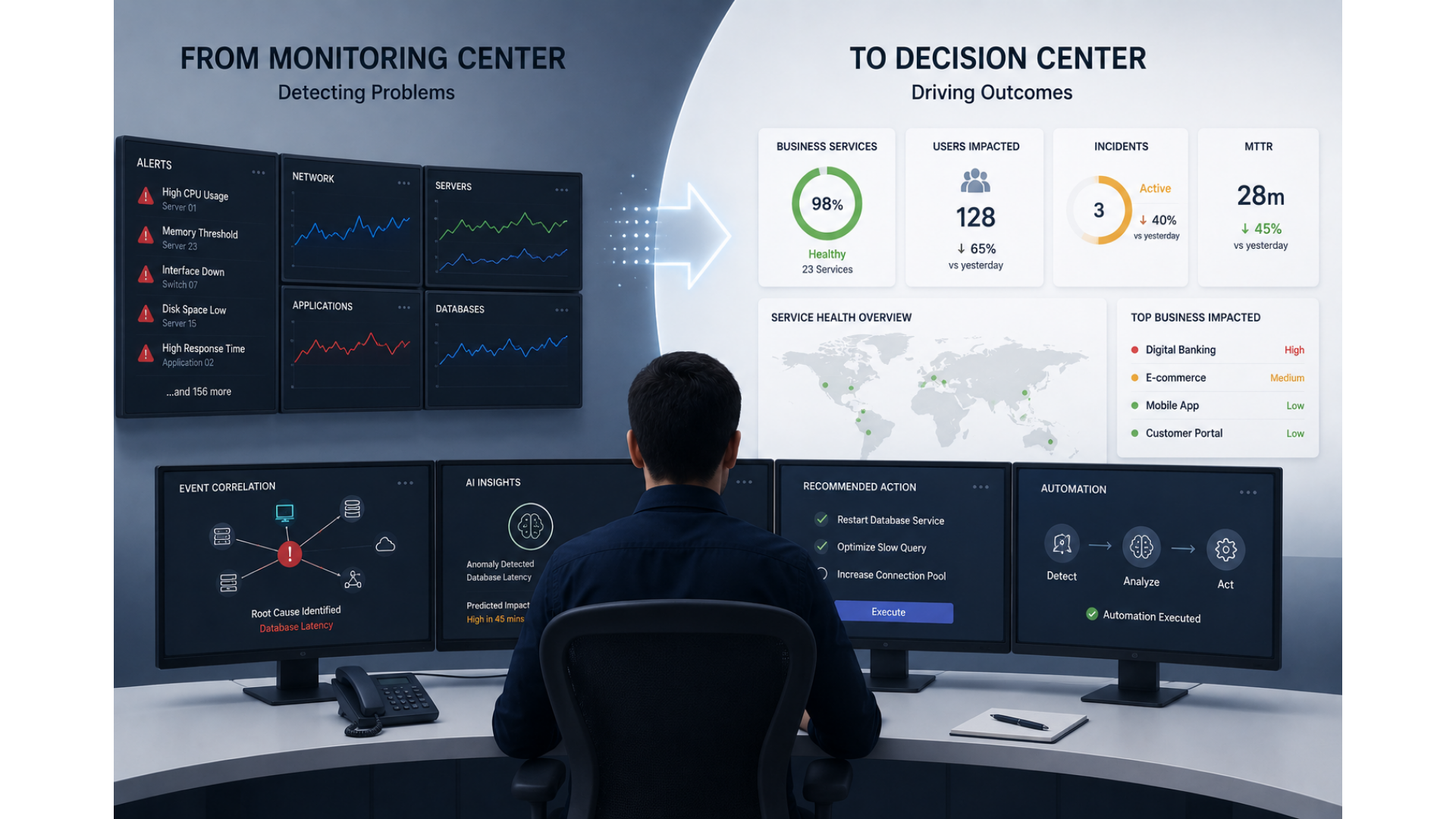
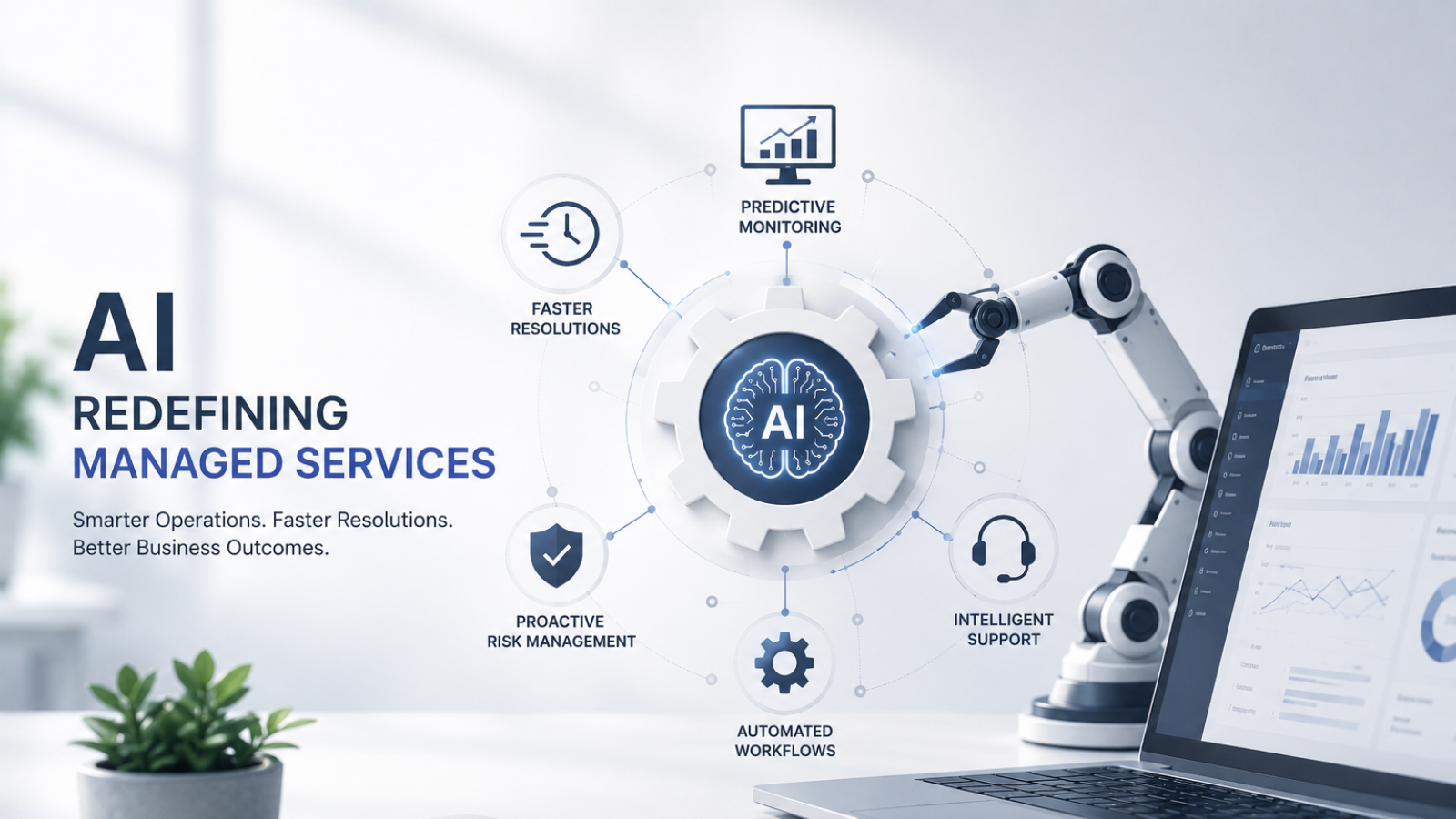
To truly reduce IT downtime, organizations are shifting toward AI-driven operations. By combining machine learning, automation, and real-time analytics, AI enables faster detection, smarter decision-making, and proactive issue resolution.

This article breaks down nine practical ways AI is transforming IT downtime prevention in enterprise environments.

1. Intelligent Alert Correlation to Reduce Noise

One of the biggest challenges in IT operations is alert fatigue. Monitoring tools generate thousands of alerts daily, many of which are duplicates or symptoms of the same issue.

AI reduces noise by correlating related alerts into a single incident. Instead of investigating multiple signals, teams can focus on one root cause.

This approach significantly improves alert fatigue in IT operations, allowing teams to respond faster and more effectively.

2. Predictive Analytics for IT Downtime Prevention

Traditional systems react after failures occur. AI changes this by identifying patterns that signal potential issues before they escalate.

By analyzing historical and real-time data, AI enables IT downtime prevention through early detection. Teams can take corrective action before users are impacted.

In enterprise environments, this shift from reactive to predictive operations is critical for maintaining uptime.

3. Automated Root Cause Analysis

When an incident occurs, identifying the root cause often takes longer than resolving it. Engineers must analyze logs, metrics, and dependencies across multiple systems.

AI automates this process by mapping relationships between components and identifying the most likely cause of failure.

This reduces investigation time and accelerates recovery, helping organizations reduce IT downtime more consistently.

4. Self-Healing IT Infrastructure

AI enables systems to resolve issues automatically without human intervention. This is known as self-healing IT infrastructure.

For example, if a service becomes unresponsive, the system can restart it automatically or scale resources to handle load spikes.

This capability minimizes downtime and ensures that issues are resolved before they affect end users.

5. Proactive IT Monitoring with AI

AI transforms monitoring from passive observation to active intervention. Instead of waiting for alerts, systems continuously analyze performance and behavior.

This enables proactive IT monitoring, where anomalies are detected in real time and addressed immediately.

The result is fewer incidents and more stable systems.

6. Capacity Planning and Resource Optimization

Many outages occur due to resource constraints—CPU overload, memory exhaustion, or network bottlenecks.

AI analyzes usage patterns and predicts future demand, enabling better capacity planning. This ensures that systems have the resources they need to operate smoothly.

By preventing resource-related failures, AI plays a key role in reducing downtime.

7. Faster Incident Response Through Automation

AI-driven automation reduces the time required to respond to incidents. Once an issue is detected, predefined workflows can be triggered automatically.

This includes actions such as:

  • Restarting services
  • Scaling infrastructure
  • Redirecting traffic

These automated responses significantly improve recovery time and help reduce IT downtime across environments.

8. Continuous Learning from Past Incidents

AI systems improve over time by learning from historical data. Every incident becomes a source of insight.

Patterns from past failures are used to refine detection models and improve future responses. This creates a feedback loop that enhances system reliability.

9. Unified Visibility Across Hybrid Environments

Enterprise IT environments are often fragmented across cloud, on-premises, and third-party systems.

AI provides a unified view by aggregating data from all sources and analyzing it centrally. This enables better decision-making and faster issue resolution.

Solutions like ZerofAI  from Team Computers integrate observability, automation, and AI to deliver end-to-end visibility across complex environments.

The Business Impact: AIOps ROI in Enterprise Operations

AI-driven operations are not just about efficiency—they directly impact business performance.

By reducing incident frequency and improving response time, organizations can:

  • Improve system uptime
  • Enhance customer experience
  • Optimize operational costs

This is where AIOps  ROI becomes evident. The value lies in fewer disruptions, faster recovery, and more predictable performance.

Conclusion

Enterprises that rely on reactive monitoring will continue to struggle with outages and inefficiencies. AI offers a different approach—one that focuses on prediction, automation, and continuous improvement.

If your goal is to reduce IT downtime, adopting AI-driven operations is no longer optional. It is a strategic requirement for managing modern IT environments.

With solutions like ZerofAI from Team Computers, organizations can move toward proactive IT monitoring, self-healing systems, and intelligent incident management—ensuring greater reliability and long-term resilience.

What Is AIOps? The Complete Guide for Enterprise IT Operations Teams

Enterprise IT environments have reached a point where complexity is no longer manageable through traditional approaches. Hybrid cloud architectures, microservices, Kubernetes, and distributed systems continuously generate massive volumes of operational data. In many organizations, thousands of alerts are triggered daily—yet only a small fraction require action. The rest create noise, slow response times, and increase operational risk.

This is where understanding what is AIOps becomes critical. AIOps—Artificial Intelligence for IT Operations—applies machine learning and advanced analytics to IT data such as logs, metrics, traces, and events. It enables organizations to detect anomalies, correlate signals, predict issues, and automate responses.

AIOps is not just an efficiency upgrade for IT operations, it is a necessary shift toward managing modern infrastructure with intelligence rather than manual effort.

What Is AIOps? Meaning, Definition, and Enterprise Context

AIOps (Artificial Intelligence for IT Operations) refers to the use of machine learning, data analytics, and automation to enhance and optimize IT operations.

To fully understand what is AIOps, it is important to compare it with traditional monitoring. Conventional tools collect and display operational data, but they rely heavily on human interpretation. Engineers must manually investigate alerts, correlate events, and identify root causes across multiple systems.

AIOps fundamentally changes this approach.

An AIOps platform ingests data from across the IT ecosystem—applications, infrastructure, networks, and cloud environments—and applies machine learning to analyze patterns and detect anomalies in real time. Instead of presenting fragmented data, it delivers contextual insights that explain what is happening and why.

This shift transforms IT operations from reactive monitoring into intelligent, data-driven decision-making.

Why Enterprise IT Teams Can No Longer Ignore AIOps

The need for AI for IT operations is driven by three key realities.

The Complexity Problem

First, complexity has increased significantly. Modern enterprises operate across multiple cloud platforms, containerized environments, and distributed services. Each layer introduces dependencies that are difficult to manage manually.

The Data Volume Problem

Second, the volume of operational data continues to grow. Without intelligent filtering, teams face alert fatigue, where important signals are lost among repetitive or low-priority alerts.

The Business Impact Problem

Third, the business impact of IT performance has become immediate and measurable. System downtime affects revenue, customer experience, and brand trust. As a result, organizations are moving toward predictive IT operations, where issues are identified and addressed before they escalate.

AIOps also improves incident response efficiency. By automating detection and analysis, it reduces the time required to identify and resolve issues, enabling faster recovery and more stable operations.

What Is AIOps and Why It Matters for Modern Enterprise IT

Understanding what is AIOps is not just about adopting new technology—it is about redefining how IT operations function at scale.

In a typical enterprise environment, a single issue can trigger alerts across multiple dependent systems. Without intelligent correlation, teams must manually trace these signals across tools to identify the root cause. This process is time-consuming and prone to error.

AIOps addresses this challenge by analyzing system behavior across the entire stack. It connects events, identifies relationships, and surfaces insights that would otherwise remain hidden.

This matters because IT operations directly impact business outcomes. Faster detection reduces downtime. Automated analysis accelerates resolution. Predictive insights prevent disruptions.

For enterprises, AIOps represents a shift from reactive troubleshooting to proactive and strategic operations management.

How AIOps Works: Architecture and Intelligence in Action

AIOps functions as a unified intelligence layer across the IT environment, transforming raw data into actionable insights.

Data Ingestion

The process begins with data ingestion. Logs, metrics, traces, and events are collected continuously from applications, infrastructure, networks, and cloud systems. This comprehensive visibility is essential for accurate analysis.

Data Normalization and Enrichment

Next, the data is normalized and enriched. Information from different sources is standardized and enhanced with context such as system dependencies and historical behavior. This allows the platform to understand how different components interact.

Machine Learning and Analysis

At the core is the machine learning engine. This is where AIOps delivers its value. The system learns normal behavior patterns and identifies deviations in real time. Unlike static monitoring thresholds, these models adapt continuously.

Event Correlation

The correlation layer then groups related alerts into a single incident. For example, a database issue may trigger multiple alerts across dependent services. AIOps consolidates these signals and identifies the root cause.

Automated Remediation

Finally, the automation layer executes remediation workflows. This may include restarting services, scaling resources, or triggering alerts with detailed context.

Platforms like ZerofAI from Team Computers integrate these layers into a unified system, enabling intelligent IT operations at scale.

Domain-Centric vs. Domain-Agnostic AIOps

AIOps platforms can be categorized based on their scope.

Domain-Centric AIOps

Domain-centric platforms focus on specific areas such as network monitoring or application performance. While they provide deep insights within their domain, they often operate in isolation.

Domain-Agnostic AIOps

Domain-agnostic platforms take a broader approach. They ingest and correlate data across the entire IT stack, providing a unified view of operations. This enables more accurate root cause analysis and better decision-making.

Generative AI-Enhanced AIOps

An emerging category includes generative AI-powered AIOps, where users can interact with systems using natural language and receive contextual insights instantly. 

Key AIOps Use Cases for Enterprise IT Operations

Intelligent Alert Management

One of the most valuable AIOps use cases is reducing alert noise. In large environments, monitoring tools generate a high volume of alerts, many of which are duplicates or symptoms of the same issue.

AIOps filters and correlates these alerts into meaningful incidents, allowing teams to focus on critical problems.

Automated Root Cause Analysis

AIOps eliminates the need for manual investigation by identifying the root cause of incidents automatically. This reduces the time spent analyzing logs and improves resolution speed.

Predictive Incident Prevention

Through pattern analysis, AIOps identifies early warning signs of system failures. This enables teams to take preventive action, supporting predictive IT operations.

Self-Healing Systems

AIOps enables automation of remediation workflows, allowing systems to resolve issues without human intervention in predefined scenarios.

Cloud Cost Optimization

By analyzing resource usage, AIOps identifies inefficiencies and supports automated scaling, helping organizations manage cloud costs effectively.

DevOps Integration

AIOps integrates with CI/CD pipelines, enabling early detection of anomalies during deployments and improving release quality.

The Business Case for AIOps

The value of AIOps extends beyond technical efficiency.

Faster Incident Resolution

One of the most significant benefits is faster incident resolution. With automated detection and analysis, organizations achieve substantial MTTD MTTR reduction AI, directly improving uptime.

Alert Noise Reduction

AIOps also enables scalability. IT teams can manage larger environments without increasing headcount.

Operational Scalability

Another key advantage is knowledge retention. Every incident and resolution is captured, creating a continuous learning system.

Business Impact and ROI

For enterprises, AIOps aligns IT operations with business outcomes. Reduced downtime protects revenue, while improved performance enhances customer experience.

AIOps vs Traditional Monitoring


Capability Traditional Monitoring AIOps Platform
Data Handling Displays raw data Analyzes and contextualizes data
Alert Management High noise Intelligent correlation
Root Cause Analysis Manual Automated
Incident Response Reactive Predictive
Learning Capability Static Continuous learning
Scalability Limited Highly scalable
Human Effort High Reduced


The key difference in AIOps vs traditional monitoring is intelligence. Traditional tools show data, while AIOps explains it and acts on it.

AIOps Tools in India and Enterprise Adoption

The market for AIOps tools India is expanding as organizations modernize their IT operations.

Enterprises are adopting platforms that combine observability, automation, and AI-driven insights. Team Computers, through its ZerofAI platform, offers a solution tailored to enterprise environments—combining global best practices with localized expertise.

Managed AIOps services are particularly valuable for organizations that want to accelerate adoption without building in-house capabilities.

How to Implement AIOps

Assess Your Current Environment

A successful AIOps journey begins with understanding your current environment. Organizations must evaluate their monitoring tools, data sources, and incident workflows.

Define a Pilot Use Case

The next step is defining a pilot use case. Starting with a focused implementation allows teams to demonstrate value quickly.

Build a Data Foundation

Building a strong data foundation is critical. AIOps relies on accurate and consistent data to deliver reliable insights.

Deploy and Measure

Once deployed, performance should be measured using operational metrics such as incident response time and alert reduction.

Finally, governance frameworks ensure that automation is implemented safely and effectively.

AIOps Challenges: What Enterprise Teams Must Prepare For

AIOps delivers substantial value, but it is not a quick fix. A successful AIOps implementation depends as much on operational readiness as it does on technology. The challenges below are not reasons to avoid AIOps—they are the variables that determine whether an initiative delivers meaningful outcomes or fails to scale.

Data Quality and Integration Gaps

The most common cause of AIOps underperformance is poor data quality. An AIOps platform is only as intelligent as the data it analyzes. When logs are incomplete, metrics are inconsistently labeled, or telemetry from critical systems is missing, the platform produces inaccurate correlations and false positives.

This not only limits effectiveness but also erodes trust among engineering teams. In many cases, this loss of trust happens early, before the system has had the opportunity to demonstrate its value. For organizations adopting AI for IT operations, establishing a reliable, well-structured data foundation is non-negotiable.

Legacy System Integration Complexity

Most enterprise environments are not built from scratch. They evolve over time, often resulting in a mix of modern cloud platforms and legacy infrastructure. Older systems—particularly on-premises hardware or proprietary vendor technologies—do not always expose the telemetry required by modern AIOps solutions.

Integrating these systems into a unified AIOps framework requires additional engineering effort, including building data pipelines and standardizing formats. For enterprises with significant legacy environments, this step is essential to achieving end-to-end visibility and accurate analysis.

Organizational Resistance and Change Management

AIOps fundamentally changes how IT operations teams work. Tasks that were once manual—such as alert triaging and root cause analysis—become automated or AI-assisted.

This shift can create resistance, particularly among experienced engineers whose expertise has traditionally been rooted in manual investigation. Addressing this requires clear positioning. AIOps should be framed as a capability that amplifies human expertise, not replaces it.

When implemented correctly, AIOps reduces repetitive work and allows teams to focus on higher-value activities such as system optimization, reliability engineering, and innovation.

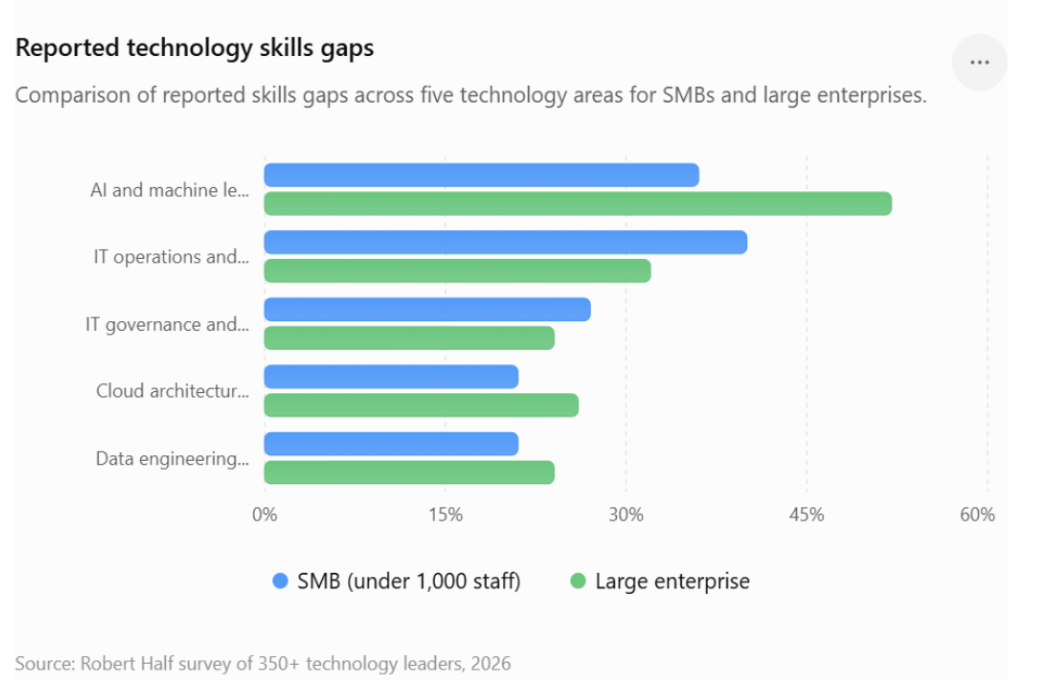
Skills Gap and Operational Readiness

Adopting AIOps requires a blend of IT operations knowledge and data fluency. Teams need to understand how machine learning models interpret system behavior, when to trust automated insights, and how to refine the system over time.

For many organizations, this capability does not exist internally at the outset. In such cases, partnering with an experienced provider can accelerate adoption and reduce risk. Managed AIOps services—such as those delivered through ZerofAI  by Team Computers—help bridge this gap by combining platform capability with operational expertise.

Unclear ROI and Success Metrics

One of the most common reasons AIOps initiatives stall is the absence of clearly defined success metrics. Without measurable outcomes, it becomes difficult to demonstrate value to stakeholders or justify continued investment.

Organizations should define success criteria before deployment. Metrics such as incident response efficiency, alert reduction, and system reliability provide a clear view of progress. Establishing a baseline ensures that improvements can be tracked and communicated effectively.

The Future of AIOps

AIOps is evolving toward more intelligent and autonomous systems.

Generative AI is enabling natural language interaction with IT environments, making insights more accessible.

Agentic AI is introducing systems that can not only detect and diagnose issues but also resolve them independently.

AIOps is also converging with security and financial operations, creating a unified operational framework.

As these capabilities mature, AIOps will become the foundation of intelligent IT operations.

Is Your Enterprise Ready for AIOps?

Readiness for AIOps is less about technology and more about operational foundations. Organizations that see sustained value from AIOps deployments share a set of common characteristics worth assessing before committing to a platform or engagement.

Readiness Indicators

  • An observability foundation is in place — Logs, metrics, and traces are collected reliably from the systems that matter, with consistent labeling and sufficient coverage.
  • IT operations processes are documented — It is impossible to automate something that is not understood. AIOps amplifies process maturity; it does not replace it.
  • Executive sponsorship is established — Leadership recognizes AIOps as a business capability investment, not just a technical initiative.
  • A well-scoped pilot use case is defined — Success criteria are clearly established in advance, enabling measurable outcomes.
  • A capability plan is in place — Either internal teams are prepared to work alongside the AIOps platform, or a managed services partner is engaged to bridge the gap.

Organizations that move to AIOps without these foundations often struggle to realize value. This is rarely due to limitations in the platform, but rather because the data and processes required for intelligent analysis are not yet mature.

If your organization is at an earlier stage of observability maturity, Team Computers can help you build a strong operational foundation through managed IT services  and infrastructure monitoring—and then layer ZerofAI-powered AIOps once your environment is ready.

Conclusion

AIOps has become a critical capability for enterprise IT operations. As environments grow more complex, traditional approaches are no longer sufficient.

Understanding what is AIOps is the first step toward building a modern, resilient IT strategy. By leveraging AI-driven insights, organizations can reduce downtime, improve efficiency, and scale operations effectively.

Team Computers powered by  ZerofAI demonstrate how AIOps can be implemented in real-world enterprise environments—delivering proactive monitoring, predictive insights, and automated remediation.

The future of IT operations is intelligent, automated, and data-driven. Organizations that adopt AIOps today will be better positioned to manage the challenges of tomorrow.

Frequently Asked Questions

What is AIOps?

AIOps stands for Artificial Intelligence for IT Operations. It uses machine learning and analytics to automate and enhance IT operations.

How is AIOps different from traditional monitoring?

AIOps analyzes and correlates data automatically, while traditional monitoring relies on manual interpretation.

How long does implementation take?

Initial results can be achieved in 3–6 months, with full implementation taking 12–18 months.

Does AIOps replace IT teams?

No. It enhances productivity by automating repetitive tasks.

What metrics define success?

Key metrics include MTTR reduction, alert reduction, and system uptime.

Why Most Data Centers Still Lack Real Visibility

According to the Uptime Institute, over 60% of data center outages cost more than $100,000, and a growing number exceed $1 million.

What’s more concerning isn’t the cost. It’s the cause.

Most failures aren’t due to catastrophic breakdowns. They’re due to hidden inefficiencies- power imbalance, cooling gaps, or capacity blind spots that go unnoticed until they escalate.

If you’re a CIO, this isn’t just an infrastructure issue. It’s a visibility problem.

Despite investments in monitoring tools, many enterprises still don’t have a unified understanding of what’s happening inside their data centers. And that’s where Data Center Infrastructure Management Services become critical not as a toolset, but as an operating model.

Because without real-time, connected visibility, scale becomes a risk.

The conventional wisdom (and why it’s wrong)

Most data center strategies still follow a legacy assumption:
“If systems are running, everything is fine.”

That assumption breaks in modern environments.

Hybrid infrastructure has introduced layers of complexity, on-prem systems interacting with cloud workloads, edge locations adding variability, and increasing compute density stressing power and cooling systems.

Yet, many organisations still rely on siloed monitoring. Facilities teams track power and cooling. IT teams track servers and applications. Rarely do these views converge.

What you get is partial visibility.

And partial visibility creates delayed decisions.

Most outages today are not sudden. They are predictable but only if you’re looking at the right signals together.

What the data is actually telling us

Analyst reports are pointing in one direction.

  • According to Gartner, through 2027, 75% of enterprise data center infrastructure will require real-time visibility tools to support hybrid environments
  • India’s data center capacity is projected to grow at over 20% CAGR, driven by cloud, AI, and data localisation requirements
  • Energy efficiency is becoming a board-level concern, with rising focus on PUE optimisation and sustainability metrics

Add to that regulatory pressure from the DPDP Act 2023, and the expectation is clear — infrastructure must be auditable, efficient, and predictable.

A BFSI organisation we engaged with had no major outages yet customer complaints about performance were rising.

The issue?

Thermal inconsistencies across racks were affecting latency-sensitive applications. Traditional monitoring didn’t flag it because systems were technically “up.”

That’s the gap between uptime and performance.

The approach forward-thinking CIOs are taking

What’s changing is how infrastructure is being governed from fragmented monitoring to integrated intelligence.

1. From isolated metrics to unified visibility

Forward-looking CIOs are implementing platforms that combine:

  • Power usage
  • Cooling efficiency
  • IT workload distribution

This creates a single operational view not multiple dashboards.

Because decisions made in silos create inefficiencies elsewhere.

2. From reactive alerts to predictive insights

Traditional systems notify you after thresholds are breached.

Modern Data Center Infrastructure Management Services analyse trends identifying anomalies before they become incidents.

That shift alone changes how downtime is managed from recovery to prevention.

3. From over-provisioning to intelligent capacity planning

IDC estimates that a significant portion of data center capacity remains underutilised due to lack of visibility

Instead of adding more infrastructure, CIOs are now:

  • Rebalancing workloads
  • Optimising rack density
  • Aligning power and cooling with actual usage

This delays capital expenditure while improving efficiency.

4. From infrastructure monitoring to operational integration

Infrastructure insights are now being integrated with broader IT operations including network management & monitoring and application performance tracking.

Because performance issues are rarely isolated.

They are systemic.

What this means for Indian enterprises specifically

India’s growth story is creating a unique infrastructure challenge.

GCCs are expanding rapidly, often with mandates to handle global workloads. At the same time, enterprises are building distributed infrastructure across multiple cities.

This introduces variability in power reliability, cooling efficiency, and operational consistency.

Add regulatory expectations from the Digital Personal Data Protection (DPDP) Act 2023, and the need for structured infrastructure management becomes even more critical.

A large manufacturing enterprise operating across regions faced inconsistent infrastructure performance across plants. Each location had different standards and visibility levels.

By implementing a centralised Data Center Infrastructure Management Services model, they standardised monitoring and control across all sites.

The outcome wasn’t just efficiency. It was governance.

The gap most organisations haven’t closed

Here’s where most enterprises fall short.

They invest in tools but not in operations.

Visibility without execution doesn’t deliver outcomes.

That’s why CIOs are increasingly aligning infrastructure management with managed IT services models that bring:

  • Continuous 24×7 NOC support
  • Skilled resources for proactive monitoring
  • Ongoing optimisation instead of one-time implementation

Because infrastructure doesn’t fail due to lack of data. It fails due to lack of action.

Where infrastructure management is heading next

The next evolution is already underway.

Data centers are moving towards:

  • AI-driven power and cooling optimisation
  • Automated incident detection and remediation
  • Integration with hybrid and multi-cloud ecosystems
  • Self-healing infrastructure environments

What this creates is a shift from managed infrastructure to autonomous infrastructure.

And that’s when infrastructure stops being a constraint and starts becoming a competitive advantage.

Conclusion

What’s ahead isn’t just more infrastructure it’s higher expectations from what that infrastructure must deliver.

If your current setup still relies on fragmented monitoring and reactive processes, it won’t scale with business demands.

To move forward:

  • Audit visibility across power, cooling, and IT systems not just individually, but collectively
  • Identify inefficiencies before planning capacity expansion
  • Shift towards predictive monitoring instead of threshold-based alerts
  • Evaluate whether your operating model supports continuous optimisation

The difference between stable operations and scalable infrastructure lies in how well you can see, understand, and act. And that’s exactly where Data Center Infrastructure Management Services make the difference.

The CIO Playbook for Managed IT Services in the AI Era

Monday morning, 9:12 AM. A CIO at a fast-growing GCC in Bengaluru is reviewing three dashboards, cloud costs spiking, a security alert flagged overnight, and a backlog of unresolved IT tickets.

None of this is new. That’s the problem.

You’re expected to drive AI-led transformation, but your foundation is still reactive. Teams are firefighting. Systems are fragmented. And despite investments, outcomes aren’t keeping pace. This is where managed IT services move from being operational support to becoming a strategic lever.

What’s changing isn’t just technology, it’s the role of IT itself. And unless the operating model evolves, even the best AI initiatives will stall.

The conventional wisdom (and why it’s wrong)

For years, managed services meant outsourcing routine IT operations, helpdesk, infrastructure monitoring, maybe some network support. The goal was simple: reduce cost and improve uptime.

That model no longer holds.

AI workloads are unpredictable. Hybrid environments are harder to manage. Security threats evolve faster than traditional monitoring systems can catch. Yet many enterprises still treat managed services as a cost center rather than an enabler.

What this leads to is a dangerous mismatch. Your business expects agility. Your IT backbone delivers stability but slowly.

Most CIOs aren’t struggling because they lack tools. They’re struggling because their operating model hasn’t caught up.

When managed services are scoped narrowly, they optimize for tickets closed not outcomes delivered. That’s why you see high SLA compliance but low business satisfaction.

What the data is actually telling us

Look closer at enterprise IT trends in India, and a clear pattern emerges.

  • India is home to over 1,500+ GCCs, and the number is expected to grow significantly in the next few years.
  • Regulatory pressure is increasing with frameworks like the DPDP Act 2023, forcing organisations to rethink data handling and governance
  • Cyber incidents targeting Indian enterprises have risen sharply

What does this mean for you?

Scale is no longer optional. Compliance is no longer periodic. And risk is no longer predictable.

Yet, many IT environments still depend on internal teams juggling multiple tools and vendors.

A BFSI enterprise we worked with had strong infrastructure but struggled with incident response times. Alerts were being generated but not correlated. By the time issues escalated, customer experience had already taken a hit.

The gap wasn’t technology. It was orchestration.

The approach forward-thinking CIOs are taking

What’s changing is not whether to adopt managed services, it’s how deeply they are integrated into the IT strategy.

1. Moving from SLAs to experience metrics

Most contracts still revolve around uptime and resolution time. But uptime doesn’t equal productivity.

CIOs are now focusing on Digital Employee Experience (DEX) measuring how IT performance impacts end users.

That’s where platforms around digital workplace management come in, giving visibility beyond tickets into real user impact.

2. Building always-on operations

AI-driven enterprises don’t operate 9 to 5. Neither can IT.

A mature 24×7 NOC support model isn’t just about monitoring it’s about proactive detection, correlation, and response.

What matters is not whether an alert is raised, but whether it is acted upon before it impacts business.

3. Integrating infrastructure visibility

Hybrid environments have made IT visibility fragmented. Cloud, on-prem, endpoints all managed differently.

Forward-thinking teams are unifying network management & monitoring with infrastructure operations to create a single view of performance and risk.

Because without visibility, automation fails.

4. Extending internal teams, not replacing them

Here’s where most organisations hesitate.

Managed services are often seen as outsourcing control. But the shift is towards co-managed models where internal teams focus on strategy, while operational complexity is handled externally.

That’s how CIOs are freeing up bandwidth for AI initiatives without burning out their teams.

What this means for Indian enterprises specifically

India presents a unique combination of scale and complexity.

On one side, GCC expansion is accelerating. Global companies are setting up large technology hubs here, expecting India teams to lead innovation not just execution.

On the other side, regulatory frameworks like the Digital Personal Data Protection (DPDP) Act 2023 are tightening expectations around data handling.

This creates a dual pressure:

  • Deliver faster innovation
  • Maintain stricter compliance

Rarely do traditional IT models handle both well.

A manufacturing enterprise operating across multiple Indian plants faced exactly this challenge. Their operations depended on uptime, but IT teams were decentralised. Each location handled issues differently, leading to inconsistent performance.

By shifting to a centralised remote IT infrastructure managed services model, they standardised operations while maintaining local flexibility.

The outcome wasn’t just efficiency. It was predictability.

The real shift: from vendor to operating partner

What’s emerging is a different expectation from a top managed IT services company.

CIOs are no longer looking for vendors who execute tasks. They’re looking for partners who:

  • Understand business context, not just IT architecture
  • Provide actionable insights, not just reports
  • Align with outcomes, not just contracts

Because the real value of managed services isn’t in doing more. It’s in making IT invisible when it works and intelligent when it doesn’t.

How to know if your model is working

Most enterprises measure success incorrectly.

Here’s what actually indicates maturity:

  • Reduction in repeat incidents, not just faster resolution
  • Improved end-user experience scores
  • Fewer escalations reaching business stakeholders
  • Increased time spent by internal teams on strategic initiatives

If these aren’t improving, the model needs rethinking not just optimisation.

Conclusion

What lies ahead isn’t just more technology, it’s more responsibility on IT to drive business outcomes. And that changes everything about how you approach managed IT services.

If your current model is still built around tickets and uptime, it won’t scale into an AI-driven enterprise.

To move forward:

  • Audit how much of your IT team’s time goes into reactive work vs strategic initiatives
  • Evaluate whether your current setup provides end-to-end visibility across infrastructure
  • Shift from SLA-based measurement to experience and outcome-based metrics
  • Reassess whether your managed services partner is enabling or limiting transformation

The difference between stable IT and strategic IT will define how fast your organisation moves next. And in that transition, managed IT services will either be your bottleneck or your multiplier.

What is a Managed Service Provider (MSP)?

Picture walking into your office on a Monday morning only to discover the network is completely dead and no one can access their email. You immediately scramble to find someone who can help, or worse, spend an hour on hold with a support hotline while your entire team sits idle and actual work piles up. This chaotic, reactive approach is exactly how most small businesses handle their technology. It turns simple digital glitches into massive productivity drains, forcing managers to play firefighter instead of focusing on running their companies.

Most people naturally treat their office technology like a toaster, meaning you do not really think about it until it stops working. However, according to industry data on business operations, treating your network this way—widely known as the “Break-Fix” model—is closer to driving a car for years without ever changing the oil. You might save a few dollars on routine maintenance today, but you shouldn’t be surprised when the engine eventually smokes and leaves you stranded. Paying an emergency premium to repair catastrophic damage will always cost more than routine upkeep.

How do you stop waiting for the digital engine to smoke? The answer begins by asking: What is a Managed Service Provider? Essentially, an MSP is a full-time mechanic for your business that operates on a flat monthly subscription. Instead of charging an hourly rate to rescue a crashed server after the fact, they provide managed IT services designed to catch those exact problems before they happen. It represents a fundamental shift from frantically reacting to emergencies to quietly preventing them in the background.

Investing in this type of continuous maintenance transforms your technology from a constant source of anxiety into a reliable, silent partner. By keeping a watchful eye on your systems, a proactive provider practically eliminates unexpected business downtime and the lost revenue that comes with it. While paying a monthly fee when things aren’t broken might sound counterintuitive at first glance, common sense logic dictates that paying a predictable rate to avoid a catastrophic disaster is simply good math.

More Than Just a Help Desk: The Real Definition of a Managed Service Provider

Waiting for a severe server crash before calling a repairman is a massive gamble for a modern business. A true managed service provider is entirely different. Instead of charging an hourly rate to put out fires, they offer a subscription for peace of mind through outsourced IT infrastructure management. You aren’t just paying for computer repairs; you are hiring a partner to guarantee your digital systems remain operational.

Behind the scenes, these partners use specific tools to achieve this reliability. They rely on Remote Monitoring and Management (RMM)—essentially a digital security guard watching your network 24/7 to fix failing hard drives before you even notice them. They also use Professional Services Automation (PSA), a central system that efficiently organizes your help desk requests. When evaluating a partner, the core managed service provider definition criteria require four essential elements:

  • Proactive monitoring to catch and neutralize issues early.
  • Fixed monthly pricing to keep your budgets predictable.
  • Comprehensive strategy to align your technology with business growth.
  • Dedicated support to handle daily employee questions.

This shift from reaction to prevention fundamentally changes your relationship with technology, helping smart companies avoid catastrophic, expensive outages.

The End of the Repair Bill: Why the Proactive MSP Model Beats ‘Wait-Until-It-Breaks’

Consider what happens when your office internet dies on a busy Tuesday morning. You aren’t just paying an emergency repair bill; you are bleeding money through lost productivity. If ten employees sit idle for two hours, that single outage costs hundreds of dollars before a technician even begins working on the problem. This hidden cost of lost work is exactly why reducing business downtime through managed services is a financial necessity rather than a technical luxury.

The secret to avoiding these expensive meltdowns is proactive network monitoring and maintenance. Instead of waiting for a physical server to crash, an MSP installs software that acts like a digital dashboard for your entire network. Just as your car’s check-engine light warns you about low oil before the motor actually seizes, this 24/7 background monitoring flags minor digital issues—like a failing hard drive—so remote technicians can quietly fix them overnight.

Ultimately, this preventative approach creates the psychological relief of the “silent server.” The true mark of a successful IT partnership isn’t seeing a technician sprinting around your office fixing broken computers; it is never having to think about your technology again. When the network simply works, your staff can finally focus on their actual jobs. To achieve this invisible reliability, these partners utilize a specific toolkit of core services.

Your Virtual IT Department: The Core Services Every Modern MSP Should Provide

Partnering with a provider instantly upgrades your business with a fully staffed virtual IT department. Instead of paying for isolated repairs, you gain a comprehensive support system tailored to keep your company moving forward.

At the core of modern managed IT services is a non-negotiable, three-part toolkit:

  • Help Desk: The ‘911’ for tech issues. Technicians use remote monitoring and management tools to silently fix glitches on your screen before they interrupt your day.
  • Backup & Disaster Recovery (DR): The ‘Time Machine’. If someone accidentally deletes a vital client file, this safety net simply rewinds your system to before the human error occurred.
  • Cloud Management: The ‘Digital Factory’ that runs your applications entirely off-site.

Relying on this off-site setup is absolutely critical for flexible work environments. Effective, scalable cloud infrastructure management ensures your remote staff can securely access shared files from their living rooms, completely eliminating the need to buy and maintain loud, expensive servers in an office storage closet.

Establishing these three foundational pillars ensures your team can collaborate efficiently and instantly bounce back from innocent accidents. However, keeping those daily operations safe from intentional, malicious attackers requires a robust cybersecurity shield.

The Cybersecurity Shield: How MSPs Manage Business Risk Without the Complexity

Many business owners assume hackers only target massive corporations, but cybercriminals actually prefer smaller companies because their digital doors are often left unlocked. A common tactic is a phishing attack, where a hacker sends a fake email designed to trick an employee into handing over their password. Buying a basic antivirus program won’t stop this human error, which is why effective cybersecurity risk management for businesses treats protection as an ongoing process rather than a one-time product purchase.

To stop everyday threats, a Managed Service Provider builds multiple defensive layers around your digital assets. If a hacker steals a password, the provider blocks them using Multi-Factor Authentication (MFA)—a second checkpoint requiring the user to approve the login from a smartphone, much like showing an ID to a bouncer. This layered defense is one of the most critical managed IT services benefits, catching intruders at the perimeter, locking internal doors, and constantly monitoring your network for suspicious behavior.

Sleeping soundly becomes much easier when a professional team actively guards your livelihood against invisible disasters. Rather than lying awake worrying about a targeted attack freezing your customer files, you can focus entirely on growing your company. Deciding who should actually hold those defensive keys requires evaluating internal versus managed support to find the perfect operational fit.

Choosing the Right Team: In-House IT vs. Managed Support

Most business owners intuitively grasp that hiring a full-time employee involves much more than just a base salary. When evaluating in-house vs outsourced IT support, that single internal hire also requires payroll taxes, healthcare benefits, paid time off, and ongoing training to keep their skills relevant. Even with those investments, you are still relying on one person whose knowledge is limited to their own personal experience. If your dedicated IT person is out sick on the exact day your server crashes, your company’s productivity essentially grinds to a halt.

Partnering with an outside firm flips this dynamic entirely, delivering highly cost-effective IT solutions for small business owners. Instead of a single point of failure, you get access to a full department. Consider these everyday operational differences:

  • Cost: You trade unpredictable salary, tax, and benefit expenses for a steady, predictable monthly fee.
  • Availability: An internal employee clocks out at 5:00 PM and takes vacations, while an MSP monitors your systems 24/7.
  • Depth of Knowledge: Rather than relying on a solo generalist, your business gains the collective intelligence of an entire team of specialists.

You don’t always have to choose one extreme or the other. Many growing companies adopt a “Hybrid IT” model, keeping a small in-house staff for daily employee help while using an MSP to handle heavy-lifting like cybersecurity and overnight monitoring. Whether you completely replace internal IT or supplement an existing team, understanding the financial structure and pricing models is the next crucial step.

Understanding Your Bill: Navigating MSP Pricing Models and ROI

Figuring out your bill shouldn’t require an accounting degree. Historically, businesses paid an hourly rate whenever a computer broke, meaning the traditional IT repairman essentially profited from your misery. Today, the most cost-effective IT solutions for small business operations use a fixed-fee model that includes unlimited support. This completely flips the script and aligns their goals with yours—an MSP only makes a profit if they do their job well and your technology runs perfectly without constant emergencies.

When reviewing a contract, you will inevitably face an MSP pricing models comparison between “Per-Device” and “Per-User” structures. Per-device billing charges a flat rate for every physical desktop or server they monitor. This works beautifully if your staff shares a few cash registers or warehouse computers. However, if your employees constantly switch between a work laptop, a tablet, and a smartphone, per-user pricing is much safer. You simply pay to support the human being, regardless of their daily gadget count.

Always check the fine print to see what “unlimited” actually covers, as some providers charge hidden hourly fees for physical on-site visits. Keeping the office network running smoothly is one thing, but you must also determine whether a generalist team is qualified to stop a targeted cyberattack, or if you need a dedicated security expert.

Security Specialist or Generalist? The Crucial Difference Between MSP and MSSP

Think of a standard IT provider as an excellent property manager who ensures the office plumbing works and the front doors lock. However, if your business stores digital gold bars, you need more than a deadbolt—you need the high-security fence and continuous patrols provided by a Managed Security Service Provider (MSSP).

Understanding the core MSP vs MSSP difference ultimately comes down to three distinct priorities:

  • Performance vs. Protection: General MSPs want your team working quickly and easily. MSSPs focus strictly on security, willingly sacrificing everyday user convenience to lock down your data.
  • The 24/7 Watchtower: Instead of a help desk fixing broken laptops, MSSPs operate a Security Operations Center (SOC)—a dedicated team actively hunting for hackers around the clock.
  • Rigorous Rules: MSSPs specialize in strict legal compliance and advanced cybersecurity risk management for businesses, ensuring you avoid devastating regulatory fines.

Highly regulated fields like healthcare clinics and financial firms absolutely require this specialized defense, accepting the “usability vs. security” tradeoff as a mandatory cost of doing business. Regardless of which provider type you ultimately choose, you must officially define their response times through a strict Service Level Agreement (SLA).

Mastering the Service Level Agreement (SLA) to Protect Your Business Interests

Signing an IT contract without a Service Level Agreement (SLA) is like buying a car without a warranty. The SLA is your provider’s written promise dictating how well they will support your business. When researching how to choose a managed service provider, reviewing this document is critical. Look out for the “Uptime Guarantee,” which is simply a plain-English assurance detailing the percentage of time your systems will remain online and working perfectly.

Frustrated business owners often confuse two entirely different promises: Response Time and Resolution Time. “Response Time” only dictates how quickly the help desk acknowledges your broken server. Conversely, “Resolution Time” guarantees when they will actually fix the problem. Implementing smart Service Level Agreement best practices means negotiating strict deadlines for both metrics, while also legally defining the financial penalties if the provider misses those targets.

Holding your IT partner accountable simply requires asking them for a monthly performance report. These routine check-ins prove whether your provider is genuinely protecting your business or just cashing a check. Once you have this rock-solid contract signed and your performance expectations clearly set, you can navigate the initial onboarding process with confidence.

The First 30 Days: What to Expect During the Managed Services Onboarding Process

Transitioning to a new IT team is like moving into a previously owned house—you must locate the light switches and fix the leaky plumbing before you can relax. During the onboarding process for managed services, expect the first month to be intensely busy. Your new provider will actively clean up lingering issues behind the scenes instead of just waiting around for your office printers to break.

To properly map your existing office equipment, the team follows this straightforward roadmap:

  • Network Audit (the ‘Home Inspection’): They examine every laptop and router to find hidden vulnerabilities.
  • Documentation (the ‘Blueprint’): They map how your Wi-Fi and software connect so future fixes are incredibly fast.
  • Agent Deployment (the ‘Sensors’): They install small, silent programs called “agents” on your computers that alert the help desk to issues before a massive crash happens.

Preparing your staff for this brief software installation phase guarantees a much smoother transition. Understanding this upfront labor is critical to setting realistic expectations for your business’s cleanup period, allowing you to confidently select a partner who meets your needs.

Finding Your Perfect Partner: How to Choose a Managed Service Provider Without the Stress

Shopping for IT support often feels like comparing apples to expensive oranges. Many owners pick the lowest bidder, but “the cheapest option” becomes the most expensive when a server crashes and your entire team cannot work. Preventing this costly downtime is exactly why companies hire managed service providers. If a prospective firm only advertises their hourly repair rates, that is a glaring red flag; they are likely just a “wait-until-it-breaks” shop wearing an MSP nametag.

To separate the true partners from the pretenders, you need to know how to choose a managed service provider who understands your unique operations. Ask these five critical questions during your interviews:

  • Do you have experience in my industry? (Crucial if you navigate strict legal or HIPAA regulations).
  • What happens if you can’t fix it remotely?
  • Do you provide a strategic technology roadmap?
  • Can I talk to three of your current clients?
  • How do you handle your own security?

That strategic roadmap is typically delivered through a Quarterly Business Review (QBR). Think of a QBR as a financial planning session, but for your technology—a regular sit-down where your IT team aligns future computer upgrades directly with your actual business goals. Once you find a partner who values this ongoing strategy, you can transition from chaos to control and modernize your IT operations.

From Chaos to Control: Your 3-Step Plan to Modernizing Your IT Strategy

You no longer have to accept the dreaded “Monday Morning Meltdown” as a normal part of running your company. By shifting your mindset from reacting to broken technology to preventing those failures in the first place, you now hold the blueprint for the “Quiet Office.” In this environment, your digital engine runs smoothly in the background, your team stays productive, and technology actually accelerates your goals instead of getting in the way.

Your first step toward this new reality is to perform a simple self-diagnostic on your current technology frustrations. For the next week, write down every time an employee gets locked out of an account, the internet runs unacceptably slow, or a stubborn software glitch disrupts your workflow. Take those daily headaches and draft a basic list of your most pressing needs to share with potential technology partners.

With your list in hand, you can begin interviewing providers and setting a realistic budget. Instead of viewing this budget as a frustrating expense, start seeing it as the essential fuel for your business engine. Finding the right partner means taking the decisive first step toward a “Zero-Downtime” business, where proactive monitoring completely replaces the chaos of the old break-fix cycle.

When you finally stop wondering, “What is a Managed Service Provider?” and actually experience managed IT services benefits firsthand, your entire relationship with technology transforms. Reducing business downtime through managed services is about much more than keeping routers blinking and computers humming. It is about reclaiming your daily focus, empowering your team to do their absolute best work, and ultimately, gaining the peace of mind that comes when professionals are actively securing your digital operations.

What Are Managed Services? The Complete Guide for Businesses in 2026

Every year, Indian enterprises lose thousands of productive hours to IT failures they never saw coming. A server goes down mid-shift. A security patch gets missed. An employee’s laptop dies on the morning of a board presentation. The break-fix cycle, wait for something to break, then scramble to fix it, has become one of the most quietly expensive habits in corporate India.

Managed services exist to break that cycle. Not by throwing more IT staff at the problem, but by changing how IT is delivered altogether.

This guide covers everything you need to know: what managed services are, how they actually work, what types exist, how they compare to in-house IT, and whether they make sense for your business. We’ve written this for IT managers, CIOs, and business leaders who want a straight answer, not a brochure.

What Are Managed Services?

Managed services is a model where a third-party provider, called a Managed Service Provider (MSP), takes responsibility for a defined set of IT functions, processes, or operations on behalf of a business, typically under a subscription-based Service Level Agreement (SLA). Rather than responding to problems after they happen, the MSP monitors, maintains, and optimises your IT environment continuously.

The term “managed services” gets used loosely. Some people use it interchangeably with “IT outsourcing” or “IT support.” They’re related but not the same thing, and the distinction matters when you’re deciding what to buy.

Traditional IT outsourcing tends to mean handing over an entire function, sometimes including staff — to an external vendor. Managed services is more modular. You choose what you want covered: just your network security, just your cloud infrastructure, or the full stack. The MSP operates within that scope under an agreed SLA, with clear metrics defining what “good” looks like.

The other thing that separates managed services from older IT support models is the shift from reactive to proactive. A traditional IT support contract means someone fixes things when they break. A managed services contract means your environment is monitored around the clock, so most things get caught before they break. That distinction drives the actual business value.

How Do Managed Services Work?

The mechanics vary by provider, but most managed services engagements follow a similar lifecycle. Here’s what a typical onboarding and ongoing relationship looks like.

Step 1: Environment Assessment and Onboarding

Before anything goes live, your MSP conducts a full audit of your current IT environment. This covers your infrastructure (servers, storage, network devices), your software and licensing, your security posture, and any existing SLAs or vendor contracts. The purpose is to understand what exists, what’s at risk, and what falls within scope.

This stage matters more than most buyers realise. An MSP that skips a proper assessment — or rushes it — is setting itself up to miss things. Ask for the output of this assessment before signing anything.

Step 2: SLA Definition

Once the scope is agreed, you negotiate a Service Level Agreement. The SLA defines what the MSP is responsible for, what response and resolution times apply to different types of incidents, what uptime is guaranteed, and what happens if those targets are missed.

Key SLA terms to scrutinise: incident classification (P1/P2/P3), response time commitments per priority level, escalation paths, reporting frequency, and penalties or credits for breaches.

Step 3: Continuous Monitoring

Once onboarding is complete, your MSP deploys monitoring tools across your environment. These tools run 24/7, collecting data on system performance, security events, network traffic, and user activity. Anomalies trigger alerts. Automated scripts handle routine responses. Human engineers handle anything requiring judgement.

At Team Computers, this is underpinned by a Zero Incident Framework, a proactive monitoring model that focuses on preventing incidents rather than resolving them. The goal is a shift-left approach: moving problem detection as early as possible in the cycle, before users are affected.

Step 4: Proactive Maintenance

Monitoring catches problems. Maintenance prevents them. Your MSP manages patch cycles, firmware updates, capacity planning, performance tuning, and regular health checks. This is the work that keeps environments stable over months and years, and it’s the work that most in-house IT teams deprioritise when they’re busy firefighting.

Step 5: Incident Response and Resolution

When something does go wrong, and eventually something always does — your MSP responds according to the agreed SLA. Priority 1 incidents (full outages, security breaches) get immediate attention. Lower-priority issues are queued and resolved within agreed timeframes. Every incident is logged, tracked, and reported.

Step 6: Reporting and Review

Good managed services providers send regular performance reports — typically monthly. These should cover SLA adherence, incident volumes and trends, system availability, and any upcoming risks or recommendations. Quarterly business reviews (QBRs) give both sides a chance to assess the relationship and adjust scope as the business evolves.

If your MSP isn’t proactively sharing performance data, that’s a red flag. You should never have to chase for a status update on your own infrastructure.

Types of Managed Services: What’s Included?

Managed services is not one product. It’s a delivery model that can apply to almost any area of IT. The categories below cover the most common service types — what each covers and why businesses buy it.

Service Type

What It Covers

Typical Reason for Buying

Managed IT Infrastructure

Servers, storage, data centre equipment, hardware lifecycle management, performance monitoring

Ageing hardware, lack of internal expertise for infrastructure management

Managed Network & Security

Firewall management, VPN, network monitoring, endpoint protection, DDoS mitigation

Complex multi-site networks; growing threat surface

Managed Cloud Services

AWS, Azure, GCP management; cloud migration; hybrid cloud operations; cost optimisation

Cloud sprawl, uncontrolled cloud spend, lack of cloud-native expertise

Managed Digital Workplace

End-user computing, device management (MDM/UEM), collaboration tools (M365, Google Workspace), VDI

Large distributed workforces; BYOD complexity; remote/hybrid work support

Managed Application Services

ERP support and management, application monitoring, performance tuning, release management

Business-critical apps that need specialist support beyond in-house capability

Managed Cybersecurity (MSSP)

SOC-as-a-service, SIEM, threat detection and response (MDR), vulnerability management, compliance

Growing regulatory requirements (ISO 27001, GDPR); increasing sophistication of attacks

Managed Help Desk / Service Desk

L1/L2/L3 user support, ticket management, ITSM tooling, knowledge base management

High volume of user requests; need for 24/7 coverage without building a round-the-clock internal team

Managed Data Centre Operations

Co-location management, power and cooling, physical infrastructure oversight, DR readiness

Own a data centre but lack the operational expertise or headcount to run it efficiently

Most enterprises don’t buy all of these at once. A common starting point is managed help desk combined with infrastructure monitoring, the two areas where reactive support costs are highest and most visible. From there, scope typically expands as the relationship matures and trust builds.

Managed Services vs In-House IT vs Break-Fix Support

The decision between managed services, building an in-house IT team, and break-fix support is one most growing businesses face at some point. Each model works — but each suits a different situation. Here’s an honest comparison.

Factor

Managed Services

In-House IT Team

Break-Fix Support

Cost model

Fixed monthly subscription — predictable

Fixed salaries + benefits + tools + training — predictable but high

Pay per incident — low baseline, high variance

Coverage hours

24/7 monitoring and support standard

Business hours unless you staff shifts (expensive)

Business hours only, unless emergency rates apply

Depth of expertise

Access to specialist teams (security, cloud, networking) within one contract

Broad generalists — deep expertise requires expensive hires

Whoever you can get — often a single generalist

Scalability

Add or remove services as business grows — contractual change

Hiring and offboarding is slow and costly

No scaling — same model regardless of growth

Proactive vs reactive

Proactive — issues detected and resolved before users notice

Varies — depends on team discipline and tooling investment

Entirely reactive — nothing happens until something breaks

Risk and accountability

SLA defines accountability; credits or penalties for breaches

Internal accountability only — culture-dependent

No accountability structure; disputes handled case by case

Technology currency

MSP continuously invests in tools and trains its engineers

Requires ongoing training budget and internal initiative

No incentive for technology investment

Best suited for

Businesses that want predictable IT costs and proactive management without building large internal teams

Large enterprises with complex, proprietary systems requiring deep internal ownership

Very small businesses with minimal IT needs and low risk tolerance

Worth noting: managed services and in-house IT are not mutually exclusive. Many of the businesses that work with Team Computers have internal IT teams, they use managed services to extend coverage into areas where building internal capability would cost more than it’s worth. Think of it as a resource decision, not an either/or choice.

Key Benefits of Managed Services for Businesses

The case for managed services is usually made in terms of cost savings. That’s fair — the cost argument is real and significant. But it’s not the whole picture. Here’s what businesses actually report gaining from well-run managed services relationships.

1. Cost Predictability

IT budgets built around break-fix support are inherently unpredictable. A major hardware failure, a ransomware incident, or a sudden need to scale can each generate six-figure costs in a single month. Managed services replaces that variability with a fixed monthly fee. Finance teams tend to like this — it converts IT from a lumpy capital expense into a steady operational cost that can be planned and accounted for.

Team Computers clients typically reduce their overall IT operational costs by up to 40% within the first year of moving to a managed services model. That figure comes from the combined effect of fewer incidents, reduced downtime, and eliminating the overhead of maintaining unused redundant capacity.

2. Access to Specialist Expertise

Hiring a team of specialists — a cloud architect, a security engineer, a network specialist, a service desk lead — is expensive and time-consuming. In a tight talent market, it’s also increasingly difficult. A managed services contract gives you access to all of these skills without carrying the full-time headcount cost.

This matters particularly for security and cloud. These are areas where the technology changes fast, certifications matter, and the cost of a knowledge gap can be severe. Most mid-sized businesses can’t justify hiring certified experts in every domain. An MSP shares that expertise across its client base.

3. Proactive Problem Prevention

This is the benefit that takes longest to appreciate but tends to become the most valued. When your environment is monitored continuously, most problems get caught before they cause visible disruption. A storage array approaching capacity gets flagged and addressed. A server showing early signs of failure gets replaced before it fails. A suspicious authentication pattern gets investigated before it becomes a breach.

The absence of incidents is hard to put on a dashboard. But the businesses that have moved from break-fix to managed services consistently report that they spend significantly less time in crisis mode — and more time on work that actually matters.

4. Scalability Without Hiring

Growing businesses face a recurring IT dilemma: they need more support, but adding headcount takes time, and the need is often immediate. Managed services handles growth through contractual scope changes rather than hiring cycles. Adding a new office, onboarding 200 new employees, or migrating to a new cloud platform can all be handled within the existing MSP relationship — with a scope change and adjusted SLA rather than a three-month recruitment process.

5. Compliance and Security Assurance

Regulatory pressure on Indian enterprises is growing. ISO 27001, GDPR obligations for businesses handling EU data, RBI guidelines for financial institutions, and sector-specific requirements for healthcare and government — all of these create compliance obligations that require ongoing operational discipline, not just one-time audits.

A good MSP builds compliance management into its standard operating model. Patch cycles are documented. Access controls are maintained. Incident logs are kept in audit-ready formats. For businesses that face regulatory scrutiny, this alone can justify the managed services cost.

6. Freeing Internal Teams to Focus on Strategy

In-house IT teams at growing companies often spend the majority of their time on operational tasks: support tickets, device provisioning, infrastructure maintenance. That’s time not spent on the work that actually drives the business forward — building internal tools, supporting product development, enabling digital transformation initiatives.

When an MSP handles the operational layer, internal IT talent can be redirected to higher-value work. This is particularly relevant for businesses with GCCs (Global Capability Centres) in India, where the internal tech teams are often doing complex, high-value work that shouldn’t be interrupted by L1 support tickets.

7. 24/7 Coverage Without 24/7 Staffing

Maintaining a follow-the-sun support operation in-house requires multiple shifts, significant staffing costs, and careful schedule management. Most businesses can’t justify this expense. Managed services provides 24/7 monitoring and response as a standard feature — your environment is watched even when your office is dark.

Managed Services Pricing Models: What to Expect

Pricing is the question every buyer eventually asks, and the honest answer is that it depends significantly on scope, scale, and SLA terms. But understanding the pricing models helps you evaluate quotes and avoid being sold something that doesn’t fit.

Per-User Pricing

The most straightforward model. You pay a monthly fee per user, and the MSP covers that user’s devices, support needs, and any services within scope. This model works well when your biggest managed services need is end-user support and digital workplace management. It’s easy to budget and scales cleanly as headcount changes.

Per-Device Pricing

A fee is charged per managed device — server, workstation, or network device. This model suits businesses whose IT complexity is driven by infrastructure rather than user volume. A manufacturing business with a large plant floor and relatively few office users might find per-device pricing more rational than per-user.

All-Inclusive Flat Fee

A single monthly fee covers everything within the agreed scope, regardless of incident volume or the number of users and devices. This model offers maximum budget predictability and aligns the MSP’s incentives with yours — the less time they spend resolving incidents, the more profitable the engagement is for them. This creates a natural incentive for proactive management.

Tiered or A La Carte Pricing

You select a baseline package and add individual service components — 24/7 SOC monitoring, cloud management, or dedicated helpdesk — as separate line items. This model gives flexibility but requires careful scope management. Cost can creep if you’re not tracking what you’ve added over time.

One thing worth understanding: a lower monthly fee is not always cheaper. An MSP with a low headline rate but minimal proactive monitoring will cost you more in incident resolution, downtime, and lost productivity over time. Total cost of ownership is what matters — not the line item on the invoice.

Who Needs Managed Services? Industry Use Cases

Managed services is not sector-specific — the model applies wherever IT is business-critical and where the cost of IT failure is meaningful. But different industries have different primary drivers. Here’s how the business case tends to look across key verticals.

Banking and Financial Services (BFSI)

BFSI organisations face three pressures simultaneously: strict regulatory requirements (RBI, SEBI, IRDAI guidelines), extremely low tolerance for downtime (even 15 minutes of core banking unavailability has customer and compliance implications), and an expanding attack surface as digital banking services proliferate.

For BFSI, managed security services and managed infrastructure are the primary entry points. 24/7 SOC coverage, incident response, and compliance documentation are the services that resonate most strongly with CIOs in this sector.

Healthcare

Healthcare IT is caught between two demands: systems must be available at all times (clinical decisions depend on them) and patient data must be protected with rigour equivalent to HIPAA-equivalent standards. The cost of a breach in healthcare — reputational, regulatory, and operational — is severe.

Managed services for healthcare typically covers endpoint management (the sheer volume of clinical devices is difficult to manage in-house), network security, and application support for hospital management systems and EMRs.

Manufacturing

Manufacturing businesses are dealing with the convergence of operational technology (OT) and IT networks — factory floor systems connecting to enterprise networks creates a security risk that most plant managers are not equipped to manage. At the same time, ERP systems running production planning and inventory are business-critical and require specialist support.

For manufacturing, managed OT/IT security and managed ERP support tend to be the highest-priority service categories.

Retail and E-Commerce

Retail has a peak season problem. IT infrastructure sized for average load falls over during Diwali sales, Big Billion Days, or end-of-season promotions. Building internal capacity to handle peaks means expensive headroom that sits idle for most of the year.

Managed cloud services with elastic scaling, combined with 24/7 monitoring during peak periods, is the most common managed services entry point for retail and e-commerce businesses.

Global Capability Centres (GCCs) and MNCs in India

India has become a hub for GCCs, with over 1,700 centres operating across Bengaluru, Hyderabad, Pune, and other cities. These organisations typically need to scale rapidly — from 50 to 500 people in 12 months is not unusual — and they need enterprise-grade IT from day one without the lead time to build an internal team.

For GCCs, managed services often starts with IT infrastructure setup and end-user computing, then expands to include IT staffing augmentation and managed security as the operation matures. Team Computers has supported several GCC scale-ups of this type, including a European retail giant’s India centre that needed vetted cloud, data, and security professionals at pace.

How to Choose the Right Managed Service Provider

The managed services market is large and not uniformly mature. There’s a significant difference between an MSP that monitors your systems from a dashboard and one that actively anticipates problems, invests in automation, and treats the engagement as a long-term partnership. Here’s how to tell them apart before you sign.

1. Define Your Own Requirements First

Before you evaluate any provider, know what you actually need. Which IT functions are you trying to cover? What does “good” look like for your business — what uptime, what response times, what reporting? If you go into an MSP evaluation without a clear scope, you’ll buy whatever the sales team is best at selling, which may not be what you need.

2. Scrutinise the SLA Terms

An SLA is only as good as its enforcement mechanism. Ask: What are the incident priority classifications and the response/resolution commitments for each? What credits or penalties apply if SLA targets are missed? Who defines whether a target has been met — the MSP’s own reporting or an independent measure? A provider reluctant to commit to measurable SLA terms is telling you something.

3. Check Certifications and Compliance Posture

For most enterprise buyers in India, ISO 27001 certification is a baseline requirement. Depending on your sector, you may also need to ask about GDPR readiness, SOC 2 attestation, NIST framework alignment, or RBI/SEBI compliance experience. Certifications don’t guarantee quality, but their absence is meaningful.

4. Ask About Monitoring and Automation Depth

What monitoring tools are deployed? Are incidents detected by automated systems or reported by users? What percentage of standard incidents are resolved through automation without human intervention? A provider investing in AI-driven monitoring and automation will deliver better outcomes than one relying primarily on manual processes — and will likely do so at lower cost over time.

5. Verify Global Delivery Capability

If your business operates across multiple time zones or geographies, ask how the MSP delivers 24/7 coverage. A single delivery centre may have operational blind spots during certain hours. Team Computers operates Global Delivery Centres with 24/7 coverage and documented BCP/DR strategies — worth asking any provider how they handle continuity risk in their own operations.

6. Request References and Case Studies

Any credible MSP can produce client references. Ask specifically for references in your industry or of similar organisational size. Case studies that describe the problem, the solution, and measurable outcomes are more useful than testimonials. A provider that can’t point to documented outcomes in comparable engagements should be pressed on why.

7. Confirm Pricing Transparency

Ask what’s included and what generates additional charges. Common gotchas: per-incident fees above a monthly threshold, charges for after-hours escalation, costs for additional users or devices beyond the base scope. A clear, itemised pricing structure is a sign of a provider that intends to have a long-term relationship — not one that’s hiding margin in the small print.

Final Thoughts

Managed services is not a product you buy once and forget about. It’s a working relationship that evolves as your business does, the scope should change when your needs change, the SLA should tighten as the MSP learns your environment, and the reporting should give you genuine visibility into how your IT is performing.

The businesses that get the most from managed services are the ones that approach it as a strategic decision rather than a cost reduction exercise. Yes, you will likely spend less on IT, Team Computers clients typically cut operational IT costs by up to 40%. But the more durable value is what your internal teams can do when they’re not spending their days on reactive support.

If you’re evaluating whether managed services makes sense for your organisation, the right starting point is an honest conversation about where your current IT model is costing you the most, in time, money, or risk. That’s the conversation we have with every business that approaches Team Computers, and it’s usually more useful than any brochure.

Frequently Asked Questions About Managed Services

These are the questions that come up most in conversations with IT leaders evaluating managed services for the first time.

Q1: What is the difference between managed services and outsourcing?

Outsourcing typically refers to transferring an entire business function — along with the staff and processes that run it — to a third party. Managed services is more targeted. You define a specific scope of IT functions, and the MSP delivers those functions under an SLA while you retain overall governance. Managed services also tends to be more technology-driven, with an emphasis on monitoring tools and automation, whereas traditional outsourcing is often primarily labour-based. The two models can overlap, but they are not interchangeable.

Q2: Are managed services suitable for small businesses?

Yes, though the scope is typically narrower. Small businesses with 20-100 employees often start with managed helpdesk and endpoint management — covering end-user support without hiring a full-time IT person. The per-user pricing model scales down effectively for smaller organisations. The key question is whether the MSP offers packages designed for your size, or whether their minimum engagement scope and pricing is built for enterprise clients. Ask about their smallest active clients to calibrate.

Q3: What is the difference between managed services and break-fix IT support?

Break-fix is reactive. Something goes wrong; you call a technician; they fix it; you pay per incident or per hour. There is no ongoing monitoring, no proactive maintenance, and no SLA governing how quickly they respond. Managed services is continuous. Your environment is monitored around the clock, issues are often resolved before users notice them, and your agreement defines exactly what support you receive and how fast. For businesses where IT downtime has a direct cost, the difference in outcomes is significant.

Q4: How long does it take to onboard with a managed service provider?

A straightforward engagement — covering a defined infrastructure scope, a single office location, and a standard service catalogue — typically takes four to eight weeks from contract signature to full operational status. Complex environments with multiple sites, legacy systems, or significant customisation requirements take longer. The onboarding timeline should be clearly documented in your contract, with milestones and acceptance criteria. Be wary of providers who promise to “be up and running in a week” for anything but the simplest scope.

Q5: What security certifications should an MSP hold?

ISO 27001 is the baseline certification to look for — it demonstrates that the provider has implemented a formal information security management system. SOC 2 Type II attestation is increasingly relevant for businesses handling sensitive data. Sector-specific certifications matter too: healthcare buyers should ask about experience with HIPAA-equivalent controls, financial services buyers should ask about RBI circular compliance. Beyond certifications, ask about the MSP’s own security posture — an MSP with weak internal security practices is a supply chain risk for your organisation.

Q6: Can managed services work alongside an existing in-house IT team?

This is one of the most common deployment models, and it works well when the boundaries are clearly defined. In-house teams typically retain ownership of strategic decisions, internal development, and vendor relationships. The MSP handles operational functions: monitoring, helpdesk, infrastructure management, security operations. The key to making this model work is a clear RACI (Responsible, Accountable, Consulted, Informed) matrix at the outset — ambiguous ownership leads to gaps and conflicts.

Why Modern IT Is Silently Breaking and How Managed IT Services Fix It Fast

Enterprise IT is under pressure like never before.

Hybrid work, growing data volumes, and increasing system complexity have created a perfect storm leaving IT teams in a constant cycle of firefighting. What was once manageable infrastructure has now become fragmented, unpredictable, and difficult to scale.

The challenge is no longer just about keeping systems running, it’s about ensuring IT can support business growth without becoming a bottleneck.

This is where Managed IT Services play a critical role shifting IT from reactive support to proactive, outcome-driven operations.

The “Always-On” Exhaustion

The Problem

Systems operate 24×7 but internal IT teams don’t.

Organizations managing global operations with limited support windows often face:

  • Undetected overnight incidents
  • Delayed response to critical failures
  • Increased workload and burnout within IT teams

This gap between system availability and human availability creates significant operational risk.

The Fix

With 24×7 NOC support, organizations gain continuous monitoring and real-time response capabilities.

Supported by a Global Delivery Center (GDC) model, this ensures:

  • Follow-the-sun monitoring across time zones
  • Faster incident detection and resolution
  • Reduced downtime before business hours begin

Instead of reacting to issues, IT operations become continuously managed and stabilized.

The Infrastructure Identity Crisis

The Problem

Many enterprises are caught between legacy data centers and rapidly expanding cloud environments.

This “hybrid complexity” leads to:

  • Unpredictable infrastructure costs
  • Security and compliance gaps
  • Lack of standardization across environments

Without a unified strategy, infrastructure becomes fragmented and inefficient.

The Fix

Through Data Center Management and Cloud Management Services, organizations can bring structure to hybrid environments.

This includes:

  • End-to-end infrastructure monitoring and optimization
  • Improved cost control across on-premise and cloud systems
  • Enhanced security and compliance readiness

The goal is not just to maintain infrastructure—but to make it scalable, efficient, and aligned with business needs.

The Manual Work Trap

The Problem

Highly skilled IT teams often spend a large portion of their time on repetitive, low-value tasks such as:

  • Password resets
  • Routine patching
  • Basic troubleshooting

This not only reduces efficiency but also prevents teams from focusing on strategic initiatives.

The Fix

With intelligent automation platforms like ZerofAI, organizations can automate routine operations.

This enables:

  • Faster incident detection and resolution
  • Reduced dependency on manual processes
  • Improved operational efficiency

The long-term goal is to move toward a self-healing IT environment, where systems resolve issues before they impact users.

The Application Performance Gap

The Problem

Infrastructure may appear stable, but user experience often tells a different story.

Common issues include:

  • Slow application performance
  • Latency across distributed environments
  • Poor user experience despite system uptime

Monitoring infrastructure alone is no longer enough.

The Fix

Application Management Services focus on performance from the user’s perspective.

This includes:

  • Continuous monitoring of application health
  • Performance optimization across environments
  • Early detection of experience-impacting issues

This ensures that IT performance is measured not just by uptime but by business productivity and user experience.

From IT Support to Strategic Partnership

Modern IT challenges cannot be solved through isolated tools or reactive support models.

Organizations increasingly need partners who can:

  • Provide continuous operational visibility
  • Align IT services with business priorities
  • Deliver consistent performance across complex environments

Providers like Team Computers enable this shift by combining Managed IT Services with structured processes, global delivery capabilities, and intelligent automation.

Fixing IT Is No Longer Enough, It Must Enable Growth

Enterprise IT is at a turning point.

Key takeaways include:

  • Modern IT environments are increasingly complex and always-on
  • Reactive support models are no longer sufficient
  • Automation and continuous monitoring are critical for efficiency
  • IT must evolve from a support function to a business enabler

Managed IT Services provide the structure, scalability, and intelligence required to make this shift.

Is your IT infrastructure driving growth or holding it back?

Discover how Team Computers can help you overcome modern IT challenges with Managed IT Services designed for reliability, scalability, and business impact.

The Tenacious CIO: Turning Operational Gains into Revenue Growth

With most CIOs expecting significant shifts in plans and outcomes, execution has become the defining factor of success. The difference is no longer in strategy alone but in how effectively organizations adapt, manage risk, and deliver measurable results.

Leading CIOs are now focusing on three critical capabilities: agility, risk-readiness, and a relentless drive for outcomes.

In this environment, Managed IT Services are evolving beyond operational support. They are becoming the foundation that enables IT leaders to execute with speed, flexibility, and financial impact.

Agility: The Power of the Off-Cycle Pivot

Many digital initiatives fail not because of poor planning, but because they are too rigid.

Modern CIOs are increasingly adopting a model of continuous reprioritization adjusting IT priorities in response to changing business conditions.

However, this level of agility is difficult to achieve when internal teams are heavily focused on maintaining day-to-day operations.

Managed IT Services enable agility by:

  • Offloading routine infrastructure management
  • Allowing faster reallocation of IT resources
  • Enabling quicker decision-making on underperforming initiatives

This creates the flexibility to pivot stopping what no longer delivers value and investing in what does.

Tenacity: Moving Beyond Efficiency to Financial Outcomes

Efficiency is no longer the end goal of IT operations—outcomes are.

CIOs are now expected to demonstrate how technology investments contribute directly to business growth, cost optimization, and revenue impact.

One of the most significant shifts enabling this is the rise of AI-driven service models within Managed IT Services.

These models allow organizations to:

  • Reduce operational costs through automation
  • Improve speed of execution across IT functions
  • Reallocate resources toward high-impact initiatives

This shift reflects a broader change from managing IT for efficiency to leveraging IT as a driver of financial performance.

Risk-Readiness in a Sovereign and Uncertain World

Risk is no longer limited to cybersecurity, it now includes geopolitical, regulatory, and operational challenges.

With increasing focus on data sovereignty and regional compliance, CIOs must rethink how infrastructure and vendors are managed.

Managed IT Services support risk-readiness by:

  • Providing structured monitoring and governance frameworks
  • Ensuring compliance with evolving regulatory environments
  • Enabling a balanced vendor strategy across global and local ecosystems

This allows organizations to operate confidently in complex and rapidly changing environments.

Rethinking Managed Services as an Execution Engine

The role of Managed IT Services is shifting.

It is no longer about maintaining systems—it is about enabling execution.

Modern enterprises are looking for partners that can:

  • Support continuous adaptation and reprioritization
  • Deliver consistent operational performance
  • Align IT services with business outcomes

Providers like Team Computers are helping organizations make this transition by delivering Managed IT Services that focus on flexibility, resilience, and measurable impact.

Execution Is the New Differentiator

In today’s environment, success is not defined by having the perfect plan—it is defined by the ability to execute.

Key takeaways include:

  • Agility enables organizations to adapt to changing priorities
  • Risk-readiness ensures stability in uncertain environments
  • IT success is increasingly measured by financial outcomes
  • Managed IT Services play a critical role in enabling execution

The most successful CIOs are not just managing IT, they are using it to drive business momentum.

Is your IT strategy built for execution or still optimized for stability?

Discover how Team Computers can help you transform your IT operations with Managed IT Services designed to deliver agility, resilience, and measurable business outcomes.

How Agentic AI Is Redefining the Modern Service Desk

For decades, the IT Service Desk has operated on a simple model, users report issues, tickets are created, and engineers resolve them.

Even with the introduction of automation and AIOps, this model remained largely reactive. Systems could detect anomalies, but resolution still depended on human intervention.

That model is now being redefined.

In 2026, enterprises are entering the era of Agentic AI, where service desks no longer revolve around ticket management, they focus on eliminating issues before they are even noticed.

This marks a fundamental shift from reactive IT support to autonomous IT operations.

From Conversational AI to Autonomous Agents

Early implementations of AI in service desks were primarily conversational. Chatbots could assist users with basic queries or execute predefined workflows such as password resets.

Agentic AI introduces a significant advancement, it brings decision-making capability and execution autonomy.

An Agentic Service Desk does not simply respond to user inputs. It interacts directly with infrastructure and systems to identify, analyze, and resolve issues independently.

For example:

  • If a system detects resource constraints in a virtual environment, the AI agent can automatically allocate additional capacity
  • It can validate system performance post-resolution
  • It logs the action as a resolved event without requiring user intervention

In this model, many incidents are resolved before they ever become visible to users.

The Three Pillars of Agentic Operations

To understand how Agentic AI transforms IT operations, it is important to look at how these systems function.

Reasoning Over Rules

Traditional automation operates on predefined logic, fixed workflows triggered by specific conditions.

Agentic AI goes beyond this by applying contextual reasoning. It can evaluate complex scenarios and determine the most effective course of action, even when no predefined rule exists.

Cross-Platform Execution

Modern IT environments span multiple systems, ITSM tools, cloud platforms, security frameworks, and endpoint management solutions.

Agentic AI operates across these environments seamlessly, enabling it to correlate data and execute actions across the entire technology stack.

Self-Correction and Escalation

Agentic systems are designed to adapt.

If an initial resolution attempt fails, the system evaluates alternative approaches. When required, it escalates the issue to human teams with complete context, reducing diagnostic time and improving resolution efficiency.

Transforming Managed Services Operations

The introduction of Agentic AI is redefining how Managed Services are delivered.

Traditional service models focused on ticket volumes, response times, and resolution metrics. With Agentic AI, the focus shifts toward incident prevention and system resilience.

Key impacts include:

  • Significant reduction in service desk tickets
  • Faster resolution of infrastructure issues
  • Improved system stability and performance
  • Reduced dependency on manual intervention

This evolution enables service providers like Team Computers to deliver more proactive and outcome-driven IT operations.

The Evolving Role of IT Teams

Agentic AI is not replacing IT professionals, it is redefining their role.

By automating repetitive tasks typically handled at L1 and L2 levels, organizations can redirect their talent toward higher-value initiatives.

IT teams are increasingly taking on roles such as:

  • Designing automation strategies
  • Defining operational policies and guardrails
  • Managing system architecture and scalability
  • Driving innovation across digital platforms

This transition allows IT teams to move from operational support to strategic enablement.

The Shift Toward a Zero-Ticket Enterprise

The long-term vision of Agentic AI is the Zero-Ticket Enterprise.

In this model:

  • Systems continuously monitor themselves
  • Issues are identified and resolved automatically
  • Users experience minimal disruption
  • Service desks focus on optimization rather than troubleshooting

While this may not eliminate all incidents, it significantly reduces the dependency on traditional ticket-based workflows.

Conclusion

The Future of IT Service Management

Agentic AI represents a fundamental shift in how IT services are delivered.

Instead of measuring success through ticket volumes and response times, organizations are beginning to focus on system stability, user experience, and operational efficiency.

Key takeaways include:

  • Traditional service desks are reactive and ticket-driven
  • Agentic AI enables autonomous, self-healing IT operations
  • IT teams evolve from support roles to strategic contributors
  • Managed Services become more proactive and outcome-focused

As enterprises continue to adopt intelligent automation, the service desk will evolve from a support function into a core driver of digital resilience and efficiency.

Is your service desk still operating in a reactive, ticket-driven model?

Discover how Team Computers can help you transition toward intelligent, autonomous IT operations, reducing incidents, improving efficiency, and enabling your teams to focus on innovation.