6 Must have features in your next Portal – with Liferay

The customer demand is evolving with every passing day, today customer demands modernization, flexibility, scalability and whatnot, all at their door-step. But is the demand being met with adequate supply?

Digital transformation is currently ruling over every industry with a mutual goal of a disciplined user journey. Every organization is striving to bind its employees, Partners, and end-customers in an integrated network. Keeping the customer at the heart of the business, Liferay DXP comes with a combination of the most effective and efficient features your next portal must have, that will enhance your User Journey like never before!


Why Liferay?

Liferay is known for its user-friendliness and easy adaptability, it is easy to build and maintain our own applications with Liferay. Both customers and agents pick up the tech-tool instantly. And lastly, Liferay allows easy integration with the existing third-party applications.


What are the challenges that a user faces while his online portal journey?


#challenge1 My online Journey is not personalized

Customized Dashboards – adding a touch of personalization to your user journey this feature of customized dashboards gathers all the information of your use at a single platform, from shortcuts to key data to your favorite products or services. By consolidating the existing systems into personalized Dashboards customer gets only the relevant information as per needs and reduces the time utilized for the same task. By using the drag-and-drop design the user can optimize Dashboards from time to time based on the applications used on a daily basis.


#challenge2 My Data is generic and not specific

Role-based Content Delivery – this features allows all the users to access a single URL and see a unique page view every time as per the user group, role, and preferences. The users can now manage their website according to their personal choice, in the way they see fit. They can create their own pages and content and keep a check on their members. This leads to better and quicker decisions in both the short and long term and makes the entire online processing system very convenient and easy to adapt for the user.


#challenge3 The website is not mobile responsive 

Mobile Experience Platform – this feature in your portal will allow your website to be compatible with all web, tablet and mobile devices conveniently. Liferay DXP CSS framework is designed to work with browsers on all platforms. Maintaining the same look and feel and the theme of the website, this features reduces the wait time and enhances the user journey by increasing the mobility and easy to use factor.


#challenge4 My Data is not Localised 

Web Content Management – This feature of the portal allows the website to run smoothly all across the globe. The experience of a user will vary from region to region having a unique user journey, yet maintaining the authenticity of the website. A website can be in different languages and deliver only the relevant content to the user of that particular location. The key features like localization, multi-language support work together to support large, complex partner networks globally with ease.


#challenge5 I cannot find what I want 

Search and Tagging –  the search management feature allows to easily manage and control the website Index and other search engine features, making information readily available to users at the time of need. Self-service tools like knowledge bases and forums enable employees to quickly find relevant information. Next, the tagging feature of the portal allows categorizing information which makes it easier to find it more than once. This pre-hand organization of data saves time and optimizes costs.


#challenge6 I am not able to make changes in my portal frequently 

Scalability and flexibility – The size of a business’ customer or partner base when creating a portal may not stay consistent and, in the case of continued growth, may quickly balloon in size. The feature supports tens of thousands of users simultaneously and allows to make changes in real-time. It allows quick and easy access, changes can be made in no time as per the present and past requirements of the user. Thus, Using the portal gets very flexible and easy to adapt.


CUSTOMER – THE HEART OF BUSINESS

For any business to be successful today the ability to reach audiences touchpoints is imperative. All the hype for improving user experience isn’t for nothing. Once the businesses get it right, the payoff is phenomenal. Portals simplify the user journey and make it all the more interactive and engaging for a user to hold on to a website. Hence innovative features in a portal will help organizations built great user experiences and gain customer satisfaction.

While some are still making up their minds there are several industries who have already started to drive the digital change in their organizations with Liferay Portals.


Read success stories with Liferay DXP.

https://www.teamcomputers.com/team-blog/liferay-airbus

https://www.teamcomputers.com/team-blog/liferay-west-bend

https://www.teamcomputers.com/team-blog/liferay-saint-gobain

West Bend rolls out it’s new partner portal and Customer Portal with Liferay

Every organization’s aim is to deliver value to its customers in real-time, but for this vision of the organizations to turn into reality we need a foundational change! And this foundational change in today’s time is Digital Transformation. No success today can be achieved without digitalizing human efforts. Because it’s not just optimizing costs of day to day operations of businesses, but also delivering value to its customers in real-time with a more disciplined User Journey.

West Bend, one of the leading insurance companies of today has been providing a broad insurance base to homes, auto and businesses. Keeping pace with the technology trends, West Bend decided to change its existing outdated information system, and come up with a more modern, mobile-responsive portal for its policyholders with Liferay.


West Bend was seeking to provide their policyholders and agents with an easy-to-use digital platform that provided them with real-time insights to information, a simple, efficient and intuitive path to their digital journey. Customer demands had changed, but the existing technology stacks were not up to the mark to match with those demands. West Bend wanted a more modern approach towards their existing information system which was fulfilled by their new Partner portal and Customer portal, with Liferay. All the challenges faced by the organization were immediately met by the new portals.

  • Old technology did not meet customer expectations – the existing technology was not up to the mark as per the existing tech-trends, customers and agents wanted a flexible and simpler platform to work upon. And this was increasing the cost of operation and the number of support calls significantly.
  • Real-time customer information was not available – the response time was very slow, agents could not access the important information needed instantly.
  • The quoting system was time-intensive and not intuitive – since the access to information was not real-time, it took a lot of time for the agents to carry out the quoting process which made them reluctant to provide quotes ahead.

Why Liferay?

Liferay ‘s Partner Portal and Customer Portal were the best solutions to West Bend since Liferay is known for its user-friendliness and easy adaptability. Secondly, it is easy to build and maintain our own applications with Liferay. Both customers and agents picked up the tech-tool instantly. And lastly, Liferay allows easy integration with the existing third-party applications.


How did Liferay’s Partner Portal and Customer Portal provide an enhanced User Experience to its Policyholders?

Liferay’s Partner Portal and customer Portal play a very key role in the success of a company over competitors, building a personalized and customized user experience is vital for any organization today to survive in the market and cope with the upcoming technology trends.


  • Self-service Account Management – the policyholders could now have quick and easy access to their account anytime, they could view and manage their billing-related information, payments, billing statements and choose their mode of payment out of available choices. With this, they did not have to rely on any representative to edit, manage or close their accounts.
  • Role-based content delivery – all the policyholders had access to a single URL with a unique page view, depending upon the user’s role, group, and preferences. It led to better and quicker decisions in both the short and long term, this made the entire online processing system very convenient and easy to adapt.
  • Mobile responsive – the policyholders had a frictionless user experience across any device may it be a desktop, mobile or tablet. The new portals were equally responsive on the website or any mobile application in no-time.
    Liferay shows easy and quick responsiveness to any device maintaining the same look and feel of a website.
  • Dashboards – this feature of the customer portal allowed the policyholders to customize information as per their choices, from shortcuts to key data and every other information as per personal requirement. This was done by creating Dashboards. By consolidating existing systems into personalized Dashboards the customers get only the relevant information as per their needs.

How did the new Liferay Portals prove to be an Aid to the Agents of the organization?


  • Personalization – the new portals paid due attention to the needs, wants, and the workflow of the agents as per their specific needs. The agents first discovered the eligibility of risk and were then supplied with minimum data required to generate a quote. This feature of personalized data made the agents more willing to do the quoting process since it was a lot easier now.
  • Time-responsiveness – the quoting process that took hours earlier, was now carried out in less than 10 minutes. With real-time access to information and quick processing of that information the frequency of quoting online, which had dwindled to 20% earlier raised to 65% within months. It not only helped the agents but also increased customer satisfaction by reducing the wait-time for them.
  • Web Content Management – it helped the website to be efficient and effective globally. The key features of the portals like localization, multi-language support, and role-based content delivery worked together to support large, complex partner networks globally with ease.
  • Search and Tagging – the search management feature allowed West Bend to easily manage and control the website Index and other search engine features, making information readily available to agents at the time of need. Next, the tagging feature of the portal allowed to categorize information which made it easier to find it more than once.

How to get the third-party Applications Integrated?


It was a huge advantage that with Liferay Partner Portal, West Bend could easily integrate its existing third-party software and databases. It was able to build a very powerful, efficient and much more responsive Partner Portal with Liferay’s feature of third party integration.

Liferay DXP customer portal and partner portal provides fields to easily add other third-party tools through customization so that they can serve your customers together. It allows you to maintain your existing IT investments simultaneously taking advantage of Liferay’s modern platform.

Liferay allowed West Bend to roll out a modern and responsive Portal for its Personal and Business policyholders. It was the first time that the organization was able to directly deliver real-time key information to its policyholders which in turn reduced costs and support calls received by the staff for non-clarity of information. Liferay assisted the organization all through to deliver an end-to-end information system to its users, with a much more enhanced and improved user journey.


CUSTOMER – THE HEART OF BUSINESS

For any business to be successful today the ability to reach audiences touchpoints is imperative. All the hype for improving user experience isn’t for nothing. Once the businesses get it right, the payoff is phenomenal.

West Bend is just one out of several others who have reached this milestone of an extraordinary digital experience for its customers with Liferay, but there are many more who are sailing in the same boat and have made a mark for themselves.


Read more about other success stories with Liferay DXP:

https://www.teamcomputers.com/team-blog/liferay-airbus/

https://www.teamcomputers.com/team-blog/liferay-saint-gobain


Disclaimer: The information within this case study is based on facts, research, and recent achievements of Airbus and Liferay solely. This is in no relation to any work done by Team Computers Pvt. Ltd.[/vc_column_text][/vc_column][/vc_row]

Saint Gobain’s new Intranet portal with Liferay

Walking along with the pace of technology is not a trend but a means to survive this tech-driven world today! But the success of this new vision of industries is only possible if the users are satisfied, both customers and employees. Creating a personalized experience for users is more than a nice-to-have in today’s digitally empowered industries.

Ideas now are the new capital! And following this path, Saint Gobain launched its new Intranet Portal with Liferay for both employees and customers.

Saint Gobain, one of the largest industry groups in the world with over 200,000 employees across 64 countries work to co-create and bring innovation to businesses in varied fields.

But a quarter of Saint Gobain’s products didn’t exist five years back, they had to sustain their key source of growth, that was Innovation. They required a quality information system and this need was closely fulfilled with Liferay’s Intranet Portal. The Portal immediately solved all the challenges that the company was facing.

  • Outdated System – The existing information portal accessed by 12,000 users every day, had become outdated and lacked flexibility
  • Slow response time – Employees used to log in anonymously or by their user details but the response time was extremely slow. Hence, they wanted their user journey to be improvised.
  • Poor content management -The content management was very poor, they wanted their users to manage content and create web pages themselves as per their roles.
  • Servers – they wanted to reduce the number of their servers.

Why Liferay?

Liferay ‘s Intranet Portal was the best solution to Saint Gobain since Liferay is known for its user-friendliness and easy adaptability. Secondly, it reflected the mindset of the users, It was very easy for the employees to use the new digital tool in the company and get used to its features and many benefits. They picked up the tech-tool instantly. And lastly, Liferay allows easy integration with the existing third-party applications.

How the intranet portal enhances user journey across their website?


Liferay-section


  • Easy access to Data – The company wanted to equip its departments better. All the important information regarding business processes, employees and target customers were under one Intranet connected database that allowed better understanding and quick access to information at the time of need.
  • Unified user experience – The portal integrated all the enterprise systems into one interface for end-users. But the employee could choose from the entire page as per needs. This allowed the employees to have a dynamic and very responsive web experience by loading only that part of the page which they need rather than loading the entire page.
  • Localization and multi-linguism – Saint Gobain is working in 64 countries across the globe, but it had to have a unique experience for its users from region to region maintaining the authenticity of the website. The Intranet portal made it localized as per region, by creating different websites in different languages, maintaining the same look and feel of the Saint Gobain theme.
  • Content management as per roles – The users could now manage their website according to their personal choice, in the way they see fit. They could create their own pages and content and keep a check on their members. The portal allowed multiple users to access a single URL and see a unique page view or content based on their role.
  • Mobile ready – The portal made the website responsive to multiple devices from mobile to tablet to desktop maintaining the Saint Gobain theme, and the same look and feel of the website with faster load time.

How did the Liferay’s Intranet portal improve productivity and increased efficiency of the business?


Audience targeting for customized campaigns – This allowed the employees from different franchises’ locations to log into their intranet, and know about promotions, new products and other significant information of their location. This provided them with the information that was relevant to them and not get them confused, increasing the individual productivity of that user.

Individual Customized Dashboards – Each user had a custom dashboard based on the applications used daily. Using the drag-and-drop design, the employees could optimize their dashboards as per their needs.

Robust, scalable and flexible – In less than an hour the Digital Solutions Team had the website created with the Saint Gobain theme and had trained users. There was no particular model used but due consistency was maintained in navigation. The portal allows quick and easy access, changes can be made in no time as per the present and past requirements of the user. Using the portal was very flexible.


The Liferay Intranet Portal helped employees to come back on track, where co-creation and creativity was the lifeblood for the business


#challenge1
I cannot find what I want!
The employees were not able to get the right content in time for their specific requirements as per their roles and campaigns which led their innovation base to reduce relatively. The company was able to come up with no new products. Where in Intranet combined out-of-the-box knowledge bases, forums and tagging with a powerful search engine. Knowledge bases and forums help to find relevant information and tagging helps to organize that data found. Thus, Intranet provided a full proof solution to employee’s search challenges

#challenge2
Our search technology does not work!
Effective information retrieval and knowledge management can never be achieved with outdated technology. The company was lacking effectively governed processes and trained employees to carry out those processes. This was resolved with Intranet. The portal comes with in-built governance and content management tools ensuring that the employees are able to adapt it easily and ensure a higher success rate.

#challenge3
I need to fix top-down communication!
Saint Gobain was struggling to keep the right teams informed about important information such as new products launch, company announcements, policies, etc.
Therefore, the intranet portal unified all the interfaces as a unique page, so that all the employees get to know the relevant information as per requirements from time to time and communication amongst the employees and the business is not hampered.

Thus, Liferay’s Intranet Portal fully met all the expectations of Saint Gobain. It just transformed the entire working pattern at the company. The user journey improvised, servers reduced and portal traffic doubled. Getting back at its strength of innovation and creativity Saint Gobain with Liferay’s Intranet Portal is a huge success!


CUSTOMER – THE HEART OF BUSINESS

For any business to be successful today the ability to reach audiences touchpoints is imperative. All the hype for improving user experience isn’t for nothing. Once the businesses get it right, the payoff is phenomenal.

Saint Gobain is just one out of several others who have reached this milestone of an extraordinary digital experience for its customers with Liferay, but there are many more who are sailing in the same boat and have made a mark for themselves.


Read more about other success stories with Liferay DXP:

https://www.teamcomputers.com/team-blog/liferay-airbus/

https://www.teamcomputers.com/team-blog/liferay-west-bend


Disclaimer: The information within this case study is based on facts, research, and recent achievements of Airbus and Liferay solely. This is in no relation to any work done by Team Computers Pvt. Ltd.

Airbus’ Customer Portal with Liferay

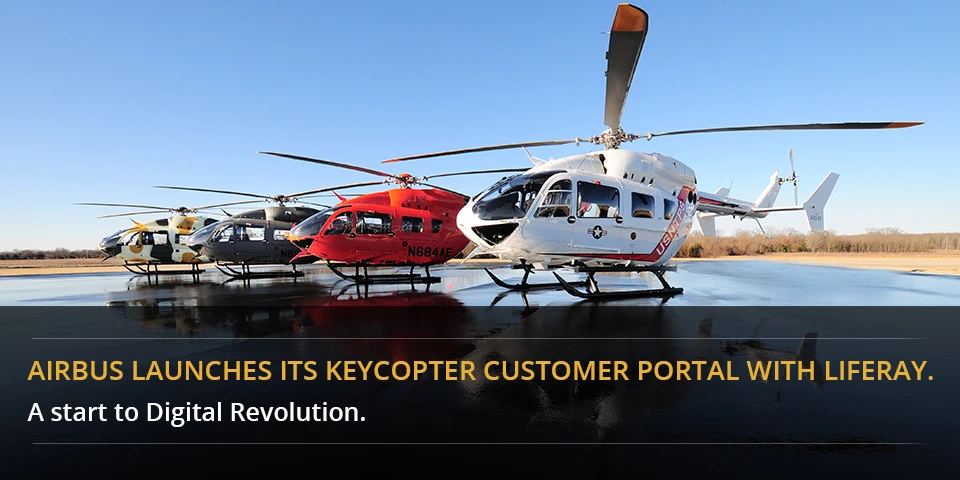
The Keycopter Customer Portal with Liferay, launched by Airbus is here to digitalise its customer experience like never before

The digital landscape of industries is changing with almost every passing day, it’s been a digital transformation mainly driven by the demands of the evolving customers. Manufacturers who have never had first- hand access are dramatically investing indirect relationships with their end customers and are willing to bind their employees’ suppliers, dealers and partners in an integrated network to provide their customers with world-class digital experiences. And Airbus is on its way of doing so with Liferay. 

Over 3,000 civil and military operators rely on Airbus helicopters since they have the right product to handle any and all the missions. In 2016 this division of the Airbus group turned to Liferay to get their customer portal re-designed and named it Keycopter. They wanted to come up with a platform that could bring efficiency and autonomy to helicopter operators and help them keep their aircraft in good condition.

  • The portal was designed to improve the customer journey by optimizing access to information and services in a way in which customers operate their helicopters and not the way in which AIRBUS is organised.
  • There was a need to introduce a reliable and robust permission management process.
  • It had several third-party heterogeneous business applications which were to be integrated and the time to market was to be improved.

All these challenges faced by Airbus Helicopters were solved by Liferay’s Customer portal alone. Customer Portal built with Liferay provides a seamless and personalized customer journey bringing in next-generation customer experience and value.


How the Keycopter Customer Portal with Liferay makes user journey interactive and simplified?

Liferay DXP comes packed with features to create tailored journeys that match customers’ unique needs, It is very essential to maintain long-term customer relationships. The personalized Dashboards enhances customer experience and instils a sense of satisfaction in them. 

  • Audience Targeting – Airbus Helicopters has enhanced its electronic file format to one single PDF file for its Flight Manual (FML). This benefits the customer with simplified handling and easier navigation within the manual. Customers who have the eTechpub subscription will automatically receive the enhanced FML from time to time, thereby optimizing maintenance task and delivering content in real-time based on customer attributes and activities.
  • Role-based content delivery– Making the most of team’ expertise, the operator can submit a request which is called as TE. The Technical request ( TE ) service is to provide sustained value for the customers. You just have to fill in a light form in order to log a TE making it user-friendly and efficient. This allows you to claim your warranty electronically by contacting the team responsible for it through the form itself, thereby saving time and improving efficiency. Liferay DXP allows for multiple user types to access a single URL and see a unique page view depending on the user role, group, and preferences.
  • Dashboards – The Keycopter page includes a new Dashboard Page that gathers all the information in one place from shortcuts, to key data, to favourite helicopters. Customers can now work per aircraft and not per service with the coming of personalized dashboards. It enables a lot of new features like purchasing spare parts, tracking orders, quotations, and online invoices. By consolidating existing systems in personalized dashboards the customers get only the relevant information as per their needs. 
  • Mobile Responsive – the Customer Portal made the website compatible with all web, tablet and mobile devices very conveniently. Liferay DXP CSS framework is designed to work with browsers on all platforms.

How was the Role and Permission Management Process improved with Liferay’s Portal solution?

  • Self-service Account Management – Transversal functionalities such as customer account management, initial contact, and notifications made the process very simplified for Airbus, the customers can keep a track of their account details on their own without relying on any team representative, edit their personal information, and close accounts on their own.
  • Permissions – Site Administrators have the ability to define what customers can view and access. Not all the information is to be disclosed to the customers, the Portal managers were able to have a hold over the website with this feature of the Keycopter Portal. Custom permissions applied at a global level or to individual sites by portal managers enable a great control.
  • Single Sign-On –  The SSO process was optimized and browsing was organized by helicopter fleet to break down silos between the services. This made the process more reliable, and efficient, providing safety and better quality. All the sites used by the customers were united under one login and password with the help of the customer Portal.

How to get the third-party Applications Integrated?

Airbus Helicopters wishes to move towards a Single platform and collect activity data on the other portals as well in order to create a more customized experience for its customers. It has two other portals for its employees and partners, that it wants to integrate on a single digital platform to call for effective customer engagement. Liferay DXP customer portal provides fields to easily add other third-party tools through customization so that they can serve your customers together. It allows you to maintain your existing IT investments simultaneously taking advantage of Liferay’s modern platform.

Thus, With the Keycopter Customer Portal, Airbus Helicopters have successfully overcome all the challenges coming in their way of Digital Transformation. Delivering an excellent user experience with the best coherent services, 24/7 accessibility and an unmatched gain in productivity with the installation of this Customer Portal.

Customer – The Heart of Business

For any business to be successful today the ability to reach audiences touchpoints is imperative. All the hype for improving customer experience isn’t for nothing. Once the businesses get it right, the payoff is phenomenal. Airbus Helicopters is just one out of several others who have reached this milestone of an extraordinary digital experience for its customers with Liferay, but there are many more who are sailing in the same boat and have made a mark for themselves.

Read more about other success stories with Liferay DXP:

https://www.teamcomputers.com/team-blog/liferay-saint-gobain/

https://www.teamcomputers.com/team-blog/liferay-west-bend


Disclaimer: The information within this case study is based on facts, research, and recent achievements of Airbus and Liferay solely. This is in no relation to any work done by Team Computers Pvt. Ltd.


4 Shot Guide for every Manufacturer to win the Battle with IoT

IN THE AGE OF INDUSTRY 4.0 THE ULTIMATE GOAL FOR  EVERY MANUFACTURER IS TO KEEP PACE WITH IIOT AND WIN THE BATTLE

IoT has come to find a place right at the cornerstone of automation, through the evolution of manufacturing industries. Internet of things is referred to as the intelligent connectivity of smart devices by which objects can sense and communicate with one another. IoT in industries has proved to be an aid solving challenges of costs, production and client satisfaction. It has led to a complete reconfiguration of industries. IIoT ( Industrial Internet of Things ) is all about simplifying and automating every single process in any industry. 

The leaps in power processing, mobility and AI have taken the idea way ahead. From where and how we initiated with water and steam to mechanise production, and to where we have reached in terms of technology today is a true Revolution!

But the question is why does the gap between reimagination and execution still exist? 

Addressing the gap and coming up with a business model that incorporates IoT is paramount.

Jatin Sawhney, the director of SMAC is an excellent communicator with the relationship, leadership, coordination and analytical skills. His ability to view the larger picture and take critical business decision makes him stand out. With an experience of over a decade, his ability to implement techno-business solutions from adoption to completion is unmatchable.

As Jatin says, technology transformation is not about technological innovations and business disruptions, but it also includes adopting those innovations and realising their value-adds.

 Here is a one-shot guide to all what and why a manufacturer can have while implementing IoT and realising its value in their businesses. 


WHY DO THE MANUFACTURING INDUSTRIES OF TODAY NEED A SMART FACTORY?

I find manufacturers very concerned that their organisations are falling behind in the race to keep pace with IIoT. According to the cases I have witnessed lately, there are several reasons due to which they are not able to cope up. They are not able to execute a data-centric factory since they still lack readiness towards it. But as far as I can predict the future of industrialisation,  there is a definite need for collaborative manufacturing systems that can take real-time decisions to meet dynamic conditions and demands in a factory, make the supply chain effective and respond to customer needs in time. In today’s time, a factory needs to be ‘Smart’ in order to withstand competition, and competition can only be survived with connectedness. 


WHAT MANUFACTURERS CONSIDER WHILE IMPLEMENTING IoT IN THEIR INDUSTRY?

When a manufacturer invests in any latest technology, his prime concern is to sash costs and improve his business. IoT enables us to evaluate and change decisions about the physical world. When two or more devices are digitally connected, the transmission of the data to any software application further becomes very convenient. It enables the manufacturer to derive insights and act in real-time. Thus leading to faster and better decisions in a cost-conscious manner. This will improve his business and disrupt the industry. 


WHAT ARE THE RESULTS A MANUFACTURER IS STRIVING TO ACHIEVE?

All that a manufacturer wishes to have is a digital factory with a better line of command so that all his remote factory units are rightly managed. Next, he will aspire to have real-time access to his production processes, so that every adjustment required can be made in real-time. Now that we have sensors installed in every device in a factory to trace manufacturing cycle times, this will help the manufacturer to bring down his capital requirements.


 WHAT ARE THE CHALLENGES TO ADAPT IoT IN INDUSTRIES? 

 Manufacturers need to build a comprehensive digital and IoT business model, but they lack the skillsets to execute that. It can be executed only when they have the apt frameworks built. There are no virtual systems, no network segregation and neither can such huge volume of data be stored and encrypted as it flows through the internet. We need to work upon the existing regulations and standards to achieve desired results. Manufacturers need to adapt the software-driven approach and start to rely on it, only then can IoT provide a ‘Smart’ vision to manufacturing industries. 


VISION OF THE FUTURE

As data becomes the new currency and want for process insights grows massively, the Internet of things will play the master role. 

A year or two ago, it was on everyone’s radar, and now it is actually shaping a smart and data-centric world. The idea of connecting people, machines and devices was imagined to be a futuristic vision of the digital business, but with the advancement in AI, mobility and cloud, IoT has emerged to be the Mainstream!

Jatin Sawhney is the Director for the Software, Mobility, Analytics and Cloud Business at Team Computers. Within his 22 years of experience at Team, he has worn multiple hats, of delivery, presales, sales across businesses and participated in both laying its foundation and growing Team to a business serving 2000+ active customers.  Jatin is passionate about playing cricket, developing leaders and building brands, in that order.


IoT, Big Data and AI – The Three Digital Pillars of every Industry

Why IoT has turned from a competitive trend to a means of survival?

We have already stepped into a world where exists virtual communication, Siri and Alexa doing half of the human efforts. Now that we have begun this trend of slashing down human effort, why not doing the same with everything else?

This is what we now call as the Internet of Things which means a network of physical devices, vehicles, electronics, sensors, software and every other object around you that are digitally connected and assists collection and exchange of data.
In its true essence, IoT technology refers to the Universe of devices with in-built sensors that provide data for further transmission in a much more convenient way. You don’t have to wait for data to reach the desired place that will delay your decisions anymore!

An increasing number of physical objects are being connected to the internet with time, for example, security sensors, smartwatches, and even household appliances like washing machines now can communicate and transfer data over time. Today, companies must leverage the latest technologies simply for survival because what were luxuries earlier are needs now. It is here to impact all industries, from logistics to manufacturing to healthcare – we are about to enter a connected world. Not just organizations, IoT has also led to massive empowerment of the consumers by providing greater control of household systems and appliances, washing clothes is no more a human task!

But the question is how to drive value from IoT, how to make it work in our favor?

It is a mere vision for most of the industries currently, there’s a gap between reimagination and execution that needs to be bridged.IoT will produce a treasure trove data – data that can sash the downtime in production with the help of real-time analysis and decisions, data that can help cities predict an epidemic using thein-built sensors in devices, data that can help manufacturing companies predict the breakdown of a machine with sensors installed in it.The possibilities that IoT bring to the table are endless. But to get these results the unstructured, messy data has to be organized and analyzed.

As the network of connected devices will go on expanding the sheer volume of data produced will be huge, and to derive results from the data it has to analyzed efficiently and well treated, what we call as Big Data Analytics. Businesses are failing miserably in harnessing the true potential of Big Data available to them. Data is only useful when it creates action, and for that, it has to be creative and contextual. To bring in this context to the existing data comes AI (artificial intelligence). The ai-based analysis becomes critical to extract optimum value from Big Data.
But how do Big Data and AI function within the IoT technology?

AI at glance

When we say AI it means machine learning. For data to be useful it must be analyzed, which is exactly what AI does. A large volume of data is of no use to an organization if it cannot lead us to any effective decision may it be minor or major, AI makes that huge volume of data meaningful. It tries to mimic human brains, how the human brain thinks, behaves and react to the respective actions.

WHAT IS THE NEED FOR AI IN INDUSTRIES?

  • A situation is to be analyzed from a rational perspective, for which we require patterns and algorithms to drive a structured approach and generate logic-driven output.
  • Data comes from varied sources such as sensors, social media and the like, also the data is unstructured and it keeps changing.
  • AI then uses perceptions to analyze the logic and incorporate machine learning to utilize that unstructured data and bring it in a format such that useful insights can be driven from it.
  • AI applications such as image recognition, language processing, computer vision, robotics and much other leverage machine learning for deriving the accurate predictions from large volumes of data and end up taking effective and efficient decisions.

AI provides results as per consumer behavior, for example, Amazon will suggest you movies and books based on your last buy, Pandora will suggest new songs as per your existing playlist. It brings in ‘intelligent connectivity’ to the users of IoT since mere connectivity of devices will do no good until the data from those devices is analyzed in terms of what is relevant and what is not.
AI can majorly be of three types –

  • Strong AI – produce a machine whose intellectual level is indistinguishable from that of a human being.
  • Applied AI – also known as information processing, aims to produce commercially viable smart systems.
  • Cognitive Simulation – where computers are used to test theories about how the human mind works.

Thus, AI is here to bring similar intelligence in machines that we find and consider high in humans.

How big is Big Data?

Big data is referred to as massive, unstructured and complicated data sets that are of huge importance to businesses. These data sets are so complicated that they cannot be treated with traditional data processing software. The recent developments in technology have exponentially reduced the cost of data storage and compute, making it possible to conveniently store huge volumes of data like never before. It has changed the job of marketers completely. They can obtain actionable insights to create highly effective marketing strategies by interpreting the tons of data that is available to the business.

But it is not possible to do this manually, we need Big Data Analytics to understand the market trends, gauge customer behavior and understand the standing and upcoming competition in the market.

HOW BIG DATA HELPS IN DERIVING USEFUL INSIGHTS?

According to statistics in the last five years, the average volume of data generated every day is 2.3 trillion gigabytes. The evolution of Big Data has provided great insights and knowledge through :

  • Adaptive Analytics – what is the appropriate action
  • Predictive Analytics – what will happen
  • Prescriptive Analytics – what should we do

But one major decision about Big Data is stored, people generally decide their medium of storage based on where their data resides currently. Cloud is gaining great popularity lately because of its ability of Vertical Scaling which increases the capacity of a server by adding resources as needed by an application, and Horizontal Scaling that allows businesses to expand hardware resources with an increase in processing requirements; making it an ideal platform to host Big Data Analytics. Cloud offers immensely high bandwidth and processing power to help Big Data applications with improved real-time processing of streaming data.

The Five V’s of Big Data

  • Volume – Organisations have a high volume of data with low density and are unstructured.
  • Velocity – The rate at which data is received and it is acted upon is what you call as velocity.
  • Variety – Data can be available in various types.
  • Variability – Data may vary from time to time and region to region.
  • Value -The value of data represents if it is relevant or not.

The primary value of data comes not in the raw form, but from the processing and analysis done on it. Thus, Big Data plays a very pivotal role in making real-time and efficient decisions.

The convergence of the Trio (IoT, AI, and Big Data)

Internet of Things has unique needs in different market segments, may it be automotive, manufacturing, power or healthcare. But one mutual fact that they share is Big Data!
And all of them want these massive unstructured data sets to be analyzed and put to use in the best possible way, and this requires Big Data Analytics to be coupled with AI. This combination is the utmost for real-time and streaming analytics and to understand customer interests in the best way. The ability to make real-time decisions, capture streaming data and add value to attributes is itself a service to logic, and this is achieved when you apply AI and Big Data Analytics together.

WHY THERE IS A NEED FOR BIG DATA ANALYTICS AND AI TO BE USED TOGETHER IN A BUSINESS TO STRIVE GREAT OUTPUTS?

  • There are five basic steps in IoT – Measuring, sending, storing, analysis, acting. The most important step here is acting, which tells why to invest in an IoT technology, it is the aim you are striving.
  • But the latter can be done only when the ‘analysis’ step goes right because ultimately analysis will derive the pattern that is being followed. The more you know about anything or any situation the better decisions you can take.
  • To reap the benefits of IoT data, we need to improve the speed and accuracy of Big Data Analysis and that is done by combining it with the quantitative methodology of AI.
  • After collecting the data from various in-built sensor devices, it is put under Artificial Intelligence and machine learning, for the computer to identify what the data represents, what patterns and algorithms it follows much more reliably than humans do.
  • By combining data intelligently and by interpreting, new insights can be driven to new services, applications, and markets.

Thus, the potential of Big Data can only be realized when it is coupled with AI.

CONCLUSION

Technology today is a major driver in any business, and we are still struggling to integrate technologies with human effort. Humans and businesses generate trillions of gigabytes of data every day but to put that data to use we need to cope with the operational challenges and implement a digital strategy that works with cloud initiatives and tools. But analytics can only be done when we understand the domain well, the old computing proverb of ‘garbage in, garbage out’ cannot be applied anymore. The trio of IoT, Big Data and AI is going to take industries to a higher notch and bring revolution in a classical sense. But are we prepared for this revolution or are we still dwelling over our past legacies?

Top Industries that are Winning with IoT

VOLVO CARS

A secured and luxury Drive

The Volvo Car group was established as a separate entity in 1999 and since then has been renowned for its high-quality standards, safety and luxury. Today the main aim of the company is to accomplish absolute human safety with a strategy of technology and services designed around the driver and passengers. Now, keeping in mind the goals to achieve and the ease that they wish to provide to their drivers; Volvo leaves no loop in technology trends that can be taken up. And there enters IoT!

Like all other competitors of the automotive industry, Volvo is working to secure high-quality connected- vehicle services. It wants to leverage data from its cars to make driving safer and improve customer experience. Lex Kerssemakers, Senior Vice President Product Strategy and Vehicle Line Management at Volvo Cars says, “We clearly see that cars in the near future will integrate the same level of digital services that consumers today are used to having in their homes or at work. This is a strategically important part of Volvo‘s investments for the future where we intend to take a leading position.”
Keeping the Mission in mind, Volvo decided to bring connected car services to the market. Volvo will be able to provide its car owners and drivers with its latest developments in connected car digital services such as automation, telematics, and navigation.

Drivers and passengers will be able to access applications for information and navigation on a screen in the car. Simultaneously Volvo Cars will be able to transmit this information to the other players in the ecosystem of the automotive industry. Volvo Cars are on its way to achieving the aim of having zero serious injuries and deaths in new Volvo cars by 2020. Volvo considers bespoke services for its customers, and IoT is assisting it to create the next generation safety features like Road Friction Indication. For example, the vehicle can detect if a road is slippery via its wheel sensors. It will send an alert to the driver and then send the alert to the cloud. And then further to every vehicle entering that area and to transportation authorities.

The technology used in a human-centric way has always been important to Volvo Cars and the prime concern to roll out new services for its customers. Its collective ambition is to develop industry-leading solutions in line with a networked society, where driving is not a need but a secured luxury!

KINSA

Making Healthcare ‘Smart’
IoT is the master key to the simplification and advancement of each and every industry and has the potential to reach every human being on the Planet once in a lifetime. Initiating from the manufacturing industries and reaching to tech-driven hospitals and medical facilities in such a short span of time, it is already on its way to make a mark in the development of Healthcare IT. It will continue to grow since the technology will continue to get more advanced with each passing day. One great example of this collateral of Healthcare and IT is KINSA.

KINSA’smission is to detect illness in real-time, helping individuals, communities and the disease centers to respond before it spreads. Kinsa has developed a communication network that is at the service of people the moment they are ill. Its greatest innovation of all times is the ‘Smart’ thermometer Kinsa brings thermometer that is connected to the Kinsa Health App to track temperature, symptoms and other issues regarding the illness of people individually and as an aggregate so that people can make informed decisions in real time. The granular illness signal provides highly accurate estimates and forecasts, enabling better state-level public health surveillance. Further, this data about public level illness, its symptoms, the number of days it lasts and its frequency is transmitted to the Centres for Disease Control and Prevention as per age groups and regions. The Kinsa app not only tracks the important symptoms, but it also follows up with important and specific information. Next, the app uses this data to update a live health map that tracks the progression of illness throughout the country. This provides a county-by-county perspective on community health. Kinsa uses Artificial Intelligence to track illness based on severity, duration, and contagiousness. It assists the ill to get the right medical guidance in real time that will help them get better.

Contagious illness such as flu is highly unpredictable in every region and needs a way out. Kinsa, with the help of connectedness and artificial intelligence, has taken the healthcare industry and its aid to great heights. And gradually there are several other Healthcare IT sectors that are starting to show readiness in IoT and taking a step ahead in means of technology and medical care together.

HITACHI

Think Beyond Things
Hitachi is delivering value-based outcomes with IoT solutions by bringing devices, people, infrastructure, and the entire cycle of processes together as a Unique Unit. The Japanese company stands out from other industrial companies in terms of its integration and experience across IT. It follows one simple strategy of ‘Think Beyond Things’, and is rigorously working in the direction of bringing social innovation in the physical and digital world.

Hitachi is an independent company, rather than partnering with other firms it keeps bringing in new innovations according to the demand and trends of the world. It offers an IoT platform by the name of ‘LUMADA’, it is a combination of data management and advanced analytics that enables customers to easily develop and deploy IoT solutions. Lamuda collects real-time data from highly heterogeneous shop floor environments and thus reduces the unplanned downtime through artificial intelligence, traceability, and real-time fault detection. Next, it detects quality issues and the machine’s health issues early in the process. The Maintenance Team is informed well in advance about a machine’s abnormal behavior, thus avoiding breakdowns. Hitachi makes a factory responsive by streamlining operations. It has also developed an IoT-enhanced production model that has slashed production lead times by half within its Omika Works division, that creates infrastructure for steel manufacturing, electricity, and other industries. Data-driven analytics let users analyze and visualize data that in turn boosts the effectiveness and efficiency of the factory.

The success story of Hitachi not only includes building and implementation of the sensors but the entire infrastructure; the turbines, trains, robotics and the entire Urban environmentin which sensors are applicable and devices are connected to collect and transmit data. Hitachi adds value to businesses and enables smart citiesto meet their sustainability goals with its capabilities and expertise in IoT solutions. It exhibits the power of intelligent innovation!

*IIoT (industrial internet of things) has opened plenty of opportunities in optimization, automation, asset management, intelligent manufacturing, industry control and what not.
The estimates today state that the Internet of Things will include 26 Billion units installed by 2020, and will generate a revenue of over $300 Billion. IoT is the next level of automation of every object in our life and Industries have already started their run to the Industrial Revolution. We see an absolutely different Era coming up, which is Smart and connected and ready to bring in industrialization like never before! *

IoT for Manufacturing: The what and why?

WHAT DO WE MEAN BY IIoT (industrial internet of things)?

Internet of things is referred to as the intelligent connectivity of smart devices by which objects can sense and communicate with one another. IoT in industries has proved to be an aid solving challenges of costs, production and client satisfaction. It has led to a complete reconfiguration of industries. IIoT is all about simplifying and automating every single process in any industry.
The leaps in power processing, mobility, and AI have taken the idea way ahead. From where and how we initiated with water and steam to mechanize production, and to where we have reached in terms of technology today is a true Revolution!
But the question is why does the gap between reimagination and execution still exist?
Addressing the gap and coming up with a business model that incorporates IoT is paramount.

WHY DO THE MANUFACTURING INDUSTRIES OF TODAY NEED A SMART FACTORY?

Manufacturers are concerned that their organizations are falling behind in the race to keep pace with IIoT. They are not able to execute a data-centric factory since they still lack readiness towards it. Manufacturing industries are seeking more efficient operations to match and survive the competition in the market. They need better product differentiation, better efficiency in production processes, and an adequate data integration source. The factories need to be ‘Smart’ in real means in order to withstand the forthcoming competition.

WHAT MANUFACTURERS CONSIDER WHILE IMPLEMENTING IoT IN THEIR INDUSTRY?

IoT enables us to evaluate and change decisions about the physical world. When two or more devices are digitally connected, the transmission of the data to any software application further becomes very convenient. It enables you to derive insights and act in real time. By cutting down the decision time and bringing intelligence at the edge, the factory ends up sashing costs.

IoT does not just provide operational efficiency, it also opens several other revenue streams. By the use of sensors, Smart devices, real-time data processes, organizations can shift from a product based enterprise to a data-driven enterprise. This will assist the manufacturer to improve business and disrupt the industry.


WHAT ARE THE RESULTS A MANUFACTURER IS STRIVING TO ACHIEVE?

Digital factory

A unit which is digitally connected helps to establish a much better line of command. This enables the operation managers and factory heads to remotely manage the scattered factory units.

Monitoring the flow of production

With the help of IoT, an entire product line can be monitored in real time. This real-time access enables to make any alterations and adjustments in the operations with respect to cost consciousness.

Supply chain management

The material can be easily tracked as it moves through the supply chain by the medium of sensors. These sensors enable manufacturers to trace the manufacturing cycle times and material flows. Thus, enabling them to predict future issues, and cutting down
capital requirements.

WHAT ARE THE CHALLENGES TO ADAPT IoT IN INDUSTRIES?

Though manufacturers are wanting to adopt newer technologies and enter the data-driven world, yet they lack the readiness to implement it in their industries. There has to be a comprehensive digital and IoT business model. But even then there’s a need for new talents and skill sets that fall short.
Most leaders haven’t built a framework that supports IoT. IT tasks like virtualizing systems, migrating to cloud for better and massive data storage, and adopting a software-defined approach; are not paid any attention.
Next, there is no segregation of networks and the data has no encryption as it flows through the internet. The manufacturers are in a great need for better regulations and standards in order to realize the potential of IoT in manufacturing industries.

*As data becomes the new currency and want for process insights grows massively, the Internet of things will play the master role.
A year or two ago, it was on everyone’s radar, and now it is actually shaping a smart and data-centric world. The idea of connecting people, machines and devices was imagined to be a futuristic vision of the digital business, but with the advancement in AI, mobility, and cloud, IoT has emerged to be the Mainstream!

How IoT Works In Industry 4.0

The world is at the cusp of the greatest of all, the fourth Industrial revolution!

Initiating with water and steam to mechanize production in the first, and now coming up with the master fusion of industrialization and IoT ( Internet of things ) in the fourth one.

BUT  WILL THE WORLD STILL DWELL ON ITS LEGACY OR IS IT PREPARED TO WITNESS A VASTLY DIFFERENT FUTURE?

The advent of IoT in industrialization is going to make the globe communicate, literally!

Internet of things is defined to be the ‘intelligent connectivity of smart devices’ by which objects can sense and communicate with one another. This enables us to evaluate and change the decisions about the physical world. The emerging industrial IoT is taking every step towards the reconfiguration of industry. The intent of this joint initiative is to encompass a framework for a particular strategy so as to achieve a milestone with substantial funding from both the public and private sources.

WATCH YOUR SMART FACTORIES COMMUNICATE FASTER THAN THE SPEED OF LIGHT

  • FASTER DECISIONS ARE COMING YOUR WAY –

The payoff for the industrialists will be better and faster decisions. The word ‘smart’ defines digital connectivity! When two or more devices are connected to one another, the data that they generate can be very conveniently transmitted further to any software application. The application acts as a helping hand to provide information to the individuals for use. Every step taken in the process is to be evaluated in reference to the decisions it will lead to economically and physically. Hence, leading to the establishment of Smart factories

  • TOOLS ARE NOT JUST TOOLS, THEY ARE SYSTEMS

In the world of industrial IoT, every tool has a system installed called the CYBER PHYSICAL SYSTEM (CPS). The CPS  integrates sensing, controls, computation, and networking into our physical tools by the medium of the internet. This allows us to measure the comprehensive performance of our device very precisely. The next advantage is Energy Management in the factory. The power consumed by all the devices can be measured and controlled conveniently bringing in effectiveness, efficiency, and optimization in the business.

  • THE TWO PILLARS OF IoT – CLOUD COMPUTING AND BIG DATA

Migrating to the cloud is always a great idea since its capacity to store and process data is unlimited. Also, it is generally more economical and flexible than any on-site alternative available. Other than this the industrial environment has massive data streams flowing to and from connected systems. Big data gathers and grants access to these data streams generated by the factory.

  • SMART FACTORIES LEADING US TO SMART CITIES

Have the water running, roads unblocked, and the people happy; there you are in a Smart City! IoT is here to change the entire concept of urban living. The industrial IoT is constantly working towards the reduction of costs, improvised communications, and enhanced services.

IoT holds the potential of providing real-time access to information, consumption, and demand & supply. Henceforth, boosting the macro productivity of the country.

BEFORE YOU GET SET AND GO, MARK THAT YOUR INDUSTRIAL IoT JOURNEY HAS CHALLENGES TOO!

  • Security & Privacy – Is my data for my eyes only?

Security has always been one prime concern of the people. Now that as many industrial users can access all the internet connected devices, the cyber threats are real, growing and global. Your data is not just yours anymore.

  • Interoperability – The Devil of the Throne 4.0

In an interconnected system, all the components work jointly and have to communicate with one another; even if they are working in different backgrounds and in different languages. Thus, the lack of common software and data formats will complicate the entire Industrial process and the co-working environment of the industry will be hampered.

*Industrial IoT is here to connect a billion of smart devices and tools to one another digitally in the coming decade,  making industrialization a play like never before. It is here to bring in opportunities fused with innovation. This revolution is the beginning of a newer and smarter world!