A Complete Guide to Remote Infrastructure Management

A decade ago, an organisation handling the IT infrastructure for another organisation seemed like a big deal and somewhat tricky. It was almost like a stranger taking care of your personal belongings. However, nowadays, it is a common practice that companies outsource infrastructure management to experts.

The practice of remote IMS came into existence ten years ago; however, it gained popularity in 2020, when the world had no choice but to be locked in a room. Everyone shifted to RIM for remote IMS, whether a small start-up or a multinational company.

What is Remote Infrastructure Management?

Remote infrastructure management is a process to monitor and manage everyday IT operations without being physically present at the location. This practice is becoming increasingly popular in organisations of all sizes and industries.

RIM adds significant value to the IT systems, increases working efficiency, improves service availability, and reduces costs. Generally, it includes network monitoring and management, remote monitoring, database administration, desktop and server administration, and security services.

The IT infrastructure management landscape has taken a 180-degree turn from what it looked like almost two years ago. Earlier, taking care of management and monitoring was at utmost priority. However, organisations are dependent on RIM solutions to meet challenges.

Remote Infrastructure Management Challenges

Some of the remote infrastructure management systems face a bunch of challenges. These are as follows:

  • Growth and Scalability
    A survey by LogicMonitor revealed that only 39% of IT decision-makers believe that their organisation can provide continuous availability uptime during crises; however, 54% are partly confident. There are several solutions designed for IT leaders regarding uptime during crises. Fewer powers are likely to persist with better IT virtualisation, leading to business continuity. The professionals should be dependent on the RIM solutions, which scales at nearly the same rate as their organisation.Security
  • Security
    For any organisation, security is one of the major concerns. With the work-from-home model, organisations are more prone to security challenges. In 2020, nearly 800,000 internet crime incidents were suspected, whereas, in 2019, 300,000 internet crimes led to huge losses of over USD 4 billion. Out of all reported crimes, phishing remains at the top. CIOs of India and the world are in search of an adequate RIM solution that improves data security while maintaining employees’ overall performance and productivity.
  • Costs
    Another major challenge is cost. For most CIOs, RIM cost remains a bugbear. Since RIM is a newer technology, there are infrastructure management service providers that charge thousands of US dollars for providing services. Investing in monitoring software offers more significant value for money. These programs are designed to do everything any RIM service provider will do at an affordable cost without adding extra charges.
    Regardless of the fact that the organisations should go for monitoring software or a service provider, the cost involved should always provide a decent investment return.
  • Automation
    The software automates remote monitoring; however, monitoring and management tools offer better performance than others. It is because RIM is still a newer concept, and service providers are still working out the finer details.
  • AI/Machine Learning
    RIM and AI/Machine learning have a long history as they have struggled a lot; however, it is changing now. Some tools take complete advantage of such technologies and provide valuable insights to users. It helps CIOs to resolve issues and suggest smarter solutions. Although not all remote management tools depend on such technologies, the software procurement team needs to run thorough market research to find a reliable platform.
  • Cloud
    Cloud and RIM are like two best friends. With the help of IT virtualisation, CIOs and Cloud environment can go hand-in-hand, leading to the following benefits:

    • Cloud eliminates the physical hardware.
    • It safeguards data for governance and security purposes.
    • No matter where the team members are in the world, they can access data easily.
    • Cloud is energy efficient.
    • It protects the data effectively.
    • It scales better.
    • It saves cost.
    • With many business leaders still unsure about cloud technology, full virtualisation seems like a long journey as it brings a lot of challenges. However, with advanced tools, these challenges can be tackled efficiently.

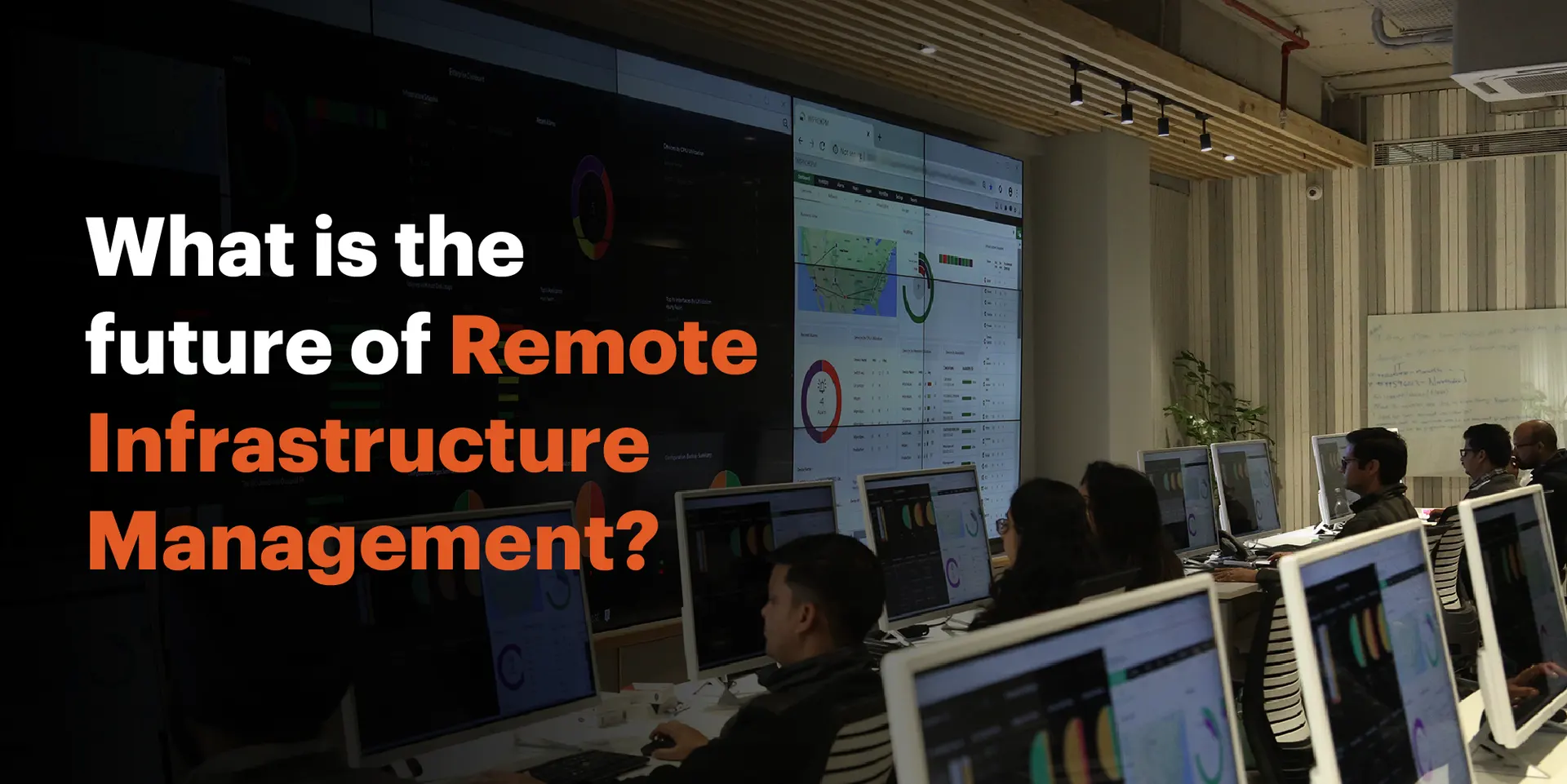
What Is the Future for Remote Infrastructure Management?

Today, organisations are moving towards remote IMS. Experts say the RIM market will touch USD 54.5 billion by 2027. In contrast, the storage system and database management will grow from 10% to 10.4% in the next five years. It is believed that the United States and China will emerge as top countries to invest in RIM.

With such massive growth in the near future, one can expect more innovative and effective RIM innovations. It is believed that RIM can also enter the space of small businesses that primarily rely on manual processes to monitor and manage data.

Conclusion

For years, RIM has been around in some way or the other. However, with the rise in the work-from-home concept, remote management grabbed the centre stage. Despite the many challenges it involves, RIM will be the future of the IT world and other industries as well. We understand your needs and identify, integrate, and support high-quality and affordable IT Solutions in hardware. For more such articles, visit us.



Data Backup Trends To Look Out For in 2022

Data storage and proper management have gained increasing importance as personal and corporate data breaches accumulate year after year, proving that our systems are not secure enough to deal with this information.

Meticulous handling of online data is an essential but time-consuming practice for companies dependent on computerized data. Thus, the need for new and upgraded techniques of data security, backup, and restoration is required.


Latest Trends in the Market

Evolution in data storage techniques has transformed and enhanced the course of action for backup and recovery.

  • Automation in Cloud
    Cloud came in as a replacement for physical media storage, with anytime anywhere access to data. Automation in the cloud made it easier to store and backup data, eliminating human errors automatically.
  • DRaaS
    Disaster Recovery as a Service (DRaaS) is a division in cloud computing for data storage and recovery in case of a catastrophe. DRaaS protects data and provides standby computing capacity to provide quick recovery.
  • IoT
    The Internet of Things (IoT) allows various industries to generate, store and transfer data in large quantities. This approach reduces human intrusion by replacing it with computing devices and digital machines.
  • Big Data and ML
    Large volumes of structured and unstructured data generated are termed Big Data. This unprecedented data is crucial for large industries and can spiral out of control. Analysts know that big data can play a vital role in planning strategic business moves once combined with machine learning. Machine Learning with massive computational power allows systematic backup and security with facile restoration.

Predictions for 2022

  • Multi-cloud Storage
    The idea of storing data across different cloud platforms in the same network architecture is called multi-cloud storage. Distributed workload helps better manage data and reduces the risk of complete data loss due to cybersecurity threats.
  • Storage Automation
    Automation in data storage practices has played a pivotal role in changing backup and security trends. Storage automation reduced human interruption in the workspace, making error-free and secure processes possible. Automation provides additional timely reports with low errors and ensures timely backup without inconsistencies.
  • In-Memory Computing
    The in-memory computing technique replaces conventional data storage in centralized databases and allows storing data on the same network’s RAM in different computing devices. RAM being faster memory allows swift data access as compared to regular databases.

Data Governance and Threats

Data explosion due to the internet has opened the horizon of new possibilities. Data storage and management have various beneficial effects, but the downside has adverse outcomes. Cyber threats like data theft, Denial of Service (DoS), SQL injections, and reckless misuse by the company itself can lead to the exploitation of valuable information.

Thus proper data protection measures are needed to ensure security. Several companies are providing a framework for maintaining data and ensuring security. Veeam Software provides features like immutability in the cloud, backup and Anti-malware framework by Acronis, and data management software solutions by Veritas Technologies are a few examples.

Team Computers is a company that bridges the gap between business and IT technology. We see ourselves as trusted problem solvers with a wealth of knowledge in all aspects related to technology.

For enterprises, we offer solutions spanning across all systems – Hardware, Software, Services, Mobility, Analytics, and Cloud – providing high-quality, affordable solutions with Delivering insight at Speed & Flexibility.

Speak to our experts: Reach out to us at rashi.verma@teamcomputers.com.

5 Biggest Announcements from Apple’s ‘Peek Performance’ Event

The recently hosted ‘peek performance’ event was unlike other Apple events, but, at the same time, much more was expected. The event was organized with an aim to reveal all that the Apple team had been working on for the past few months. The Apple community gathered for insightful sessions, a handful of keynotes, and a bit of partying. The entire day was brimming with energy and was later termed “the Apple day”.

If you missed attending Apple’s ‘peek performance’ event in 2022 or wanted to get the details of the events once again, here are the most exciting highlights.


Apple M1 Ultra 

This time, Apple went a mile ahead with the announcement of the newest edition to its Apple Silicon lineup called the Apple M1 Ultra processor. Rather than hopping from M1 to M2, they decided to expand the already existing M1 line with M1 Ultra, which indeed is exciting. So there it is now! M1, M1 Pro, M1 Max and M1 Ultra. It is 8 times faster and better than the M1 chip. 

With ultra-high efficiency, mind-blowing performance, and 128GB of RAM, Apple M1 Ultra is here with a bang. Are you excited to unbox the sleek Apple M1 Ultra?

The Mac Studio 

The next exciting announcement that made the crowd jump off their seats was regarding the Mac Studio. With 7.7×7.7×3.7 inches, the newly launched Mac Studio looks like a mini version of the Mac, which, let’s face it, isn’t so mini. Thanks to M1 Ultra, the Mac Studio is 2.5x faster on the CPU front when compared to the fastest 27-inch iMac. Also, it is 50% faster than a Mac Pro and features a 16-core Xeon processor.

At the back, the Mac Studio features a 10-gigabit ethernet port, four Thunderbolt ports (4/USB-C), two USB-A ports, an audio jack, and an HDMI port. However, at the front, the Mac Studio features an SD slot and two more USB-C ports.

Apple’s New iPad Air 

With custom-built silicon, another classic launch is the New iPad Air. This gadget has been designed and developed for the generation of tomorrow, especially great for those who love to stick to their laptops for hours.

The new iPad Air has a wide-angle, front-facing camera, which keeps your face at the center during video calls.

New iPhone SE 3

Do you find Apple products out of your budget? The newly launched Apple iPhone SE 3 is more budget-friendly, making it easier for more people to invest in it. The iPhone SE 3 runs an A15 processor (Bionic), which means it promotes things such as live text. It also offers better battery life and 5G connectivity.

With a 4.7″ display and the same durable glass, the iPhone SE 3 is the ultimate edition of your Apple collection. What are you waiting for? Get your hands on it!

Studio Display 

Wanted a new and better Apple Studio Display? Apple knows what its customers are waiting for. So, here it is; the newly launched Apple Studio Display! A 27-inch 5K display with an ultra-wide 12-megapixel built-in camera, a six-speaker sound system, and a three-mic array. It also features Thunderbolt 4 ports along with 3 USB-C ports at the back. Apple claims that their new Studio display has several mounting options, including a tilt/height-adjustable stand, a tilting stand, and the VESA-mount option.


Conclusion 

In addition, Apple has launched an array of digital products that have become must-have gadgets. People who were a part of the Apple ‘peek performance’ event believe that it was one of the best events held to date.

The day-long Apple ‘peek performance’ event also featured several talks, which made people discover the horizons of Apple as a company. To find out more about the ‘peek performance’ event 2022, visit our website now!

Team Computers is Apple Authorized Enterprise Reseller (AAER). We have been Apple’s preferred partner in India for more than 30 years now & have successfully built a dedicated team for Apple business.

If you want to learn more about How team computers can help you succeed with Apple visit https://www.teamcomputers.com/Apple

Tech Companies Going Political Amidst Russian Ukrainian Conflict

The five leading tech companies of the world, including Google, Apple, Meta, Amazon, and Microsoft, have taken significant steps to impose voluntary sanctions on Russia amidst the Russian Ukrainian conflict. However, this decision wasn’t taken overnight. The Prime Minister of Ukraine successfully lobbied these companies in the same way it gained assistance from NATO, European Union, and the US government. Since these companies were nation-states, Ukraine directly appealed to these big names in the tech world.

Was there an impact of these sanctions? Or does Russia face any outset? Let’s find out.


Google

Undoubtedly, Google, now known as Alphabet, is one of the leading tech companies that responded to the Russian Ukrainian conflict in two parts. Firstly, there have been finance-related issues. The company has imposed restrictions on the usage of Google Play in Russia for merchants as well as customers. Google leaders have also decided to restrict online advertisements of its services in Russia. Also, YouTube monetization is blocked in Russia. However, Maps and Google Search are still available.

Amazon

Andy Jassy, the chief executive of Amazon, has decided to support cybersecurity efforts in Ukraine and offers logistical support. However, Amazon has not taken countable steps to reduce its revenues from Russia.

Meta

Another major tech company is Meta who is also the owner of both Sputnik and RT. It has removed the access of Sputnik and RT on Instagram as well as Facebook. Further, it is not allowed for state media to monetize content.

Apple

Apple is another big name in the tech world that has gone several steps ahead of Google when it comes to imposing restrictions on Russia as a result of the Russian Ukrainian Conflict. The company has stopped the sale of any Apple product in the country. Also, services offered by Apple, such as Apple Pay, are limited. Also, Sputnik and RT have been blocked from the Apple App Store in Russia.

Microsoft

Another tech-leader playing from the front is Microsoft, which has blocked RT and Sputnik advertisements across its ad network and banned access to channels in Russia.


Other consequences in front of Russia

Apart from direct restrictions imposed on Russia, there are several indirect restrictions as well. Google has restricted new reviews in Ukraine and Russia. This is done to avoid potential disinformation delivery from both sides. Both Google and Meta have decided to restrict certain location-based services in Ukraine with an aim to limit military use.


What will be the impact?

The steps taken by both leading companies, Google and Meta, will not have an immediate impact to a certain extent; however, the impact from the direct financial sanctions will be much larger. Also, not being able to use Apple pay or Google Pay is still not a bigger deal in Russia; however, citizens will be greatly affected by imposing restrictions on the use of ATMs. Team Computers, Digital Engineering segment is ensuring we have a seamless experience for our clients amidst this conflict. We feel proud to be associated with some of the top partners in the digital segment for the products like Google Workshop, Google Chrome Enterprise, Tableau, Qlik, Microsoft Power Bi, Alteryx, Workspace by Meta, Automation Anywhere, Snowflake, IceWrap and many more.


Conclusion

Russia’s untimely invasion of Ukraine has left the world in a state of shock; however, the world’s biggest tech companies, including Google, Apple, Meta, Amazon, and Microsoft, have acted bravely in the Russian Ukrainian Conflict. The tech platforms have somewhere transformed into battlefields where everyone is rooting against Russia and imposing strict restrictions, which might trigger Russia to step back. Hopefully, the results of these steps by the tech giants will be positive.

How Scheme Analytics can be a game changer for effective Dealer Management ?

What is Scheme Analytics?

The pandemic has provided unexpected challenges and opportunities for innovation in the industrial business. Team Computers can help you react to today’s changing business environment and confidently think about the future with the help of scheme management.

A transparent and efficient process that assists in distributing sales incentives to trade partners by analyzing sales data.


Why is it essential in Manufacturing Industries?

This new feature gives you a solid framework for recording information about a collection of connected initiatives and opportunities. Scheme Analytics connects possibilities, including their connected relationships, organizations, and activities, under a unified platform.

Scheme dashboards can be used as command centers for massive, more significant projects than a single opportunity or customer.

This is a one-of-a-kind opportunity in the manufacturing industry. To create a solid addition for our Scheme Management program, Team Computers worked closely with the client in the manufacturing industries.

With the Scheme Management Program by Team Computers:

  • Obtain a comprehensive picture of reliability across people, locations, and processes.
  • Gather, evaluate, and act on customer feedback.
  • Identify, prioritize, and characterize concerns with warranty and service performance.
  • Also, manage your supply chain in an integrated, market-driven manner.

What are some of the key challenges?

  • Market conditions are constantly changing, so what works in one area/product may not work in another.
  • Trade Partners must develop the right plans to win market share as multi-brand retailers.
  • Targets are the driving force behind the Sales Incentives and meddled with on the go.
  • Schemes are created regularly and involve a variety of parties.
  • In terms of compensation, there is a lack of transparency and compliance.
  • The system is mainly based on Excel, with many versions circulating.

But, now, Scheme managers may track their sales teams’ actions against their scheme goals and maximize scheme value by keeping an overview of the performance of their schemes’ goals at a glimpse. It will result in practical benefits, such as increased sales, sales incentive management, and cost control.


Process Flow Making the process efficiently using analytics

  • Budget Creation: Making this budget creation lets you know ahead of time if you will have enough money to do the things you need or want to do. Budgeting is simply the process of matching your expenses and revenue.
  • Scheme Creation: Following that, create a scheme or a plan that has the plan of action, designated roles, goals to be achieved, and other key metrics.
  • Scheme Distribution: Distribute the scheme created to effectively allocate the resources and designated roles. Keep a check on the progress and send routine feedback.
  • Automated Payout Calculation: Control the automated payout timeline for your linked accounts. Now no manual efforts are required to maintain calculations and reduce the chances of errors.
  • Exception Management: Streamline the entire management procedure via exception submission, exception approval, and directly move to process the finance and settle all the creditors’ accounts.
  • Payout Processing: Instantly settle all the pending payments. The payout processing is streamlined, and accounts get settled on time.

Why Team Computers?

Today’s manufacturing leaders are innovators, pioneering increasingly sophisticated means of producing and transporting physical items while looking beyond performance, cost reductions, and reducing risk. Manufacturers are leveraging technology to become flexible, AI-driven businesses that minimize risk and capture possibilities via profound operational perceptions and predictive decision making to survive in the future.

Team Computers as one of the preferred partners has helped multiple top companies in their digital journey to optimize production operations for low cost and risk while leveraging advanced analytics as a resource that enables you to create new services and high-quality goods achievable only in a connected economy. We provide proven value. And we can assist you in realizing the tremendous potential of your digitalization.

With Team Computers, you can:

Achieve Manufacturing Excellence

  • Increase the yield and throughput of your production.
  • Enhance the quality of the final result.
  • Reduce the risk of unplanned downtime and equipment breakdowns, as well as the costs associated with them.

Well-Connected Organization

  • Processes should be improved, as well as business reliability.
  • Predict upkeep difficulties and save money by avoiding costly breakdowns.
  • Boost your performance and the efficiency of your equipment as a whole (OEE).

Reduction of Warranty Costs

  • Reduce the expense of warranties.
  • Improve the quality of the product and the level of consumer happiness.
  • Increase the profitability of service contracts.

Optimization of the Supply Chain

  • Recognize demand signs that imply market shifts quickly.
  • Adapt your supply chain to demand swings more quickly.
  • Easy distributor and dealer management.
  • Inventory, waste, and expenditures are all reduced, while customer satisfaction is increased.

Moreover, we offer “one-on-one” instruction on video calls and screen sharing to assist you in getting started quickly and easily with our website along with onsite support if needed. Get  timely responses to any questions you may have from our pool of certified resources.


Conclusion

With the help of advanced analytics platforms built on a robust, cloud-native framework, you can enable digitization and drive innovation in your manufacturing industry.
Team Computers has it all.

Visit us to know more about our work in the manufacturing vertical.

Why Is Cloud-First Strategy the Need for Your Business?

Thinking of Adopting A Cloud-First Strategy? 10 Reasons Why You Should  

The evolving automation has propelled technology to help businesses to succeed. 73% of organisations have adopted cloud and run their applications on it. This is how it is completely evident how organisations have undergone a digital transformation and have turned technological by the end of 2000.

A Cloud-First Strategy helps in overcoming business system complexities and streamlining the business operations with a software solution, expediting the time for business to market and a competitive edge over the others for achieving a digital transformation.

According to a recent Gartner survey, cloud services in the worldwide market are anticipated to grow from $182 billion to $331 billion by 2022. The SaaS cloud application services have grown remarkably, and the revenue has enhanced by 80%. This gives a clear indication of why enterprises are moving towards Cloud-First Strategy no matter what their company size is for a smooth IT framework and cloud migration.

In this article, we will put up some top reasons why businesses must adopt the Cloud-First Strategy and how it empowers your business for rapid and reliable growth. Before that, let us first give you a detailed glimpse of a cloud-first strategy.

A Brief Introduction to the Cloud Solutions and Cloud-First Strategy

Today’s era is technology-oriented with faster and cheaper communication, faster transportation and perfect resource utilisation, and maximum output efficiency. Due to this, cloud computing has gained traction.

Using a cloud-first strategy, businesses can save money on infrastructure, platforms, and software. They can subscribe to a service provider for premium services at cheaper costs in place of building their technology stack and getting access to high-end cloud services with a fraction of the market cost.

Parts of Cloud Architecture

Cloud computing covers an extensive range of cloud services. In general, cloud computing is made of three main tiers:

  • Iaas (Infrastructure as a service): Encompasses hardware and software including the OS, networks, servers, and storage;
  • Paas (Platform as a service): Set of tools and cloud services that ensures application deployment over the cloud space quickly and efficiently;
  • Saas (Software as a service): End-user web software and applications delivered through cloud computing.

The Purpose of a Cloud Strategy

Although the cloud strategy is beneficial when implemented correctly in an organization, here is the core purpose behind implementing it:

  • To communicate with the approved service providers and associated services.
  • To communicate the service provider process
  • To determine the services built internally and consumed from a public cloud provider
  • To determine how the organization offers consistent policy and governance across diverse services
  • To determine protections for reducing the data privacy, resources availability, service costs, and other risks and implementing an “on-premise”, private cloud strategy to provide users with the requisite resources.
  • To identify the benefits cloud services offer to the organization
  • To identify the organization partnerships with public cloud providers for the approved service providers
  • To state the resources utilization risk from a non-approved provider and service consumption

In the next section, we will discuss the prominent reasons why a cloud-first strategy is needed for your business.


Top Ten Reasons Why Cloud-First Strategy Is the Utter Need for Your Business

Owing to the advantages it offers, there are several reasons why businesses choose a cloud-first strategy. It is important to know the benefits of implementing a cloud-first strategy for making an informed decision, as below:

  • Better Scalability
    A cloud solution offers an auto-scaling feature with which a cloud services supplier can scale the application resources. If the CPU of the application or memory usage is high, the user moves to the following resource tier. If configured rightly, the provider can do it automatically. In the event of a huge traffic spike, it upgrades the server hardware not letting customers down.
    As the companies’ IT demands change, they must have an infrastructure to expand their capacity for new demands. With cloud computing, the company can expand its capacity almost instantly, launching new applications and managing increasing customer needs. The entire company infrastructure is virtual in the cloud and the cloud provider’s resources, which are quite expansive, limit the growth.
  • Holistic Security
    The cloud services provide a secure business network. The cloud enables a secure data infrastructure in a protected security environment and ensures crucial security factors. Cloud adoption is an excellent approach to protect your company data and user information. It offers a secure network at affordable rates. In addition, cloud adoption and cloud migration are relatively cheaper.
    The constantly evolving world of cybersecurity makes it difficult for IT departments to be updated for the latest threats. Enterprise-level organizations have a squad aligned to cybersecurity; smaller companies are coerced to rely upon third-party services or software updates. The nature of cloud computing is conventionally public that forces cloud providers to ponder over their security and how it affects their customers. They have the requisite resources for the latest cybersecurity strategies implemented to tackle cyber threats. By keeping the systems updated and patching known vulnerabilities regularly, the cloud providers can build a safer environment for customers.
  • A Necessity not Luxury
    Cloud computing can be executed with minimal financial and physical resources for the company’s IT operations and for bringing a digital transformation in the organization system. Cloud enhances agility in business operations and an infrastructure service model for reducing IT costs. From the CIO’s perspective, a Cloud-First Strategy offers a better on-demand self-service, enhances scalability, resources pooling, network access, with other technical benefits. Cloud services are a proven business solution rather than developing a technology yourself.
    Thus, it is apparent that Cloud has become a necessity for every SMB and large-scale organization and not a luxury.
  • Lesser Investment
    Cloud-First Strategy can be implemented with lesser investment and offers higher performance. As compared to the edges it offers, the cost incurred is secondary.
    Utilizing virtual computing resources does not require investing in hardware such as cables, routers, and servers. In addition, the infrastructure costs for equipment management are reduced. With an on-premise solution such as a dedicated server, building infrastructure and cooling management, maintenance, and power costs are beyond the small-to-medium companies’ capabilities. Collaborating with a cloud provider offers organizations to convert the capital into operating expenses and use the savings in innovations and creating better customer experiences.
  • Easy Configuration
    In a cloud-first strategy, you need not control the hardware, and getting new online services requires capital spend approval. Many teams code rightly to define their infrastructure. A cloud-first strategy determines what the team requires for their software. The APIs exposed are an add-on benefit to cloud computing.
    For operating dedicated hardware, a plethora of applications and log sources of devices are interlinked. For the cloud, software tools integrate with the cloud service providers natively. Instead of plugging disparate applications, the software combines the logs on a dashboard and your team tracks your application performance, giving you insights into the software and keeping you informed when any issues occur.
  • A Reliable Approach
    With a cloud-first strategy, the maintenance of hardware and server is performed by the cloud computing provider. They make sure that the connected power supplies are uninterrupted. In the event when an entire data center goes offline, the cloud providers configure automatic failover to create a data center backup. A cloud-first strategy beats dedicated hardware when the application availability is critical for the business.
    It offers flexibility in business operations for the employees and management team, improves resource utilization, reduces annual financial spending, and facilitates seamless business scaling. For the organization CIOs, following the tech trends of leading organizations can be possible no matter whatever the scale of the business is!
  • Multi-Access
    For organizations, an all-time availability of data is crucial as customers access services in many more ways because of the surge of mobile platforms and IoT devices. In addition, the present-day workplace is getting virtual with employees who are accessing IT networks from remote locations. Cloud computing allows organizations to access cloud services from multiple locations and devices, and facilitate greater collaboration between people working concurrently. The increasingly complex workloads can be migrated to the cloud for unprecedented efficiency and performance.
    Cloud computing offers additional benefits if your business is located in the exterior of a city as all cloud computing centers are near internet setup. Even for small towns, there is no need to pay for office connectivity.
  • Redundancies Implementation
    At times, there can be some mishappening in an organization when you are on the verge of losing data. The cost incurred in the data loss and services at any time is humongous and incurs a hefty budget spend. Any event of natural disasters, infrastructure fallout, or malicious cyberattacks, can lead to system downtime demanding a redundancy implementation for safeguarding critical organisation data and applications.
    Using cloud computing, organizations can back up the essential company assets easily. With it, the data can be stored in the cloud rather than purchasing backup servers to automate the data backup process. This overhauls the organization’s redundancy and makes it ready for adversities. Also, since it’s in the cloud, it can be accessed from any place, at any time.
  • Infrastructure Modernization
    Keeping the IT infrastructure as per the latest standards can be challenging for organizations, especially when the next-gen server comes into the market, and you need to invest in a piece of new equipment. Cloud service providers always want to deliver the best possible computing resources as they are working consistently to build an efficient and flexible infrastructure.
    Cloud services assure that an enterprise gets the best technology platform for building its solutions. This mitigates the issues related to compatibility and performance encountered in outdated infrastructure and the need for cloud providers to buy their updated hardware.
    For any cloud or on-premise business, cloud computing is an affordable and transparent solution for hosting infrastructure, connectivity, cooling, and power.
  • Maintaining Control
    An organization has so many choices in how it builds and manages the cloud environment when it moves its data and workload to the cloud environment. For deploying a private cloud for an organization, companies can perpetuate the control and visibility for their on-premise infrastructure. For accessing the extended public cloud services, a hybrid cloud environment can be installed, which involves the private cloud controls and the public cloud versatility.
    Cloud security control protects the cloud environment from vulnerabilities. It encompasses the best practises and procedures implemented for achieving, addressing, and evaluating complete security in the cloud landscape. Organisations must comprehend how cloud security is different from data centre security before making a cloud migration and implement security controls once the migration is done.

How to Make a Cloud Adoption?

Now that we have highlighted the reasons for implementing a cloud-first strategy, here we will explain how you can actually make a cloud adoption:

  • Cloud-first Migration Roadmap
    Planning is key when performing cloud migration. Build a roadmap centred on your organization, which includes cloud solutions. Define the steps in your cloud migration process. Set a path for migration for all the applications in your organization – from recently updated applications to the oldest legacy applications. Determine the cloud deployment you would choose among public, private, or hybrid.
  • Frame a Cloud-First Culture
    Cloud-first transformation demands a culture shift to the cloud-first approach. Let your employees know your plans and make them understand the value of this culture and how cloud migration will make their jobs easier.
  • Analyse Competitors
    Learn from others’ experiences when you are building a cloud-first strategy. Research about organizations who have navigated their cloud migration journey. Also, know their long-term vision for their cloud solution.

The Bottom Line

A cloud-first approach helps organisations obtain the maximum of their investment by exploring the possibilities of the cloud in the existing or new processes. Its ultimate goal is to remove the constraints of costly and inefficient legacy infrastructure and outdated applications, making your organization innovate and scale in the long term.

There are several reasons that we have mentioned here why businesses must adopt this strategy. Every cloud computing platform eases to start on its service. Looking at the advantages it offers, its benefits outweigh the cost it incurs for the setup, which is also quicker and easier. Cloud, now, can never be an aspirational innovation. It has become an imperative investment for staying competitive. Organizations should view the cloud as an opportunity to strive and thrive in a cloud-first digital transformation.

Thinking about moving your business to the cloud? There has never been a better time to start; the best is now, and you can make the most of it today!

How is Metaverse Changing Businesses?

Metaverse has become a buzzword in the technology sphere. By rebranding its name to Meta, Facebook has captured all the news headlines in a strategic move.

Furthermore, Microsoft has also joined the Metaverse party by incorporating Mesh for Microsoft Teams. It announced that it will blend quasi-Metaverse ability into its prevalent video collaboration tool.

But what is Metaverse? Why is it expected that Metaverse will change the future? Well, it is expected to revolutionise businesses; let’s have a quick precap of the Metaverse in 2022.


What is Metaverse?

Metaverse is a portmanteau of Meta and Universe. It is a virtual world that will work as an interactive internet.

It will support persistent online 3D virtual environments via personal computing experiences and augmented reality headsets. It will revolutionise the next generation web, also known as web 3.0.

It has conglomerated different technological aspects such as video, multimedia, virtual reality (VR), augmented reality (AR), and mixed reality (MR).

It will help users co-exist within a digital world. Now, the question is how the Metaverse will change the future and the way today’s businesses work.

According to Mark Zuckerberg, CEO of Facebook, the Metaverse environment will take years to develop. However, people can expect a prototype within the next five years. By 2031, Zuckerberg is expecting to sign on a billion users to the Metaverse platform.


How will Metaverse change businesses?

The Metaverse will render a 3D virtual space where users can come together and interact with digital entities through avatars. These avatars will resemble the person whosoever entered the Metaverse plus mimic their movements and actions as that of the physical world.

It will enable immersive problem-solving abilities across a broad range of industries and businesses.

  • Metaverse in retail
    In the physical world, users measure the value of an item through various factors. Among these, factors like scarcity, authenticity, and ownability.
    With the advent of the Metaverse in retail, consumers can virtually go to the shop and check on all the factors before buying retail items. Metadata will also include NFT (non-fungible tokens) and blockchain for rendering retail item authenticity and ownability, which will then be delivered to your doorstep. This is how Metaverse will change businesses and its approaches.
  • Metaverse in advertising
    Advertising will take a new form in the Metaverse. Organizations will render immersive and clickable advertisements landing customers to their desired brands, businesses, and marketers. Hence, it will give rise to in-world advertising.
    In-world advertising will capture more customer attention as companies render ads through digital billboards. Companies will perform advertising through story-telling via 3D models and immersive videos. Consumers will also receive interactive ads based on users’ behaviour & historical datasets.
  • Metaverse in healthcare
    Metaverse in healthcare will bring a revolutionary change through rich visuals and collaboration. Doctors and researchers can train medical students, fellow doctors, and staff members on various critical medical complications.
    Through Metaverse, researchers in the pharmaceutical businesses can visualise different chemical compounds while developing medicines. Doctors can experience 360-degree visuals of a patient’s ailment and replicate surgery and other procedures before applying them in the real world.
    That is how metaverse will change the future of the healthcare industry.
  •  Metaverse in e-commerce
    In today’s e-commerce market, customers can only read the product description before buying it. But imagine a situation where you can hold the product in your hand or try it before buying. Yes, this is how the Metaverse is expected to change the future of e-commerce.
    Customers will touch, feel, and wear (through avatars) the item from that virtual shop. Every account will have associated digital wallets, and once the customer buys something online, the amount of money gets automatically deducted from that account associated with the customer.
  •  Virtual property, malls, and art galleries
    Metaverse is virtual reality-driven universes that won’t change every time you wear the VR kit and log into it. It will shape the new form of business where people from different parts of the world can buy property, house, rent them, build a virtual casino, hotel, sports stadium, art galleries, etc.
    Other OTT and on-demand entertainment platforms will shift their business to 3D entertainment. Such entertainment companies may even create a separate & customized room or cinema hall for providing their shows.
    Such a form of business can bring more customers through 3D effects and enriched visuals.

Through Metaverse, innovative, lightweight, and multifunctional VR kit manufacturing industries will grow. IT and other industries can also present their projects or deliver their meetings through this virtual world under one roof, even though they sit at different corners of the world.

The auto manufacturing industries can also leverage Metaverse for planning, strategy building, meeting new automobile engineers across the globe through this breakthrough technology to bring more innovations in the automobile industry.

Various Information Technology Enabled Services (ITES) operations can also enjoy the benefit of metaverse by providing virtual meetings, collaborations, virtual webinars, ultimately improving the efficiency of an organization.

Also, Metaverse can bring friends, relatives, and families closer by enhancing business communication through rich visuals, irrespective of their geolocation.


How will Metaverse change the world?

This breakthrough technology draws its potency from a vision where users can work, play, and stay tuned with others or any business. It ranges from conferences, work events, buying & selling, virtual vacations, entertainment, etc.

Risk of accomplishing businesses in the Metaverse

  • Different users react differently when it comes to VR sets. It’s because they are bulky, and wearing the headset for a long time can cause visual impairment.
  • In the Metaverse, transactions will employ cryptocurrencies or non-fungible tokens by leveraging blockchain technology. And, as we know, cryptos fluctuate to a broad spectrum that might generate a span of economic flux in the metaverse.
  • Developing virtual prototypes can be costly unless there is some efficient way of modelling them

Conclusion

The Metaverse can bring people closer and increase business communication irrespective of their geolocation. It will enhance business innovation, advertising, marketing strategies, etc., and make companies predict the manufacturing requirement way before time.

The 5 Best Business Laptops for Working From Home in 2021

A powerful business laptop is extremely important for today’s professionals. Whether you’re working remotely or constantly on the road, whether work involves heavy coding or editing spreadsheets and writing emails all day, You’ll need a fast, efficient business laptop with a long-lasting battery that also keeps your data safe and secure.

Here are the top 5 business laptops of 2021!

So here’s a list of the top 5 business laptops that go a long way in boosting your work from home productivity –
  • The Macbook Air M1

    The M1 chip has certainly taken the tech industry by storm, with its superior speed and performance making it a benchmark for all other laptops to follow. It’s not just the processor however but it also contains the longest battery life in a MacBook to date, giving you an amazing experience while handling CPU-intensive applications like Adobe Premiere and Photoshop with little to no lag and complaint. On top of all this, The MacBook Air M1’s webcam quality along with its Dolby Atmos Audio gives you the premium work from home experience you deserve.

  • Surface Laptop 4

    The Surface Laptop 4 has everything you need in a top notch business laptop, from amazing performance speeds to long lasting battery life all packed in a beautiful ultrathin lightweight chassis. It also packs an IR camera giving your security a serious boost enabling you to sign into your system with Facial Recognition. With 16 GB of RAM and the Intel core i7-1135G7 CPU the laptop is able handle several intensive tasks with little to no slowdown or lag. When you also factor in the 13.5 inch Pixel display, which gives you fantastic picture quality and exquisite detail, The Surface Laptop 4 is surely an excellent all round choice for today’s corporate professional.

  • Dell Latitude 7000 series 2 in 1

    The Dell Latitude 7000 is not only extremely travel friendly, with its lightweight placing the laptop at only 1.6 kgs, but its magnesium alloy body also gives it a strong sturdy build. It also comes with a TPM (Trusted Protection Module) which is quite useful with enterprise data prone to more and more attacks by the day. Last but not least, when It comes to performance and processing speeds, The Dell Latitude 7000 is able to multitask extremely well, easily switching between multiple spreadsheets, while being able to simultaneously browse with several apps, making it an excellent choice for the businessman constantly on the go!

  • HP Spectre x360 (2021)

    The HP Spectre x360 powered by Intel’s latest 11th gen processors is extremely fast, responsive and is able to handle several different tasks speedily with little to no heating issues. Another exciting feature is Sure View, which makes it impossible for Visual hackers to steal your corporate information by showing less than 1.5% of the screen for unwelcome strangers, viewing from a 45 ° angle. If that wasn’t enough, it also has a fingerprint scanner to keep your work safe and secure. With an excellent battery life of over 11 hours and sleek polished diamond-shaped edges, The HP Spectre x360 is an excellent choice for users who want a laptop with top of the line specs as well as security measures that protect your data at all costs.
  • Lenovo Thinkpad Yoga 2 in 1 business series

    The Lenovo ThinkPad Yoga 2 in 1 business series has several exciting features. Firstly with the new Lift & Lock feature, the ThinkPad allows you to rotate its lid 360 ° allowing you to easily adjust its viewing mode, while at the same time locking its Keys in place to make sure no mishaps happen. It is also extremely durable and is built to work in extreme temperatures and is extremely drop resistant. With Intel Core i5-4200U CPU, 128GB SSD and 4GB of RAM, the Lenovo ThinkPad is able to perform most business tasks efficiently, all while maintaining a battery life up to a respectable 8 hours, making this Laptop an extremely viable option for all office as well as work from home needs.

In the hybrid workspace of today, A top-notch Business Laptop is extremely crucial. Why wait? To invest in a laptop that meets all your business requirements and more, contact us at sales.india@teamcomputers.com

Hospital Automation

How to deliver a better patient experience with RPA

Robotic Process Automation has been helping industries accelerate and streamline manual business processes. One of the major industries being Hospitals and Healthcare organizations,  while they heavily depend on human experience for decision making, there are areas such as Patient appointment scheduling and monitoring against discharge instructions where a highly secure, scalable, and reliable Digital Workforce can assist in improving patient care and business efficiency, both.

Challenges while scheduling patient appointments

  • While scheduling patient appointments online, the scheduling systems collect information such as medical history, insurance details, and diagnosis in the registration process.
  • The appointment further has to be scheduled as per the doctors’ availability, location, and diagnosis. Processing patient information, matching it with all the criteria, and then fixing the appointment manually is a very tedious, time-consuming task.
  • In case, a doctor is not available to attend to the patient, the staff has to inform the patient beforehand.

How can RPA help

The RPA Bots automatically collect patient information, create it into a report and process it further to a management representative to fix the appointment. The bots track the doctor’s schedule and notify patients in case of unavailability for the patient’s appointment.


Challenges while monitoring discharge instructions

  • At the time of discharge, a patient has to fill in a number of prescriptions and is required to follow a few post-discharge guidelines such as follow-up appointments and medical tests.
  • It is the healthcare provider’s responsibility to ensure that all the forms are filled and the patient is abiding by the post-discharge guidelines.
  • It is a very challenging task for healthcare providers to monitor and ensure compliance with those discharge instructions.

How can RPA help

The RPA Bots send automated reminders about the discharge guidelines such as follow-ups scheduled or due medical tests to the patients. In case a patient comes up with a query or needs help for his further condition, the bots send an automated alert to the healthcare providers.


Conclusion – 

Robotic Process Automation has been providing healthcare providers the time to do the tasks they are uniquely qualified to do, while the RPA Digital workforce does all the mundane, repetitive tasks. RPA is helping the hospitals to address the patient’s needs better with an instant, automated response and provide them better healthcare services.

Google Feb 2021 Updates

We bring you the most useful updates from Google in the month of March.

1) End a Google Meet video call for everyone at once

What’s changing

When a Google Workspace for Education Fundamentals or Education Plus host leaves their meeting, they can now choose to keep others on the call or to end the call instead, ejecting everyone else.


We’ll launch this feature to additional Google Workspace editions in the coming months.


Who’s impacted

End users

Why you’d use it

In some cases, a host may not want people to continue a meeting without them present. For example, teachers may want to prevent students from having unsupervised meetings.

Additional details

When a host is done with a meeting and wants to leave, they now have two options:

  • Leave meeting: The host will leave the meeting, but the meeting will continue.
  • End meeting for all: Everyone, including people in breakout rooms, will be ejected from the meeting. Participants will be informed that the host has ended the meeting. Once the meeting has been ended, people will not be able to rejoin, unless the host rejoins first.

We recommend that, after ending a meeting, if a host wants to meet with a new group of people, that they create a new meeting. This can help prevent previous participants from joining.

Getting started

  • Admins: There is no admin control for this feature.
  • End-users: There is no end-user setting for this feature. Visit the Help Center to learn more about ending a video call in Meet.

Rollout pace

Availability

  • Available to Google Workspace for Education Fundamentals and Education Plus customers
  • Not available to Google Workspace Essentials, Business Starter, Business Standard, Business Plus, Enterprise Essentials, Enterprise Standard, and Enterprise Plus, as well as G Suite Basic, Business, and Nonprofits customers

Resources


2) More options for sharing your availability in Google Calendar

What’s changing

We’re adding two new options in Calendar, which will help you better communicate your work availability to your colleagues. Specifically, you can:

  • Create repeating out-of-office entries.
  • Split your working hours into multiple segments each day.

At the moment, working hour segments will only be available on the web and repeating out-of-office entries on the web and Android devices. See below for more information on these features, including rollout details.

Who’s impacted

End users

Why it’s important

As many people have experienced changes to their working environments in the past year, their work schedules have also changed—and are now often mixed with personal commitments and other obligations. We hope that with the addition of repeating out-of-office entries and segmentable working hours, you can better organize your time and communicate availability to your colleagues.

You can use segmentable working hours to indicate when certain blocks of time are outside of your working hours. Working hours are visible on your calendar when someone schedules a meeting with you.

In addition to using repeating out-of-office entries for vacation time, you can use them to indicate time when you need to handle personal commitments—like childcare, exercise, and more. They can also be used to better communicate part-time availability or certain days when you’re consistently unavailable.

Additional details

Repeating out of office entries and declining meeting behavior
If you create a repeating out-of-office entry and select “Automatically decline meetings,” a decline meeting notification will be sent to the organizers of any meetings scheduled during your repeating out-of-office entry. If the declined meeting is a recurring meeting, those organizers may get multiple notifications—these emails are bundled for Gmail users, but not always for users of other email services.

Getting started

Admins: No action required.
End users: Visit the Help Center to learn more about splitting your working hours or creating repeating out of office entries in Google Calendar.

Segment your working hours in Google Calendar


Creating repeating out of office entries in Google Calendar


Rollout pace

Working hour segments

  • Rapid Release domains: Gradual rollout (up to 15 days for feature visibility) starting on February 22, 2021
  • Scheduled Release domains: Extended rollout (potentially longer than 15 days for feature visibility) starting on March 8, 2021

Repeating out of office entries

  • Rapid Release domains: Extended rollout (potentially longer than 15 days for feature visibility) starting on March 1, 2021
  • Scheduled Release domains: Gradual rollout (up to 15 days for feature visibility) starting on March 15, 2021

Availability

  • Available to Google Workspace Essentials, Business Starter, Business Standard, Business Plus, Enterprise Essentials, Enterprise Standard, Enterprise Plus, Education Fundamentals, and Education Plus, as well as G Suite Basic, Business, and Nonprofits customers

Resource