Solve IT Instances- The Zero Incident Way

There is perhaps no area in an organization that does not encounter problems or incidents. But the good part about such encounters is that they are not one of a kind. After a period of time, every organization starts to face a set of complications that don’t appear in isolation. The challenges can be easily clubbed to address them as a whole.

Team Computers’ Zero Incident Methodology aims to recognize such recurrences. The methodology is more of a philosophy that considers that incidents should not happen in the first place. Initiating a solution for a recurring problem proves to be inefficient for both the client as well as the service provider. So, the basic principle it operates on is to not handle the same issue multiple times. It looks to develop an effective solution, fit for the recurring problem and adopts means to employ it in all areas. The prime focus of this methodology is to not resolve issues in silos. It aims to put a mechanism in place that can be referred to in varied instances.

Now, how does a centralized IT infrastructure help?

Hence, the presence of a root cause analysis. The zero-incident methodology will involve a continuous review of call data to identify the biggest contributors of calls and would try finding the elimination or reduction methods of such categories. More than identifying the solution, it is imperative to seek the root cause behind its presence. The cause helps to develop a foolproof mechanism against the complication. Not just that, the same solution can be employed at multiple locations of the organization.

For instance, after a stipulated period, all employees of an organization are required to update their mailing passwords. This would require each of them to do so in time otherwise there will be multiple instances of the same problem for the IT department. For a size of over 2000 employees, manual updation of the passwords is a task that is almost impossible. With the help of an automation tool, a procedure is adopted to send automatic reminders and a process to update. This makes incident management nearly 30% easier.

In case such possibilities are not there for some categories, then remote or automation possibility will be the next focus which may also involve Self-help or Self-heal methods.

  • For achieving these probable reductions following methods may be used with Zero Incident Approach:
  • Process engineering & optimization
  • User Awareness & education
  • Self -Heal scripts on the automation platform
  • Self Help buttons (single click) for the execution of a series of steps
  • Robotic guidance on screen for new task management/user education
  • Knowledgebase creation & regular updates with awareness guidance/tips.


Through proven methodologies, proactive approach and thrust on continual improvement through analysis, the reactive incident tickets will significantly reduce significantly over a period of time. This Zero Incident approach thereby reduces IT resource utilization.


This approach is carried out by keeping a view on the feedback received for each problem addressed. The way the complication was overcome, through what solution and the method through which it was carried out is deeply analyzed. Thus, the record of all the probable complexities along with their solutions creates a knowledge bank that can be beneficial for future references. A separate user base is simultaneously prepared to equip ourselves with any form of complexity that can arise in that particular sector. Therefore, it becomes comparatively easier for newer clients who choose a service provider who can already define a set solution for their common problems.

Thus, a problem management solution is proactively established to remove the root cause of a problem’s possibility. It aims to clearly wipe out all the reasons that can result in the presence of, and a consecutive solution of a particular problem. Hence, the zero-incident approach works for not just the solution but also the complete analysis of the problem.

Top 4 Industries with G Suite

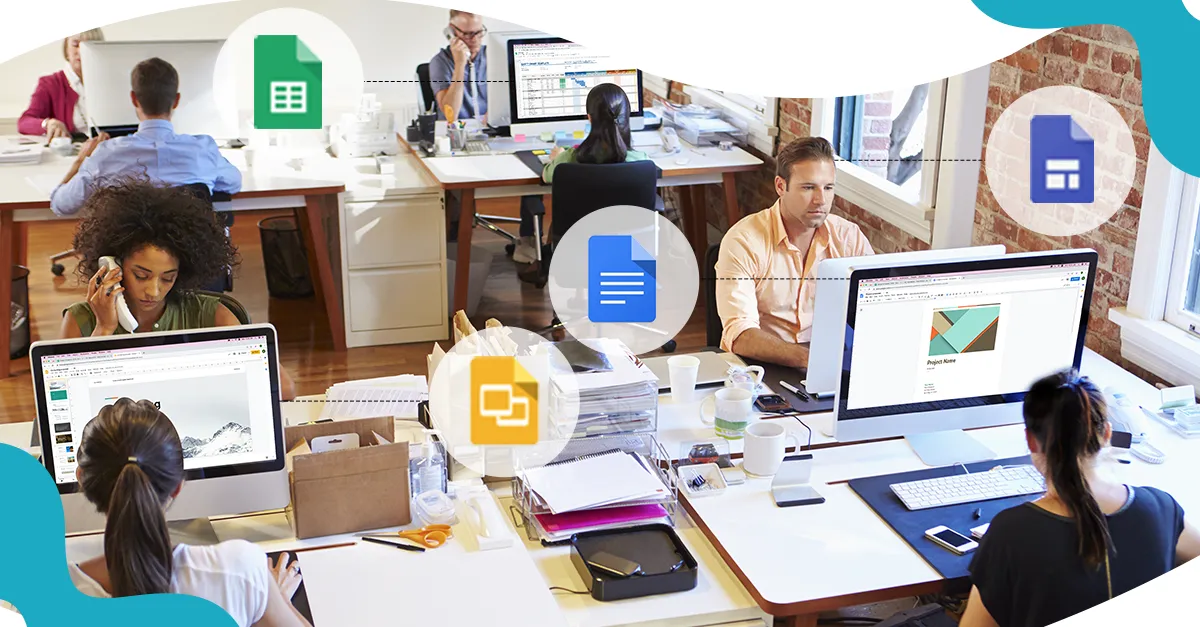
Since the launch of G Suite, it has brought in perspective in work with dozen new apps and services, unveiled intelligent features by using cloud technology to collaborate and stay productive. With the giant leaps made with phishing and spam control, businesses have relied on G Suite and its collaborative tools including Gmail, Docs, Sheets, Slides, Drive, and Hangouts for more than a decade now. More than 5 million paying businesses are using G Suite to work faster and smarter every day. In the past year alone, 1 million new customers have signed up for G Suite, with Google boasting of clients like Verizon, Colgate-Palmolive and Keller Williams.

Leading companies from financial services, retail, manufacturing, media, and entertainment are tapping G Suite to reimagine the way they work. Here are some examples.

ATB Financial, as a part of its customer-oriented attitude and belief to transform banking, has launched a bold transformation initiative “Work Reimagined”, powered by G Suite. Strategic planning, consolidation, and reporting are twice as fast using G Suite for collaboration. When ATB uses Google Chromebox with Google Hangouts Meet, for any time, anywhere meetings connected in one click.

BBVA, a global financial services group founded in Spain migrated to G Suite to increase efficiency and help their teams to work seamlessly, irrespective of their location. With employees in more than 30 countries across the world, Google Hangouts Meets, Google Slides, and Google Docs prove to be a blessing in disguise for them. Here’s how-

  • To gauge the worth of the proposed project, financial models are created by businesses by using Google Sheets.
  • Calculation of internal rate of return (IRR), return on investments, (ROI) and net present value (NPV) is a smooth process with the administration of G Suite.
  • Finance teams often communicate cross-functionally with other departments, such as marketing and sales. With Groups, it is easy to communicate quickly at once. The users can also limit sensitive information by only adding certain people to a group.
  • At the time of cross-functionality, team members often need key metrics on topics, such as budgets and bottom lines. Hosting this data by creating a team website in Google Sites can be used by organizations to link important documents and use permissions to provide access
  • Not just that, when beginning a project, they can even start with an existing template in Slides to draft a proposal.

Sheets make it easier to enhance financial data and bring them in order. The data from several spreadsheets can be comfortably moved into a single spreadsheet with the IMPORT RANGE function. Need to add stock prices to visualize trends? Experience the same with the GOOGLE FINANCE function.

Astley Clarke, a leading luxury jewelry brand employed Google Apps for Work to enable new, better ways in the working of their retail sector:-

  • To publish lookbooks for the latest product line and manage rich-media assets like images, logos, and videos across every retail channel was the biggest challenge for Astley Clarke. With the employment of Drive, they could sync to the cloud so that everyone’s always accessing the most up-to-date content. Thus, their creation and distribution of catalogs were reduced to a much easier process.

Travis Perkins, UK’s leading building merchant and the largest supplier to the construction market, helped optimize the workday of 30,000 employees by using G Suite.

  • The company also built a new intranet on G Suite, which combines Calendar, Gmail, Drive, and Sites for its employees. Travis Perkins staff use this tool to present tasks, deadlines, performance reviews, the status of colleagues, calendar reminders and Hangout links where a team can jump into a meeting — all from one screen.

With G Suite, products are brought to the market faster with increased collaboration and task management. Retailers collaborate and share product designs, mock-ups, quality guidelines and Key Performance Indicators (KPIs) in a secure workspace using Drive or shared drives. Stores constantly changing their physical footprint; while opening a new store or rebuilding a space. Thus, coordinating every task with various internal departments and outside contractors is a challenge.

  • With the help of Sheets and Calendar, users can collaborate task assignments and timelines. Retailers at times, also experience high employee turnover. Hence, shortening the recruiting and onboarding process improves the borderline. Moreover, the interested candidates can submit their information through Forms, and consequently, interviews can be conducted with top choices from anywhere in the world with Hangout Meets.

Aerotech, designs and manufactures the highest performance motion control, positioning tables/stages, and positioning systems for customers in industry, government, science, and research institutions around the world.

  • G Suite resources helped Aerotech improve its international and domestic communication within the organization. Team members frequently rely on Hangouts Meet and Hangouts Chat to talk internally and with clients. The calendar has become an invaluable resource for team coordination that includes assigning time zones to events.

Celestica, a multinational electronics manufacturing and supply chain services, brings global expertise and insight into every stage of product development—from the drawing board to full-scale production and after-market services. It also used the mobile device management capabilities included with G Suite to replace it’s legacy Blackberry Enterprise Server (BES) environment and thereby recovering software license costs.

Moving to G Suite helps:-

  • Erase the worry of spending time cleaning out the inboxes and folders to remain within a storage quota.
  • To acquire accurate measure on collaboration across the company, businesses can also use the reporting available through the G Suite Admin panel to identify how Google Docs, Sheets, and Slides have been edited by another person other than the owner of the document.
  • Real-time collaboration in G Suite can save more than 17,000 hours of employee time per year!

Nielsen, a global measurement and data analytics company, moved all of its 56,000 users to G Suite in 6 months to reduce IT support requirements and infrastructure travel costs by 20%. It was successful to identify that G Suite is built with enterprise security and workflows in mind. At each of its global offices, Nielsen appointed Google Guides to help distribute marketing materials, raise awareness and make employees get faster answers to their questions.

Google Drive fundamentally changes how employees work together, allowing them to move from an email-based workflow to real-time collaboration. Furthermore, they can also have a consistent and productive experience on mobile devices, Chromebooks, Macs, or PCs. As a result, time-sensitive communications can be accelerated.

G Suite comes with an annual subscription cost per user, with an SSO solution included in the G Suite license. So why wait? Switch to Google to enable an unparalleled working experience!

(Please note: Google offers a period of a free trial so that there are no issues before committing to anything)

With G Suite- Cost saving like never before

A one-stop solution for all your business needs, with G Suite, a set of secure, intelligent, cloud-native applications, help your businesses work faster, smarter, and more collaboratively than ever! In one suite of tools, it offers solutions for emails, word processing, spreadsheets, presentation decks, shared calendars, cloud storage and more!

But apart from driving productivity, collaboration and innovation within the organization, G Suite can reduce your capital and operating expenses directly.

Savings with G Suite comes from several areas:

  • Retired Servers and Data Centers
  • Reduced Cost and Labour of server hardware and maintenance
  • Reduced Corporate Travel with easy collaboration through Drive, Hangout and Chat.
  • Reduced Training Costs for onboarding of new employees on Google. (It’s simply something we all use in our daily lives)
  • Reduced IT software license costs from sunsetting third-party tools and like Mobile Device Management, Spam filter, Identity and Access Management, Meeting Solutions and Content Management Platforms.

Google owns one of the most robust computing infrastructures in the world, including one of the safest environments for protecting sensitive data. G Suite is built on top of Google Cloud Platform, which offers the highest security on the market. It’s trusted by some of the biggest companies in the world; such as HP, Verizon, Whirlpool and Salesforce.

Mike Heim, CIO of Whirlpool Corporation says “G Suite is a simple solution in many ways, but the features are actually very sophisticated, enabling us to surround our business processes with the right tools to connect people.” G suite comprehensively allows unleashing the talent in the company, without a lot of IT support, which is very helpful. The move to G Suite isn’t just a change in IT strategy, it’s a shift in the company culture. With Google, geographical barriers are broken down to race on the track to build “the winning workplace”.

Japan’s largest airline, All Nippon Airways, was delighted to announce that they will be embarking on a journey on “a different kind of cloud”- to collaborate and communicate more easily. As a global business, it doesn’t matter if their staff is on tarmacs in Tokyo, offices in London, or on-the-go in the streets of Beijing. With Google, they are able to communicate and collaborate in real-time, using Google Docs, Google Sheets and Google Slides from their PCs, smartphones or tablets. As well as removing the barriers of distance, the move to G Suite also helps them break down language barriers with Hangouts’ translation feature. They proudly confess that with Gmail, they not only have dependability and scalability, they no longer have to dedicate resources to maintain and operate their email system as they heavily depend on Google’s infrastructure.

In late 2015, DB Corp, India’s largest newspaper publisher, experienced failure with their on-premises infrastructure and traditional applications. They could not deliver the flexibility and agility needed to support the transition to real-time news delivery. This process led to the business to deploy a range of Google Cloud products and services, including Google Cloud Platform and G Suite.

“We were (also) impressed by the fact that Google had a local team with the skills and expertise to educate us about how best to use its products.”, says R D Bhatnagar, Chief Technology Officer, DB Corp.

Sales teams started using Google Forms and Google Sheets to centralize and control tasks such as sales forecasting, reducing the time required to complete reports and updates from up to a week to two hours.

Furthermore, various teams were able to save on the costs of third party tools and increase ease of use at the same time.

Here’s how:

  • Google Single Sign-on procedures make managing permissions simple without compromising on security.
  • Docs and Sheets allow members to collaborate on key files at the same time with live editing.
  • Gmail provides a fast, efficient search capability to help make sure nothing gets lost in the long threads.
  • Employees can meet using voice and video connections from their desktops, mobile devices, and meeting rooms to collaborate in real time on documents! This is a massive improvement when compared to the previous platforms that require each stakeholder to wait until other people provided their inputs, or people providing input into different copies of the same document, forcing a document author to spend time consolidating all feedback into a final version.
  • Automation through Google completes back-end processes associated with workflows from two days to just two minutes.
  • 99% Uptime, helping ensure that organizations meet their regulatory and internal business requirements. G suite is equipped with no scheduled downtime or maintenance windows, all of their data centers are built with infrastructure that can be omitted without any loss of function.
  • G Suite also has the best compatibility on mobile compared to any other email provider. It simply works, everywhere!

Google Cloud Platform is designed to meet all technical and business requirements, including minimizing the number of team members needed for back-end administration and maintenance tasks. It even focuses on the need to avoid the costs of hiring a system administrator or a database administrator!

Google boasts of industry-leading knowledge and expertise backing each of its products, including G Suite. Moving to G suite, thus, improves security posture and reduces the likelihood of data breach.

Irrespective of the industry, companies are chanting the mantra of Google Drive- to store and access documents, Gmail for email; Calendar to schedule appointments; Sheets to create and share spreadsheets; Docs to create and share documents; Slides to create presentations, and Hangouts Meet to discuss all the above!

G Suite is your best option for all email hosting and other tools, and that’s why it is the highest on the recommendation list.

G Suite comes with an annual subscription cost per user, with an SSO solution included in the G Suite license. So why wait? Switch to Google to enable an unparalleled working experience!

(Please note: Google offers a period of a free trial, so that there are no issues before committing to anything)

IoT, Big Data and AI – The Three Digital Pillars of every Industry

Why IoT has turned from a competitive trend to a means of survival?

We have already stepped into a world where exists virtual communication, Siri and Alexa doing half of the human efforts. Now that we have begun this trend of slashing down human effort, why not doing the same with everything else?

This is what we now call as the Internet of Things which means a network of physical devices, vehicles, electronics, sensors, software and every other object around you that are digitally connected and assists collection and exchange of data.
In its true essence, IoT technology refers to the Universe of devices with in-built sensors that provide data for further transmission in a much more convenient way. You don’t have to wait for data to reach the desired place that will delay your decisions anymore!

An increasing number of physical objects are being connected to the internet with time, for example, security sensors, smartwatches, and even household appliances like washing machines now can communicate and transfer data over time. Today, companies must leverage the latest technologies simply for survival because what were luxuries earlier are needs now. It is here to impact all industries, from logistics to manufacturing to healthcare – we are about to enter a connected world. Not just organizations, IoT has also led to massive empowerment of the consumers by providing greater control of household systems and appliances, washing clothes is no more a human task!

But the question is how to drive value from IoT, how to make it work in our favor?

It is a mere vision for most of the industries currently, there’s a gap between reimagination and execution that needs to be bridged.IoT will produce a treasure trove data – data that can sash the downtime in production with the help of real-time analysis and decisions, data that can help cities predict an epidemic using thein-built sensors in devices, data that can help manufacturing companies predict the breakdown of a machine with sensors installed in it.The possibilities that IoT bring to the table are endless. But to get these results the unstructured, messy data has to be organized and analyzed.

As the network of connected devices will go on expanding the sheer volume of data produced will be huge, and to derive results from the data it has to analyzed efficiently and well treated, what we call as Big Data Analytics. Businesses are failing miserably in harnessing the true potential of Big Data available to them. Data is only useful when it creates action, and for that, it has to be creative and contextual. To bring in this context to the existing data comes AI (artificial intelligence). The ai-based analysis becomes critical to extract optimum value from Big Data.
But how do Big Data and AI function within the IoT technology?

AI at glance

When we say AI it means machine learning. For data to be useful it must be analyzed, which is exactly what AI does. A large volume of data is of no use to an organization if it cannot lead us to any effective decision may it be minor or major, AI makes that huge volume of data meaningful. It tries to mimic human brains, how the human brain thinks, behaves and react to the respective actions.

WHAT IS THE NEED FOR AI IN INDUSTRIES?

  • A situation is to be analyzed from a rational perspective, for which we require patterns and algorithms to drive a structured approach and generate logic-driven output.
  • Data comes from varied sources such as sensors, social media and the like, also the data is unstructured and it keeps changing.
  • AI then uses perceptions to analyze the logic and incorporate machine learning to utilize that unstructured data and bring it in a format such that useful insights can be driven from it.
  • AI applications such as image recognition, language processing, computer vision, robotics and much other leverage machine learning for deriving the accurate predictions from large volumes of data and end up taking effective and efficient decisions.

AI provides results as per consumer behavior, for example, Amazon will suggest you movies and books based on your last buy, Pandora will suggest new songs as per your existing playlist. It brings in ‘intelligent connectivity’ to the users of IoT since mere connectivity of devices will do no good until the data from those devices is analyzed in terms of what is relevant and what is not.
AI can majorly be of three types –

  • Strong AI – produce a machine whose intellectual level is indistinguishable from that of a human being.
  • Applied AI – also known as information processing, aims to produce commercially viable smart systems.
  • Cognitive Simulation – where computers are used to test theories about how the human mind works.

Thus, AI is here to bring similar intelligence in machines that we find and consider high in humans.

How big is Big Data?

Big data is referred to as massive, unstructured and complicated data sets that are of huge importance to businesses. These data sets are so complicated that they cannot be treated with traditional data processing software. The recent developments in technology have exponentially reduced the cost of data storage and compute, making it possible to conveniently store huge volumes of data like never before. It has changed the job of marketers completely. They can obtain actionable insights to create highly effective marketing strategies by interpreting the tons of data that is available to the business.

But it is not possible to do this manually, we need Big Data Analytics to understand the market trends, gauge customer behavior and understand the standing and upcoming competition in the market.

HOW BIG DATA HELPS IN DERIVING USEFUL INSIGHTS?

According to statistics in the last five years, the average volume of data generated every day is 2.3 trillion gigabytes. The evolution of Big Data has provided great insights and knowledge through :

  • Adaptive Analytics – what is the appropriate action
  • Predictive Analytics – what will happen
  • Prescriptive Analytics – what should we do

But one major decision about Big Data is stored, people generally decide their medium of storage based on where their data resides currently. Cloud is gaining great popularity lately because of its ability of Vertical Scaling which increases the capacity of a server by adding resources as needed by an application, and Horizontal Scaling that allows businesses to expand hardware resources with an increase in processing requirements; making it an ideal platform to host Big Data Analytics. Cloud offers immensely high bandwidth and processing power to help Big Data applications with improved real-time processing of streaming data.

The Five V’s of Big Data

  • Volume – Organisations have a high volume of data with low density and are unstructured.
  • Velocity – The rate at which data is received and it is acted upon is what you call as velocity.
  • Variety – Data can be available in various types.
  • Variability – Data may vary from time to time and region to region.
  • Value -The value of data represents if it is relevant or not.

The primary value of data comes not in the raw form, but from the processing and analysis done on it. Thus, Big Data plays a very pivotal role in making real-time and efficient decisions.

The convergence of the Trio (IoT, AI, and Big Data)

Internet of Things has unique needs in different market segments, may it be automotive, manufacturing, power or healthcare. But one mutual fact that they share is Big Data!
And all of them want these massive unstructured data sets to be analyzed and put to use in the best possible way, and this requires Big Data Analytics to be coupled with AI. This combination is the utmost for real-time and streaming analytics and to understand customer interests in the best way. The ability to make real-time decisions, capture streaming data and add value to attributes is itself a service to logic, and this is achieved when you apply AI and Big Data Analytics together.

WHY THERE IS A NEED FOR BIG DATA ANALYTICS AND AI TO BE USED TOGETHER IN A BUSINESS TO STRIVE GREAT OUTPUTS?

  • There are five basic steps in IoT – Measuring, sending, storing, analysis, acting. The most important step here is acting, which tells why to invest in an IoT technology, it is the aim you are striving.
  • But the latter can be done only when the ‘analysis’ step goes right because ultimately analysis will derive the pattern that is being followed. The more you know about anything or any situation the better decisions you can take.
  • To reap the benefits of IoT data, we need to improve the speed and accuracy of Big Data Analysis and that is done by combining it with the quantitative methodology of AI.
  • After collecting the data from various in-built sensor devices, it is put under Artificial Intelligence and machine learning, for the computer to identify what the data represents, what patterns and algorithms it follows much more reliably than humans do.
  • By combining data intelligently and by interpreting, new insights can be driven to new services, applications, and markets.

Thus, the potential of Big Data can only be realized when it is coupled with AI.

CONCLUSION

Technology today is a major driver in any business, and we are still struggling to integrate technologies with human effort. Humans and businesses generate trillions of gigabytes of data every day but to put that data to use we need to cope with the operational challenges and implement a digital strategy that works with cloud initiatives and tools. But analytics can only be done when we understand the domain well, the old computing proverb of ‘garbage in, garbage out’ cannot be applied anymore. The trio of IoT, Big Data and AI is going to take industries to a higher notch and bring revolution in a classical sense. But are we prepared for this revolution or are we still dwelling over our past legacies?


IoT for Manufacturing: The what and why?

WHAT DO WE MEAN BY IIoT (industrial internet of things)?

Internet of things is referred to as the intelligent connectivity of smart devices by which objects can sense and communicate with one another. IoT in industries has proved to be an aid solving challenges of costs, production and client satisfaction. It has led to a complete reconfiguration of industries. IIoT is all about simplifying and automating every single process in any industry.
The leaps in power processing, mobility, and AI have taken the idea way ahead. From where and how we initiated with water and steam to mechanize production, and to where we have reached in terms of technology today is a true Revolution!
But the question is why does the gap between reimagination and execution still exist?
Addressing the gap and coming up with a business model that incorporates IoT is paramount.

WHY DO THE MANUFACTURING INDUSTRIES OF TODAY NEED A SMART FACTORY?

Manufacturers are concerned that their organizations are falling behind in the race to keep pace with IIoT. They are not able to execute a data-centric factory since they still lack readiness towards it. Manufacturing industries are seeking more efficient operations to match and survive the competition in the market. They need better product differentiation, better efficiency in production processes, and an adequate data integration source. The factories need to be ‘Smart’ in real means in order to withstand the forthcoming competition.

WHAT MANUFACTURERS CONSIDER WHILE IMPLEMENTING IoT IN THEIR INDUSTRY?

IoT enables us to evaluate and change decisions about the physical world. When two or more devices are digitally connected, the transmission of the data to any software application further becomes very convenient. It enables you to derive insights and act in real time. By cutting down the decision time and bringing intelligence at the edge, the factory ends up sashing costs.

IoT does not just provide operational efficiency, it also opens several other revenue streams. By the use of sensors, Smart devices, real-time data processes, organizations can shift from a product based enterprise to a data-driven enterprise. This will assist the manufacturer to improve business and disrupt the industry.


WHAT ARE THE RESULTS A MANUFACTURER IS STRIVING TO ACHIEVE?

Digital factory

A unit which is digitally connected helps to establish a much better line of command. This enables the operation managers and factory heads to remotely manage the scattered factory units.

Monitoring the flow of production

With the help of IoT, an entire product line can be monitored in real time. This real-time access enables to make any alterations and adjustments in the operations with respect to cost consciousness.

Supply chain management

The material can be easily tracked as it moves through the supply chain by the medium of sensors. These sensors enable manufacturers to trace the manufacturing cycle times and material flows. Thus, enabling them to predict future issues, and cutting down
capital requirements.

WHAT ARE THE CHALLENGES TO ADAPT IoT IN INDUSTRIES?

Though manufacturers are wanting to adopt newer technologies and enter the data-driven world, yet they lack the readiness to implement it in their industries. There has to be a comprehensive digital and IoT business model. But even then there’s a need for new talents and skill sets that fall short.
Most leaders haven’t built a framework that supports IoT. IT tasks like virtualizing systems, migrating to cloud for better and massive data storage, and adopting a software-defined approach; are not paid any attention.
Next, there is no segregation of networks and the data has no encryption as it flows through the internet. The manufacturers are in a great need for better regulations and standards in order to realize the potential of IoT in manufacturing industries.

*As data becomes the new currency and want for process insights grows massively, the Internet of things will play the master role.
A year or two ago, it was on everyone’s radar, and now it is actually shaping a smart and data-centric world. The idea of connecting people, machines and devices was imagined to be a futuristic vision of the digital business, but with the advancement in AI, mobility, and cloud, IoT has emerged to be the Mainstream!

Build a culture of Analytics

Without the required organizational change, your analytics project will not fly

Companies are looking to leverage the benefits derived from analytics tools to enhance decisions and performance at all levels of their organisation. However, merely investing in analytics is not sufficient to obtain the desired results.

Merely layering technology on top of existing operations is not sufficient in itself. It can be hard to persuade end users that the solution deployed adds value to their work, rather than adding complexity. This added value may range from something as simple as saving hours of routine work to the generation of strategically valuable insights.

Users need to start demanding data to make decisions rather than relying on their gut feeling or untested assumptions. They should be both excited and aware of the opportunity to save hours of time wasted on slow methods so that they can do more productive tasks. This can happen if they see how the new tools make their day-to-day work more efficient and effective.

“A common issue is that end-users continue to
use the old methods despite the availability of
productivity enhancing tools at their disposal.”

Adoption issues are not uncommon

Organisations build large data warehouses, hire right talent, and deploy advanced analytics only to find that decisions are still made with the help of inefficient (and sometimes even ineffective) old methods. No matter how advanced the technology underlying the analytics program, adoption and change management is necessary”

Common problems with adoption According to a 2017 Forbes Insights-EY report on Analytics:

38%

Lack of support from senior leaders

46%

Lack of collaboration between IT and Users

38%

Inability to change organizational culture

Problem

Lack of support from top management

Insufficient engagement of business users

Inability to Adopt a Data Driven Culture

Questions to be asked

Are top leaders encouraging the use of BI tools?

Is there a mechanism to drive change towards the new system?

Was there top management and business user buy-in before and during the adoption of the solution?

Are business users aware of the benefits of the new tools?

Do they have trust in the information generated from these tools?

Are users receiving the desired information from the tools?

Has the program facilitated a change in the manner of decision-making?

How often are the users leveraging the BI tools to increase the efficiency and effectiveness of their work?

Are users comfortable with accessing and navigating through the solution provided to them?”

Things to do

Appoint a change sponsor who owns the transformation process

Regular communication with management on the progress of usage and RoI

Train managers so that they can promote new behaviours in their teams

Engage all users to build trust and acceptance

Enable the IT team to handle queries of business users

Identify the top users and what they are doing as against the low performers

Recognise the users who are doing their best in driving the change

Establish incentives to drive new behaviour

Team Computer drives adoption as an essential component of its analytics implementation. We work closely with our clients to help them realize high returns from their analytics investments. Get in touch by writing to us at analytics@teamcomputers.com to know more.

Riding Change like a Boss. The IFFCO MC Story.

T:eam Computers has engaged with IFFCO since July, 2017. The project, managed by Jaganand Saini, is bring implemented by Sudhanshu Srivastava, and Gaurav Yadav.

A quick overview of the project:

Client Name: IFFCO MC
Product Used: Qlik Sense, NPrinting
ERP: Tally
Transition: From Maya BI to Qlik
Number of Users: 128
Head Office: Saket, New Delhi, India

Dashboards Implemented at IFFCO:

  • Sales Performance
  • Industry Sales performance (How competitors are performing)
  • Debtors Analysis
  • Profitability Analysis
  • Transit handling
  • Inventory Analysis
  • Rainfall Analysis
  • Soil Testing and Suggestion of fertilizers based on the health of the soil
  • Promotional Activity: Marketing planning and RoI
  • Warehouse Performance analysis
  • Finance Dashboards
  • Plant Operation

All dashboards are provided across devices, providing the users of BI at IFFCO access anytime, anywhere.