Empowering GCCs with Team Computers and Apple

Global Capability Centers (GCCs) in India are transforming the way global businesses operate. They are no longer just back offices but innovation hubs driving strategy, technology, and growth. To thrive, these centers need cutting-edge tools, secure systems, and smooth digital experiences for their employees. This is where Team Computers, in partnership with Apple, steps in.

The Power of Apple in the Workplace

Apple devices are loved worldwide for their performance, design, and security. For employees, they bring speed, reliability, and ease of use. For companies, they deliver strong data protection and lower support costs. When employees work on devices they enjoy using, productivity and creativity naturally rise.

How Team Computers Makes It Possible

Being India’s first Apple Authorised Enterprise Reseller (AAER), Team Computers bridges the gap between Apple technology and enterprise needs. Their role goes far beyond just supplying devices:

  • End-to-end support – From procurement to deployment, Team Computers ensures Apple devices are set up right and ready to use from day one.
  • Lifecycle management – They manage upgrades, repairs, and replacements, so IT teams don’t have to worry.
  • Custom workplace solutions – From mobile device management to secure connectivity, they tailor solutions for large enterprise environments.
  • Training and adoption – Employees get guidance and support to make the most of Apple’s ecosystem at work.

Transforming GCCs with Apple + Team Computers

For GCCs, this partnership means faster adoption of modern digital tools and smoother employee experiences. Teams get:

  • Secure and scalable IT infrastructure that meets global compliance standards.
  • Device-as-a-Service models, so companies can pay for technology as they grow, without heavy upfront costs.
  • AI-enabled support and proactive monitoring, ensuring maximum uptime for critical operations.
  • Happier employees, thanks to working on devices they genuinely like.

A Partnership for the Future

The collaboration between Team Computers and Apple is not just about selling devices — it’s about empowering organizations to innovate. With India emerging as a global hub for GCCs, this partnership is helping companies unlock new levels of efficiency, security, and employee satisfaction.

Together, Team Computers and Apple are building the workplaces of the future — where technology works seamlessly, and people do their best work.
Reimagining Security to the new normal

Since the onset of the pandemic, organizations are increasingly adopting a work-from-home model. That calls for shifting from an in-office workspace with stricter security features to an in-home scenario with lesser restrictions.

But, cloud computing ensures a seamless transition of business data to the cloud servers. Your team can do away with manual documents and maintain all the digital documents on a single platform. Also, collaboration is much easier on a cloud platform. Every team member can drop their comments or share files, ensuring smooth communication.

However, cloud computing also comes with certain security risks. Your data is no more in an on-premise platform with enough firewalls and encryption. Reports suggest that in the last 18 months, 98% of organizations have faced a data breach in one form or the other. That’s a whopping amount!

Hence, you need to put additional security measures in place for your cloud platform to ensure that your business data is not compromised.


How Can You Modify Your Organizational Security to Meet these Challenges?

To ensure organizational security, you can adopt various techniques like layered approach, end-point protection, and using a mix of both human and artificial intelligence.

Use a Mix of Both Artificial Intelligence and Human Intelligence

Cybercriminals can mimic even machine behavior to break into your cloud systems. Hence, you cannot solely rely on artificial intelligence-powered cloud platforms. You need to employ a set of cyber experts to monitor your cloud data continuously. By interpreting these data at a regular interval, you can prevent major cyberattacks.

Go for Wholistic Data Protection

Many devices, like mobiles, printers, smartphones, laptops, etc., connect to the cloud. Hence, your organizational data is scattered all over the web. Therefore, you need additional encryption techniques to protect the distributed data. Ensure that you employ advanced technologies like data encryption and tagging to ensure protection against all your devices, be it on-premise or on cloud platforms.

Integrate all the Network Infrastructure

Your cloud infrastructure consists of various devices from different vendors. Many of them may not communicate due to a lack of integration. This aspect can be a challenge when it comes to cybersecurity. Once you integrate all the cloud devices and services, you can easily monitor threats from a centralized platform. Eventually, the cyber risks will be much lower.

Effective Control of All the End-points

Your cloud ecosystem comes with multiple connected devices. Separately monitoring all the end-points can be challenging. You require a central agent who can connect to all cloud and on-premise solutions. This multilayered approach uses techniques like machine learning, real-time sandboxing, behavioral analysis, etc.


Final Thoughts: Use a Managed IT Service Provider to Protect Your Cloud

A managed IT service provider like Team Computers has the expertise to track and prevent any IT risk for your organization. We provide the latest cloud solutions, data analytics, and infrastructure solutions. Partner with us to completely protect both your on-premise and cloud infrastructure.

To speak to our IT experts, email us at rashi.verma@teamcomputers.com.

Chrome OS for Pharma & Healthcare Industries

In today’s disruptive healthcare industry, the need for modern technology and innovation has skyrocketed. With smartphones within an arm’s reach, millions in the country are now digitally literate. Therefore, when it comes to emergency services, faster information access, digital appointments, tracked medical records, and secured patient history is the need of the hour.

The ultimate challenge for the healthcare sector is to transform seamlessly into the digital suite without increasing its operational costs. The quest is to provide a rich, fast-paced, and on-cloud doctor-patient experience.

The shift from traditional PCs to a cloud-centric workflow seems expensive and cumbersome. But this has been made super simple with Chrome OS.

Benefits of Using Chrome OS

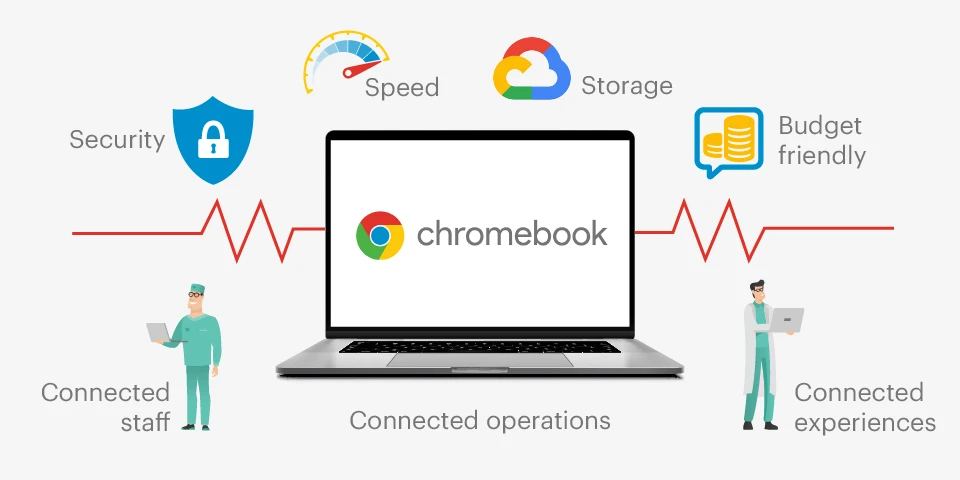
Chrome OS comes with a range of benefits for Indian pharmaceutical and healthcare institutions.

But why should you migrate to Chrome OS today?

1. Increased mobility and speed

The patient-doctor relationship is as crucial as the diagnosis. Meaningless paperwork, long queues, fixed workstations, etc., hinders the effective procurement of patient history and check-ups.

But with Chromebooks or Google Cloud, patients can book their visit on the go, anytime, anywhere. Chrome OS can bring the amount of time wastage to zero. Monitoring and accessing patients’ records can be done in seconds now.

2. Cloud-based enhanced security

The cloud-based console of Chrome OS allows quicker deployments with built-in security, keeping your data confidential.

Multi-tiered security layers of the OS protect critical medical records and financial data. The end-to-end integration protects against external malware. Besides, there is no need to spend a penny on antivirus protection with Chrome devices.

3. Cost Reduction by Shared OS

Cloud’s pay-as-you-go service offers effective cost reduction. The shared workspaces promote the tracking of information among the health staff network.

Comparatively, Chrome devices’ yearly upgrade costs less. The shared OS makes the day-to-day operations hassle-free, allowing increased productivity among the workers. It reduces operational costs as well.

4. High Productivity & Improved Connectivity

The maintenance of Chrome OS devices requires 75% less time as it is cloud-based. The real-time monitoring and deployment of patient data have increased productivity hours by tenfold.

Shared kiosks connect you to your doctor with faster check-ins, seamless collaboration, and a personalized experience. Remote connectivity with staff and tap-and-go virtual care can propel the efficiency of the medical industry.

5. Migrate your sluggish old systems into Chromebooks today! 

This cloud-based operating system requires much less processing power and is simple to set up.

Saving time, money, and effort with Chrome OS lets you give back your precious time to the patients and the people in need.

Dive into the world of Chrome OS with Team Computers!

5 Years since Demonetisation: What has changed?

November 8, 2016, will remain etched in the memory of every Indian. The launch of demonetization by the Indian government changed the face of our financial sector forever. Cancellation of Rs 1000 and Rs 500 notes and the unavailability of newer denominations forced the population to reduce their dependence on cash transactions and go digital. The transition, which in any other circumstance would have taken years, happened in a fortnight. Since then, digital transactions have witnessed massive growth, especially with the government and banking regulators striving to make India a cash-independent economy in the coming decade.

The government’s push towards the digital economy has opened the doors for various startups such as Paytm, Google Pay, Phone Pe, Amazon Pay, etc. These startups use Unified Payment Interface (UPI) technology as their base to transfer money digitally. As per the National Payments Corporation of India, transactions made through UPI stand at Rs 7.7 Lakh Crores. From street-side vegetable vendors to big grocery stores, everyone has jumped on the bandwagon of digital transactions, even if it’s for a meager amount.

Chart Courtesy: https://www.npci.org.in

While the rise in digital transactions is great for the economy, it has also increased the occurrences of digital crime. As per industry reports, suspected digital fraud has risen by 89% when comparing the last 4 months of 2020 with the first 4 months of 2021. With millions of digital transactions happening every day, the government has put its focus on increasing digital security to counter fraud.

The government, in tandem with RBI, has mandated all banks, fintech companies, and payment apps to offer secure network gateways for transactions, as well as raise awareness on various kinds of digital frauds and how one can prevent them.

The popularity of digital transactions doesn’t mean that Indians have discarded cash. It is still the king with over Rs 29 trillion of currency in circulation as of November 2021, 65% up by the pre-demonetization era. Yet, it doesn’t hold the charm anymore. People in cities and villages, millennials and baby boomers — all are finding it easier, safer, and more convenient to transact digitally. The COVID-19 pandemic also created an urge among people to migrate towards contactless online transactions, as it was the need of the hour.

Demonetization paved the way for Indians to usher in a new era of digital. The ease of using smartphones, along with better network connectivity in far regions, empowered people to take on the journey of contactless transactions. It is not uncommon to find people with more digital transaction apps on their phones and less cash in their wallets, signifying the importance of demonetization in making India a lesser cash-based economy.

With the increase in digital transactions the increase in security concerns are increasing. To know more about securing your digital transactions, reach out to our security experts https://www.teamcomputers.com/information-cyber-it-security

MacBook vs. Windows Laptops: Which Is Best for Your Business?

Planning to get a new laptop for your business but confused about which one to choose? It happens to the best of us when we’re presented with a confusing range of the most lucrative options. While most of us go with customer reviews and total cost, a few of us have a taste for the right operating system.

Windows and Apple both provide a premium range of laptops. Each of them comes with its advantages. The popular models are the Windows 11 and MacBook Air for business. While Windows has better login and gaming options, MacBooks have better integration with Apple mobiles.

Through this blog, let us analyze the different parameters to select a business laptop. We shall compare Windows and MacBook for business purposes. Based on how they fare and their unique requirements, you can make the final choice.

MacBook Vs. Windows: Parameters of comparison

While choosing between a Windows and MacBook laptop, ensure that you keep the critical factors in mind, like integrations, compatibility with different software, voice features, navigation, and overall costs.

  • Initial setup
    It is easy to install initial setup software in both Windows and MacBook. The OS automatically downloads the driver software for ports and drives. With Microsoft Cortana, you can give voice commands for installation. In either case, you do not need to sign in to an Apple or Microsoft account separately.
  • Third-party software compatibility
    Both Windows and MacBook are compatible with many third-party apps. The inbuilt app store lets you download business apps of your choice. For example, you can download video recording software, Photoshop, etc., on either laptop. But, do not expect these platforms to provide you with the same comfort level as your mobile devices.
  • Hardware integrations
    When it comes to external hardware for your business laptop, Windows has the upper hand. You can easily integrate graphics cards, CPUs, and other storage systems. However, MacBook has an upscale look and design options, especially with the optional 5K screens on iMacs. Windows 11 for business gives the option to connect superior-quality VR Headsets or HoloLens.
  • Touch options
    Windows provides superior touch inputs, as compared to the MacBook. For example, with the Windows tablet mode, you can navigate between the keyboard and screen for inputs. In addition, you can use a pen to input data. Your handwriting is automatically recognized and converted to text. With MacBook, the touch option is available only via MacBook Pros using the Touch Bar option.
  • Search functionality
    Both Windows and MacBook have equally good search functionality. You can either use the search bar or utilize the voice search functionality. The search bar in Windows is more versatile and displays results like apps, weather, stock prices, etc.
  • Voice integration
    When it comes to voice commands between MacBook vs. Windows, MacBook has Siri, while Windows has Cortana. Both Cortana and Siri are good at giving results of daily weather, YouTube videos, stock prices, map directions, etc. But, Cortana is superior to Siri in the case of the logging off feature. You can use Cortana to log out of your system, but the same is not applicable for Siri. Similarly, Cortana can easily integrate with Amazon’s Alexa and send voice commands to it.
  • Safety and security features
    In the case of safety and security, MacBook has the upper hand. It is less prone to cybersecurity threats like phishing, malware, and ransomware. However, both Windows and MacBook have robust VPN support. Since MacBook has its native hardware ecosystem, they are more stable. Windows’ instability here is due to its overdependence on third-party drivers.
  • Gaming functionality
    Gaming functionality is more developed in a Windows ecosystem. Many top titles on Steam are compatible with the Windows OS. You can even stream PlayStation games through the Xbox app. You can also stream or record your gaming activities to Microsoft’s mixer community using the Windows 10 Game Bar.
  • Desktop and file navigation
    It is much easier to go for desktop navigation using Windows. You can easily open multiple tabs and navigate between these. Be it a webpage or a folder, you can arrange it side-by-side on a single screen for compelling viewing. In addition, both MacBook and Windows help you create multiple virtual desktops.
    Both Windows and MacBook Air for business have relatively efficient file searching features. With Windows, you can easily track your last saved file, while MacBook allows you to use multiple tabs while searching for your favorite file.
  •  Overall costs
    Windows laptops have more versatile options and are comparatively less priced. While MacBook has competitive and stylish models, they are in the higher price range.

MacBook vs. Windows debate: Which one to choose?

Whether MacBook Air or Windows 11 for business, selecting the right laptop can majorly impact your business decisions. While shortlisting either Windows or MacBook for business, focus on speed, flexibility, third-party devices’ compatibility, etc. Ensure that you review your requirements thoroughly to get a cost-effective laptop for your workplace.

Are you looking for more guidance to select the right business laptop? Team Computers is an authorized partner for all devices brands like Apple, MS Surface, Dell, Lenovo, HP, and Acer. If you are still confused about making a decision, feel free to email us at wsmarketing@teamcomputers.com for expert advice!

Cloud Mining : Method Behind The Cryptocurrency Model

What is Cloud Mining?

A technique to earn cryptocurrencies without owning any hardware. This method helps miners source hardware equipment, i.e., the mining rigs from any facility. A cloud miner simply registers the hardware in their name remotely or virtually and gets started with the minting process.

But before that, let’s understand Blockchain

In simplest terms, a blockchain is a decentralized ledger for all transactions made across a P2P network. Usually publicly available, and the nodes can generally be operated worldwide. Blockchain is completely transparent as everyone in the network owns the data. It is impossible to modify data without catching attention. Blockchains are immutable; once a transaction is made, it is added to the ledger permanently, solving the double-spending problem.

What is a Cryptocurrency model?

Cryptocurrency is a digital coin graded with encryption, and each such coin has a business model. There are millions of crypto-driven small businesses with a unique value proposition. Cryptocurrency acts as a medium of exchange explicitly created to transact in the blockchain network, and bitcoin stands as the first representation.

How does crypto mining work?

Crypto mining is a process of adding blocks to the network by solving complex mathematical equations. Like mining in rigs, crypto miners are responsible for solving such cryptographic equations with the help of high-powered computers.

Miners are in a race against each other to solve the problem, the first to get a fraction as a reward. A new set of coins is introduced into the network for every successful completion by miners.

How does cloud mining work?

Cloud miners work similarly, but they outsource their computing needs to avoid the hassle and avoid overhead costs of maintaining the equipment.

Pros of using cryptocurrency

  • Secure encrypted end-to-end transactions
  • Individual ownership
  • Removal of added middlemen costs
  • Adaptive networks
  • Global access.

Cons

  • Volatile markets
  • No ownership and authority
  • Exposure to illegal payment activities
  • The risk of loss is high

Market trends

Major organizations worldwide are now looking into adopting the crypto-financial ecosystem. Also, financial bodies are keen to enable smooth transactions for customers worldwide.

  • DeFi(Decentralized Finance) was introduced recently to facilitate financial transactions by using smart contracts. DeFi has witnessed exponential growth by registering contracts valuing $15 billion in 2020.
  • Rise of Decentralized exchanges- Data accumulated in the past year showed decentralized exchanges were responsible for transacting above $50 Billion. Paypal/ Venmo, CoinDesk, and others are growing in volumes of newly registered users.
  • NFTs- With NFT, you can now own certificates of ownership of any digital entity, which can be traded into fractions. NFT transactions have made many people financially profitable this year.

Security Lapses 

In recent times, hackers used Google cloud to gain unauthorized access and mine cryptocurrencies. Exposing the system’s vulnerabilities and highlighting customer security lapses by falling prey to third-party applications.

Some cryptocurrencies have already been affected by such attacks; here are some notable aspects-

Missing credentials- User identity can be manipulated, and accounts can be accessed by stealing private keys and digital signatures.

Code exploitation- Ethereum recorded a loss of $ 60 Million as hackers managed to break into the system, exposing the vulnerable side of the blockchain network.

Future of cloud mining

Cloud mining has gained extreme popularity in the past few years, and cloud mining platforms have enabled users to earn coins without any equipment. Mining is still profitable if done smartly. A significant chunk of miners have witnessed increased expenses with power usage and supporting hardware. As each coin has a capped limit, miners should be aware that the reward size will continue to depreciate as they get close to the number.

Profitability in today’s time is still variable concerning the coin, cost of power, hash rate, time, and the coin value.

The Future of Cloud and RPA

These days, businesses are increasingly making use of automation techniques to simplify work processes. The Future of Jobs Report 2020 shows that 80% of business leaders are speeding up automation processes for remote working. 50% of companies already make use of AI for their business function. Of these, Robotic Process Automation (RPA) and Cloud technologies look most promising.

These advanced technologies make your workplace more efficient and help you save business costs. Also, with the Cloud, you can scale up your business operations based on the requirements.

Through this blog, let’s see what Cloud and RPA hold for businesses in the future.

What is Robotic Process Automation (RPA)?

RPA is an advanced automation technology where software bots try to imitate human actions and behaviour. For example, if you want robots to manage a supply chain, you can train them to mimic human behaviour of processing orders, finalising digital payments, or confirming delivery. A robot can do the entire process with minimal human intervention.

The robot functions in a virtual environment and takes the place of a human worker. They can handle high volumes of data in the user interface at a faster rate. In addition, these robots can automatically observe and learn using machine learning algorithms. This reduces the need for a script to train the robots.

Benefits of RPA

Robotic process automation (RPA) comes with benefits like enhanced productivity, security, analytics, and customer satisfaction.

  • RPA reduces human intervention to do repetitive tasks. Robots can efficiently perform these tasks in a short time-interval. Moreover, robots focus on single tasks and provide undivided attention to them without tiring themselves out.
  • With RPA, the chances of errors come down. The robots can properly map and optimise business processes with precision.
  • Collecting and storing a large amount of data can get challenging for small and medium-sized organisations that employ few workers. With RPA automation, it is easy to sort through complex data and arrange them logically. Top-level managers can have a bird’s-eye view of the data to make crucial decisions.
  • Customer service lies at the core of any organisation. Many businesses have less workforce, hence catering to different customer queries can be challenging. With RPA, robots can take over repetitive tasks like order processing and paperwork. In turn, the workforce can better focus on core customer needs, thereby enhancing customer satisfaction.

New Trends in RPA and Cloud Adoption

The Automation Anywhere “Now and Next: State of RPA” July 2021 report shows the latest trend in RPA and Cloud adoption by businesses.

Let’s understand these trends in detail.

  • Cloud led RPA Adoption
    Organisations are increasingly moving towards cloud led RPA adoption. More than one in four companies use RPA solely in the cloud. By next year, on-premise deployments will come down from 36% to 10%.
  • Spending on RPA to Increase
    Organisations are planning to spend more on the RPA infrastructure. About half of them will increase their spending by 24%, while 11% of businesses will increase their spending by 25% or more.
  • Top Priorities: AI and ML
    Artificial intelligence (AI), Machine learning (ML), and Independent data processing will be the top-three priorities of half the surveyed businesses for the next twelve months.
  • Productivity Drives RPA
    One of the top benefits of RPA includes higher productivity. More than half of the surveyed businesses have been able to move their workforce towards higher value work. With more time at their disposal, workers can contribute effectively towards innovation.
  • Lack of Training is a Significant Barrier to RPA Adoption
    Most organisations feel that advanced training and simplified implementation tools are needed to adopt RPA across their workplace quickly.
  • Directors Remain the Strongest Advocates of RPA
    The Directors continue to remain the strongest advocates of RPA. However, the no: of managers who support RPA has gone up dramatically. However, frontline workers seem to be least enthusiastic about adopting robotic process automation technologies.
  • Businesses are Looking for No-Code Tools
    The number one priority for organisations looking for just RPA was simplified no-code tools.
  • The Return on Investment (ROI) on RPA is Very High
    So far, top companies saw a return on investment (ROI) on RPA at a whopping 380% (average).

Final Thoughts: Use Team Computers, Top RPA Partner in India

Transitioning to robotic process automation and cloud platforms can be challenging if you are just starting out. That’s why you need a dedicated IT service provider who can handhold you with the transition process.

Team Computers can be your trusted partner with Automation Anywhere in India. Be it robotic process automation or cloud solutions; we have everything covered under one roof. You don’t have to worry about the infrastructure solutions or your business apps; we are here to set them up for you.If you are looking for the best RPA+cloud solution, feel free to contact Team Computers today!


What makes Cloud profitable for the Business and the Planet?

It is a fact that the climate crisis is an issue that cannot be ignored for long. The rise in global economic activity has created a surge for more resources, infrastructure, etc. This growth has resulted in increased emissions, pollution and pushed resources to the verge of extinction.

Technology has become more advanced with the Cloud by providing an ability to upscale and lose on-site infrastructure. While this has increased flexibility, an urgent need for data centers arose gradually.

How Cloud Saves the Day

Cloud computing offers companies the opportunity to reduce their energy consumption, reduce their carbon footprint and move to a greener, smarter future. As a result, leading technology companies and other sustainable businesses are integrating Cloud computing technologies.

Sustainable companies need to find the right technology partners to create a sustainable Cloud that allows them to use their assets more effectively and provides a platform with greater organizational flexibility, availability, and control at the enterprise level. In addition, innovations and technologies can use Cloud infrastructure to achieve sustainability goals.

The Cloud includes Software-as-a-Service (SaaS) offerings that detect and connect real-time data sources, accelerate integration and reporting, provide accurate carbon accounting, measure performance targets and provide intelligent insights to help organizations act more effectively.

How Cloud Solutions can Lead to Sustainability

Google has introduced its plans and measures to reduce the impact of carbon emissions. By taking control over the non-computing energy, they divert them to power the machines serving their prime products – resulting in zero net emissions for their products and a reduction in carbon emissions by 65-90% annually, with an overall increase in productivity. Their servers can handle multiple products, thus decreasing the data centers and servers and optimizing energy usage.

Google sustainability project is set to fight climate change, running on completely renewable energy sources. Additionally, they have managed to become carbon neutral; their data centers do not leave any carbon footprint as a commitment to creating a carbon-free world. Google is set to supply carbon-free energy to industries by 2030. Google aims to boost sustainability-based solutions to support healthy living. Optimizing servers and data centers has helped Google save over $1 billion in energy consumption, underscoring the scale of savings in the Cloud.

AI and machine learning can also help create sustainable supply chains. They describe how Cloud data points can connect to provide a new level of insight, such as reducing excess inventory and solving complex logistic problems.

A Green Cloud Solution

A study last year found that Microsoft’s Cloud is 93% more energy-efficient, resulting in 98% lower CO2 emissions than traditional enterprise data centers. Microsoft, together with Accenture and WSP Environment, conducted a study on the energy of Cloud computing and sustainability and published the results in a White Paper.

Helping Businesses Save Energy

Moving local data centers to the public Cloud could reduce energy consumption with potential benefits such as electricity, cooling, hardware efficiency, computer use, sustainable software development, and carbon-free energy use.

Alternative Fuels

Cloud data centers can switch to renewable energy sources to run their operations and reduce their carbon footprint. Public Cloud providers can set up Green Cloud data centers that use other energy sources. Enterprise systems and data hosted in the Cloud enable people to work remotely and therefore help companies reduce, if not eliminate, the carbon footprint of their offices.

To know more, reach out to us at:

https://www.teamcomputers.com/googlecloud/google-cloud-platform.html

BFSI now a favorite target of hackers, 2.9 Lakh cases reported in 2020

Cybercrimes and cyber breaches are growing exponentially both tact-wise and frequency-wise also. With the growth of technology to enable business efficiency & reducing cost, the attempt of cyber threats towards the BFSI industry is also rising. With the ever-increasing adoption of technology in the BFSI sectors, there is an equal risk of losing data, securities, money, and reputation. In this article, you will know some facts & ways cyber attackers enjoy breaching the business, insurance, and financial sectors.

Significant surge in Cyber threats in the BFSI Industry –

According to some reports, banks and financial institutions experience a cost of around $18.3 million annually per organisation due to cyberattacks. Most criminals target financial data, digital money, Personally Identifiable Information (PII), and digital assets of such BFSI industry and sell them on the dark web. They gain monetary benefits from these assets and receive huge funds from buyers who pay through cryptocurrencies like Bitcoin. That is how the entire buying and selling becomes untraceable.

Other cybercriminals use different applications and vulnerabilities to transfer funds from all hacked financial accounts into their own. That is where these industries need compliance regulations. Such compliances aim at strengthening cyber resilience and preserving consumers’ data and money.

Security Gaps in the BFSI Sectors –

The BFSI industries face daunting challenges despite the explicit security concerns. These challenges are apparently due to the security gaps. Some of them are:

  • The BFSI industry is lacking substantial talent gaps as they do not have adequate security professionals. In contrast, cybercriminals are growing in numbers and are leveraging advanced technologies (such as artificial intelligence, machine learning, automated tools, etc.) as their arsenal.
  • Another reason for the gaps in cybersecurity is the use of too many disparate security tools. Different companies build diverse and siloed security tools that add complexity to the security system. These security applications do not integrate and communicate effectively and thus do not provide accurate security insights. Hence, organisations should research before using them so that these tools can establish seamless and holistic protection.
  • Another gap that creates security chaos is the lack of attention to security fundamentals in the BFSI industries. Frequently, the business and financial sectors lack discipline from the security perspective. Due to the lack of cybersecurity responsibilities and knowledge, employees of many BFSI industries unknowingly let attackers breach their systems. That is why proper security training is essential for every employee within such organisations.
  • Adoption of the latest technology and not following stringent cybersecurity regulations is a gap in the security aspect. These days, BFSI firms are adopting hybrid cloud and leveraging machine learning algorithms. These sectors need to meet new security standards to leverage them.

According to the PSD2 regulations, payment service providers and other BFSI organisations should implement preventive app cloning measures. These digital payment app makers should employ internal vulnerability assessment and penetration testers. They will check the source code before the app goes live. Again, for web applications, organisations should leverage enterprise-grade application firewalls plus dedicated modular hardware firewalls to meet the security level.

Also, it is essential to collaborate with industry experts and peers. The BFSI industry should also improve the incident response and defence mechanism to minimise the risk. While the BFSI industries enjoy the hybrid cloud, it is equally essential to place enterprise cloud security.

Key learnings 

The BFSI industry has plenty of options to improve. The theme that they should opt for is to have the right tools & measures for better security. It is equally essential to have the right partners and third parties for the organisation’s security.

To know about various security options and getting assessment done or demo for SASE Security Request Demo at:

https://pacemarketingsolutions.com/2021/cisco/october/team%20computers/edm-4/form/

How a leading Manufacturing giant is saving 2000+ man hours leveraging Automation?

Industry 4.0 is changing the way of operating any business. Industry 4.0 uses automation, digitization, AI, and IoT to eliminate inefficiency and avoid human error. Manufacturing industry, especially pharma companies have been in the limelight for two years, proving to be a key industry for a country’s economy. The entire process of having the right kind of medicine at the right hospital is pivotal and is possible due to solid finance and supply chain control.

Automation of Logistics Tracking

Logistics of manufactured products is crucial. There shouldn’t be a single process with contingent risk when delivering medicines to the concerned recipient of the shipment. All stakeholders should be updated constantly with the tracking details. Today we see automation in every small operation. We have Autonomous Mobile Robots in warehouses, AI-powered conveyor belts in the manufacturing hub, and SaaS (Software as a Service) for planning and designing a manufacturing company’s supply chain.

A mammoth challenge for Industry 4.0 is tracking the supply chain  & logistics. As consumers, we are still unknown when and at what time our parcel is reaching our place. The same is the situation in the B2B market. The clients are unaware whether they will get the consignment in time or delay procurement of the right APIs or medicines. We still face challenges –

  • Lack of efficiency in process completion – Here, we look at different problems arising at different stages. For instance, while shipping goods from one place to another, an importer or exporter has to face many issues that decrease the quality of work. Problems arise due to incompetent planning and less automation present in the business.
  • Manual Repetitive Task – In shipping and logistics, there are 100 different documents, 1000s of couriers, each of them having various courier partners. For every shipment, the professional needs to check with the ETA the status of a cargo with the ETA, forecasting problems. Monotonous work is the reason behind inefficiency.
  • Time-Consuming – These repetitive tasks lead to time consumption. In the pharma industry, there are 1000s of shipments from one country to another. Each shipment has 100s of documents making the entire process time-consuming.

Another crucial problem regarding imports & exports is dealing with foreign exchange rates and managing the company’s foreign exchange. Due to changes in USD rates every minute, it is impossible to lock in one rate to carry out the transaction. Globalization has led to heavy traffic on foreign exchange authorized websites. Due to this heavy traffic, it is hard to have our desired exchange rate.

Team Computers is a company that has automated this, and it links with official websites like RBI to track changes and update amounts automatically. These adjustments make it possible for a company to track down live USD/INR, USD/YEN, or other global currency exchange rates. One of the advantages is that it can extract information from recognized and trustworthy sources.

Team Computers specializes in automating the tracking service of every shipment with ease and updating it on ERP, SAP, Navision, and other Software as a Service platforms. Recently they have collaborated with a billion-dollar pharmaceutical company. Team Computers are saving 2000 person-hours for this company, helping them to perform better in challenging situations. In the shipping and logistics sector, Team Computers has managed to automate tracking of 300+ shipments services by 30+ courier companies within the ETA.

Last but not least, with the help of their expertise, Team Computers are converting 50+ currency rates daily, all associated with the government. They believe that we have a higher employee productivity rate and reduced turnaround time by automating the process. The companies can solve all the bottleneck issues with the shipment, logistics, and foreign currency transactions without losing the focus on core activities.

To know more about our automation practice or request for a demo:

https://www.teamcomputers.com/business-process-automation