
The State of AIOps and Automation in Mid-Market Enterprises

A 2026 Industry Survey Report

Benchmark data on how automating IT workflows — from ticket triage to self-healing infrastructure — is reshaping operational metrics, cost structures, and team efficiency for MSPs and mid-sized IT organizations.

Executive Summary & Key Findings

AIOps has crossed the threshold from enterprise-only territory into the mid-market. The data from 2025–2026 research surveys, analyst reports, and vendor benchmarks tell a consistent story: organizations that automate IT workflows see measurable, repeatable improvements across every core operational metric.

Headline numbers:

  • 40–50% average MTTR reduction with AIOps vs. manual dispatch (Forrester / Research Square, 2025)
  • $85 → $2–5 cost per ticket: manual vs. fully automated resolution (Mizo / Lorikeet, 2025–26)
  • 80% of outages attributable to human error in manual operations (Enconnex / Uptime Institute, 2025)
  • 18% of mid-market firms have any AIOps tooling deployed, vs. 67% of Fortune 500 (DataIntelo, 2025)
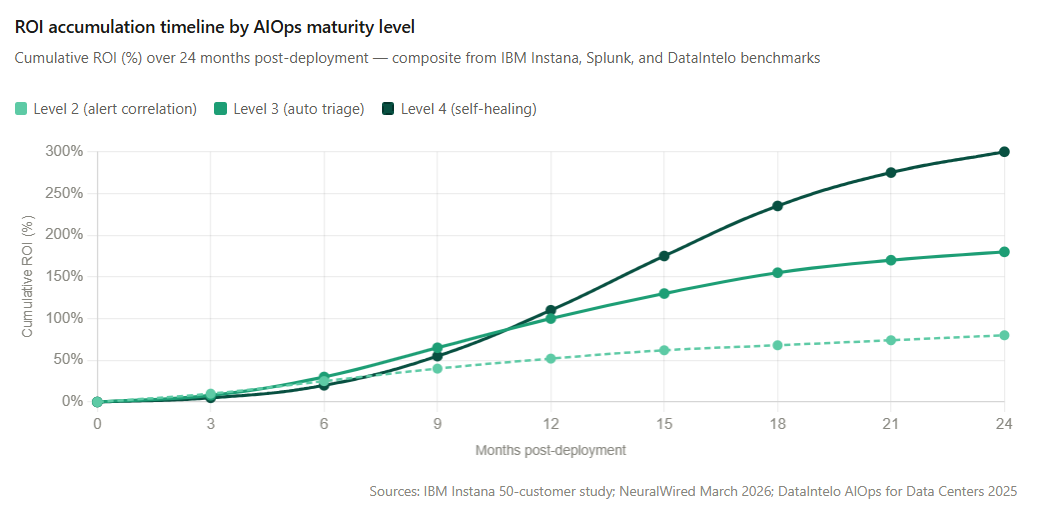
  • 300% ROI within 18 months for organizations at AIOps maturity Level 4 (IBM Instana / NeuralWired, 2026)

Report thesis: The mid-market automation gap is the defining IT operations story of 2026. While large enterprises have spent years deploying AIOps, fewer than one in five mid-sized firms has any form of AI-driven IT operations tooling. The cost to remain manual — in MTTR, ticket labor, human error, and downtime — is compounding. This report benchmarks where the savings are, how large they are, and what it takes to close the gap.

Headline findings table:

Metric Manual baseline Automated benchmark Improvement
Mean Time to Resolve (MTTR) 2–4 hours average 18–85 minutes 40–60% faster
Cost per service ticket $75–$600 (L1–L3) $0.50–$5 (automated) Up to 95% lower
Human error-related outages ~40% of orgs hit annually Significant reduction via runbook enforcement Reduced 30–50%
Alert noise (volume) Hundreds of raw alerts/day 80–90% suppressed by correlation ~85% noise cut
Ticket triage accuracy 77% (manual routing) 95–99% (AI routing) +22 percentage points
Time to first ticket response 4–6 hours Instant (under 2 seconds for AI-handled) 99% reduction
ROI payback period N/A (cost center) 9–18 months to full ROI Proven ROI timeline

Market Context: AIOps Growth & the Mid-Market Adoption Gap

The AIOps platform market is one of the fastest-growing segments in enterprise software — but growth is heavily concentrated at the top of the market. Mid-sized firms face a window of opportunity before the gap becomes a competitive disadvantage.

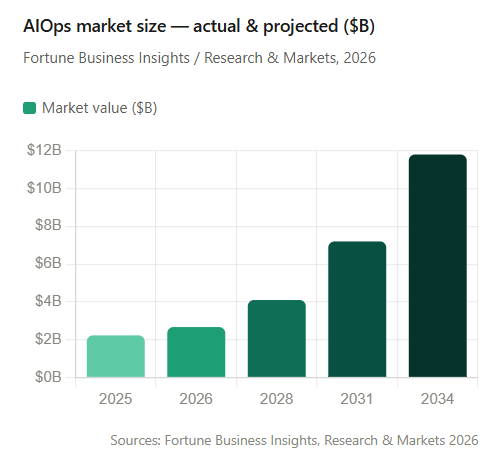
The global AIOps market was valued at $2.67 billion in 2026, growing toward $11.8 billion by 2034 at a 20.4% CAGR (Fortune Business Insights). A separate, broader market definition by Global Growth Insights places the 2025 figure at $24.24 billion when adjacent AI operations tooling is included. Either way, the growth trajectory is steep and consistent across analyst firms.

Ops market size, actual & projected

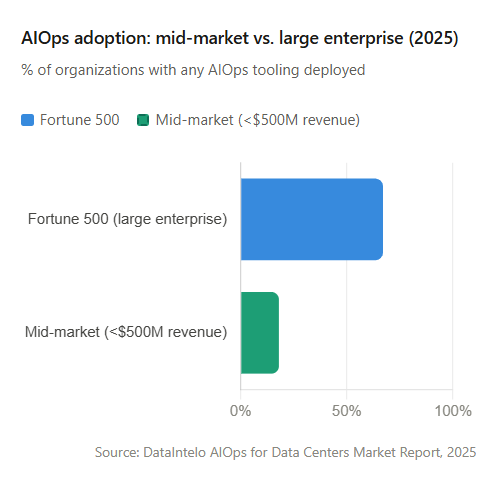
The critical story for mid-market operators is not market size, but the adoption gap. Only 18% of mid-market enterprises have deployed any form of AIOps tooling, compared to over 67% of Fortune 500 companies. The SME segment of the AIOps market is growing at the fastest CAGR (20.8% through 2034), driven by SaaS delivery models and entry-level pricing below $30,000 annually from vendors such as PagerDuty, BigPanda, and LogicMonitor.

Adoption gap: Fortune 500 at 67% vs. mid-market at 18%

Market access point: 57% of mid-sized firms are currently transitioning from manual monitoring to AI-based systems, per Gartner’s 2025 US AIOps tracking. The barrier is no longer technology availability or cost — it is organizational readiness and tool-selection confidence.

MSP market: AI as the core service layer

For Managed Service Providers specifically, the shift is structural. In 2024, over 60% of new managed-service contracts included AI-backed IT service tools, and automation-driven services (self-healing networks, proactive monitoring) surged 31% year-on-year. According to a 2025 MSP trend report, 58% of MSPs are now investing in operations automation as a key capability area. Firms using MSP-delivered managed services in 2024 reported a 27% decrease in system downtime and a 19% reduction in IT operation costs.

MTTR Benchmark: Automated Triage vs. Manual Dispatch

Mean Time to Resolve is the single most cited operational metric in AIOps ROI conversations — and the data is striking. Across multiple independent studies, the improvement range is narrow and consistent: 40–60% reduction in MTTR when automated incident detection, correlation, and triage replace manual processes.

Headline benchmark: A Forrester-commissioned study found that combining observability with AIOps reduces MTTR by up to 50% and increases availability of revenue-generating apps by 15%. Research Square’s peer-reviewed analysis of multiple AIOps deployments found a consistent 40% MTTR reduction across services and systems, alongside a 35% improvement in incident detection speed and a 25% improvement in problem-solving accuracy.

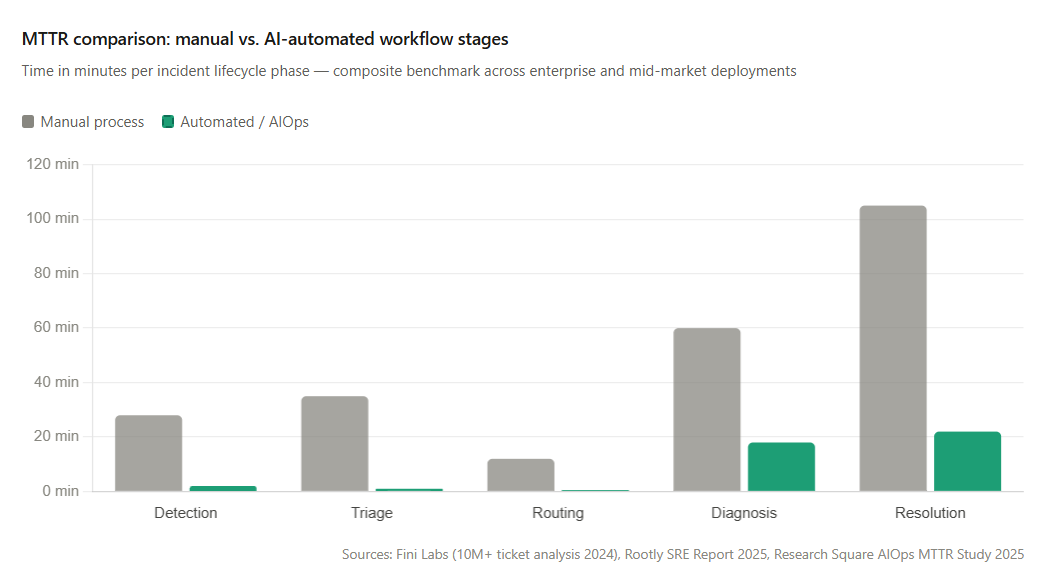
MTTR by lifecycle phase, manual vs. automated (minutes)

  • Detection: 28 min manual → 2 min automated
  • Triage: 35 min manual → 1 min automated
  • Routing: 12 min manual → 0.5 min automated
  • Diagnosis: 60 min manual → 18 min automated
  • Resolution: 105 min manual → 22 min automated
    Sources: Fini Labs (10M+ ticket analysis, 2024), Rootly SRE Report 2025, Research Square AIOps MTTR Study 2025.

Five documented benchmarks worth citing directly:

  1. BT Group case study: MTTR from 2 hours to 85 seconds. One of the most extreme documented examples — a 97% improvement through automated alert correlation and runbook-driven self-resolution.
  2. Microsoft Azure: 97% triage accuracy, 91% reduction in Time-to-Engage. Microsoft’s Triangle system achieved 97% triage accuracy in production, with a 91% reduction in the time it takes an engineer to engage with an incident.
  3. AI triage: under 1 second categorization vs. 3–8 minutes manually. Fini Labs’ analysis of 10M+ tickets across 150+ enterprise deployments found AI triage completes categorization in under 1 second and routing in under 2 seconds, versus 3–8 minutes and 5–12 minutes for human dispatchers — a 99% reduction.
  4. Rootly: AI-driven SRE cuts MTTR by 70%. Rootly’s 2025 benchmark found AI handles “the first 80% of incident response” — log aggregation, metric correlation, runbook surfacing — before human engineers engage.
  5. Uber’s Genie copilot: 13,000 engineering hours saved since September 2023. Translates to measurable headcount leverage without additional hires.

“AI incident agents now handle what incident.io calls the ‘first 80% of incident response’ — aggregating logs, metrics, and traces; identifying related changes; and surfacing relevant runbooks before engineers even engage.”
— Nitish Agarwal, Medium, January 2026 (synthesizing production data from Microsoft, Uber, Netflix deployments)

Cost Per Ticket: The Automation ROI Case

The cost delta between manually handled and automatically resolved tickets is the most direct line from AIOps investment to CFO-legible ROI. The data shows a 12x to 17x cost differential — and for high-volume MSPs, this is transformational math.

The baseline problem: Manual ticket handling costs MSPs an average of $85 per ticket for L1 work, rising to $75–$600 when tickets escalate through L2 and L3 tiers. 67% of MSP tickets are repetitive, low-value tasks. The average technician spends 40% of their day on ticket triage and administrative tasks alone — work that automation can absorb entirely.

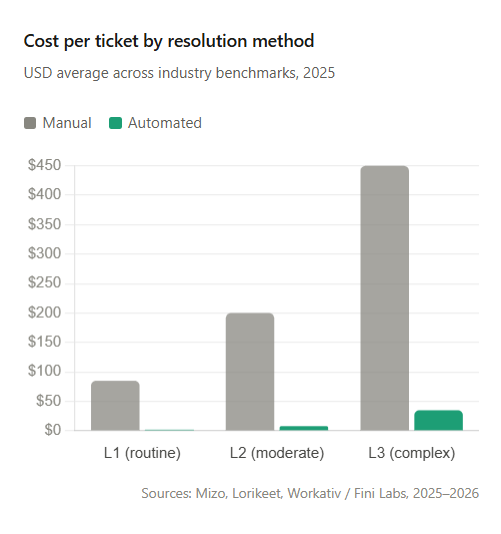
Cost per ticket by resolution method

  • L1: $85 manual → $2 automated
  • L2: $200 manual → $8 automated
  • L3: $450 manual → $35 automated
    Sources: Mizo, Lorikeet, Workativ / Fini Labs, 2025–2026.

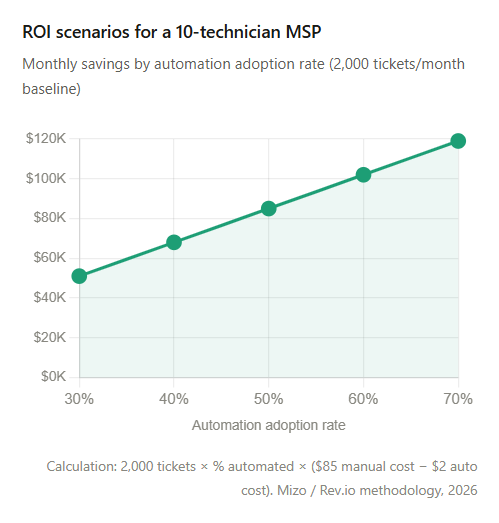
ROI scenarios for a 10-technician MSP

Industry benchmark — cost per ticket by sector:

Industry segment Manual cost/ticket AI-automated cost Potential saving Automation fit
MSP / IT managed services (L1) $85 avg $1–$3 $82–$84 High
SaaS / software internal IT $18–$35 $2–$6 $12–$29 High
B2B enterprise IT support $30–$60 $3–$8 $22–$52 High
Telecom & utilities $20–$30 $2–$5 $15–$25 Moderate–high
L3 escalations (all sectors) $75–$600 $30–$60 (AI-assisted, not full auto) Variable Low (human required)


The sharpest ROI is in L1 ticket automation — password resets, printer connectivity, disk space alerts, software access requests. These account for 67% of MSP ticket volume by typical count and require zero specialist knowledge. Fini Labs’ analysis found AI triage and resolution achieves 80% autonomous resolution rates in mature deployments, with first-year ROI ranging from 920% to 1,947%.

The AI chatbot vs. human cost comparison from Customer Experience Update data compiled by Fullview (2025) quantifies the core delta simply: AI interactions average $0.50 per resolution compared to $6.00 for human-handled interactions — a 12x difference at the per-contact level, before accounting for escalation, overtime, or error costs.

Human Error Reduction in Routine Network Maintenance

Human error is not a peripheral contributor to IT outages — it is the dominant one. The Uptime Institute’s 7th Annual Outage Analysis (2025) and Cisco’s 2025 networking research converge on the same conclusion: most outages are preventable, and automation is the most reliable mechanism for prevention.

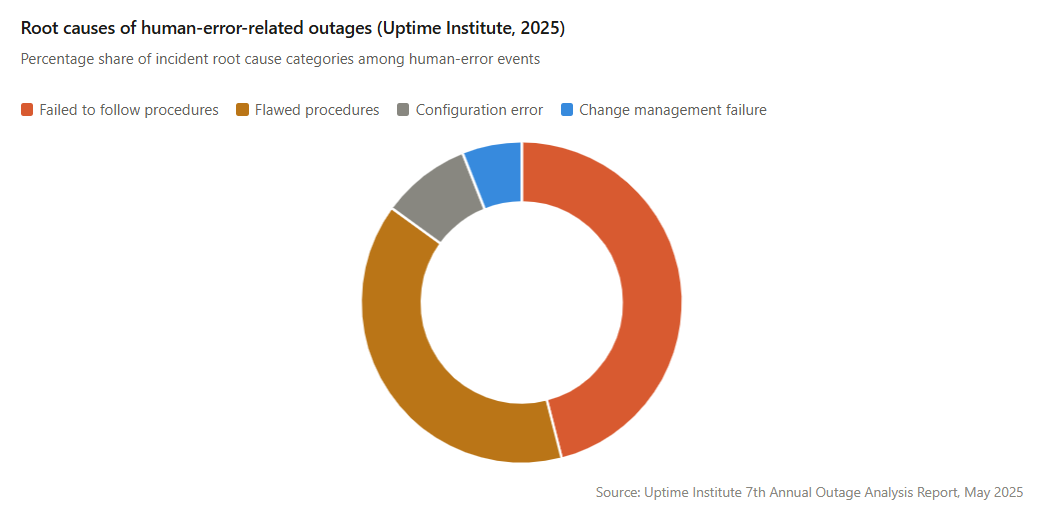
The human error problem: Human error accounts for approximately 80% of all IT outages (Enconnex / CACI, 2025). Nearly 40% of organizations have suffered a major outage caused by human error over the past three years. Of those incidents, 85% stem from staff failing to follow procedures or from flaws in the procedures themselves. In 2025, the proportion of human error-related outages caused by failure to follow procedures rose by ten percentage points vs. 2024.

Root causes of human-error-related outages (Uptime Institute, 2025)

What automation addresses (estimated error reduction by category):

  • Procedure compliance (runbook automation): eliminates ~85% of failure-to-follow errors
  • Configuration management (IaC / automated drift detection): reduces config errors by 60–75%
  • Patch and update automation (RMM-driven): eliminates manual patch scheduling errors (~90%)
  • Change management guardrails (pre-flight checks): prevents the majority of unplanned change failures (~55%)
  • Alert noise reduction (AI correlation): 80–90% alert suppression, reducing decision fatigue

Downtime cost context: The average cost of a single hour of downtime now exceeds $300,000 for over 90% of mid-size and large enterprises (ITIC Hourly Cost of Downtime Study). One in five major outages now costs over $1 million. With human error driving 80% of events, the financial case for automation is immediate.

Frequency reduction: Cisco’s 2025 networking research found 77% of organizations reported major outages over the last two years — with the global economic impact of a single severe disruption extrapolated to $160 billion. Network automation projects achieve ROI within two years in roughly half of deployments, per EMA Research.

The integration of AI into network automation is expected to grow at a 31.2% CAGR from 2025 to 2030, per Verified Market Reports — driven specifically by demand for predictive maintenance and real-time network optimization that removes human decision latency from routine maintenance windows.

Self-Healing Infrastructure: Outcomes & ROI Timelines

Self-healing infrastructure — where systems detect, diagnose, and remediate incidents autonomously without human intervention — is no longer a research concept. It is in production at a growing number of mid-market firms, with measurable outcome data now available from mature deployments.

Key stats:

  • 65% incident resolution time reduction for AIOps self-healing adopters (NeuralWired / Deloitte, 2026)
  • 9–14 months time to full ROI for SMEs adopting AIOps platforms (DataIntelo AIOps Data Centers Market, 2025)
  • 73% of enterprises plan self-healing AIOps adoption by end of 2026 (Gartner Dec 2025 survey of 500+ IT leaders)
  • 30% of enterprises projected to automate 50%+ of network ops by 2026 (Gartner, cited in Motadata, 2026)

AIOps maturity levels & corresponding outcomes

Level Stage What it looks like
Level 1 Monitoring Centralized log/metric collection. No AI. High alert volume, all manual triage.
Level 2 Alert correlation AI deduplicates and groups alerts. 80–85% noise reduction. Still manual resolution.
Level 3 Automated triage ML-driven root cause analysis and routing. 40–50% MTTR reduction. Most MSPs target here.
Level 4 Self-healing Autonomous remediation via runbooks. 65%+ incident resolution reduction. 300% ROI in 18 months.


ROI accumulation timeline by AIOps maturity level

Caution — deployment failure rate: NeuralWired’s 2026 report notes that nearly one in three teams still fail at Level 4 rollout. The recommended approach: deploy in shadow mode for a minimum of two weeks — running autonomous remediation in parallel with production traffic, logging every action without executing it — before enabling live automation. Failures concentrate in misconfigured runbooks and insufficient training data, not technology limitations.

Adoption Maturity & Barriers for Mid-Market Firms

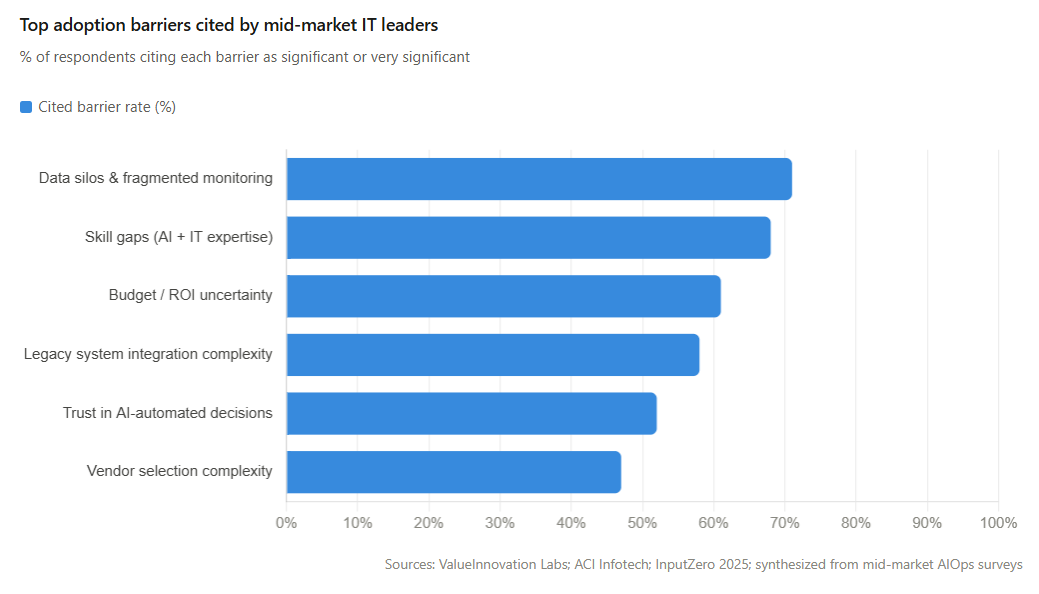
Understanding why 82% of mid-market enterprises have not deployed AIOps is as important as knowing the benefits. The barriers are structural and solvable — and the competitive window for early movers is narrowing.

Top adoption barriers cited by mid-market IT leaders

What separates early movers from laggards

Dimension Laggards (below Level 1) Early movers (Level 2–3) Leaders (Level 4)
Ticket volume trend Growing 3x over 5 years Flat or declining 40–70% below baseline
Technician utilization 40% on triage/admin tasks 15–25% on triage/admin Under 10% on routine tasks
MTTR 2–4+ hours 45–90 minutes Under 30 minutes
Alert fatigue Severe — hundreds daily Managed — correlated feeds Minimal — only actionable
Hiring pressure High — must hire to grow Moderate — partial relief Low — automation absorbs growth
SLA performance Frequent breaches Consistent compliance Proactive: issues resolved pre-SLA


The starting point that works: Industry guidance from InputZero, ValueInnovation Labs, and ACI Infotech consistently recommends the same entry sequence: start with a single high-volume use case (alert noise reduction or password reset automation), establish clean data governance before integration, and expand by maturity level. Most MSPs achieve Level 2 ROI within 6 months of a focused pilot.

Recommended action framework for mid-market IT leaders

  • Baseline your current metrics before any deployment. Track MTTR, tickets per endpoint, repeat ticket rate, technician utilization, and cost per ticket. You cannot demonstrate ROI without a pre-automation baseline. Most ROI claims fail to land because this step was skipped.
  • Select the highest-volume, lowest-complexity ticket category first. Password resets, disk space alerts, printer connectivity, and software access requests are the universal starting point — fully automatable, low-risk, and generating the fastest visible ROI.
  • Clean and centralize your monitoring data first. AIOps platforms are only as good as their data inputs. Data silos and inconsistent naming conventions are the most common technical failure mode. Standardize before integrating AI correlation layers.
  • Run autonomous actions in shadow mode before enabling live automation. For self-healing capabilities specifically, log every action the system would have taken for at least two weeks without executing it. Review with your on-call team. This prevents cascading failures from misconfigured runbooks.
  • Reframe pricing and value delivery around outcomes, not headcount. By 2026, leading MSPs are shifting from per-device or per-hour billing to outcome-based contracts: “reduce downtime by X%,” “maintain 99.9% uptime.” Automation makes these commitments commercially viable — and differentiating.

All statistics sourced from publicly available Tier 1–3 research: Forrester, Research Square, Uptime Institute, Gartner, Mizo, DataIntelo, Rootly, Fini Labs, ITIC, Fortune Business Insights, and peer-reviewed AIOps studies (2025–2026 vintage).

How to Choose the Right Technology Staffing Partner for Enterprise Hiring

When a critical project slips because the right talent isn’t available, the impact goes far beyond recruitment. Product launches are delayed, infrastructure upgrades stall, customer experience suffers, and internal teams stretch themselves too thin trying to bridge the gap.

For CIOs, IT Heads, and Talent Acquisition leaders, choosing a technology staffing partner isn’t just a procurement decision—it’s a business decision. The right partner helps you scale quickly, maintain delivery timelines, and access specialised talent that may not exist within your existing network. The wrong one leaves you chasing resumes instead of results.

Technology staffing services have evolved significantly over the past few years. Today’s enterprises need partners who understand technology, business priorities, and workforce planning equally well.

This guide explores what separates an average staffing vendor from a true technology staffing partner—and the questions every enterprise should ask before making that choice.

Why Enterprise Technology Hiring Is Harder Than It Looks

Most hiring challenges don’t begin with a lack of candidates. They begin with a mismatch between business expectations and hiring realities.

Digital transformation projects demand professionals with specialised expertise across cloud, AI, cybersecurity, SAP, infrastructure, DevOps, data engineering, and application development. These skills are in high demand, making competition fierce and hiring timelines longer.

What makes the situation even more complex is the speed at which technology changes. Job descriptions written six months ago may no longer reflect the skills required today.

Consider a rapidly growing retail enterprise planning a nationwide infrastructure refresh. The project required resident engineers, cloud specialists, and application support teams across multiple cities. Internal recruitment couldn’t source qualified professionals quickly enough, delaying deployment schedules and increasing project costs.

Rather than treating hiring as an isolated HR activity, the organisation partnered with a technology staffing provider that maintained a pre-qualified talent pool, used AI-assisted screening, and had pan-India delivery capabilities. The project stayed on schedule because workforce planning started before resource shortages became a business problem.

This difficulty is magnified for organisations scaling GCCs in India, where the talent race is intensifying faster than most internal recruiting functions can absorb.

Hiring technology talent today requires strategic planning—not reactive recruitment.

The Five Mistakes Enterprises Make When Choosing a Staffing Partner

Many organisations focus primarily on cost. While pricing matters, it shouldn’t be the deciding factor.

Here are the most common mistakes:

1. Choosing General Recruiters for Specialist Roles

Technology hiring requires domain expertise. A recruiter who understands SAP, cloud architecture, cybersecurity, or semiconductor engineering can evaluate candidates far more effectively than someone working across unrelated industries.

2. Ignoring Talent Availability

Ask about the provider’s active talent pool, deployment capabilities, and regional reach. Access to pre-screened professionals significantly reduces hiring timelines.

3. Looking Only at Resume Volume

More resumes don’t mean better hiring. What matters is the percentage of candidates who successfully clear technical interviews and perform well after deployment.

4. Overlooking Governance

Enterprise staffing doesn’t end with onboarding. Workforce governance, attendance tracking, compliance, performance reviews, and customer success all influence long-term outcomes.

5. Treating Staffing as a Transaction

The best staffing partners contribute to workforce planning, skills forecasting, and retention—not just recruitment.

A Practical Framework for Evaluating Technology Staffing Partners

Instead of comparing vendors solely on commercial proposals, evaluate them against five operational capabilities.

1. Technical Understanding

Can they explain the difference between a DevOps Engineer, Site Reliability Engineer, Cloud Architect, and Platform Engineer? Technology expertise matters because it improves candidate quality.

2. Talent Network

Do they maintain active talent communities across infrastructure, cloud, AI, SAP, cybersecurity, data engineering, and application development?

3. Delivery Capability

Can they deploy resources across multiple cities while maintaining consistent service quality?

4. Workforce Governance

Strong staffing partners provide structured governance through regular reviews, performance monitoring, compliance management, and dedicated customer experience teams.

5. Scalability

Your hiring requirements will change. The partner should support permanent hiring, contract staffing, project-based deployment, and specialised resource augmentation without disrupting delivery.

A strong staffing partner should already be sourcing on capability, not resume volume — ask how their screening process reflects the broader shift toward skills-based hiring in IT recruitment before signing an agreement.

These capabilities become increasingly important as organisations scale digital initiatives across India.

What Leading Enterprises Expect Today

Enterprise buyers have become more demanding—and rightly so.

They’re no longer evaluating staffing partners based solely on recruitment speed. They’re looking for providers that improve workforce quality, reduce operational risk, and support long-term business growth.

Increasingly, organisations expect:

  • AI-assisted candidate screening combined with human technical validation
  • Faster access to niche technology skills
  • Transparent governance and reporting
  • Workforce continuity with backup resources
  • Pan-India deployment capability
  • Compliance and documentation support
  • Continuous engagement to improve retention

These expectations reflect a broader shift. Technology staffing is becoming an extension of enterprise delivery rather than a standalone recruitment function.

Leading enterprises now expect staffing partners to use AI-assisted screening as standard practice, not a differentiator. It’s worth understanding how AI is reshaping hiring trends across Indian enterprises before evaluating whether a partner’s process is actually keeping up.

Forward-looking organisations understand that workforce quality directly influences customer experience, project success, and business resilience.

How Do You Know It’s Working?

The success of a technology staffing partnership should be measured using business outcomes rather than recruitment metrics alone.

Key indicators include:

  • Reduction in average hiring time
  • Percentage of positions filled within SLA
  • Candidate interview-to-selection ratio
  • Resource retention after deployment
  • Customer satisfaction scores
  • Project delivery milestones achieved
  • Workforce availability across locations
  • Compliance and governance performance

The most successful partnerships create measurable improvements across all these areas rather than focusing on recruitment volume alone.

Looking Ahead

Technology hiring will only become more specialised as enterprises expand AI, cloud, cybersecurity, semiconductor, and digital transformation initiatives. Organisations that choose staffing partners based solely on cost may save money initially but often pay more through delayed projects, repeated hiring cycles, and inconsistent workforce quality.

Before selecting your next technology staffing partner:

  • Evaluate their technical expertise—not just recruitment experience.
  • Review their governance model alongside hiring capabilities.
  • Ask for evidence of pan-India delivery and specialised talent availability.
  • Measure long-term business outcomes rather than placement numbers alone.

Choosing the right technology staffing partner is ultimately about enabling business growth. The organisations that invest in strong hiring partnerships today will be better positioned to execute tomorrow’s technology priorities.

Get Access to Technology Talent That Keeps Projects Moving

Whether you’re hiring for cloud, AI, cybersecurity, SAP, infrastructure, or application development, the right staffing strategy can reduce hiring delays and improve delivery outcomes. Team Computers helps enterprises build high-performing technology teams through specialised staffing, structured governance, and pan-India deployment capabilities.

Speak with a Technology Staffing Specialist

AI Hiring Trends in India Are Changing Enterprise Recruitment Faster Than Most Leaders Expected

Every hiring plan looks good on paper—until the right candidate never appears.

Across India, enterprise technology teams are discovering the same challenge. Open positions remain vacant for months, salary expectations continue to rise, and the skills needed for today’s digital projects often didn’t exist just a few years ago. Hiring has become less about filling vacancies and more about competing for capabilities.

AI hiring trends in India aren’t simply changing recruitment. They’re changing how organisations build technology teams, how projects are delivered, and how competitive businesses remain over the next five years.

If you’re responsible for technology hiring, the question is no longer whether AI will influence your recruitment strategy. It’s whether your organisation is adapting quickly enough.

By the end of this article, you’ll understand what’s driving these changes, why traditional hiring models are struggling, and what leading Indian enterprises are doing differently.

The Conventional Wisdom Says AI Will Replace Recruiters. That’s Missing the Bigger Picture.

Many discussions around AI hiring begin with automation.

Automated resume screening.
AI-generated interview questions.
Chatbots for candidate communication.

Those tools certainly improve efficiency, but they’re only solving a small part of the problem.

The real shift is happening because technology itself is changing.

Companies are investing heavily in cloud platforms, cybersecurity, data engineering, AI applications, semiconductor design and enterprise automation. As these investments grow, the definition of a “qualified candidate” changes almost every quarter.

A Java developer today may also need experience with cloud-native architectures.

A network engineer may be expected to understand Zero Trust principles.

A data engineer increasingly needs familiarity with Large Language Models and AI infrastructure.

Hiring teams can’t rely solely on historical job descriptions anymore.

Instead, they’re evaluating adjacent skills, learning potential, and practical problem-solving ability alongside technical expertise.

That’s where AI becomes valuable—not because it replaces recruiters, but because it helps identify talent patterns that traditional screening often misses.

What the Market Is Actually Telling Us

India continues to strengthen its position as one of the world’s largest technology talent hubs.

The rapid expansion of Global Capability Centres (GCCs), increased investment in digital transformation, and widespread adoption of AI are creating demand across almost every technology function.

AI’s real value isn’t automation for its own sake, it’s better signal. Used well, it complements a broader move toward skills-based hiring over resume-based screening, helping recruiters validate capability faster instead of replacing human judgment altogether.

What’s becoming increasingly clear is that demand isn’t rising evenly.

Today’s enterprise hiring priorities include:

  • AI and Machine Learning Engineers
  • Data Engineers
  • Cloud Architects
  • DevOps Engineers
  • Cybersecurity Specialists
  • SAP Consultants
  • Platform Engineers
  • Site Reliability Engineers
  • Semiconductor Design Engineers

Meanwhile, hiring timelines continue to extend because experienced professionals often receive multiple competing offers.

For hiring leaders, the shortage isn’t simply about numbers.

It’s about finding candidates who can contribute immediately while remaining adaptable as technologies evolve.

Forward-Thinking Enterprises Are Building Talent Pipelines, Not Just Filling Positions

Here’s a pattern we’re seeing repeatedly.

A large enterprise begins a cloud migration programme expecting to hire fifty specialists over six months.

The internal recruitment team starts sourcing candidates after project approval.

Three months later, only a fraction of positions have been filled.

Delivery timelines begin slipping.

Project costs increase.

Business stakeholders lose confidence.

Contrast that with organisations that begin workforce planning before hiring officially starts.

Instead of reacting to demand, they continuously assess emerging skill requirements, maintain talent communities, pre-validate specialist candidates, and combine AI screening with experienced technical evaluation.

One large enterprise that partnered with Team Computers significantly reduced hiring delays by combining AI-assisted screening with structured technical assessments and dedicated governance, allowing projects to move faster while maintaining hiring quality.

The lesson isn’t that AI solves hiring.

It’s that preparation beats reaction every time.

Why India Presents a Different Challenge

India offers one of the world’s deepest technology talent pools.

It also has one of the fastest-changing demand landscapes.

Global Capability Centres continue expanding into cities beyond Bengaluru and Hyderabad.

Domestic enterprises are accelerating digital transformation.

Government initiatives supporting electronics manufacturing and semiconductor investments are creating entirely new talent requirements.

India’s hiring pressure is compounded by scale: GCCs are competing for the same specialised talent pool across engineering, AI, and cybersecurity roles, often in the same three or four cities.

At the same time, regulations such as the Digital Personal Data Protection (DPDP) Act are increasing demand for cybersecurity, governance and compliance specialists.

These shifts mean hiring strategies designed three years ago are already becoming outdated.

Technology leaders now need hiring partners who understand regional talent availability, salary movements, emerging skill clusters and enterprise delivery expectations—not simply recruitment processes.

That’s becoming a competitive advantage.

The Organisations Winning the Talent Race Think Beyond Recruitment

Perhaps the biggest misconception is believing recruitment ends once an offer is accepted.

The strongest technology organisations think much further ahead.

They invest in continuous learning.

They measure deployment quality.

They plan for retention from day one.

They build governance into workforce delivery.

Most importantly, they recognise that technology hiring has become an operational capability—not merely an HR function.

That’s why AI should be viewed as an accelerator rather than a replacement for experienced hiring professionals.

Technology changes too quickly for algorithms alone to understand context.

People still make the difference.

The best hiring strategies simply help those people make better decisions faster.

Looking Ahead

Technology hiring in India will become even more specialised over the next few years. Organisations that wait until a critical project begins before thinking about talent will continue to face delays, higher costs and increased competition for the same limited skill pools.

A few practical actions can make an immediate difference:

  • Audit your hiring roadmap against the skills your technology strategy will require over the next 12 months.
  • Build relationships with specialised technology staffing partners before urgent hiring needs arise.
  • Evaluate candidates for adjacent capabilities and learning agility, not just current technical expertise.
  • Combine AI-assisted screening with experienced technical assessments to improve hiring quality.

AI hiring trends in India are reshaping how enterprises compete for technology talent. The organisations that adapt early won’t simply hire faster—they’ll build teams capable of delivering tomorrow’s business priorities while others are still searching for candidates.

Get Faster Access to Enterprise Technology Talent

Adopting AI-assisted screening internally only solves part of the problem. The other half is partnering with a staffing provider built for this scale, one that pairs AI-driven sourcing with governance and delivery capability across regions.

Whether you’re scaling a GCC, expanding your cloud practice, or hiring for specialised technology roles, having the right hiring strategy matters as much as finding the right people. Team Computers helps enterprises identify, assess and deploy technology professionals across infrastructure, cloud, cybersecurity, SAP, AI, data engineering and application development.

Talk to a Technology Staffing Expert