
Why CISOs Are Re-Evaluating Apple Security for the Modern Enterprise

For years, enterprise endpoint security discussions followed a familiar pattern. Firewalls became stronger, endpoint detection tools became smarter, and identity platforms became more sophisticated. Yet security incidents continued to evolve, targeting the endpoint where employees access business-critical applications and sensitive data every day.

That’s changing the conversation inside boardrooms.

Today’s CISOs aren’t asking only which security software they should deploy. They’re asking whether the endpoint itself can reduce risk before additional security controls are even applied.

This shift is one reason Apple devices are receiving renewed attention across Indian enterprises. The discussion is no longer centred on design preferences or employee choice. Instead, it’s focused on how hardware, operating systems, identity, and device management work together to create a stronger security posture.

At Team Computers, we’ve worked with organisations across banking, healthcare, manufacturing, consulting, and Global Capability Centers (GCCs) to implement Apple environments that align with enterprise security frameworks. The organisations making the most progress aren’t replacing existing security investments—they’re strengthening the endpoint that sits at the heart of modern work.

Enterprise security has moved beyond antivirus

Not long ago, endpoint security was largely reactive. Devices were protected by antivirus software, periodic patching, and network-based controls.

Hybrid work changed that model.

Employees now work from homes, airports, customer sites, and branch offices. Business applications live in the cloud, identities authenticate from multiple locations, and corporate data moves across different devices throughout the day.

The traditional network perimeter has become less relevant.

Instead, every endpoint has become part of the security perimeter.

For CISOs, this changes the priority from simply detecting threats to reducing the attack surface itself.

That means evaluating:

  • How securely a device starts up
  • How data is protected if a device is lost or stolen
  • How identities are verified before access is granted
  • How devices remain compliant throughout their lifecycle
  • How quickly policies can be enforced across thousands of endpoints

Apple’s enterprise approach aligns well with this shift because security is designed across hardware, software, and management rather than relying on a single defensive layer.

Why security architecture matters more than individual features

Many technology evaluations focus on checklists. Does the device support encryption? Can it be remotely managed? Is multifactor authentication available?

While these capabilities are important, CISOs increasingly look beyond individual features.

What matters is how those controls work together.

Apple’s security architecture is built on multiple integrated layers, including hardware-based protections, secure operating system design, encryption, application controls, identity integration, and enterprise management.

The value isn’t found in any one capability.

It’s found in how those capabilities reinforce one another.

When encryption, identity, device compliance, and policy enforcement operate as part of a unified architecture, organisations reduce opportunities for configuration gaps and inconsistent security practices.

From our experience at Team Computers, enterprises that treat Apple as part of a broader security ecosystem—not just another endpoint—achieve stronger governance with less operational complexity.

Identity has become the new security perimeter

One of the biggest changes in enterprise security is the growing importance of identity.

Employees no longer connect only from trusted office networks. They access business systems from wherever work happens.

Because of this, verifying the user—and the device they’re using—has become fundamental.

Modern Apple deployments can integrate with enterprise identity platforms to support secure authentication, conditional access, and policy-based controls.

This allows organisations to make access decisions based not only on user credentials but also on the security posture of the device itself.

For CISOs, that means security becomes proactive rather than reactive.

Instead of waiting for a threat to be detected, organisations can prevent access when devices fail to meet compliance requirements.

Identity, device trust, and policy enforcement work together to strengthen enterprise security.

Security doesn’t end with the device—it extends to management

Even the most secure endpoint can introduce risk if it isn’t deployed or managed consistently.

This is why enterprise security depends as much on operational discipline as it does on technology.

Questions CISOs should be asking include:

  • Are devices enrolled into management from day one?
  • Are security policies applied automatically?
  • Can devices be remotely locked or wiped if they’re lost?
  • Is encryption enforced across the fleet?
  • Are software updates managed consistently?
  • Can compliance be monitored in real time?

At Team Computers, we help organisations implement Apple Business Manager, zero-touch deployment, and enterprise MDM solutions so that security controls are applied automatically from the moment a device is activated. This reduces manual intervention, improves consistency, and helps IT teams maintain governance at scale.

Your Employees Already Want Macs. Here’s How Enterprise IT Is Responding

A few years ago, employees had little say in the laptops they used. IT teams selected a standard device, procurement purchased it in bulk, and every new employee received the same machine on their first day.

That model is changing.

Today’s workforce expects technology that matches the way they work. Whether it’s software developers, designers, consultants, senior executives, or customer-facing teams, many employees are actively asking for Macs—not because they’re fashionable, but because they believe they’ll be more productive using the tools they’re already comfortable with.

For CIOs and IT leaders, this presents a new challenge. Supporting employee choice without increasing security risks, management complexity, or operational costs isn’t as simple as approving a different laptop.

The conversation is no longer about giving employees what they want. It’s about creating a workplace where employee experience and enterprise governance can exist together.

At Team Computers, we’ve seen this shift across enterprises in BFSI, IT services, GCCs, healthcare, manufacturing, and consulting. Organisations that respond strategically to employee demand aren’t creating exceptions—they’re building modern workplace strategies that improve productivity while keeping IT firmly in control.

Employee expectations have changed—and enterprise IT is adapting

Think about how employees work today.

A software engineer collaborates across multiple time zones. A consultant spends half the week with clients. A sales leader joins meetings from airports and hotels. A designer moves between creative applications while collaborating with distributed teams.

The device has become the primary workplace.

Employees no longer compare workplace technology only with what other companies provide. They compare it with the experience they have using technology in their personal lives.

That’s one of the reasons Mac adoption continues to grow in enterprise environments.

When employees believe a device helps them work more efficiently, they become more engaged with it.

For IT leaders, however, the challenge isn’t simply choosing between Windows and Mac.

It’s answering bigger questions.

  • How do we support employee choice without increasing support tickets?
  • Can Apple devices integrate with existing enterprise systems?
  • Will security become more complicated?
  • How do we manage devices consistently across thousands of employees?
  • Can procurement support multiple endpoint strategies without increasing operational complexity?

These questions deserve strategic answers—not assumptions.

Why employees are asking for Macs

The reasons vary by role, but the underlying theme is remarkably consistent.

Employees want technology that helps them do their best work.

They want fewer interruptions

Modern work is continuous.

Employees move between email, meetings, collaboration platforms, presentations, spreadsheets, and customer conversations throughout the day.

Every delay, reboot, or performance issue interrupts momentum.

Many employees believe Macs provide a smoother day-to-day experience, particularly when handling multiple workflows simultaneously.

They already know the platform

For many professionals, especially younger employees entering the workforce, Apple devices are already familiar.

That familiarity reduces onboarding friction and helps new hires become productive more quickly.

Hybrid work has changed expectations

Employees no longer spend every working hour inside a corporate office.

They’re working from home, client locations, airports, and coworking spaces.

They expect a device that performs consistently wherever work happens.

The workplace has become mobile.

The endpoint has become critical.

Employee experience has become a competitive advantage

In highly competitive industries such as technology, consulting, financial services, and Global Capability Centers (GCCs), workplace technology increasingly influences employer branding.

While compensation, career growth, and culture remain the biggest factors in attracting talent, providing employees with the tools they prefer can contribute to a stronger workplace experience.

Forward-looking CIOs recognise that endpoint strategy is becoming part of the broader employee value proposition.

Why IT doesn’t simply say “yes”

If employees are asking for Macs, why don’t organisations immediately approve them?

Because IT has responsibilities that employees rarely see.

Every new device affects:

  • Security policies
  • Identity management
  • Device provisioning
  • Software deployment
  • Compliance
  • Support operations
  • Lifecycle management
  • Procurement
  • Asset tracking

Introducing a new endpoint platform without planning can create operational complexity.

That’s why successful enterprises don’t respond by purchasing devices.

They respond by building an Apple strategy.

At Team Computers, we often begin these conversations by understanding the organisation’s existing workplace architecture. Apple adoption should strengthen enterprise operations—not create parallel IT environments.

When implemented thoughtfully, Macs become part of the same governed workplace ecosystem, integrated with enterprise identity, security policies, and device management frameworks.

Smart enterprises aren’t offering Macs to everyone

One of the biggest misconceptions is that adopting Apple means replacing every Windows laptop.

In practice, most organisations take a far more strategic approach.

They begin with employee groups where Macs deliver the greatest business value.

Common starting points include:

  • Software development teams
  • Design and creative professionals
  • Product management teams
  • Senior leadership
  • Consulting and client-facing teams
  • Engineering and innovation groups

This phased approach allows IT to refine deployment processes, security policies, user support, and lifecycle management before expanding to additional departments.

It’s a practical strategy that balances flexibility with operational control.

The Hidden Cost of Delayed Technology Hiring (It’s More Than Vacant Positions)

A cloud migration was scheduled to go live in the second quarter. The infrastructure was ready, the budget had been approved, and executive stakeholders expected the project to stay on track.

Six months later, the migration still hadn’t started.

The reason wasn’t funding, technology, or vendor delays. The organisation simply couldn’t hire experienced cloud engineers quickly enough.

Most enterprises measure hiring delays by counting vacant positions. In reality, the true cost is much greater. Every unfilled technology role can slow projects, increase operational risk, overburden existing teams, and postpone business outcomes that leadership is counting on.

As digital transformation accelerates across India, delayed technology hiring has become more than a recruitment challenge. It’s a business performance issue that affects revenue, innovation, customer experience, and competitive advantage.

Every Vacant Role Creates a Ripple Effect

Technology teams rarely work in isolation.

When one critical position remains vacant, the impact spreads across multiple departments.

A missing Cloud Architect delays infrastructure planning.

Without infrastructure planning, application migration slows.

Project managers adjust delivery timelines.

Business teams postpone launches.

Customers wait longer for new capabilities.

The delay rarely appears as a single hiring metric. Instead, it quietly affects productivity across the organisation.

Consider an enterprise implementing SAP S/4HANA across multiple business units. While most technical positions were filled, the organisation struggled to hire experienced SAP Basis consultants. As a result, testing schedules slipped, infrastructure validation was delayed, and business users had less time for training before go-live.

The project eventually succeeded, but months of avoidable delays increased costs and placed additional pressure on internal teams.

Technology hiring doesn’t simply fill vacancies—it enables business execution.

The Financial Impact Often Goes Unnoticed

Many organisations calculate recruitment costs carefully.

Far fewer calculate the cost of waiting.

Every month that a specialist role remains open can create hidden expenses, including:

  • Delayed project delivery
  • Increased contractor costs
  • Overtime for existing employees
  • Reduced productivity
  • Lost revenue opportunities
  • Higher employee burnout
  • Increased attrition among overloaded teams

For customer-facing technology initiatives, delays may also affect client satisfaction and business reputation.

These indirect costs often exceed the recruitment budget itself.

Why Hiring Takes Longer Than It Used To

Technology recruitment has changed dramatically over the past five years.

Enterprise hiring teams are no longer searching for general IT professionals.

They’re competing for specialists in:

  • Artificial Intelligence
  • Cybersecurity
  • Cloud Architecture
  • SAP
  • Platform Engineering
  • DevOps
  • Data Engineering
  • Full Stack Development
  • Site Reliability Engineering
  • Enterprise Infrastructure

These professionals are highly sought after across startups, Global Capability Centres (GCCs), consulting firms, product companies, and multinational enterprises.

Many candidates receive multiple offers within days.

Others aren’t actively applying for jobs at all.

Traditional recruitment methods often struggle to engage this talent pool before competitors do.

That’s why reducing hiring delays requires more than increasing recruitment activity—it requires improving hiring strategy.

How Leading Enterprises Reduce Hiring Delays

Organisations that consistently deliver technology projects on time don’t wait until vacancies arise.

They build workforce readiness into business planning.

Common practices include:

Workforce Forecasting

Hiring plans are created alongside technology roadmaps rather than after project approval.

Continuous Talent Pipelines

Relationships with specialist professionals begin months before hiring demand peaks.

Specialist Staffing Partners

Technology staffing partners maintain active networks of pre-qualified professionals, helping enterprises reduce sourcing time.

Faster Technical Validation

Structured technical assessments reduce interview cycles while improving hiring quality.

Flexible Workforce Models

Contract staffing, staff augmentation, and project-based hiring help organisations respond quickly to changing project priorities.

These strategies reduce hiring delays while improving workforce quality.

Why This Matters More in India

India remains one of the world’s largest technology talent markets, yet competition has never been greater.

Global Capability Centres continue expanding their engineering operations.

Digital transformation initiatives are increasing across BFSI, healthcare, manufacturing, telecom, retail, and public sector organisations.

Emerging technologies such as AI, semiconductor design, cloud engineering, and cybersecurity are creating demand for specialised capabilities that remain difficult to source.

Organisations that continue treating recruitment as an isolated HR activity risk falling behind competitors that integrate workforce planning into business strategy.

The hiring market is moving faster than traditional recruitment processes.

Business planning needs to keep pace.

Looking Ahead

Technology projects rarely fail because organisations lack ambition. More often, they lose momentum because the right expertise isn’t available when it’s needed.

Reducing hiring delays isn’t about filling positions faster—it’s about enabling business outcomes with greater confidence.

Before your next transformation initiative:

  • Forecast technology hiring requirements at least six months before project kickoff.
  • Build talent pipelines for specialised roles instead of recruiting reactively.
  • Review time-to-hire metrics alongside project delivery milestones.
  • Consider flexible staffing models for short-term, high-impact initiatives.

The organisations that move fastest over the next decade won’t simply adopt new technologies. They’ll build workforce strategies that ensure the right talent is available when opportunity arrives.

Accelerate Your Technology Hiring Without Compromising Quality

Building high-performing technology teams requires speed, expertise, and access to the right talent network. Team Computers helps enterprises reduce hiring timelines through specialised technology staffing, pre-assessed professionals, workforce planning, and flexible engagement models across cloud, AI, cybersecurity, SAP, infrastructure, and application development.

Accelerate My Technology Hiring

Apple Security for Enterprises: What CISOs and IT Security Leaders in India Should Really Be Evaluating

A CISO at a large Indian BFSI organisation recently asked a simple question in a security review meeting: “We’ve standardised on multiple device platforms. But which one actually reduces risk at the endpoint?”

The room went quiet for a moment.

Not because there was no answer—but because the answer wasn’t straightforward.

Most enterprises today don’t struggle with buying devices. They struggle with understanding what those devices mean for their security posture once they enter production environments, hybrid work setups, and distributed access models.

For CISOs and IT security leaders, Apple devices are often evaluated through two conflicting lenses: strong user experience versus perceived enterprise control limitations.

But that framing is outdated.

Modern Apple security for enterprises is not about comparing devices. It’s about evaluating how well identity, encryption, policy enforcement, and lifecycle governance come together at scale.

At Team Computers, we’ve worked with enterprise security teams across India to design Apple-first environments where security is not layered on later—it is built into deployment, access, and lifecycle from day one.

This guide breaks down what matters when evaluating Apple’s security posture in enterprise environments.

Why enterprise device security is no longer just endpoint protection

Traditional endpoint security models were built around a simple assumption: devices stay inside controlled networks.

That assumption no longer holds.

Today’s workforce operates across:

  • Remote environments
  • Client locations
  • Hybrid offices
  • Personal networks
  • Cloud-first applications

This shift has changed the security perimeter entirely.

Instead of securing a network boundary, CISOs now secure identity, access, and devices that move constantly.

In this model, device security is not just about antivirus or firewalls. It is about:

  • Encryption at rest
  • Identity-based access control
  • Device compliance enforcement
  • Remote management capabilities
  • Secure onboarding and offboarding

From our experience at Team Computers, enterprises that treat device security as part of identity and lifecycle management—not just endpoint protection—achieve significantly better control and lower operational risk.

Security is no longer a product layer.

It is an architecture decision.

How Apple approaches enterprise security differently

Apple’s enterprise security model is built on a layered approach that integrates hardware, software, and services.

Instead of relying on a single control point, Apple distributes security across multiple layers:

  • Hardware-level security
  • OS-level protection
  • Encryption mechanisms
  • Identity-based access control
  • Managed device policies

For CISOs, the key evaluation point is not whether Apple devices are “secure,” but how security is enforced consistently across scale.

Apple’s model assumes that devices may operate outside traditional networks, which aligns well with modern enterprise environments in India where hybrid work is now standard across BFSI, IT services, GCCs, and manufacturing sectors.

However, security effectiveness depends heavily on how these capabilities are implemented—not just whether they exist.

This is where enterprise execution becomes critical.

File-level and disk-level encryption as a baseline control

One of the foundational elements of Apple enterprise security is full-disk encryption.

Encryption ensures that if a device is lost, stolen, or accessed without authorization, data remains protected.

But encryption alone is not enough.

CISOs need to evaluate:

  • Whether encryption is enforced across all devices
  • How recovery keys are managed
  • Whether encryption status is continuously monitored
  • How compliance is verified at scale

In many enterprises, encryption exists in policy but not in enforcement.

That gap creates risk.

At Team Computers, encryption policies are typically integrated into the device provisioning stage itself, ensuring that devices are compliant before they reach end users. This eliminates inconsistency between policy and execution.

Identity: the real control layer in Apple enterprise security

Modern enterprise security is identity-driven.

Devices do not grant access—identities do.

Apple environments integrate with enterprise identity platforms to ensure that:

  • Only authenticated users access corporate resources
  • Conditional access policies are enforced
  • Risk-based access decisions can be applied
  • Device compliance becomes part of login behavior

For CISOs, this shift is critical.

Instead of focusing only on securing devices, security teams can enforce policies at the point of access.

From what we see across enterprise deployments at Team Computers, identity integration is often the difference between “controlled security” and “fragmented security.”

Without identity at the center, device security remains incomplete.

Mobile Device Management (MDM) as the enforcement engine

MDM is where policy becomes operational.

It allows enterprises to enforce security standards across Apple devices at scale, including:

  • OS version compliance
  • Application control
  • Network configurations
  • Encryption enforcement
  • Remote lock and wipe
  • Certificate-based access

However, the effectiveness of MDM depends on design quality.

Common enterprise gaps include:

  • Overly restrictive policies that reduce adoption
  • Inconsistent configurations across departments
  • Lack of lifecycle alignment
  • Poor visibility into compliance status

At Team Computers, MDM design is typically role-based rather than device-based. This ensures security policies align with how employees actually work, without creating operational friction.

The goal is not control for its own sake.

It is consistent enforcement without complexity.

Zero-touch deployment and security at onboarding

One of the most overlooked security risks in enterprises is device onboarding.

Manual setup introduces inconsistencies such as:

  • Missing encryption
  • Incorrect configurations
  • Delayed policy enforcement
  • Application gaps

Zero-touch deployment eliminates this risk by ensuring devices are:

  • Pre-registered in enterprise systems
  • Automatically enrolled into MDM
  • Configured with security policies on first boot
  • Assigned identity-based access immediately

This means security is not applied later—it is enforced from the moment the device is activated.

At scale, this becomes a major risk reduction mechanism.

What CISOs should actually evaluate in Apple security posture

When assessing Apple security for enterprises, the right questions are not about features—they are about execution.

Key evaluation areas include:

  • Is encryption enforced consistently across all devices?
  • Is identity the primary access control layer?
  • Are MDM policies role-based and scalable?
  • Can devices be remotely managed and wiped securely?
  • Is onboarding automated and policy-driven?
  • Is compliance continuously monitored, not periodically checked?

From our work with Indian enterprises at Team Computers, the organisations that mature fastest in Apple security are those that shift from “tool evaluation” to “architecture evaluation.”

They stop asking what the device can do.

They start asking how the ecosystem behaves at scale.

Where most enterprise Apple security strategies fail

The most common failure point is fragmentation.

Security is often split across teams:

  • Endpoint security team manages devices
  • Identity team manages authentication
  • IT operations manages deployment
  • Security team defines policies

Without integration, gaps appear between these layers.

Apple environments perform best when these systems are unified into a single operational model.

That alignment is where implementation expertise becomes critical.

The Team Computers approach to Apple enterprise security

At Team Computers, we focus on building Apple security environments that align with enterprise-scale governance, not isolated device deployment.

Our approach typically includes:

  • Apple Business Manager setup and integration
  • Zero-touch deployment architecture
  • MDM policy design based on business roles
  • FileVault and encryption enforcement frameworks
  • Identity and access integration planning
  • Lifecycle management from onboarding to retirement
  • Continuous compliance monitoring support

The objective is not just deploying Apple devices into enterprises.

It is ensuring they remain secure, compliant, and manageable throughout their lifecycle.

For CISOs, this shifts Apple from being a “device decision” to a “managed security ecosystem.”

Conclusion

Apple’s enterprise security model is built for a world where work is mobile, distributed, and identity-driven.

But security strength is not determined by devices alone.

It is determined by how well encryption, identity, policy enforcement, and lifecycle management are integrated into enterprise operations.

For CISOs and IT security leaders in India, the evaluation should focus less on device comparisons and more on architecture alignment.

Here’s what matters most:

  • Enforce encryption as a baseline, not an option
  • Make identity the primary access control layer
  • Ensure MDM policies are role-based and consistent
  • Automate onboarding through zero-touch deployment
  • Treat security as a lifecycle, not a configuration

When these elements come together, Apple devices become part of a controlled, predictable, and secure enterprise environment.

At Team Computers, we help organisations design and operationalise Apple enterprise security frameworks that scale across thousands of devices while maintaining governance and compliance.

Because in modern enterprises, security is not about locking devices.

It is about controlling access, identity, and lifecycle—at scale.

Why CIOs Are Quietly Moving Their Leadership Teams to Mac

Most enterprise-wide technology transformations don’t begin with thousands of employees.

They begin with a handful of executives.

Across Indian enterprises, a subtle shift is taking place. CIOs aren’t replacing every Windows laptop overnight. Instead, many are starting with their leadership teams—CEOs, CFOs, business unit heads, sales directors, and CXOs—before expanding Apple adoption across the organisation.

It isn’t about offering premium devices to senior leaders.

It’s about enabling faster decision-making, strengthening security for high-value users, and creating a workplace experience that reflects how modern businesses operate.

Leadership teams spend their day switching between meetings, presentations, approvals, travel, customer engagements, and strategic planning. Their devices are no longer just productivity tools—they’re business continuity tools.

At Team Computers, we’ve seen this pattern emerge across industries, from Global Capability Centers (GCCs) and IT services to financial services, consulting, healthcare, and manufacturing. The organisations seeing the greatest success aren’t asking whether Apple belongs in the enterprise. They’re asking where Apple delivers the greatest business impact first.

For many, that journey starts with leadership.

Leadership productivity has become an enterprise priority

Executive teams don’t work like the average employee.

Their day isn’t spent inside one application or one office.

A typical day for a CEO or business leader may involve:

  • Reviewing financial dashboards before arriving at work
  • Joining virtual meetings from multiple locations
  • Approving contracts while travelling
  • Responding to customers between board meetings
  • Collaborating with global teams across different time zones
  • Presenting business strategy to investors or clients

Every interruption matters.

When devices take longer to boot, struggle under heavy workloads, or require frequent IT intervention, the impact extends beyond individual productivity. Delayed decisions can slow projects, customer commitments, and business momentum.

That’s why CIOs increasingly evaluate endpoints not only through technical specifications but also through the experience they deliver to business leaders.

From our experience at Team Computers, organisations that align technology decisions with executive workflows often see broader digital adoption follow naturally. Leadership teams become early adopters, creating confidence for wider enterprise rollouts.

Technology decisions are no longer judged solely on hardware performance. They’re measured by how effectively they support the people making the organisation’s most critical decisions.

Why leadership teams are often the first to transition

Rolling out a new device strategy across an entire enterprise can be complex.

Starting with leadership creates a controlled environment where organisations can evaluate business outcomes before scaling further.

We’ve seen several practical reasons why CIOs choose this approach.

Executive mobility has changed dramatically

Senior leaders work from airports, client offices, hotels, boardrooms, and home offices—often within the same week.

Their device needs to transition effortlessly between locations while maintaining secure access to corporate applications, collaboration tools, and business data.

The objective isn’t simply mobility.

It’s uninterrupted productivity.

Security risks are highest at the executive level

Executives have access to financial reports, merger discussions, customer information, board communications, and confidential business strategy.

These users naturally become attractive targets for cyber threats.

Rather than relying solely on additional security software, many organisations are strengthening endpoint security through built-in platform capabilities, centralised management, and policy-driven governance.

For CISOs and CIOs, protecting executive devices has become a business priority—not just an IT responsibility.

Employee experience starts at the top

Leadership influences workplace culture more than any policy document.

When executives actively use modern workplace technologies, adoption across departments becomes significantly easier.

Employees notice.

IT gains executive sponsorship.

Transformation accelerates.

We’ve observed this consistently in Apple deployments led by Team Computers. Organisations that begin with executive users often experience smoother adoption during broader enterprise rollouts because leadership has already validated the experience.

Apple is becoming part of the executive workplace—not just the device strategy

One of the biggest misconceptions in enterprise IT is that organisations adopt Macs simply because senior leaders prefer them.

In reality, successful deployments are driven by business outcomes.

Today’s executive teams expect their technology to work seamlessly across meetings, travel, collaboration, and decision-making. They don’t have time to troubleshoot devices or wait for routine IT interventions.

Apple’s enterprise ecosystem supports this expectation by combining hardware, operating system, and enterprise management capabilities into a consistent workplace experience.

When integrated with enterprise services such as identity management, collaboration platforms, and secure device management, Macs become part of a broader digital workplace strategy rather than isolated endpoints.

At Team Computers, we help organisations build that strategy. Beyond device procurement, we work with enterprises to design Apple-first workplace environments that include Apple Business Manager integration, zero-touch deployment, lifecycle services, enterprise financing options, device management, and ongoing support. The result is a workplace where leadership teams can focus on business priorities while IT maintains governance and visibility.

It’s not about replacing every laptop

One of the most successful approaches we’ve seen is incremental adoption.

Rarely do enterprises begin by replacing every endpoint.

Instead, they identify user groups where the business value is highest.

Leadership teams often fit that profile because:

  • They handle business-critical decisions every day.
  • Their productivity has a direct impact on organisational outcomes.
  • They require secure access from multiple locations.
  • They frequently represent the organisation in front of customers, partners, and investors.

Starting with these users allows IT teams to validate deployment models, security policies, support processes, and employee experience before expanding to additional business functions.

It’s a measured strategy that reduces risk while building confidence across the organisation.

The Technology Skills Gap Is Growing. Here’s How Smart Enterprises Are Responding.

Your next technology project probably isn’t waiting for funding.

It’s waiting for people.

Across Indian enterprises, digital transformation programs are accelerating. Organizations are modernizing infrastructure, migrating to the cloud, strengthening cybersecurity, adopting AI, and building data-driven applications. Yet despite increased investments in technology, many initiatives are progressing slower than expected for one simple reason: the right talent isn’t available when it’s needed.

The technology skills gap in India has become one of the biggest barriers to enterprise growth. It’s no longer just an HR challenge—it affects project delivery, customer experience, operational efficiency, and competitive advantage.

For CIOs, CHROs, and business leaders, the question isn’t whether the skills gap exists. It’s how quickly they can adapt their workforce strategy to overcome it.

Why the Skills Gap Keeps Widening

Technology evolves faster than traditional hiring models.

A decade ago, organizations primarily recruited for infrastructure support, networking, database administration, and application development. Today, hiring requirements include cloud architects, AI engineers, cybersecurity specialists, DevSecOps professionals, platform engineers, MLOps experts, FinOps analysts, and data scientists.

These aren’t just new job titles.

They’re entirely new capability areas.

At the same time, experienced professionals are becoming increasingly selective about where they work. Hybrid work expectations, continuous learning opportunities, meaningful projects, and career growth now influence hiring decisions as much as compensation.

The result is a widening gap between enterprise demand and available expertise.

Hiring Alone Won’t Solve the Problem

When organizations struggle to fill technology positions, the immediate response is usually to increase recruitment activity.

Post more jobs.

Contact more agencies.

Interview more candidates.

Yet these efforts often produce the same outcome—longer hiring cycles with limited success.

Why?

Because the challenge isn’t simply finding people.

It’s finding professionals with practical, enterprise-ready experience.

Consider an organization planning a company-wide cybersecurity transformation. The hiring team received hundreds of applications for security roles, but very few candidates had hands-on experience with Zero Trust architecture, cloud security, or enterprise compliance frameworks.

Instead of expanding recruitment indefinitely, the company redefined the role, prioritized transferable skills, and partnered with specialists who understood the cybersecurity talent market. Hiring accelerated because the focus shifted from volume to capability.

Enterprises that rethink how they evaluate talent often discover stronger candidates than traditional hiring methods reveal.

The Skills That Enterprises Are Competing For

Demand is growing across nearly every area of enterprise technology, but some capabilities are especially difficult to find.

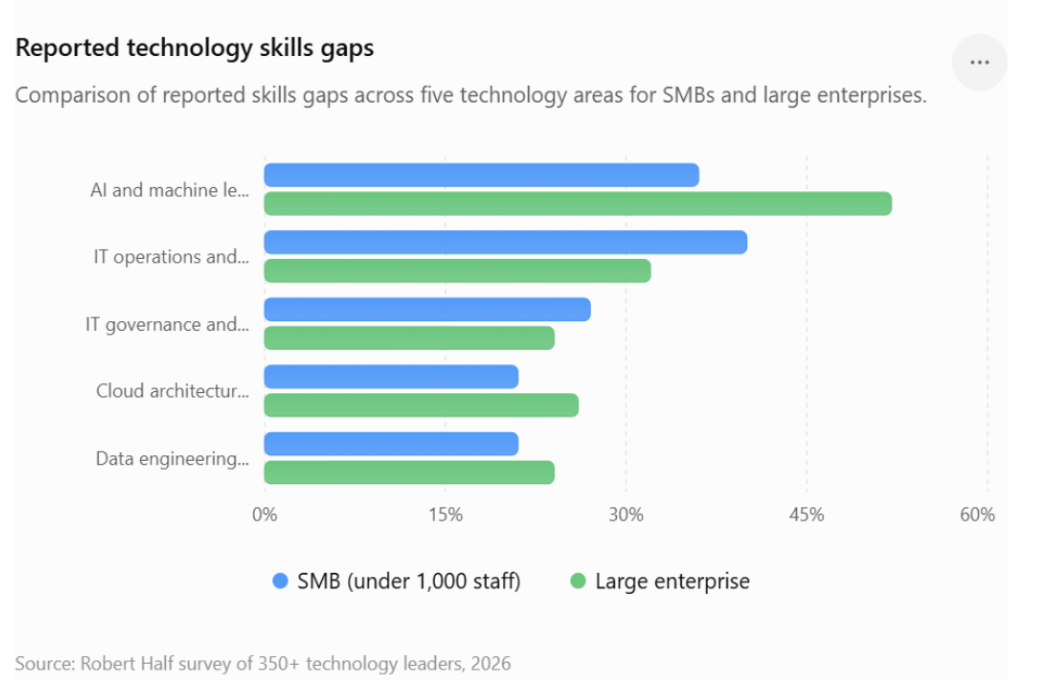
These include:

  • Artificial Intelligence and Machine Learning
  • Cloud Architecture (AWS, Azure, Google Cloud)
  • Cybersecurity and Zero Trust
  • SAP and Enterprise Applications
  • DevOps and Site Reliability Engineering
  • Data Engineering
  • Platform Engineering
  • Full Stack Development
  • Semiconductor Design
  • Enterprise Infrastructure Management

Many of these roles require expertise across multiple technologies rather than proficiency in a single platform.

For example, a modern Cloud Engineer is expected to understand infrastructure automation, Kubernetes, security, networking, and cost optimization—not just cloud deployment.

As technology becomes more interconnected, hiring strategies must evolve accordingly.

What Forward-Thinking Enterprises Are Doing Differently

Organizations that consistently attract top technology talent rarely rely on recruitment alone.

They’re investing in workforce planning as a business capability.

Common strategies include:

Hiring for Potential

Instead of filtering candidates solely by years of experience, they evaluate adaptability, learning agility, and adjacent technical skills.

Building Internal Capability

Continuous learning programs help existing employees transition into emerging technology roles.

Maintaining Talent Pipelines

Rather than hiring only when vacancies arise, enterprises engage with potential candidates throughout the year.

Using Specialist Staffing Partners

Specialized technology staffing providers help organizations access pre-qualified professionals with expertise in niche domains, reducing hiring time while improving candidate quality.

Combining Technology with Human Expertise

AI-assisted screening improves efficiency, but experienced technical evaluators remain essential for assessing real-world capability.

The organizations making the greatest progress understand that workforce planning is an ongoing process—not an annual hiring exercise.

Why India Has a Unique Opportunity

India continues to strengthen its position as one of the world’s leading technology talent destinations.

The rapid expansion of Global Capability Centres, growing investments in digital transformation, government initiatives supporting electronics manufacturing, and increasing demand for AI and cloud technologies are creating new opportunities for skilled professionals.

At the same time, these developments are intensifying competition for experienced talent.

This presents both a challenge and an opportunity.

Organizations that invest in learning, workforce flexibility, and strategic hiring today will be better prepared to support tomorrow’s business priorities.

The skills gap won’t disappear overnight.

But businesses that plan ahead won’t feel its impact as severely as those reacting only when projects begin.

Looking Ahead

Technology will continue evolving faster than job descriptions, certifications, and traditional hiring practices. The organizations that thrive won’t necessarily have access to the largest talent pool—they’ll have the most adaptable workforce strategy.

Before your next technology initiative:

  • Map future business goals against the skills you’ll need over the next 12–18 months.
  • Identify existing employees who can be reskilled into emerging technology roles.
  • Build relationships with specialist technology staffing partners before urgent hiring needs arise.
  • Measure workforce readiness alongside hiring metrics to identify capability gaps early.

The technology skills gap in India isn’t simply a recruitment issue. It’s a strategic business challenge, and the organizations that address it proactively will be better positioned to innovate, grow, and compete in the years ahead.

Build a Workforce That’s Ready for Tomorrow’s Technology

Finding skilled technology professionals has never been more challenging—or more important. Team Computers helps enterprises bridge the technology skills gap through specialized staffing, AI-assisted candidate screening, workforce planning, and access to talent across cloud, AI, cybersecurity, SAP, infrastructure, data engineering, and application development.

Strengthen My Technology Team

AI Is Transforming Every Business. Finding the Right Talent Is the Hard Part.

Artificial Intelligence has quickly moved from innovation labs to boardroom discussions.

Across industries, organizations are investing in AI-powered customer experiences, predictive analytics, intelligent automation, generative AI, and data-driven decision-making. Yet many of these initiatives face an unexpected obstacle—not technology, but talent.

Hiring an AI engineer today isn’t as simple as posting a job description. Enterprises are competing for professionals who combine machine learning expertise with cloud architecture, data engineering, MLOps, business understanding, and problem-solving skills. Those professionals are in short supply.

For CIOs, CTOs, and Talent Acquisition leaders, building an AI-ready workforce has become one of the most important priorities of the decade. The challenge isn’t just finding skilled professionals—it’s finding the right mix of technical capability, adaptability, and business understanding.

This article explores why AI and data hiring has become increasingly complex and what enterprise leaders can do to stay ahead.

Why Demand for AI Talent Is Growing Faster Than Supply

Artificial Intelligence is no longer limited to technology companies.

Banks are using AI for fraud detection.

Manufacturers are applying machine learning to predictive maintenance.

Retailers are improving customer experiences through recommendation engines.

Healthcare organizations are adopting AI-assisted diagnostics.

Every new use case creates demand for professionals who can build, train, deploy, and manage intelligent systems.

The challenge is that experienced AI professionals remain limited.

Most organizations are competing for the same talent pool.

As a result:

  • Hiring cycles are becoming longer.
  • Salary expectations continue to increase.
  • Offer acceptance rates are declining.
  • Skilled professionals often receive multiple offers simultaneously.

Technology leaders are discovering that traditional hiring methods simply can’t keep pace with AI adoption.

AI Hiring Requires More Than Machine Learning Skills

Many organizations still write job descriptions that focus on a single technology.

In reality, AI professionals rarely work in isolation.

A successful AI Engineer may need experience across:

  • Python
  • Machine Learning frameworks
  • Cloud platforms
  • Data Engineering
  • SQL and NoSQL databases
  • APIs
  • MLOps
  • Kubernetes
  • Business Intelligence
  • Prompt Engineering
  • Large Language Models

The role is becoming increasingly interdisciplinary.

That’s why resume screening alone often fails.

A candidate may not list every technology on a CV, yet possess transferable experience that makes them an excellent fit.

Forward-thinking enterprises evaluate capabilities rather than keywords.

Why Internal Hiring Teams Are Feeling the Pressure

Technology recruitment has become significantly more specialized.

Hiring managers expect recruiters to understand:

  • LLMs
  • Retrieval-Augmented Generation (RAG)
  • Vector Databases
  • AI Infrastructure
  • MLOps
  • Data Pipelines
  • Cloud-native AI
  • Responsible AI

These aren’t traditional recruitment conversations.

They’re highly technical discussions that require domain understanding.

An enterprise recently planned to launch an AI-powered customer support platform. The hiring team quickly realized they weren’t looking for a generic software developer—they needed professionals experienced in Generative AI, cloud deployment, APIs, and enterprise security.

Rather than widening the search indefinitely, the company partnered with a specialist technology staffing provider that could identify pre-assessed AI professionals. The result was a faster hiring process and stronger technical alignment.

Building an AI Workforce That Can Scale

Organizations that succeed in AI hiring rarely depend on reactive recruitment.

Instead, they build continuous talent strategies.

Some of the most effective practices include:

Develop Internal Talent

Many software engineers can transition into AI roles through structured learning programs.

Expand Beyond Traditional Profiles

Look beyond job titles.

Cloud Engineers, Data Engineers, and Backend Developers often possess adjacent skills that accelerate AI adoption.

Build Specialist Talent Pipelines

Maintain relationships with AI professionals before hiring demand peaks.

Combine AI Screening With Human Expertise

Automation improves speed, but experienced technical evaluators still play a critical role in assessing practical capability.

The objective isn’t simply hiring faster.

It’s building teams capable of delivering enterprise AI initiatives successfully.

Why India’s AI Talent Story Is Unique

India has one of the world’s largest technology workforces, making it a strategic destination for AI investment.

Global Capability Centres (GCCs), startups, research institutions, and large enterprises are all competing for the same AI professionals.

Government initiatives supporting digital innovation and AI adoption continue expanding the market.

At the same time, universities, online learning platforms, and professional certification programs are producing a new generation of AI practitioners.

The opportunity is enormous.

So is the competition.

Organizations that build long-term AI hiring strategies today will be significantly better positioned as enterprise AI adoption accelerates.

Looking Ahead

Artificial Intelligence will reshape every industry over the coming decade, but technology alone won’t determine success. People will.

Organizations that invest in workforce planning, skills development, and specialist hiring strategies today will adapt more quickly than those relying on traditional recruitment methods.

Before launching your next AI initiative:

  • Identify the technical capabilities your business will need over the next 12–24 months.
  • Assess existing employees for adjacent AI skills before hiring externally.
  • Build talent pipelines for specialized AI roles rather than waiting for vacancies.
  • Partner with technology staffing specialists who understand emerging AI capabilities.

The organizations leading the AI revolution won’t necessarily be those with the largest budgets—they’ll be the ones that build the strongest technology teams.

Build Your AI & Data Team with Confidence

From AI Engineers and Data Scientists to MLOps specialists, Data Engineers, and Prompt Engineers, finding the right talent requires more than traditional recruitment. Team Computers helps enterprises identify, assess, and deploy skilled AI and data professionals through specialized technology staffing and structured workforce governance.

Apple Enterprise Security Guide: FileVault, MDM Policies & Zero-Touch Deployment Explained

An IT leader at a rapidly growing enterprise recently shared a challenge that many organisations can relate to. The company had successfully deployed hundreds of MacBooks across multiple offices, but a simple question from the CISO exposed a significant gap.

“If a MacBook is lost tomorrow, can we be certain company data is protected? Can we verify that every device has the right security policies? And can we deploy the next 500 devices without IT touching each one?”

The organisation had invested in premium hardware, but securing those devices consistently at scale was becoming increasingly complex.

This is where many enterprises find themselves today. Buying Apple devices is straightforward. Managing them securely across offices, remote employees, and growing teams is not.

That’s why enterprise security for Apple devices goes beyond passwords and antivirus software. It requires a strategy that combines encryption, policy-driven management, automated deployment, and lifecycle governance.

At Team Computers, we’ve helped enterprises across India design and implement secure Apple workplace environments. One lesson stands out every time—security is strongest when it is built into every stage of the device lifecycle, from procurement and deployment to retirement.

In this guide, we’ll explain three of the most important building blocks of Apple enterprise security—FileVault, Mobile Device Management (MDM), and Zero-Touch Deployment—and how they work together to create a secure, scalable workplace.

Why securing Apple devices is about more than antivirus

When organisations think about endpoint security, antivirus software is often the first thing that comes to mind.

While endpoint protection remains important, enterprise security has evolved significantly.

Today’s IT teams must manage:

  • Hybrid work environments
  • Employees working from personal and corporate locations
  • Sensitive business information stored locally and in the cloud
  • Compliance requirements
  • Growing numbers of enterprise devices

Simply installing security software doesn’t address these challenges.

A secure Apple environment should answer questions such as:

  • Is every Mac encrypted?
  • Can only authorised users access company data?
  • Are devices compliant with organisational policies?
  • Can lost or stolen devices be managed remotely?
  • Can new devices be deployed securely without manual configuration?

These questions require a layered security approach rather than individual tools.

From our experience at Team Computers, organisations that view security as part of the entire device lifecycle consistently experience fewer operational issues than those that focus only on endpoint protection.

Security isn’t a product.

It’s a process.

FileVault: Your first line of defence for enterprise Macs

One of the simplest—and most important—security capabilities built into macOS is FileVault.

FileVault encrypts the contents of a Mac’s startup disk, helping protect business data if the device is lost or stolen. Without the appropriate credentials, the information stored on the device remains unreadable.

For enterprises, this provides an important layer of protection for sensitive business information stored locally.

However, enabling FileVault is only the beginning.

Many organisations make one of three common mistakes:

They don’t enforce FileVault consistently

Some employees enable encryption.

Others don’t.

Without centralised management, IT teams often lack visibility into which devices are actually encrypted.

Recovery keys aren’t managed properly

If an employee forgets their password and the recovery key isn’t securely stored, recovering access can become difficult.

Enterprise deployments should include secure escrow of recovery keys so authorised administrators can assist when required.

Encryption isn’t integrated with broader security policies

Encryption works best when combined with:

  • Identity management
  • Compliance monitoring
  • Device management
  • Access policies

Viewed in isolation, FileVault protects stored data.

Integrated into a broader security framework, it becomes part of a comprehensive endpoint security strategy.

At Team Computers, FileVault configuration is typically incorporated into the initial provisioning process, ensuring encryption is enabled before devices reach employees. This eliminates inconsistencies and helps organisations maintain security standards from day one.

MDM policies: The foundation of enterprise Apple security

If FileVault protects the data on a device, Mobile Device Management (MDM) helps organisations manage the device itself.

Think of MDM as the operational control layer for your Apple environment.

It enables IT administrators to configure devices remotely, enforce security policies, distribute applications, monitor compliance, and maintain visibility across the enterprise device fleet.

Without MDM, every MacBook, iPhone, or iPad becomes an individual device requiring manual management.

With MDM, they become part of a centrally governed environment.

Essential MDM policies every enterprise should implement

While every organisation has unique requirements, several policies are considered foundational.

Password and authentication policies

Require strong passcodes, biometric authentication where appropriate, and automatic lock after periods of inactivity.

Operating system compliance

Ensure devices remain on approved versions of macOS and iOS so they continue receiving important security updates.

Application management

Control which business applications are deployed and updated while reducing the use of unauthorised software.

Security configuration

Apply organisation-wide settings for encryption, firewall configuration, certificates, VPN access, and network policies.

Lost device management

If a device is misplaced or stolen, IT should be able to locate, lock, or remotely erase corporate data when necessary.

Why policy design matters

One mistake we often see is organisations applying identical policies to every employee.

In reality, different roles require different levels of access.

A finance executive handling confidential reports should have different controls than a field sales representative.

At Team Computers, we help enterprises design policy frameworks based on business roles rather than devices alone. This improves security while ensuring employees receive an experience that supports how they actually work.

Policies should adapt to business needs—not the other way around.

Zero-Touch Deployment: Secure devices before employees even open the box

For organisations deploying dozens—or even thousands—of Apple devices, manual setup quickly becomes unsustainable.

Imagine a new employee joining your organisation.

Instead of collecting their MacBook from IT, waiting for applications to be installed, security settings to be configured, and accounts to be created, the device is shipped directly to them.

The employee powers it on, signs in with their corporate credentials, and within minutes the Mac automatically configures itself with:

  • Enterprise security policies
  • FileVault enabled
  • Required business applications
  • Wi-Fi and VPN settings
  • Compliance configurations
  • Identity integration
  • Corporate certificates

No manual imaging.

No desk-side IT support.

No inconsistent configurations.

This is Zero-Touch Deployment.

Using technologies such as Apple Business Manager integrated with an enterprise MDM platform, organisations can automate the provisioning process while ensuring every device follows the same security standards from the moment it is activated.

For growing enterprises, this doesn’t just improve security—it significantly reduces deployment effort and accelerates employee onboarding.

Contract Staffing vs Permanent Hiring: Which Is the Smarter Choice for Enterprise IT Teams?

A cloud migration is scheduled to begin in six weeks. The project has executive sponsorship, the budget has been approved, and every technology dependency is mapped out. There’s just one problem—you still haven’t hired the engineers who’ll make it happen.

This scenario plays out every day across Indian enterprises. Technology initiatives move faster than traditional hiring processes, leaving CIOs and HR leaders under pressure to build teams without delaying business outcomes. Choosing between contract staffing vs permanent hiring is no longer just an HR decision; it’s a strategic business choice that directly affects delivery timelines, operational costs, and workforce agility.

If you’re planning your next digital transformation initiative, understanding when to use each hiring model can help you avoid talent shortages, reduce project risk, and build teams that scale with your business.

Why the Hiring Decision Is More Strategic Than Ever

Technology projects have become more dynamic than ever before.

Whether it’s implementing SAP S/4HANA, modernising data centres, adopting AI, strengthening cybersecurity, or migrating workloads to the cloud, enterprises require specialised skills that may only be needed for a specific phase of the project.

Hiring permanent employees for every requirement often creates long-term overhead. Relying solely on contract professionals, however, can affect continuity for business-critical functions.

Most organisations don’t struggle because they lack access to talent. They struggle because they apply the same hiring model to every business problem.

Consider a large retail enterprise expanding into new markets across India. The organisation required infrastructure engineers, cloud specialists, application support professionals, and project managers within two months. Hiring every role permanently would have increased fixed costs significantly, while depending entirely on contractors would have reduced long-term knowledge retention.

Instead, leadership adopted a blended workforce strategy. Permanent employees led architecture, governance, and business continuity, while contract professionals supported deployment, migration, and implementation. The project launched on schedule while keeping workforce costs aligned with business demand.

The lesson is simple: workforce strategy should follow business strategy—not the other way around.

Understanding Contract Staffing: Speed Meets Flexibility

Contract staffing allows organisations to access skilled professionals for a defined period or project without creating permanent headcount.

For enterprise IT teams, this model has become increasingly valuable because technology requirements change faster than traditional recruitment cycles.

Contract staffing works particularly well when organisations need to:

  • Accelerate cloud migration projects
  • Deploy SAP implementation teams
  • Expand cybersecurity operations
  • Support data centre modernisation
  • Build AI or analytics capabilities
  • Meet seasonal or project-specific demand
  • Fill temporary skill gaps while permanent hiring continues

One of the biggest advantages is speed. Instead of spending months sourcing, interviewing, onboarding, and training new employees, businesses can deploy experienced professionals who are already familiar with enterprise environments.

Another benefit is flexibility. As project priorities evolve, workforce capacity can scale up or down without creating unnecessary long-term commitments.

That doesn’t mean contract staffing is the right answer for every role. Leadership positions, business-critical architecture, and long-term product ownership often require deeper organisational integration that permanent employees provide.

The goal isn’t to replace permanent hiring—it’s to complement it where agility matters most.

When Permanent Hiring Delivers Greater Value

Permanent hiring remains the foundation of every successful technology organisation.

Certain roles require institutional knowledge, strategic ownership, and continuous collaboration that develops over years rather than months.

Examples include:

  • Enterprise Architects
  • Product Engineering Leaders
  • Technology Managers
  • Information Security Leadership
  • Core Software Engineering Teams
  • Platform Owners
  • Digital Transformation Leaders

These professionals don’t simply execute projects—they shape long-term technology direction.

Permanent employees also strengthen organisational culture, mentor junior engineers, preserve business knowledge, and contribute to continuous innovation.

For organisations investing heavily in proprietary platforms or customer-facing digital products, retaining critical knowledge internally becomes essential.

However, even companies with strong permanent teams frequently rely on contract specialists during periods of accelerated growth or transformation.

Rather than viewing the two models as competitors, successful enterprises treat them as complementary workforce strategies.

The Rise of the Hybrid Workforce Model

Increasingly, enterprise leaders are moving away from choosing between contract staffing and permanent hiring.

Instead, they’re combining both.

A hybrid workforce allows organisations to balance agility with stability.

A typical enterprise technology structure might include:

  • Permanent leadership for business continuity
  • Contract specialists for transformation projects
  • Project-based consultants for niche expertise
  • Managed service teams for operational support
  • Staff augmentation for sudden demand spikes

This approach reduces hiring delays while maintaining operational consistency.

It’s particularly valuable for organisations managing multiple digital initiatives simultaneously.

For example, while a permanent infrastructure team maintains daily operations, contract cloud engineers can support a six-month migration project without affecting existing service levels.

The result is a workforce that’s both resilient and responsive.

How to Decide Which Model Fits Your Business

Choosing the right hiring model starts with understanding the nature of the work—not simply the availability of budget.

Ask yourself these questions:

Choose Contract Staffing When:

  • The project has a defined timeline.
  • Specialist skills are needed immediately.
  • Business demand fluctuates significantly.
  • Speed of deployment is critical.
  • Internal hiring capacity is limited.

Choose Permanent Hiring When:

  • The role influences long-term business strategy.
  • Deep organisational knowledge is essential.
  • Continuous innovation is expected.
  • Leadership and mentoring are required.
  • The capability will remain core to the business for years.

Many enterprises discover that different projects require different workforce models—even within the same department.

The key is building flexibility into workforce planning instead of relying on a single hiring approach.

Looking Ahead

Technology hiring will become increasingly specialised as organisations continue investing in AI, cloud, cybersecurity, automation, and digital transformation. Businesses that rely exclusively on either permanent hiring or contract staffing may find themselves struggling to balance speed, capability, and cost.

The strongest workforce strategies are built around business objectives rather than employment models.

Before your next hiring initiative:

  • Audit upcoming technology projects and identify which roles are temporary versus long-term.
  • Build a hybrid workforce strategy that combines permanent expertise with specialised contract talent.
  • Measure hiring success by project outcomes, not simply by positions filled.
  • Review workforce plans quarterly to align with evolving business priorities.

The debate around contract staffing vs permanent hiring isn’t about choosing one over the other. It’s about creating a workforce that’s flexible enough to support today’s projects while preparing your organisation for tomorrow’s opportunities.

Get the Right Talent Model for Every Technology Initiative

Whether you’re scaling a cloud migration, expanding your cybersecurity operations, or building a long-term engineering team, choosing the right workforce model can make the difference between meeting deadlines and missing opportunities. Team Computers helps enterprises design technology staffing strategies that combine specialised talent, workforce flexibility, and structured governance to support sustainable business growth.

Talk to a Technology Staffing Expert

How to Enforce BYOD Policies on Apple Devices: An Enterprise Guide

A global capability centre (GCC) in Bengaluru recently faced an unexpected challenge. More than half of its employees preferred working on their personal MacBooks and iPhones, but the IT team had little visibility into which devices were accessing corporate applications, how company data was being protected, or whether those devices met internal security standards.

The issue wasn’t employee adoption. It was governance.

If you’re an IT leader, CISO, or workplace technology manager, you’ve probably experienced the same dilemma. Employees want the flexibility to use the devices they’re most comfortable with, while your organisation needs to protect business data, comply with regulations, and maintain operational control.

That’s exactly why Apple BYOD solutions have become a strategic priority for Indian enterprises. When implemented correctly, they allow employees to work on their preferred Apple devices without compromising enterprise security or user privacy.

At Team Computers, we’ve helped organisations across industries build Apple-first workplace strategies that support secure mobility at scale. One thing has become clear—successful BYOD programmes aren’t built around devices. They’re built around policies, identity, lifecycle management, and employee trust.

This guide explains how to enforce BYOD policies on Apple devices while creating an experience that works for both employees and IT.

Why BYOD is harder than simply allowing personal devices

Many organisations believe BYOD begins and ends with allowing employees to connect personal devices to corporate email.

In reality, that’s only the starting point.

Once personal MacBooks, iPhones, and iPads begin accessing business applications, customer information, confidential documents, and collaboration platforms, the organisation takes on a new set of responsibilities.

Questions quickly emerge.

Which devices are compliant?

Who has access to what?

How is business information separated from personal content?

What happens when an employee resigns or loses a device?

Without clear governance, IT teams lose visibility while security risks increase.

The challenge is particularly relevant for Indian enterprises. Hybrid work has become a long-term operating model, and organisations are expected to handle personal and business data responsibly under frameworks such as the Digital Personal Data Protection (DPDP) Act, 2023. While the Act doesn’t prescribe specific BYOD controls, it reinforces the importance of protecting personal data through appropriate organisational and technical measures.

From our experience at Team Computers, the biggest obstacle isn’t the technology. Apple already provides a mature enterprise ecosystem for device management and security. The real challenge is designing policies that employees willingly adopt while giving IT teams the governance they need.

Successful organisations treat BYOD as an enterprise mobility strategy—not simply a device policy.

The five mistakes enterprises make with Apple BYOD solutions

1. Writing policies without employee input

Most BYOD projects start with IT creating security policies.

Employees, however, have different concerns.

They worry that enrolling a personal device means the company can view personal photos, messages, browser history, or installed applications.

Without clear communication, adoption slows dramatically.

One of the first conversations Team Computers has with customers isn’t about technology—it’s about transparency. Employees should understand exactly what information the organisation manages and what remains private.

When expectations are clear, trust improves.

2. Applying identical policies to every employee

A finance executive handling confidential financial reports doesn’t need the same access as a field sales executive.

Similarly, HR, legal, software engineering, and leadership teams often require different security controls.

Role-based access creates stronger security while giving employees only the permissions necessary for their responsibilities.

The result is better governance without unnecessary restrictions.

3. Ignoring the separation between personal and business data

One of the most common reasons employees resist BYOD is the fear of losing privacy.

A well-designed Apple BYOD environment keeps corporate information separate from personal content.

Business applications, enterprise accounts, certificates, and managed data can be controlled independently without giving organisations visibility into personal emails, photographs, or applications.

This balance between security and privacy is one of the reasons Apple devices have become increasingly popular in enterprise environments.

4. Treating deployment as the finish line

Many organisations celebrate once employees successfully enrol their devices.

That’s only the beginning.

A mature BYOD programme includes:

  • Continuous compliance monitoring
  • Security policy updates
  • Application lifecycle management
  • Certificate renewal
  • Identity verification
  • Secure offboarding

From what we’ve observed at Team Computers, organisations that invest in lifecycle management experience fewer support issues and stronger long-term compliance than those focused solely on deployment.

5. Believing BYOD reduces IT responsibility

Some organisations assume allowing personal devices means less work for IT.

The reality is different.

IT may no longer own the hardware, but it still owns access management, compliance, application security, identity, and governance.

The role shifts from device ownership to secure digital workplace management.

That’s a much more strategic responsibility.

A step-by-step approach that actually works

Step 1: Create a clear BYOD policy before enrolling devices

Technology should never come before policy.

Your BYOD policy should clearly define:

  • Eligible Apple devices
  • Supported operating system versions
  • Approved business applications
  • Password and authentication requirements
  • Employee responsibilities
  • IT responsibilities
  • Conditions for removing corporate access

Employees should understand the policy before their devices are enrolled—not afterwards.

Clear expectations reduce confusion and improve adoption.

Step 2: Make identity the foundation of your BYOD strategy

Identity is more important than the device itself.

Before granting access to corporate resources, every employee should authenticate through the organisation’s identity platform using modern authentication methods.

At Team Computers, we recommend building identity, conditional access, and compliance policies together rather than treating them as separate initiatives.

When identity drives access decisions, organisations gain greater control while creating a smoother experience for employees.

Step 3: Keep work and personal data separate

The most successful BYOD programmes respect employee privacy.

Corporate applications should remain managed independently of personal applications.

Business data should be removable without affecting personal files if an employee leaves the organisation or changes roles.

When employees know their privacy is protected, resistance to BYOD decreases significantly.