
Why Most IT Dashboards Fail to Show the Real Problem

A major application slowdown impacts users across the organization.

The NOC dashboard looks healthy, infrastructure metrics remain within thresholds, cloud resources appear stable, network utilization seems normal, yet employees continue reporting issues. Hours later, the root cause is finally identified.

For many IT leaders this scenario feels familiar and it exposes an uncomfortable reality:

Having visibility isn’t the same as having insight.

Over the last decade, enterprises have invested heavily in monitoring tools and dashboards. Every layer of technology now generates data. Infrastructure teams monitor servers. Network teams monitor traffic. Security teams monitor threats. Cloud teams monitor workloads.

The result should be better decision-making.

Instead, many organizations find themselves drowning in information while struggling to identify the real problem.

The issue isn’t a lack of dashboards, it’s that most dashboards were never designed to explain business impact.

The dashboard explosion nobody talks about

Modern enterprises have never had more visibility tools.

A typical IT environment may include:

  • Infrastructure monitoring platforms
  • Cloud observability tools
  • Network monitoring solutions
  • Endpoint management dashboards
  • Security operation consoles
  • Application performance monitoring tools

Each system serves a purpose. Each provides valuable information.

Yet something important happens when every team operates from a different dashboard.

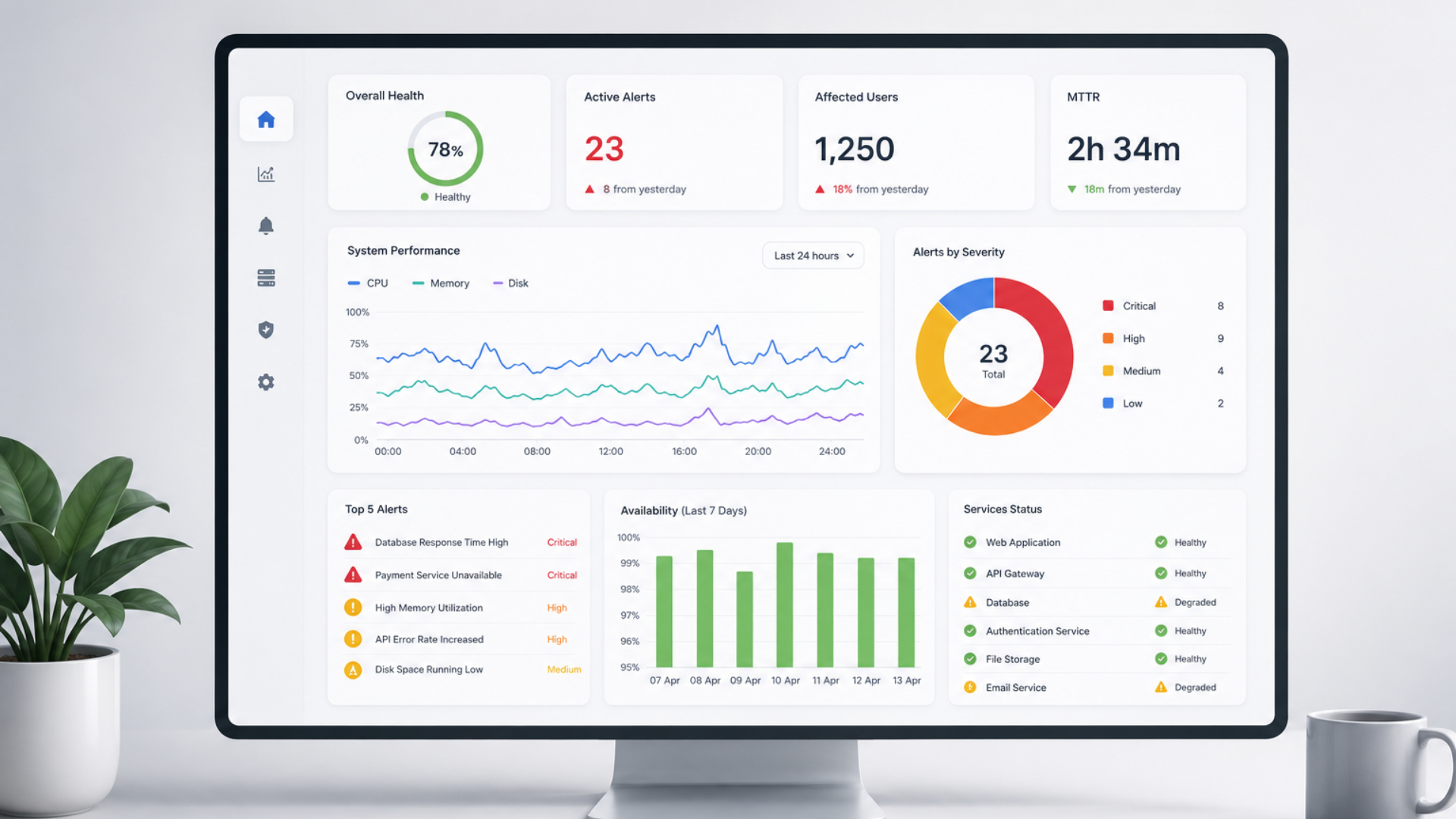
Visibility becomes fragmented, an infrastructure team may see healthy servers, a network team may see normal traffic, a security team may see no active threats. At the same time, employees may be struggling to complete basic tasks.

The problem isn’t missing data. The problem is disconnected context.

Dashboards show symptoms. Leaders need causes.

Most dashboards excel at reporting events.

They can tell you:

  • CPU utilization increased
  • Network latency spiked
  • Application response time slowed
  • Storage thresholds were exceeded

Useful information. But rarely enough information.

When a business-critical service is impacted, leaders need answers to different questions:

  • What is causing the issue?
  • How many users are affected?
  • What business processes are impacted?
  • How urgent is the situation?
  • What should happen next?

Traditional dashboards often stop at observation. Modern IT operations require correlation.

The difference matters, because organizations don’t solve incidents by collecting more alerts.

They solve incidents by understanding relationships between events.

The biggest blind spot: Employee experience

One of the most common dashboard failures occurs when infrastructure appears healthy while users experience disruption.

Consider a simple example.

A collaboration platform remains technically available, servers are operational, network connectivity exists, no major alerts are triggered.

Yet employees complain about:

  • Slow performance
  • Intermittent access issues
  • Poor meeting quality
  • Delayed file synchronization

From a dashboard perspective, everything looks fine. From a business perspective, productivity is declining.

This gap is becoming increasingly important as enterprises adopt hybrid work models and distributed operations.

Many IT dashboards measure technology health, far fewer measure human experience. That’s why Digital Employee Experience (DEX) is becoming an increasingly valuable operational metric.

Because employees experience technology differently than dashboards do.

More alerts don’t create more visibility

A common reaction to operational blind spots is simple:

Add more monitoring. Add more dashboards. Add more alerts.

Unfortunately, this often makes the problem worse.

Research from multiple industry analysts continues to highlight alert fatigue as one of the biggest challenges facing modern operations teams.

When teams receive thousands of alerts every day, two things happen: First, response quality declines. Second, truly important issues become harder to identify. This is why leading organizations are shifting toward intelligent operations.

Instead of monitoring everything equally, they focus on:

  • Event correlation
  • Root-cause identification
  • Business impact analysis
  • Predictive insights

The goal isn’t more data. The goal is better decisions.

What forward-thinking IT leaders are doing differently

The strongest IT organizations are changing how they think about visibility.

Rather than asking: “Do we have enough dashboards?”

They’re asking: “Can we understand business impact quickly?”

This shift is influencing investment priorities across enterprise IT.

Modern leaders increasingly prioritize:

Unified visibility

Connecting infrastructure, applications, networks, and user experience.

Operational context

Understanding how technical events affect business outcomes.

Automation

Reducing manual analysis during incidents.

Predictive intelligence

Identifying risks before users are affected.

The objective is not to build a larger monitoring environment. It’s to build a smarter one.

What this means for Indian enterprises

This challenge is becoming increasingly relevant across India.

Organizations are managing:

  • Multi-location operations
  • Growing GCC environments
  • Hybrid workforces
  • Cloud-first applications
  • Distributed infrastructure

As complexity increases, traditional monitoring approaches become harder to sustain.

A dashboard designed for a single data center may not provide meaningful visibility across a hybrid enterprise environment. Similarly, separate monitoring systems rarely provide the operational context required by CIOs and infrastructure leaders.

The future belongs to organizations that can connect technology insights with business outcomes because executives don’t make decisions based on CPU utilization. They make decisions based on business impact.

The future of IT visibility isn’t dashboards

This may sound counterintuitive, but the future of IT visibility may involve fewer dashboards not more.

Instead, organizations are moving toward:

  • Intelligent observability
  • AI-assisted operations
  • Experience monitoring
  • Automated root-cause analysis
  • Business-centric visibility

The focus shifts from displaying information to delivering insight and that’s a significant difference because the most effective IT teams don’t need more screens filled with data. They need faster answers.

Conclusion

Dashboards remain valuable but visibility alone does not solve operational challenges.

The most common mistake organizations make is assuming that more monitoring automatically leads to better understanding. In reality, the real problem often hides between dashboards.

To improve operational visibility:

  • Focus on context, not just metrics
  • Measure employee experience alongside infrastructure health
  • Reduce alert noise through intelligent correlation
  • Connect technical events to business impact

Because the goal isn’t to collect more data. The goal is to understand what matters before the business feels the impact.

Move Beyond Monitoring Toward Insight

Discover how modern IT operations can connect infrastructure visibility, user experience, and business outcomes into a single operational view.

Organizations that solve issues fastest are usually the ones that understand them first.

Improve My IT Visibility

Predictive Analytics in Life Insurance: How AI is Transforming Underwriting, Claims, and Customer Experience

Data is the New Currency of Life Insurance

The life insurance industry has always been built on data.

Every policy application, medical record, premium payment, customer interaction, underwriting decision, and claim generates valuable information. Today, insurers possess enormous volumes of structured and unstructured data, yet many continue to rely on legacy systems and static reports that only explain what has already happened.

The real opportunity lies elsewhere.

Leading insurers are now using Artificial Intelligence (AI) and Predictive Analytics to forecast future outcomes, automate decision-making, improve operational efficiency, and deliver highly personalized customer experiences.

As customer expectations evolve and competition intensifies, the question is no longer whether insurers should adopt AI. The question is how quickly they can transform their data into intelligent business decisions.

What is Predictive Analytics?

Predictive Analytics is the use of historical data, real-time information, machine learning, statistical modelling, and artificial intelligence to identify patterns and predict future business outcomes.

Unlike traditional business intelligence that answers “What happened?”, predictive analytics answers questions such as:

  • Which customers are likely to lapse?
  • Which policies require additional underwriting?
  • Which claims may be fraudulent?
  • Which customers are most likely to purchase another insurance product?
  • Which distribution channels will deliver the highest conversion rates?

Rather than relying on intuition, insurers can make confident decisions backed by data.

Combined with Generative AI, Large Language Models (LLMs), and Decision Intelligence, predictive analytics is becoming the foundation of the modern insurance enterprise.

Why Traditional Insurance Analytics Is No Longer Enough

For years, insurers have invested heavily in reporting platforms and dashboards.

While these tools provide visibility into historical performance, they rarely help business leaders anticipate future risks or recommend the next best action.

Many insurance organizations continue to face challenges such as:

  • Lengthy underwriting cycles
  • Fragmented customer data
  • Increasing fraud risks
  • Low policy persistency
  • Limited cross-selling opportunities
  • Manual claims investigations
  • Siloed business systems
  • Delayed executive reporting

Without a trusted data foundation and AI-powered analytics, business decisions remain reactive instead of proactive.

Modern insurers require an intelligence layer that can continuously learn from enterprise data and generate actionable recommendations in real time.

AI-Powered Underwriting: Making Faster and Smarter Decisions

Underwriting is one of the most critical processes in life insurance.

Traditional underwriting often involves manual reviews, medical evaluations, and multiple approval stages, increasing operational costs and delaying policy issuance.

AI-powered predictive models significantly accelerate this process.

Instead of evaluating individual risk factors in isolation, machine learning models analyse thousands of variables simultaneously, including age, occupation, lifestyle, medical history, financial behaviour, family history, and policy information.

The result is a far more accurate understanding of customer risk.

Modern predictive models can help insurers:

  • Improve underwriting accuracy
  • Reduce policy issuance time
  • Optimize premium pricing
  • Standardize underwriting decisions
  • Minimize manual intervention
  • Deliver a better customer experience

At Team Computers, we have worked with insurance organizations to modernize underwriting through AI-driven decision intelligence. These experiences led to the development of an insurance-focused analytics accelerator that combines predictive models, conversational AI, and real-time business intelligence to help underwriting teams make faster and more informed decisions.

Intelligent Claims Management with AI

Claims processing defines the customer experience.

Policyholders expect quick, transparent, and hassle-free settlements, while insurers must simultaneously identify fraudulent claims and reduce financial risk.

This is where Predictive Analytics creates significant business value.

AI models analyse historical claims, customer behaviour, policy information, medical records, transaction history, and external data sources to identify anomalies that traditional rule-based systems often miss.

Technologies such as:

  • Machine Learning
  • Anomaly Detection
  • Graph Analytics
  • Behavioural Analytics
  • Pattern Recognition
  • AI-assisted Fraud Detection

enable insurers to prioritize suspicious claims while accelerating the settlement of genuine ones.

The outcome is faster claim resolution, improved customer satisfaction, and stronger fraud prevention.

Predictive Analytics Across the Insurance Value Chain

The impact of predictive analytics extends well beyond underwriting and claims.

Customer Retention

AI models identify policyholders who are most likely to discontinue their policies, allowing insurers to launch proactive retention campaigns before lapses occur.

Customer 360

By integrating data across sales, servicing, claims, and policy administration systems, insurers gain a unified customer view that improves personalization and service delivery.

Cross-Sell and Upsell

Machine learning identifies the next best product for each customer, improving advisor productivity while increasing policyholder lifetime value.

Sales Performance

Predictive analytics enables branch managers and sales leaders to forecast business performance, identify high-potential leads, and improve conversion rates.

Executive Decision Intelligence

CXOs no longer need to wait for monthly reports.

Modern AI platforms provide real-time visibility into underwriting performance, claims trends, persistency, profitability, distribution efficiency, and customer engagement through interactive dashboards and conversational analytics.

From Predictive Analytics to Generative AI

The insurance industry is now entering its next phase of digital transformation.

Predictive Analytics tells insurers what is likely to happen.

Generative AI explains why it is happening.

AI Agents recommend what action should be taken next.

Business users can now ask questions in natural language, such as:

“Which customers are likely to surrender their policies next quarter?”

“Why has claim frequency increased in a specific region?”

“Show me advisors with the highest persistency ratio.”

Instead of building reports or writing SQL queries, users receive contextual insights powered by trusted enterprise data.

This shift towards Conversational Analytics, AI Copilots, and Agentic AI is making business intelligence more accessible than ever before.

Building an AI-Ready Insurance Enterprise

Successful AI initiatives begin with trusted data.

Without governed, high-quality, and integrated data, even the most advanced AI models produce unreliable outcomes.

Organizations investing in modern data platforms, real-time integration, data governance, and predictive analytics are building a stronger foundation for AI adoption.

Recognizing this need, Team Computers developed an insurance-focused intelligence platform that brings together predictive analytics, conversational AI, geo-intelligence, executive dashboards, customer 360 insights, and AI-powered decision support in a unified solution. Rather than replacing existing policy administration systems, it integrates with enterprise data sources to help insurers modernize underwriting, claims, distribution, sales, and customer servicing.

This approach enables insurers to accelerate digital transformation without disrupting their existing technology landscape.

Why Team Computers

For over two decades, Team Computers has been helping enterprises build modern data ecosystems that transform business data into actionable intelligence.

Our expertise spans:

  • Data Strategy & Consulting
  • AI-Ready Data Platforms
  • Data Engineering
  • Enterprise Data Warehousing
  • Real-Time Data Integration
  • Predictive Analytics
  • Generative AI
  • AI Agents
  • Microsoft Fabric
  • Databricks
  • Conversational Analytics
  • Decision Intelligence

With 20+ years of analytics expertise, 2,000+ projects delivered, 850+ customers, and 400+ analytics professionals, we help organizations modernize their data foundations and unlock measurable business outcomes through Data & AI.

The Future of Life Insurance Is Predictive

The life insurance industry is rapidly moving from reactive reporting to intelligent decision-making.

Insurers that embrace Predictive Analytics, Artificial Intelligence, Machine Learning, and Generative AI will be better equipped to reduce risk, improve customer experience, detect fraud, optimize underwriting, and uncover new growth opportunities.

The real differentiator is no longer how much data an insurer owns.

It is how effectively that data is transformed into actionable intelligence.

At Team Computers, we believe the future belongs to insurers that build trusted data foundations today and empower every business decision with AI. By combining deep insurance expertise with modern analytics and intelligent automation, we help organizations move beyond dashboards to a future where every insight drives measurable business impact.

Skills-Based Hiring Is Replacing Resume-Based Hiring. Here’s Why.

A candidate has 12 years of experience, a polished resume, and every certification your job description asks for. Another has six years of experience, fewer certifications, but has built and deployed solutions remarkably similar to your project. Which one would you hire?

For many enterprises, the first candidate still gets the interview. Increasingly, however, the second candidate is delivering better business outcomes.

Technology is evolving faster than job titles can keep up. Cloud platforms, AI, cybersecurity, DevOps, and data engineering have transformed what organisations expect from technology professionals. Traditional hiring methods that rely heavily on resumes, years of experience, or degrees are no longer enough.

Skills-based hiring is helping enterprises identify professionals who can solve business problems—not just meet hiring criteria. If you’re responsible for building technology teams, understanding this shift could significantly improve your hiring outcomes.

Experience Doesn’t Always Equal Capability

For years, experience has been treated as the safest hiring metric.

Five years in cloud.
Ten years in SAP.
Eight years in infrastructure.

Those numbers offer useful context, but they rarely tell the complete story.

Technology changes rapidly. Someone with ten years of experience may still rely on outdated practices, while another professional with four years of hands-on work in modern cloud environments could be better prepared for today’s challenges.

We’ve seen organisations reject highly capable candidates because they didn’t meet an arbitrary experience threshold, only to struggle filling the position for months.

The hiring market has shifted from asking “How long have you done this?” to “Can you solve this problem?”

That subtle change is reshaping enterprise recruitment.

Technology Skills Are Evolving Faster Than Job Descriptions

Most job descriptions are updated once or twice a year.

Technology evolves every month.

A cloud engineer today may also need automation expertise.

A cybersecurity analyst is increasingly expected to understand cloud security, identity management, and AI-assisted threat detection.

Application developers often work across full-stack frameworks, APIs, containers, and DevOps pipelines rather than a single programming language.

This growing overlap makes hiring based solely on job titles increasingly ineffective.

According to industry reports, enterprises are placing greater emphasis on demonstrable technical skills, project experience, certifications, and problem-solving ability than ever before.

Skills have become more dynamic than careers.

That’s changing how successful organisations evaluate talent.

What Skills-Based Hiring Actually Looks Like

Skills-based hiring isn’t about ignoring resumes.

It’s about using resumes as one input—not the only one.

Forward-thinking organisations evaluate candidates across multiple dimensions.

They look at:

  • Technical assessments relevant to the role
  • Hands-on project experience
  • Certifications and continuous learning
  • Problem-solving ability
  • Adaptability to new technologies
  • Communication and collaboration
  • Learning agility

Imagine you’re hiring a DevOps Engineer.

Rather than filtering candidates simply because they have “five years of DevOps experience,” you assess whether they’ve built CI/CD pipelines, managed Kubernetes clusters, automated cloud infrastructure, and resolved production incidents.

That approach often uncovers exceptional candidates who would otherwise never appear in traditional searches.

Why This Matters Even More in India

India’s technology ecosystem is changing at an extraordinary pace.

Global Capability Centres (GCCs) continue expanding into cities such as Bengaluru, Hyderabad, Pune, Chennai, Gurugram, and Noida. Digital transformation initiatives across BFSI, manufacturing, healthcare, retail, and telecom are increasing demand for specialised technology skills.

At the same time, emerging areas like Artificial Intelligence, semiconductor design, cloud engineering, cybersecurity, and platform engineering are creating roles that didn’t exist a few years ago.

Many professionals are learning these skills through certifications, real-world projects, and continuous upskilling rather than traditional career paths.

Organisations that continue filtering candidates primarily by degree or years of experience risk overlooking some of the market’s strongest talent.

India’s competitive hiring landscape increasingly rewards organisations that recognise capability over convention.

This shift is especially urgent in India, where the GCC boom is creating a talent race across Bengaluru, Hyderabad, and Pune, and organisations still screening on resumes alone are losing candidates to competitors who move faster on capability.

Building a Skills-First Hiring Strategy

Moving to skills-based hiring doesn’t require rebuilding your recruitment process overnight.

It starts with asking better questions.

Instead of focusing exclusively on qualifications, evaluate how candidates apply their knowledge in real-world situations.

Some practical steps include:

  1. Define the critical technical skills required for each role.
  2. Introduce practical assessments alongside resume reviews.
  3. Evaluate adjacent skills that support long-term adaptability.
  4. Include technical experts during candidate evaluations.
  5. Measure hiring success based on project outcomes rather than recruitment speed alone.

Technical assessments and project-based evaluation take more recruiter time than resume screening — which is exactly where AI is starting to change how enterprises approach hiring, by surfacing capability signals that a static resume can’t capture.

One enterprise recently shifted its hiring process for cloud engineers from experience-based screening to capability assessments. The result wasn’t simply faster hiring—it was improved project delivery because selected candidates possessed stronger practical skills than previous hiring methods had identified.

Looking Ahead

The organisations that build the strongest technology teams over the next decade won’t necessarily hire the most experienced candidates. They’ll hire the most capable ones.

Skills-based hiring allows enterprises to access broader talent pools, reduce hiring bias, improve workforce quality, and prepare for technologies that continue evolving long after recruitment ends.

To begin that transition:

  • Review whether your current job descriptions reflect today’s technology landscape.
  • Replace arbitrary experience requirements with measurable technical capabilities.
  • Introduce practical assessments early in the hiring process.
  • Build hiring processes that identify future potential alongside current expertise.

Skills-based hiring isn’t replacing recruitment best practices—it’s making them more relevant. Enterprises that embrace this shift today will be better positioned to compete for tomorrow’s technology talent.

Build Teams Based on Skills, Not Just Resumes

Making this shift internally is one thing; sourcing skills-verified talent at scale is another. That’s why it’s worth understanding how to choose a technology staffing partner that already evaluates candidates the way your organisation now wants to hire.

Finding the right technology professional requires more than matching keywords on a CV. Team Computers helps enterprises identify, assess, and deploy skilled technology talent through AI-assisted screening, technical validation, and structured workforce governance.

Find Skilled Technology Talent

7 Reasons Smart Enterprises Are Switching to Device as a Service (DaaS) in 2026

Buying laptops in bulk is the easy part.

What comes after – imaging, tagging, deploying, patching, repairing, refreshing, and tracking hundreds of endpoints across cities — is where IT teams quietly lose months of their year.

Device as a Service (DaaS) changes that equation. Instead of owning devices and managing everything in-house, you subscribe to a bundled service: hardware, deployment, support, lifecycle management, and refreshes, one predictable monthly cost.

Here’s why enterprises are making the switch.

1. Your IT Team Gets Its Time Back

IT teams already handle helpdesk tickets, security ops, network issues, and infrastructure projects. Laptop logistics shouldn’t be on that list.

With DaaS, your provider takes over provisioning, asset tagging, user onboarding, warranty claims, and repair coordination. Your team can focus on work that actually moves the business forward.

2. Employees Unbox and Start Working

Nobody should spend half a day setting up a work laptop.

Under DaaS, every device arrives configured, secured, enrolled, and application-ready. Whether your employee is in Mumbai, Bengaluru, Gurgaon, or a Tier 2 branch office, the experience is the same. First day, they’re working — not waiting for IT to sort out their machine.

3. Fewer Budget Surprises

Traditional procurement hits your capital budget upfront. Then come the costs nobody planned for: out-of-warranty repairs, emergency replacements, unplanned support mid-quarter.

DaaS converts it into a fixed monthly operational expense. Finance knows what to approve. Budgets don’t blow up in October.

4. Security Built In

A misconfigured device is a vulnerability. With distributed workforces, one gap can expose a lot.

DaaS means every endpoint arrives policy-compliant: endpoint protection active, disk encryption enabled, patches current, remote management configured. Your security team has visibility across every device from day one — not three weeks later when someone finally gets around to the onboarding checklist.

5. Refresh Cycles Stop Being a Crisis

Most organizations delay refreshes because planning them is painful. The result: employees grinding through slow startups and dead batteries, and nobody quite sure whose problem that is.

With DaaS, refresh schedules are written into the contract. Devices arrive at predefined intervals. No emergency approvals, no aging fleets, no complaints sitting in someone’s inbox for months.

6. Scaling Without the Inventory Problem

Teams grow. Projects ramp up. Acquisitions happen. Departments restructure.

When you own your devices, every change creates an inventory headache. DaaS lets you add or reduce devices as demand shifts — without large upfront commitments or hardware collecting dust in a storeroom.

7. CIOs Stop Talking About Laptops

This sounds minor until you’ve sat through one too many leadership meetings that somehow ended up being about a broken Dell warranty.

When device management runs itself, IT stops chasing vendors, employees stop complaining, and the conversation shifts to something more useful than endpoint logistics.

Is DaaS Right for Your Organization?

It tends to be a strong fit for companies with multiple locations or hybrid teams, frequent hiring, messy refresh cycles, or a finance team that would rather see OpEx than a big hardware line item.

The Bottom Line

DaaS is not a magic fix for endpoint management, it shifts the burden to a provider who specialises in it, which only works if you choose the right one. For enterprises modernising in 2026, that tradeoff is usually worth exploring.

Why Uptime Is No Longer the Most Important IT Metric

For decades, uptime was the gold standard of IT success.

If systems were available, infrastructure was stable, and major outages were rare, technology teams were considered effective. Boardroom conversations often revolved around a single number: uptime percentage.

99%.

99.99%.

The closer to perfection, the better.

But something interesting has happened over the last few years.

Businesses are achieving impressive uptime figures while employees still complain about slow systems. Customers abandon transactions because applications lag. Collaboration tools remain technically available but perform inconsistently during critical meetings.

In other words, technology can be “up” without delivering a great experience.

That’s forcing CIOs to ask a different question:

Is uptime still the best way to measure IT success?

Increasingly, the answer is no.

The conventional wisdom: Keep systems running

Historically, uptime was a logical metric. Most enterprise technology environments were centralized. Applications lived in data centers. Employees worked from offices. Infrastructure availability directly reflected user experience.

If a server went down, everyone felt it.

If a network failed, operations stopped.

In that world, uptime was a reliable indicator of IT performance. Many organizations built entire operating models around maximizing availability. Network Operations Centers monitored infrastructure, IT teams tracked outages, Service providers committed to uptime-based SLAs and for a long time, it worked.

The problem is that today’s enterprise environment looks very different.

Infrastructure is distributed, Applications are cloud-based, Employees work from multiple locations, Customer experiences depend on dozens of interconnected systems, availability alone no longer captures that complexity.

What the data is actually telling us

Most IT dashboards are still dominated by infrastructure metrics:

  • Uptime
  • Server health
  • Network availability
  • Ticket closure rates

These metrics remain important but they often fail to answer a much more relevant question:

How is technology performing for the people using it?

Consider a simple example.

An ERP application may show 100% availability during the month.

However:

  • Login times may be increasing
  • Reports may take longer to generate
  • Users may experience intermittent latency

From an infrastructure perspective, everything appears healthy. From a business perspective, productivity is declining.

Gartner has repeatedly highlighted the growing importance of digital employee experience and user-centric technology measurement as organizations adopt hybrid work models.

This shift reflects a broader realization: Technology performance and business performance are becoming inseparable.

The metrics forward-thinking CIOs are paying attention to

What we’re seeing across enterprise IT is not the abandonment of uptime, it’s the expansion of measurement. Forward-looking CIOs still monitor availability, but they increasingly combine it with experience-based indicators.

Examples include:

Application performance

How quickly do critical applications respond?

Employee digital experience

Can employees work without technology friction?

Mean Time to Resolution (MTTR)

How quickly are issues resolved when they occur?

User sentiment

Are employees satisfied with workplace technology?

Business transaction performance

Can customers complete transactions without disruption?

These metrics provide a more complete picture of operational health because ultimately, users don’t care whether a server is online, they care whether they can get their work done.

What this means for Indian enterprises

This shift is particularly important in India. Organizations are managing increasingly distributed environments:

  • GCCs supporting global operations
  • Multi-location manufacturing businesses
  • Retail networks spanning hundreds of stores
  • Hybrid workforces across cities

In these environments, infrastructure availability tells only part of the story. A manufacturing plant may remain operational while application delays affect production workflows. A GCC may maintain excellent uptime while employee productivity suffers due to poor collaboration experiences.

A retail chain may experience no outages while transaction latency affects customer experience. The challenge is not availability.

It’s visibility.

IT leaders need to understand how technology is experienced, not just how infrastructure is performing.

A real-world example

A financial services organization maintained infrastructure availability above 99.9%. On paper, everything looked excellent, yet employee complaints continued to rise. The issue wasn’t outages.

It was performance.

Employees were experiencing:

  • Slow application response
  • Delayed VPN connections
  • Collaboration tool instability

None of these issues significantly impacted uptime metrics but collectively, they affected productivity across the organization.

Once IT began measuring user experience alongside availability, the root causes became easier to identify and address.

The lesson was simple: High uptime did not automatically mean high performance.

The future: From availability to experience

The next evolution of IT operations will be experience-led.

Organizations are increasingly adopting:

This doesn’t replace uptime monitoring, it builds upon it.

Availability remains the foundation, experience becomes the differentiator. Businesses that understand both will gain a clearer view of operational health than those relying on infrastructure metrics alone.

Conclusion

Uptime is still important. Nobody wants systems that are unavailable but availability alone no longer reflects how technology supports business outcomes.

Modern IT environments are too complex, too distributed, and too dependent on user experience for a single metric to tell the whole story.

To move forward:

  • Continue measuring uptime
  • Expand visibility into employee experience
  • Track application performance, not just availability
  • Connect IT metrics to business outcomes

Because the most successful IT organizations are no longer asking:

“Are our systems running?”

They’re asking:

“Are our people productive?”

And increasingly, that’s the metric that matters most.

The Hidden Cost of IT Downtime Nobody Calculates

A critical application goes down for 45 minutes. The IT team scrambles to restore service. Leadership asks for updates. Users complain. Eventually, systems come back online and business resumes.

A few days later, someone calculates the cost of the incident.

Lost transactions.
Support hours.
Recovery effort.

Case closed.

Or is it?

Most organizations are surprisingly good at measuring the visible cost of downtime. What they rarely calculate is everything that happens around the outage.

The delayed decisions.
The missed customer interactions.
The productivity drain.
The loss of confidence.

These costs don’t appear in incident reports, but they often have a far greater impact on the business than the outage itself.

As digital operations become central to how enterprises serve customers, employees, and partners, understanding the true cost of downtime has become an executive priority not just an IT concern.

The number everyone calculates

When downtime occurs, organizations usually focus on direct impact. Questions typically include:

  • How long were systems unavailable?
  • How many transactions were affected?
  • How much revenue was lost?
  • What was the recovery cost?

Those are important measurements but they only tell part of the story.

A manufacturing company may calculate lost production during a system outage.

A retailer may estimate missed sales.

A financial services firm may quantify transaction delays.

These figures are useful because they are easy to see. The problem is that many business consequences are much harder to measure and therefore often ignored.

Productivity loss starts long before systems fail

Downtime is rarely a single event. In many cases, performance degradation begins hours or even days before a major disruption occurs.

Applications become slower.
Employees experience intermittent access issues.
Collaboration tools lag.
Critical workflows take longer to complete.

Nothing appears serious enough to trigger escalation, yet productivity quietly declines.

Imagine a 2,000-person organization where employees lose just 15 minutes due to technology disruption, that doesn’t sound significant until you realize it equals 500 hours of lost productivity in a single day. No outage dashboard will show that number, yet the business feels the impact immediately.

The customer cost is often underestimated

Customers don’t measure downtime the way IT teams do.

They measure outcomes: If a banking application fails during a transaction, customers remember the frustration.

If an e-commerce site becomes unavailable during checkout, customers may never return.

If a support portal is inaccessible, confidence erodes.

What’s interesting is that customer trust often takes far longer to recover than infrastructure.

Servers may return in minutes, reputation may take months. This is particularly important as Indian enterprises expand digital channels and self-service experiences.

Today, a technology disruption is often perceived as a brand disruption that changes the stakes considerably.

The cost nobody talks about: Decision delays 

Most downtime discussions focus on operational systems. Yet many outages impact decision-making rather than production. Consider a leadership team unable to access reporting dashboards before a critical review or a supply chain team waiting for inventory visibility, or a sales organization operating without customer intelligence during quarter-end.

The business doesn’t stop.

But it slows.

Decisions are postponed.
Approvals are delayed.
Opportunities are missed.

These costs rarely appear in post-incident reviews because they are difficult to quantify, yet they directly affect business agility.

When downtime becomes an employee experience problem

Most organizations think about downtime from an infrastructure perspective.

Employees experience it differently. Repeated technology disruptions create friction. People begin creating workarounds, they rely on personal devices, they adopt unauthorized applications, they bypass approved processes.

Eventually, technology stops feeling like an enabler and starts feeling like an obstacle.

This is one reason Digital Employee Experience is becoming an increasingly important metric for CIOs.

The issue isn’t simply whether systems are available, it’s whether employees can consistently do their jobs without interruption.

The real financial impact grows over time

The most expensive outages are not always the longest ones, they are the recurring ones.

Every repeated incident creates:

  • Additional support costs
  • Employee frustration
  • Operational inefficiencies
  • Lost confidence
  • Increased risk exposure

Over time, organizations develop a culture of compensation. Teams start assuming systems will fail, processes are designed around expected disruption, manual workarounds become normal.

At that point, downtime is no longer an event. It becomes part of the operating model.

That’s where the financial impact compounds.

What leading organizations measure differently

Forward-thinking IT leaders still track uptime.

But they increasingly look beyond availability metrics.

They ask:

  • How many employees were affected?
  • What business processes were disrupted?
  • How long did productivity take to recover?
  • Was customer experience impacted?
  • Did decision-making slow down?

These questions create a much more accurate view of operational resilience, because the goal is not simply to reduce downtime, the goal is to reduce business impact. Those are not always the same thing.

Conclusion

The next time an outage occurs, don’t just ask how long systems were unavailable, ask what happened around the outage, because the most significant costs are often the ones that never appear in the incident report.

To better understand the true impact of downtime:

  • Measure productivity loss alongside system availability
  • Evaluate customer experience impact after incidents
  • Track recurring disruptions, not just major outages
  • Connect IT performance metrics to business outcomes

Infrastructure can recover quickly. Trust, productivity, and momentum often take much longer and those are the costs nobody calculates.

What Makes an Enterprise IT Environment Truly Resilient?

A server failure isn’t unusual. Neither is a network outage. Cloud service disruptions happen. Applications crash. Users make mistakes. Hardware reaches end-of-life. Cyber incidents occur.

The reality is that failure is part of every enterprise IT environment, yet some organizations recover quickly and continue operating with minimal disruption, others spend hours or days trying to regain control.

The difference is not always better technology, it’s resilience.

For years, infrastructure leaders focused heavily on availability, redundancy, and performance. Those priorities remain important. But modern IT environments are now too interconnected, distributed, and business-critical for resilience to be treated as a secondary objective.

Today’s question is not: “Can we prevent every failure?”

It’s: “How effectively can we operate when failure occurs?”

That’s what true resilience looks like.

The conventional wisdom: Resilience equals disaster recovery

Ask most people about IT resilience and the conversation quickly turns to:

  • Backup systems
  • Disaster recovery sites
  • Business continuity plans
  • Failover infrastructure

Those capabilities matter, but they represent only one part of the picture.

A resilient IT environment isn’t measured by how well it performs during a disaster once every few years, it’s measured by how it handles the disruptions that occur every week.

Consider the incidents most enterprises encounter regularly:

  • Application slowdowns
  • Network instability
  • Cloud service interruptions
  • Endpoint failures
  • Identity and access issues
  • Capacity constraints

None of these qualify as disasters, yet collectively they create significant business disruption.

True resilience starts with handling everyday operational stress, not just catastrophic events.

Resilience begins with visibility

You cannot protect what you cannot see. One of the most common challenges in enterprise IT is fragmented visibility.

Infrastructure teams often have separate views for:

  • Network performance
  • Server health
  • Cloud environments
  • End-user devices
  • Application monitoring

The result? Teams see individual symptoms but struggle to understand overall operational health.

A resilient environment requires connected visibility. When a critical application slows down, leaders should be able to understand:

  • Is it an infrastructure issue?
  • A network bottleneck?
  • A cloud resource problem?
  • A user experience issue?

The faster that visibility exists, the faster recovery begins.

What we’ve observed across enterprise environments is simple: Organizations rarely struggle because problems occur. They struggle because they discover them too late.

The most resilient environments reduce dependency on heroics

Many organizations unknowingly rely on a handful of highly experienced individuals.

When something goes wrong, everyone knows exactly who to call. At first glance, this seems efficient. In reality, it’s fragile.

If operational success depends on a small number of people holding critical knowledge, resilience becomes difficult to scale. The strongest IT environments operate differently.

Processes are documented, operational knowledge is distributed, response workflows are standardized, automation handles repetitive tasks. Recovery does not depend on a single expert being available at the right moment.

Resilience grows when organizations reduce dependency on individual heroics and build repeatable operational discipline.

Why employee experience has become a resilience metric

Traditionally, resilience was viewed as an infrastructure concern. Today, employee experience is becoming part of the conversation. Here’s why.

An infrastructure dashboard may show everything functioning normally, yet employees may experience:

  • Slow application response times
  • Repeated login failures
  • Collaboration platform interruptions
  • Endpoint performance degradation

From an operations perspective, systems appear available. From an employee perspective, productivity suffers. This is one reason Digital Employee Experience is gaining attention among CIOs and infrastructure leaders, because resilience is not simply about keeping technology available, it’s about ensuring people can continue working effectively when technology environments become complex.

The organizations recovering fastest are investing in operational resilience

A few years ago, resilience was often associated with infrastructure investment. Today, operational resilience is becoming equally important. This includes:

Continuous monitoring

Identifying issues before widespread disruption occurs.

Predictive insights

Recognizing risk patterns early.

Automation

Reducing manual intervention for common operational issues.

24×7 operational coverage

Ensuring critical incidents receive immediate attention.

Clear escalation paths

Reducing delays during high-impact events.

The objective is not to eliminate every incident, the objective is to shorten the distance between detection and resolution.

That capability often determines whether an issue becomes a minor inconvenience or a major business disruption.

What resilience means for Indian enterprises

The resilience conversation is becoming increasingly relevant across India.

Organizations are managing:

  • Distributed branch networks
  • Hybrid workforces
  • Growing GCC operations
  • Cloud-first application environments
  • Rising cybersecurity expectations

As complexity grows, traditional approaches become harder to sustain.

A manufacturing company operating across multiple plants has different resilience requirements than it did five years ago, a BFSI organization supporting digital banking services faces far greater availability expectations, a GCC supporting global operations cannot afford prolonged disruption during critical business hours.

What connects these organizations is the need for resilience at scale.

Not just recovery. Not just uptime. Operational resilience.

A real-world lesson from resilient organizations

One pattern appears consistently in organizations that recover quickly from disruption. They don’t wait for incidents to test resilience. They continuously evaluate it.

They ask:

  • What happens if this system fails?
  • How quickly can we identify the issue?
  • Who responds first?
  • What dependencies exist?
  • How much business impact would occur?

Resilience is treated as an operational capability rather than a technology project, that mindset often creates more value than any individual tool or platform.

The future of resilience: Adaptability

The most resilient IT environments of the next decade will not necessarily be the ones with the largest infrastructure investments. They will be the ones that adapt fastest.

Emerging trends include:

  • AI-assisted operations
  • Predictive infrastructure monitoring
  • Self-healing environments
  • Experience-based monitoring
  • Automation-led incident response

These capabilities are helping organizations move from reactive recovery toward proactive resilience.

The focus shifts from responding to disruption toward reducing its impact altogether.

Conclusion

Every enterprise IT environment will experience failure, that’s not the challenge. The challenge is maintaining business continuity when it happens.

Resilience is no longer defined solely by disaster recovery plans or backup systems. It is built through:

  • Visibility
  • Operational discipline
  • Automation
  • Employee experience
  • Rapid response capability

To strengthen resilience:

  • Evaluate operational dependencies, not just infrastructure dependencies
  • Improve visibility across technology environments
  • Reduce reliance on individual expertise
  • Measure business impact alongside technical performance

Because the most resilient organizations are not the ones that avoid disruption. They’re the ones that continue moving forward despite it.

Build Resilience Into Every Layer of IT Operations

Discover how proactive monitoring, operational visibility, and modern managed services can help strengthen enterprise resilience.

The organizations that thrive during disruption are usually the ones that prepared long before it arrived.

The State of AIOps and Automation in Mid-Market Enterprises

A 2026 Industry Survey Report

Benchmark data on how automating IT workflows — from ticket triage to self-healing infrastructure — is reshaping operational metrics, cost structures, and team efficiency for MSPs and mid-sized IT organizations.

Executive Summary & Key Findings

AIOps has crossed the threshold from enterprise-only territory into the mid-market. The data from 2025–2026 research surveys, analyst reports, and vendor benchmarks tell a consistent story: organizations that automate IT workflows see measurable, repeatable improvements across every core operational metric.

Headline numbers:

  • 40–50% average MTTR reduction with AIOps vs. manual dispatch (Forrester / Research Square, 2025)
  • $85 → $2–5 cost per ticket: manual vs. fully automated resolution (Mizo / Lorikeet, 2025–26)
  • 80% of outages attributable to human error in manual operations (Enconnex / Uptime Institute, 2025)
  • 18% of mid-market firms have any AIOps tooling deployed, vs. 67% of Fortune 500 (DataIntelo, 2025)
  • 300% ROI within 18 months for organizations at AIOps maturity Level 4 (IBM Instana / NeuralWired, 2026)

Report thesis: The mid-market automation gap is the defining IT operations story of 2026. While large enterprises have spent years deploying AIOps, fewer than one in five mid-sized firms has any form of AI-driven IT operations tooling. The cost to remain manual — in MTTR, ticket labor, human error, and downtime — is compounding. This report benchmarks where the savings are, how large they are, and what it takes to close the gap.

Headline findings table:

Metric Manual baseline Automated benchmark Improvement
Mean Time to Resolve (MTTR) 2–4 hours average 18–85 minutes 40–60% faster
Cost per service ticket $75–$600 (L1–L3) $0.50–$5 (automated) Up to 95% lower
Human error-related outages ~40% of orgs hit annually Significant reduction via runbook enforcement Reduced 30–50%
Alert noise (volume) Hundreds of raw alerts/day 80–90% suppressed by correlation ~85% noise cut
Ticket triage accuracy 77% (manual routing) 95–99% (AI routing) +22 percentage points
Time to first ticket response 4–6 hours Instant (under 2 seconds for AI-handled) 99% reduction
ROI payback period N/A (cost center) 9–18 months to full ROI Proven ROI timeline

Market Context: AIOps Growth & the Mid-Market Adoption Gap

The AIOps platform market is one of the fastest-growing segments in enterprise software — but growth is heavily concentrated at the top of the market. Mid-sized firms face a window of opportunity before the gap becomes a competitive disadvantage.

The global AIOps market was valued at $2.67 billion in 2026, growing toward $11.8 billion by 2034 at a 20.4% CAGR (Fortune Business Insights). A separate, broader market definition by Global Growth Insights places the 2025 figure at $24.24 billion when adjacent AI operations tooling is included. Either way, the growth trajectory is steep and consistent across analyst firms.

Ops market size, actual & projected

The critical story for mid-market operators is not market size, but the adoption gap. Only 18% of mid-market enterprises have deployed any form of AIOps tooling, compared to over 67% of Fortune 500 companies. The SME segment of the AIOps market is growing at the fastest CAGR (20.8% through 2034), driven by SaaS delivery models and entry-level pricing below $30,000 annually from vendors such as PagerDuty, BigPanda, and LogicMonitor.

Adoption gap: Fortune 500 at 67% vs. mid-market at 18%

Market access point: 57% of mid-sized firms are currently transitioning from manual monitoring to AI-based systems, per Gartner’s 2025 US AIOps tracking. The barrier is no longer technology availability or cost — it is organizational readiness and tool-selection confidence.

MSP market: AI as the core service layer

For Managed Service Providers specifically, the shift is structural. In 2024, over 60% of new managed-service contracts included AI-backed IT service tools, and automation-driven services (self-healing networks, proactive monitoring) surged 31% year-on-year. According to a 2025 MSP trend report, 58% of MSPs are now investing in operations automation as a key capability area. Firms using MSP-delivered managed services in 2024 reported a 27% decrease in system downtime and a 19% reduction in IT operation costs.

MTTR Benchmark: Automated Triage vs. Manual Dispatch

Mean Time to Resolve is the single most cited operational metric in AIOps ROI conversations — and the data is striking. Across multiple independent studies, the improvement range is narrow and consistent: 40–60% reduction in MTTR when automated incident detection, correlation, and triage replace manual processes.

Headline benchmark: A Forrester-commissioned study found that combining observability with AIOps reduces MTTR by up to 50% and increases availability of revenue-generating apps by 15%. Research Square’s peer-reviewed analysis of multiple AIOps deployments found a consistent 40% MTTR reduction across services and systems, alongside a 35% improvement in incident detection speed and a 25% improvement in problem-solving accuracy.

MTTR by lifecycle phase, manual vs. automated (minutes)

  • Detection: 28 min manual → 2 min automated
  • Triage: 35 min manual → 1 min automated
  • Routing: 12 min manual → 0.5 min automated
  • Diagnosis: 60 min manual → 18 min automated
  • Resolution: 105 min manual → 22 min automated
    Sources: Fini Labs (10M+ ticket analysis, 2024), Rootly SRE Report 2025, Research Square AIOps MTTR Study 2025.

Five documented benchmarks worth citing directly:

  1. BT Group case study: MTTR from 2 hours to 85 seconds. One of the most extreme documented examples — a 97% improvement through automated alert correlation and runbook-driven self-resolution.
  2. Microsoft Azure: 97% triage accuracy, 91% reduction in Time-to-Engage. Microsoft’s Triangle system achieved 97% triage accuracy in production, with a 91% reduction in the time it takes an engineer to engage with an incident.
  3. AI triage: under 1 second categorization vs. 3–8 minutes manually. Fini Labs’ analysis of 10M+ tickets across 150+ enterprise deployments found AI triage completes categorization in under 1 second and routing in under 2 seconds, versus 3–8 minutes and 5–12 minutes for human dispatchers — a 99% reduction.
  4. Rootly: AI-driven SRE cuts MTTR by 70%. Rootly’s 2025 benchmark found AI handles “the first 80% of incident response” — log aggregation, metric correlation, runbook surfacing — before human engineers engage.
  5. Uber’s Genie copilot: 13,000 engineering hours saved since September 2023. Translates to measurable headcount leverage without additional hires.

“AI incident agents now handle what incident.io calls the ‘first 80% of incident response’ — aggregating logs, metrics, and traces; identifying related changes; and surfacing relevant runbooks before engineers even engage.”
— Nitish Agarwal, Medium, January 2026 (synthesizing production data from Microsoft, Uber, Netflix deployments)

Cost Per Ticket: The Automation ROI Case

The cost delta between manually handled and automatically resolved tickets is the most direct line from AIOps investment to CFO-legible ROI. The data shows a 12x to 17x cost differential — and for high-volume MSPs, this is transformational math.

The baseline problem: Manual ticket handling costs MSPs an average of $85 per ticket for L1 work, rising to $75–$600 when tickets escalate through L2 and L3 tiers. 67% of MSP tickets are repetitive, low-value tasks. The average technician spends 40% of their day on ticket triage and administrative tasks alone — work that automation can absorb entirely.

Cost per ticket by resolution method

  • L1: $85 manual → $2 automated
  • L2: $200 manual → $8 automated
  • L3: $450 manual → $35 automated
    Sources: Mizo, Lorikeet, Workativ / Fini Labs, 2025–2026.

ROI scenarios for a 10-technician MSP

Industry benchmark — cost per ticket by sector:

Industry segment Manual cost/ticket AI-automated cost Potential saving Automation fit
MSP / IT managed services (L1) $85 avg $1–$3 $82–$84 High
SaaS / software internal IT $18–$35 $2–$6 $12–$29 High
B2B enterprise IT support $30–$60 $3–$8 $22–$52 High
Telecom & utilities $20–$30 $2–$5 $15–$25 Moderate–high
L3 escalations (all sectors) $75–$600 $30–$60 (AI-assisted, not full auto) Variable Low (human required)


The sharpest ROI is in L1 ticket automation — password resets, printer connectivity, disk space alerts, software access requests. These account for 67% of MSP ticket volume by typical count and require zero specialist knowledge. Fini Labs’ analysis found AI triage and resolution achieves 80% autonomous resolution rates in mature deployments, with first-year ROI ranging from 920% to 1,947%.

The AI chatbot vs. human cost comparison from Customer Experience Update data compiled by Fullview (2025) quantifies the core delta simply: AI interactions average $0.50 per resolution compared to $6.00 for human-handled interactions — a 12x difference at the per-contact level, before accounting for escalation, overtime, or error costs.

Human Error Reduction in Routine Network Maintenance

Human error is not a peripheral contributor to IT outages — it is the dominant one. The Uptime Institute’s 7th Annual Outage Analysis (2025) and Cisco’s 2025 networking research converge on the same conclusion: most outages are preventable, and automation is the most reliable mechanism for prevention.

The human error problem: Human error accounts for approximately 80% of all IT outages (Enconnex / CACI, 2025). Nearly 40% of organizations have suffered a major outage caused by human error over the past three years. Of those incidents, 85% stem from staff failing to follow procedures or from flaws in the procedures themselves. In 2025, the proportion of human error-related outages caused by failure to follow procedures rose by ten percentage points vs. 2024.

Root causes of human-error-related outages (Uptime Institute, 2025)

What automation addresses (estimated error reduction by category):

  • Procedure compliance (runbook automation): eliminates ~85% of failure-to-follow errors
  • Configuration management (IaC / automated drift detection): reduces config errors by 60–75%
  • Patch and update automation (RMM-driven): eliminates manual patch scheduling errors (~90%)
  • Change management guardrails (pre-flight checks): prevents the majority of unplanned change failures (~55%)
  • Alert noise reduction (AI correlation): 80–90% alert suppression, reducing decision fatigue

Downtime cost context: The average cost of a single hour of downtime now exceeds $300,000 for over 90% of mid-size and large enterprises (ITIC Hourly Cost of Downtime Study). One in five major outages now costs over $1 million. With human error driving 80% of events, the financial case for automation is immediate.

Frequency reduction: Cisco’s 2025 networking research found 77% of organizations reported major outages over the last two years — with the global economic impact of a single severe disruption extrapolated to $160 billion. Network automation projects achieve ROI within two years in roughly half of deployments, per EMA Research.

The integration of AI into network automation is expected to grow at a 31.2% CAGR from 2025 to 2030, per Verified Market Reports — driven specifically by demand for predictive maintenance and real-time network optimization that removes human decision latency from routine maintenance windows.

Self-Healing Infrastructure: Outcomes & ROI Timelines

Self-healing infrastructure — where systems detect, diagnose, and remediate incidents autonomously without human intervention — is no longer a research concept. It is in production at a growing number of mid-market firms, with measurable outcome data now available from mature deployments.

Key stats:

  • 65% incident resolution time reduction for AIOps self-healing adopters (NeuralWired / Deloitte, 2026)
  • 9–14 months time to full ROI for SMEs adopting AIOps platforms (DataIntelo AIOps Data Centers Market, 2025)
  • 73% of enterprises plan self-healing AIOps adoption by end of 2026 (Gartner Dec 2025 survey of 500+ IT leaders)
  • 30% of enterprises projected to automate 50%+ of network ops by 2026 (Gartner, cited in Motadata, 2026)

AIOps maturity levels & corresponding outcomes

Level Stage What it looks like
Level 1 Monitoring Centralized log/metric collection. No AI. High alert volume, all manual triage.
Level 2 Alert correlation AI deduplicates and groups alerts. 80–85% noise reduction. Still manual resolution.
Level 3 Automated triage ML-driven root cause analysis and routing. 40–50% MTTR reduction. Most MSPs target here.
Level 4 Self-healing Autonomous remediation via runbooks. 65%+ incident resolution reduction. 300% ROI in 18 months.


ROI accumulation timeline by AIOps maturity level

Caution — deployment failure rate: NeuralWired’s 2026 report notes that nearly one in three teams still fail at Level 4 rollout. The recommended approach: deploy in shadow mode for a minimum of two weeks — running autonomous remediation in parallel with production traffic, logging every action without executing it — before enabling live automation. Failures concentrate in misconfigured runbooks and insufficient training data, not technology limitations.

Adoption Maturity & Barriers for Mid-Market Firms

Understanding why 82% of mid-market enterprises have not deployed AIOps is as important as knowing the benefits. The barriers are structural and solvable — and the competitive window for early movers is narrowing.

Top adoption barriers cited by mid-market IT leaders

What separates early movers from laggards

Dimension Laggards (below Level 1) Early movers (Level 2–3) Leaders (Level 4)
Ticket volume trend Growing 3x over 5 years Flat or declining 40–70% below baseline
Technician utilization 40% on triage/admin tasks 15–25% on triage/admin Under 10% on routine tasks
MTTR 2–4+ hours 45–90 minutes Under 30 minutes
Alert fatigue Severe — hundreds daily Managed — correlated feeds Minimal — only actionable
Hiring pressure High — must hire to grow Moderate — partial relief Low — automation absorbs growth
SLA performance Frequent breaches Consistent compliance Proactive: issues resolved pre-SLA


The starting point that works: Industry guidance from InputZero, ValueInnovation Labs, and ACI Infotech consistently recommends the same entry sequence: start with a single high-volume use case (alert noise reduction or password reset automation), establish clean data governance before integration, and expand by maturity level. Most MSPs achieve Level 2 ROI within 6 months of a focused pilot.

Recommended action framework for mid-market IT leaders

  • Baseline your current metrics before any deployment. Track MTTR, tickets per endpoint, repeat ticket rate, technician utilization, and cost per ticket. You cannot demonstrate ROI without a pre-automation baseline. Most ROI claims fail to land because this step was skipped.
  • Select the highest-volume, lowest-complexity ticket category first. Password resets, disk space alerts, printer connectivity, and software access requests are the universal starting point — fully automatable, low-risk, and generating the fastest visible ROI.
  • Clean and centralize your monitoring data first. AIOps platforms are only as good as their data inputs. Data silos and inconsistent naming conventions are the most common technical failure mode. Standardize before integrating AI correlation layers.
  • Run autonomous actions in shadow mode before enabling live automation. For self-healing capabilities specifically, log every action the system would have taken for at least two weeks without executing it. Review with your on-call team. This prevents cascading failures from misconfigured runbooks.
  • Reframe pricing and value delivery around outcomes, not headcount. By 2026, leading MSPs are shifting from per-device or per-hour billing to outcome-based contracts: “reduce downtime by X%,” “maintain 99.9% uptime.” Automation makes these commitments commercially viable — and differentiating.

All statistics sourced from publicly available Tier 1–3 research: Forrester, Research Square, Uptime Institute, Gartner, Mizo, DataIntelo, Rootly, Fini Labs, ITIC, Fortune Business Insights, and peer-reviewed AIOps studies (2025–2026 vintage).

How to Choose the Right Technology Staffing Partner for Enterprise Hiring

When a critical project slips because the right talent isn’t available, the impact goes far beyond recruitment. Product launches are delayed, infrastructure upgrades stall, customer experience suffers, and internal teams stretch themselves too thin trying to bridge the gap.

For CIOs, IT Heads, and Talent Acquisition leaders, choosing a technology staffing partner isn’t just a procurement decision—it’s a business decision. The right partner helps you scale quickly, maintain delivery timelines, and access specialised talent that may not exist within your existing network. The wrong one leaves you chasing resumes instead of results.

Technology staffing services have evolved significantly over the past few years. Today’s enterprises need partners who understand technology, business priorities, and workforce planning equally well.

This guide explores what separates an average staffing vendor from a true technology staffing partner—and the questions every enterprise should ask before making that choice.

Why Enterprise Technology Hiring Is Harder Than It Looks

Most hiring challenges don’t begin with a lack of candidates. They begin with a mismatch between business expectations and hiring realities.

Digital transformation projects demand professionals with specialised expertise across cloud, AI, cybersecurity, SAP, infrastructure, DevOps, data engineering, and application development. These skills are in high demand, making competition fierce and hiring timelines longer.

What makes the situation even more complex is the speed at which technology changes. Job descriptions written six months ago may no longer reflect the skills required today.

Consider a rapidly growing retail enterprise planning a nationwide infrastructure refresh. The project required resident engineers, cloud specialists, and application support teams across multiple cities. Internal recruitment couldn’t source qualified professionals quickly enough, delaying deployment schedules and increasing project costs.

Rather than treating hiring as an isolated HR activity, the organisation partnered with a technology staffing provider that maintained a pre-qualified talent pool, used AI-assisted screening, and had pan-India delivery capabilities. The project stayed on schedule because workforce planning started before resource shortages became a business problem.

This difficulty is magnified for organisations scaling GCCs in India, where the talent race is intensifying faster than most internal recruiting functions can absorb.

Hiring technology talent today requires strategic planning—not reactive recruitment.

The Five Mistakes Enterprises Make When Choosing a Staffing Partner

Many organisations focus primarily on cost. While pricing matters, it shouldn’t be the deciding factor.

Here are the most common mistakes:

1. Choosing General Recruiters for Specialist Roles

Technology hiring requires domain expertise. A recruiter who understands SAP, cloud architecture, cybersecurity, or semiconductor engineering can evaluate candidates far more effectively than someone working across unrelated industries.

2. Ignoring Talent Availability

Ask about the provider’s active talent pool, deployment capabilities, and regional reach. Access to pre-screened professionals significantly reduces hiring timelines.

3. Looking Only at Resume Volume

More resumes don’t mean better hiring. What matters is the percentage of candidates who successfully clear technical interviews and perform well after deployment.

4. Overlooking Governance

Enterprise staffing doesn’t end with onboarding. Workforce governance, attendance tracking, compliance, performance reviews, and customer success all influence long-term outcomes.

5. Treating Staffing as a Transaction

The best staffing partners contribute to workforce planning, skills forecasting, and retention—not just recruitment.

A Practical Framework for Evaluating Technology Staffing Partners

Instead of comparing vendors solely on commercial proposals, evaluate them against five operational capabilities.

1. Technical Understanding

Can they explain the difference between a DevOps Engineer, Site Reliability Engineer, Cloud Architect, and Platform Engineer? Technology expertise matters because it improves candidate quality.

2. Talent Network

Do they maintain active talent communities across infrastructure, cloud, AI, SAP, cybersecurity, data engineering, and application development?

3. Delivery Capability

Can they deploy resources across multiple cities while maintaining consistent service quality?

4. Workforce Governance

Strong staffing partners provide structured governance through regular reviews, performance monitoring, compliance management, and dedicated customer experience teams.

5. Scalability

Your hiring requirements will change. The partner should support permanent hiring, contract staffing, project-based deployment, and specialised resource augmentation without disrupting delivery.

A strong staffing partner should already be sourcing on capability, not resume volume — ask how their screening process reflects the broader shift toward skills-based hiring in IT recruitment before signing an agreement.

These capabilities become increasingly important as organisations scale digital initiatives across India.

What Leading Enterprises Expect Today

Enterprise buyers have become more demanding—and rightly so.

They’re no longer evaluating staffing partners based solely on recruitment speed. They’re looking for providers that improve workforce quality, reduce operational risk, and support long-term business growth.

Increasingly, organisations expect:

  • AI-assisted candidate screening combined with human technical validation
  • Faster access to niche technology skills
  • Transparent governance and reporting
  • Workforce continuity with backup resources
  • Pan-India deployment capability
  • Compliance and documentation support
  • Continuous engagement to improve retention

These expectations reflect a broader shift. Technology staffing is becoming an extension of enterprise delivery rather than a standalone recruitment function.

Leading enterprises now expect staffing partners to use AI-assisted screening as standard practice, not a differentiator. It’s worth understanding how AI is reshaping hiring trends across Indian enterprises before evaluating whether a partner’s process is actually keeping up.

Forward-looking organisations understand that workforce quality directly influences customer experience, project success, and business resilience.

How Do You Know It’s Working?

The success of a technology staffing partnership should be measured using business outcomes rather than recruitment metrics alone.

Key indicators include:

  • Reduction in average hiring time
  • Percentage of positions filled within SLA
  • Candidate interview-to-selection ratio
  • Resource retention after deployment
  • Customer satisfaction scores
  • Project delivery milestones achieved
  • Workforce availability across locations
  • Compliance and governance performance

The most successful partnerships create measurable improvements across all these areas rather than focusing on recruitment volume alone.

Looking Ahead

Technology hiring will only become more specialised as enterprises expand AI, cloud, cybersecurity, semiconductor, and digital transformation initiatives. Organisations that choose staffing partners based solely on cost may save money initially but often pay more through delayed projects, repeated hiring cycles, and inconsistent workforce quality.

Before selecting your next technology staffing partner:

  • Evaluate their technical expertise—not just recruitment experience.
  • Review their governance model alongside hiring capabilities.
  • Ask for evidence of pan-India delivery and specialised talent availability.
  • Measure long-term business outcomes rather than placement numbers alone.

Choosing the right technology staffing partner is ultimately about enabling business growth. The organisations that invest in strong hiring partnerships today will be better positioned to execute tomorrow’s technology priorities.

Get Access to Technology Talent That Keeps Projects Moving

Whether you’re hiring for cloud, AI, cybersecurity, SAP, infrastructure, or application development, the right staffing strategy can reduce hiring delays and improve delivery outcomes. Team Computers helps enterprises build high-performing technology teams through specialised staffing, structured governance, and pan-India deployment capabilities.

Speak with a Technology Staffing Specialist

AI Hiring Trends in India Are Changing Enterprise Recruitment Faster Than Most Leaders Expected

Every hiring plan looks good on paper—until the right candidate never appears.

Across India, enterprise technology teams are discovering the same challenge. Open positions remain vacant for months, salary expectations continue to rise, and the skills needed for today’s digital projects often didn’t exist just a few years ago. Hiring has become less about filling vacancies and more about competing for capabilities.

AI hiring trends in India aren’t simply changing recruitment. They’re changing how organisations build technology teams, how projects are delivered, and how competitive businesses remain over the next five years.

If you’re responsible for technology hiring, the question is no longer whether AI will influence your recruitment strategy. It’s whether your organisation is adapting quickly enough.

By the end of this article, you’ll understand what’s driving these changes, why traditional hiring models are struggling, and what leading Indian enterprises are doing differently.

The Conventional Wisdom Says AI Will Replace Recruiters. That’s Missing the Bigger Picture.

Many discussions around AI hiring begin with automation.

Automated resume screening.
AI-generated interview questions.
Chatbots for candidate communication.

Those tools certainly improve efficiency, but they’re only solving a small part of the problem.

The real shift is happening because technology itself is changing.

Companies are investing heavily in cloud platforms, cybersecurity, data engineering, AI applications, semiconductor design and enterprise automation. As these investments grow, the definition of a “qualified candidate” changes almost every quarter.

A Java developer today may also need experience with cloud-native architectures.

A network engineer may be expected to understand Zero Trust principles.

A data engineer increasingly needs familiarity with Large Language Models and AI infrastructure.

Hiring teams can’t rely solely on historical job descriptions anymore.

Instead, they’re evaluating adjacent skills, learning potential, and practical problem-solving ability alongside technical expertise.

That’s where AI becomes valuable—not because it replaces recruiters, but because it helps identify talent patterns that traditional screening often misses.

What the Market Is Actually Telling Us

India continues to strengthen its position as one of the world’s largest technology talent hubs.

The rapid expansion of Global Capability Centres (GCCs), increased investment in digital transformation, and widespread adoption of AI are creating demand across almost every technology function.

AI’s real value isn’t automation for its own sake, it’s better signal. Used well, it complements a broader move toward skills-based hiring over resume-based screening, helping recruiters validate capability faster instead of replacing human judgment altogether.

What’s becoming increasingly clear is that demand isn’t rising evenly.

Today’s enterprise hiring priorities include:

  • AI and Machine Learning Engineers
  • Data Engineers
  • Cloud Architects
  • DevOps Engineers
  • Cybersecurity Specialists
  • SAP Consultants
  • Platform Engineers
  • Site Reliability Engineers
  • Semiconductor Design Engineers

Meanwhile, hiring timelines continue to extend because experienced professionals often receive multiple competing offers.

For hiring leaders, the shortage isn’t simply about numbers.

It’s about finding candidates who can contribute immediately while remaining adaptable as technologies evolve.

Forward-Thinking Enterprises Are Building Talent Pipelines, Not Just Filling Positions

Here’s a pattern we’re seeing repeatedly.

A large enterprise begins a cloud migration programme expecting to hire fifty specialists over six months.

The internal recruitment team starts sourcing candidates after project approval.

Three months later, only a fraction of positions have been filled.

Delivery timelines begin slipping.

Project costs increase.

Business stakeholders lose confidence.

Contrast that with organisations that begin workforce planning before hiring officially starts.

Instead of reacting to demand, they continuously assess emerging skill requirements, maintain talent communities, pre-validate specialist candidates, and combine AI screening with experienced technical evaluation.

One large enterprise that partnered with Team Computers significantly reduced hiring delays by combining AI-assisted screening with structured technical assessments and dedicated governance, allowing projects to move faster while maintaining hiring quality.

The lesson isn’t that AI solves hiring.

It’s that preparation beats reaction every time.

Why India Presents a Different Challenge

India offers one of the world’s deepest technology talent pools.

It also has one of the fastest-changing demand landscapes.

Global Capability Centres continue expanding into cities beyond Bengaluru and Hyderabad.

Domestic enterprises are accelerating digital transformation.

Government initiatives supporting electronics manufacturing and semiconductor investments are creating entirely new talent requirements.

India’s hiring pressure is compounded by scale: GCCs are competing for the same specialised talent pool across engineering, AI, and cybersecurity roles, often in the same three or four cities.

At the same time, regulations such as the Digital Personal Data Protection (DPDP) Act are increasing demand for cybersecurity, governance and compliance specialists.

These shifts mean hiring strategies designed three years ago are already becoming outdated.

Technology leaders now need hiring partners who understand regional talent availability, salary movements, emerging skill clusters and enterprise delivery expectations—not simply recruitment processes.

That’s becoming a competitive advantage.

The Organisations Winning the Talent Race Think Beyond Recruitment

Perhaps the biggest misconception is believing recruitment ends once an offer is accepted.

The strongest technology organisations think much further ahead.

They invest in continuous learning.

They measure deployment quality.

They plan for retention from day one.

They build governance into workforce delivery.

Most importantly, they recognise that technology hiring has become an operational capability—not merely an HR function.

That’s why AI should be viewed as an accelerator rather than a replacement for experienced hiring professionals.

Technology changes too quickly for algorithms alone to understand context.

People still make the difference.

The best hiring strategies simply help those people make better decisions faster.

Looking Ahead

Technology hiring in India will become even more specialised over the next few years. Organisations that wait until a critical project begins before thinking about talent will continue to face delays, higher costs and increased competition for the same limited skill pools.

A few practical actions can make an immediate difference:

  • Audit your hiring roadmap against the skills your technology strategy will require over the next 12 months.
  • Build relationships with specialised technology staffing partners before urgent hiring needs arise.
  • Evaluate candidates for adjacent capabilities and learning agility, not just current technical expertise.
  • Combine AI-assisted screening with experienced technical assessments to improve hiring quality.

AI hiring trends in India are reshaping how enterprises compete for technology talent. The organisations that adapt early won’t simply hire faster—they’ll build teams capable of delivering tomorrow’s business priorities while others are still searching for candidates.

Get Faster Access to Enterprise Technology Talent

Adopting AI-assisted screening internally only solves part of the problem. The other half is partnering with a staffing provider built for this scale, one that pairs AI-driven sourcing with governance and delivery capability across regions.

Whether you’re scaling a GCC, expanding your cloud practice, or hiring for specialised technology roles, having the right hiring strategy matters as much as finding the right people. Team Computers helps enterprises identify, assess and deploy technology professionals across infrastructure, cloud, cybersecurity, SAP, AI, data engineering and application development.

Talk to a Technology Staffing Expert